
FROM OUTSIDER TO ICON
words by AÏCHA PILMEYER
When I asked people around me to describe YAYOI KUSAMA, I got: polka dots, Infinity Mirror Rooms, crazy, and even basic and cliché. For years now, Kusama has been one of the biggest names in contemporary art. Somehow, her work has still been reduced to a flattened image of the polka dot or a snapshot inside one of her Infinity Mirror Rooms, where visitors from all over the world queue for hours to spend thirty seconds inside her universe. Maybe you have an image of Kusama based on one of her most exhibited works or a kind of caricature — her short red hair, stern gaze and iconic polka dots — or the artist who lives in a mental institution. But what if there is a different picture? She is an icon, yes, but also a master of self-branding, and that work began very early on, at a time when building a persona was not the norm.
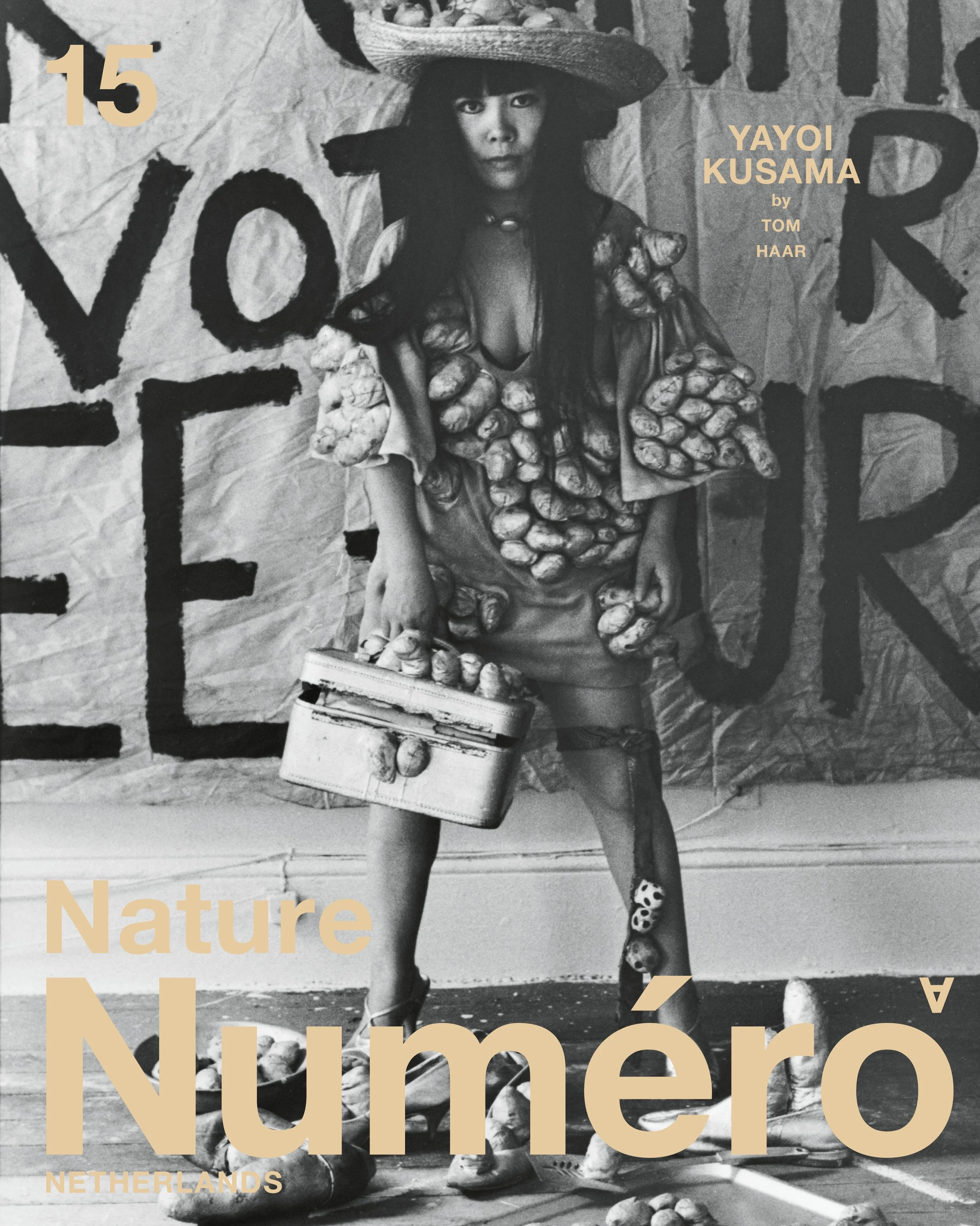
photography by TOM HAAR © YAYOI KUSAMA
For the first time in years, Europe is seeing a major retrospective of Kusama’s work. Just weeks before the exhibition was due to open, news broke of Kusama’s passing. This gives the exhibition unexpected weight, as the last major overview of her career, which she helped shape with her studio.
The STEDELIJK MUSEUM AMSTERDAM, in collaboration with the FONDATION BEYELER and MUSEUM LUDWIG, brings together more than seven decades of her practice, from the 1950s to the present. Rather than presenting Kusama through a collection of her most recognisable works, the exhibition follows the development of her practice chronologically.
Alongside pieces spanning her entire career, the exhibition also includes works from her final years, as well as two Infinity Rooms. According to curator LEONTINE COELEWIJ, this allows visitors to encounter a more layered Kusama and see how consistently and deliberately she has built her enormous body of work. It’s a way of seeing Kusama in a different light. Not just the art: the person behind seven decades of it.
That curatorial approach reveals something important. Kusama cannot be confined to a single style, movement or discipline. The scale of her output, often described as obsessive, has produced a body of work that spans painting, sculpture, installation, performance, film, ceramics, fashion, literature and more. Her practice moves between contradictions: love and disgust, belonging and exclusion, liberation and hatred, with an ever-present fascination with the cycles of nature, life and death. It is characterised by an inexhaustible drive to make a name for herself, and perhaps, to be understood.
That drive has been there from the beginning. Kusama was born in 1929 in Matsumoto, Japan, into a conservative, wealthy family that ran a plant-and-seed nursery. Her mother expected her children to follow a strict traditional path and saw her daughter’s growing devotion to art as a threat to that future. Unable to conform, Kusama turned to art to build a world of her own. Amid the pressures of family life and the anxieties of wartime Japan, she began experiencing hallucinations in which plants and animals seemed to come alive. Painting — as seen in her early works on show at the Stedelijk — became a way to document what she saw, gradually transforming those visions into a visual language of abstract fields, cellular forms and repetitions.
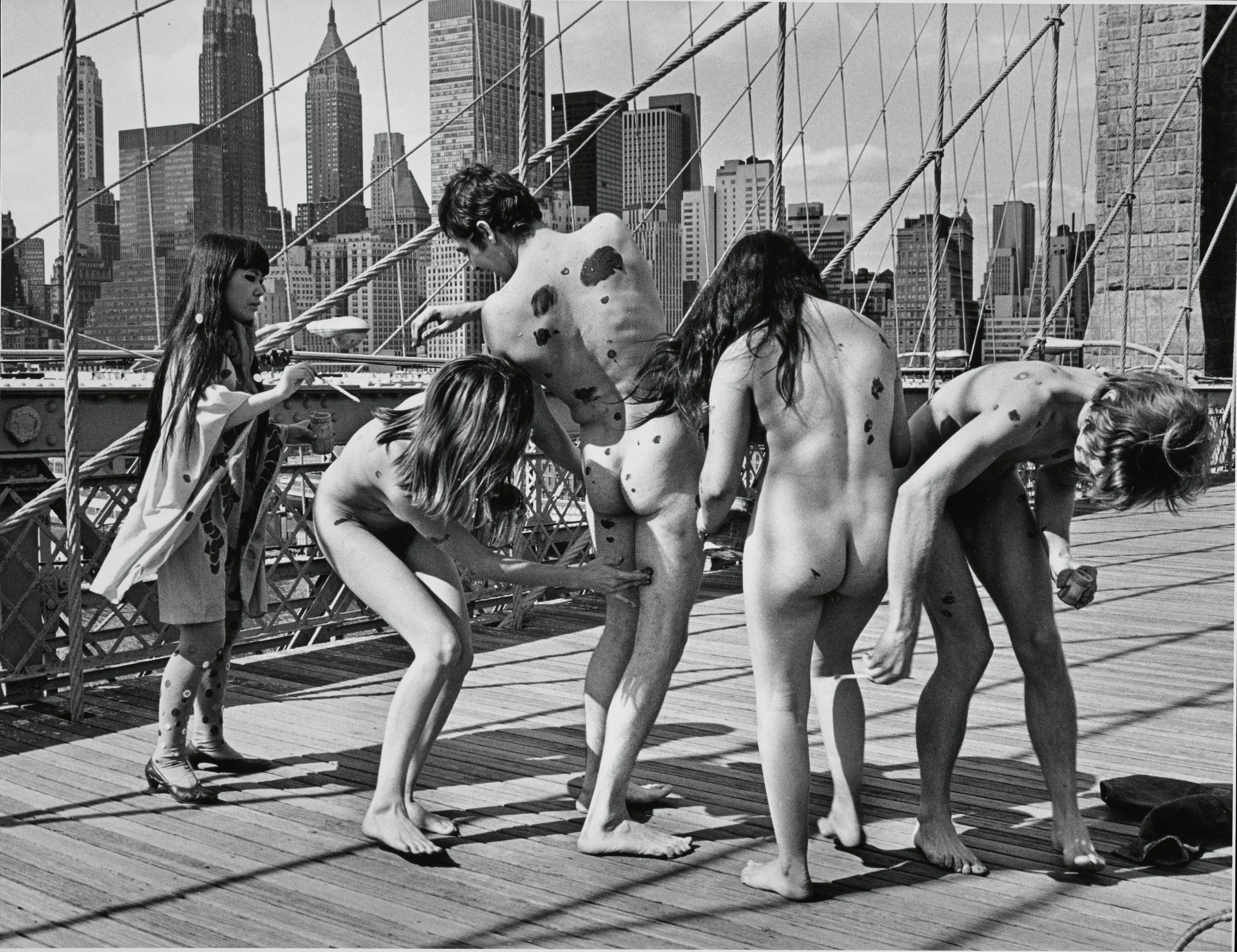
Anatomic Explosion happening on the Brooklyn Bridge, New York, August 14, 1968
photography by SHUNK-KENDER
GETTY RESEARCH INSTITUTE, LOS ANGELES. gift of the ROY LICHTENSTEIN FOUNDATION in memory of HARRY SHUNK and JANOS KENDER
© J. PAUL GETTY TRUST
She threw herself into making work at a relentless pace and, by the age of 23, had her first solo exhibition in Japan. Already, Kusama understood that making the work was only part of being an artist. Publicity mattered too. She encouraged the press to frame her as a young woman challenging Japan’s conservative art world. She was not waiting for someone else to decide what her work meant. She was shaping the story around it.
One of the most important transformations of Kusama’s career began when she decided she had to leave Japan. “I felt that my art stood in opposition to the conservatism and insularity of Japan. I had to get out.” She arrived in New York in 1958, having organised the difficult, unusual journey largely on her own and at real personal risk, with little money, little support and limited English. She was stepping into an art world dominated by white Western men, and later described those first years as a living hell.
The journey to America opened up a new sense of scale. For the first time, Kusama saw the vast sea stretching beyond the Japanese Alps, inspiring the work The Pacific Ocean (1980), where small marks take over the canvas until the surface becomes almost endless. This developed into the Infinity Nets series: huge monochromatic paintings made from thousands of tiny repeated loops, in which one circle disappears into the rest. Painting them for hours on end, Kusama described losing herself completely in the repetition, a state she calls “self-obliteration”.
Her art became an active way of confronting what frightened her: “Reproducing the objects, again and again, was my way of conquering the fear. A kind of self-therapy, to which I gave the name ‘psychosomatic art.’” Through this repetition, she described shedding her painter’s skin and metamorphosing into an environmental sculptor. Afraid of sex and male sexuality, she covered everyday objects and environments with suggestive forms. The fear itself became the material.
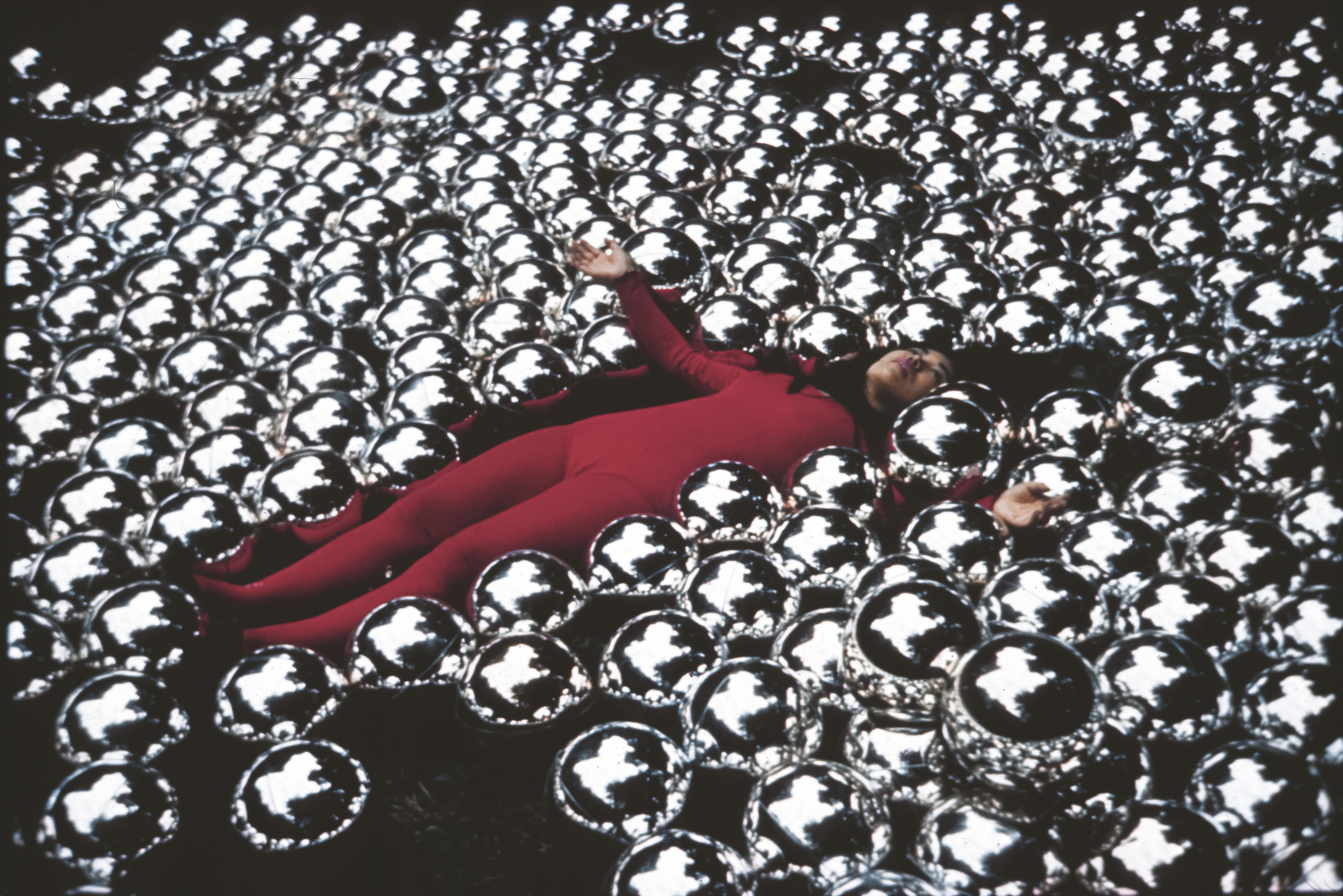
Yayoi Kusama amid her installation Narcissus Garden at the 33rd Venice Biennale, 1966
courtesy of OTA FINE ARTS and DAVID ZWIRNER
© YAYOI KUSAMA
Self-liberation did not stop there; it grew beyond the walls of her studio. Her happenings became another way to challenge the status quo, bringing people together around anti-war protest, anti-capitalism and sexual freedom. Often staged outside official art spaces and without permission, many involved Kusama painting dots on naked bodies, testing how far she could push what was publicly acceptable. Actual sex became part of the work, even making it into print when she published Kusama Presents an Orgy of Nudity, Love, Sex and Beauty in 1969. It was self-obliteration taken to its limit. She was always the one in charge: “I was the creator and choreographer but never a participant.”
It’s difficult to ignore the friction between the political messages in her work and the way it exists today. Like in her installation Narcissus Garden (1966), where she directly questioned the art world’s obsession with value and the few who decided what art was worth. Today, her dots, pumpkins and Infinity Rooms have become a global brand, reproduced and commercialised through luxury fashion, merchandise and social media. That’s not the only paradox in Narcissus Garden: its title refers to Narcissus, who fell in love with his own reflection. Decades later, visitors enter her Infinity Rooms — spaces originally intended to make you lose yourself in the universe — only to photograph themselves. A practice built around self-obliteration has become closely tied to self-display. Maybe what matters is not whether these contradictions exist but what Kusama does with them.
Once she mastered a new way of expressing herself, she pushed it into new forms and new ways of making art. Seen together, the works in this exhibition begin to show those connections. It is never disconnected from what came before it; one idea leads to another, and her visual language is constantly developed and pushed further. For Kusama, tension creates the spark that fuels a journey that will never be boring. “There’s an enormous freedom that speaks from her practice, the freedom to do all kinds of different things,” Coelewij says.
Kusama was doing everything at once: founding businesses, orchestrating happenings, painting, sculpting, performing, building environments and working with fashion and film. But the intensity took its toll, and the freedom she’d found in America was becoming unsustainable. So she went home, thinking it would only be for a brief time. Japan, however, was not exactly welcoming. The nudity, politics and happenings that had helped build her name were now recast as scandal. She had left as an outsider and returned as one.
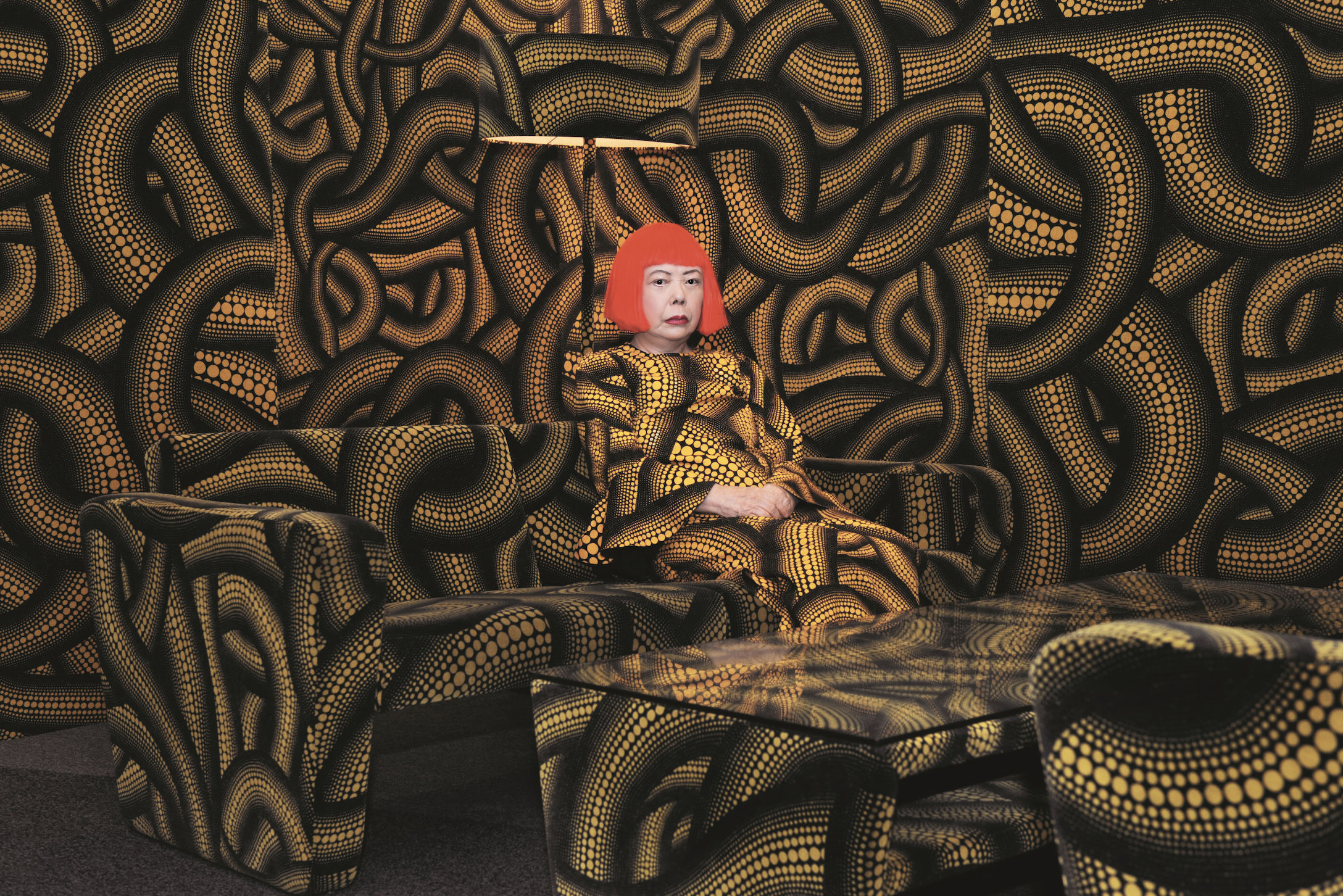
Yayoi Kusama with Yellow Tree / Living Room at the Aichi Triennale, 2010
courtesy of OTA FINE ARTS and DAVID ZWIRNER
© YAYOI KUSAMA
Eventually, she chose to live voluntarily in a psychiatric hospital in Tokyo, with a studio nearby where she continued to work. It wasn’t until a retrospective of her work in New York that Kusama returned to public view. In 1993, she represented Japan at the Venice Biennale, where her work received major acclaim. From there, her pumpkins, polka dots and Infinity Rooms became increasingly recognisable. She wasn’t just being rediscovered. She was becoming an icon.
Reduce Kusama to the polka dots, the selfie in the Infinity Room, or the "mentally ill artist," and you reduce her to a single image, as if she was never in charge of the story around her. The opposite is true: there is an enormous amount of agency in her work. She spent her life navigating not fitting in, and made being an outsider part of her persona, building her brand around it.
She did not slow down in her final years. If anything, she painted as if she were running out of time. “O Time: hold still awhile,” she wrote. “I have so much more work to do. There are so many things I would like to express.” She worked until her very last days, 97 years spent forging a path that was determined, restless and at times controversial. Her work was never about making things easy or pretty. It was about continuing to make, continuing to transform, continuing to be in charge. That drive is visible in every room.
Yayoi Kusama, on view at Stedelijk Museum Amsterdam until 17 January 2027
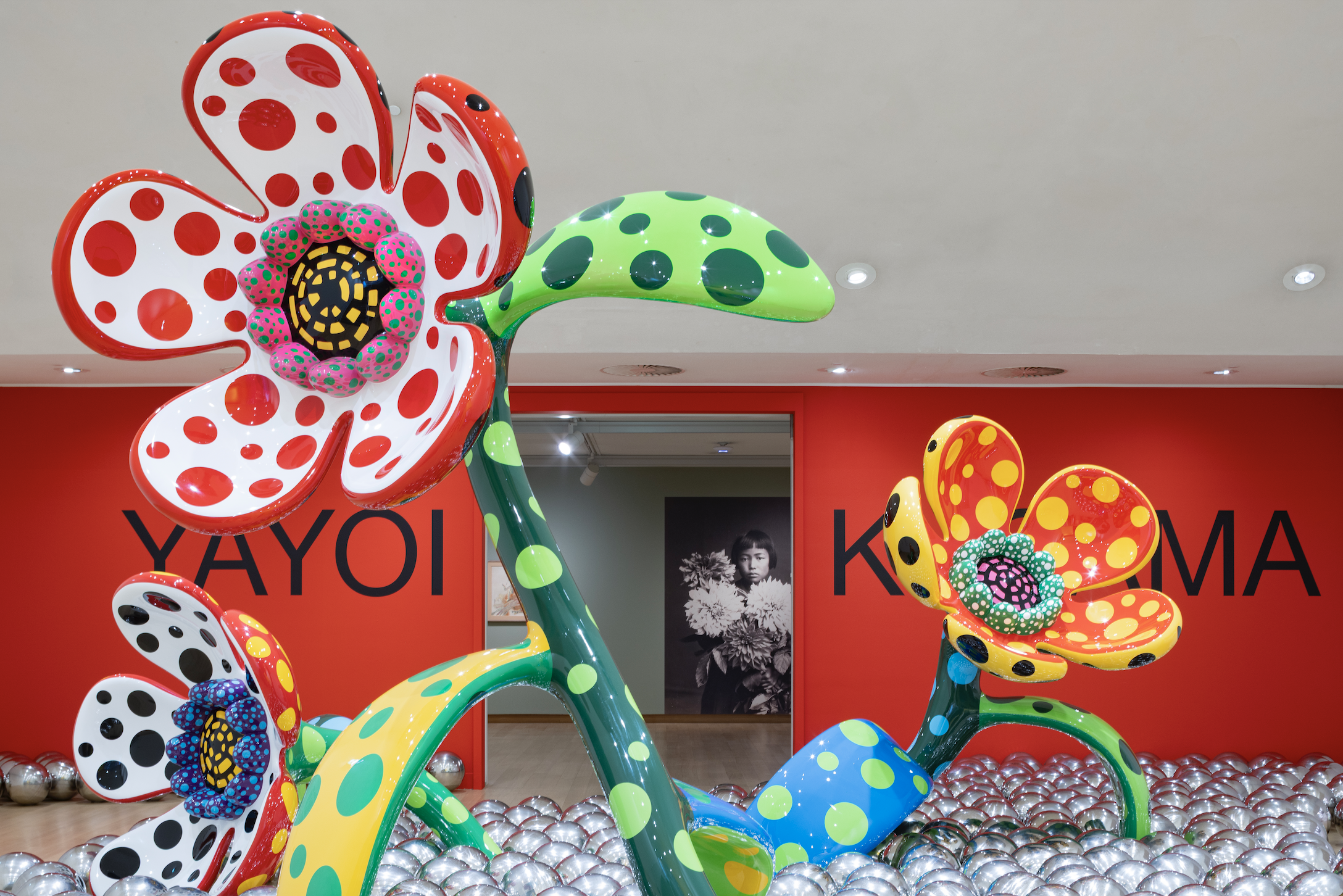
Installation view Yayoi Kusama, 2026, Stedelijk Museum Amsterdam
photography by PETER TIJHUIS
© YAYOI KUSAMA
TEAM CREDITS:
photography TOM HAAR
editor TIMI LETONJA
cover design ARTHUR ROELOFFZEN
