IN CONVERSATION WITH LEO FRONTINI
interview by JANA LETONJA
photography by SOPHIE DEZHAO JIN
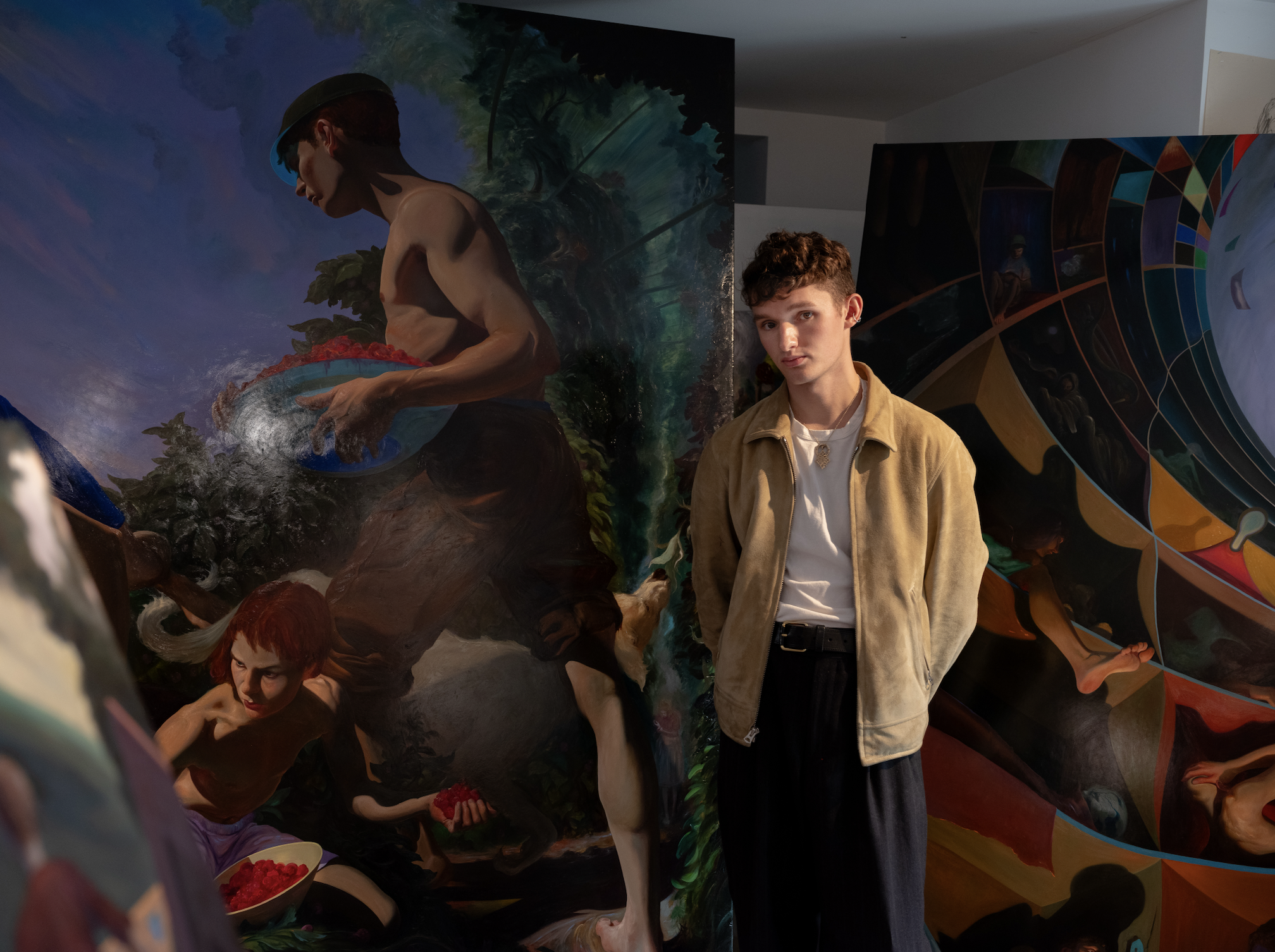
At just 25, painter Leo Frontini has emerged as one of the most compelling young voices in contemporary figurative art, and his newest solo exhibition ‘Everlapsing Interlude’ at Make Room Los Angeles marks a striking evolution in his practice. Known for collapsing interiority, folklore, and emotional memory into feverishly detailed worlds, Leo paints the liminal — those fragile, incandescent spaces between endings and beginnings. In this latest body of work, figures, objects, and landscapes slip in and out of cohesion, forming dreamlike, kaleidoscopic narratives that stretch across myth, memory, and the subconscious. Drawing on classical draftsmanship, oil painting traditions, and poetic sensibilities, he invites viewers into a suspended realm where time softens, meaning liquefies, and every gesture carries the weight of something just about to happen, or just having passed. ‘Everlapsing Interlude’ further cements him as a singular talent redefining the visual language of contemporary figurative painting.
‘Everlapsing Interlude’ centers on the space between endings and beginnings. What first drew you to explore this emotional and temporal “in-between”?
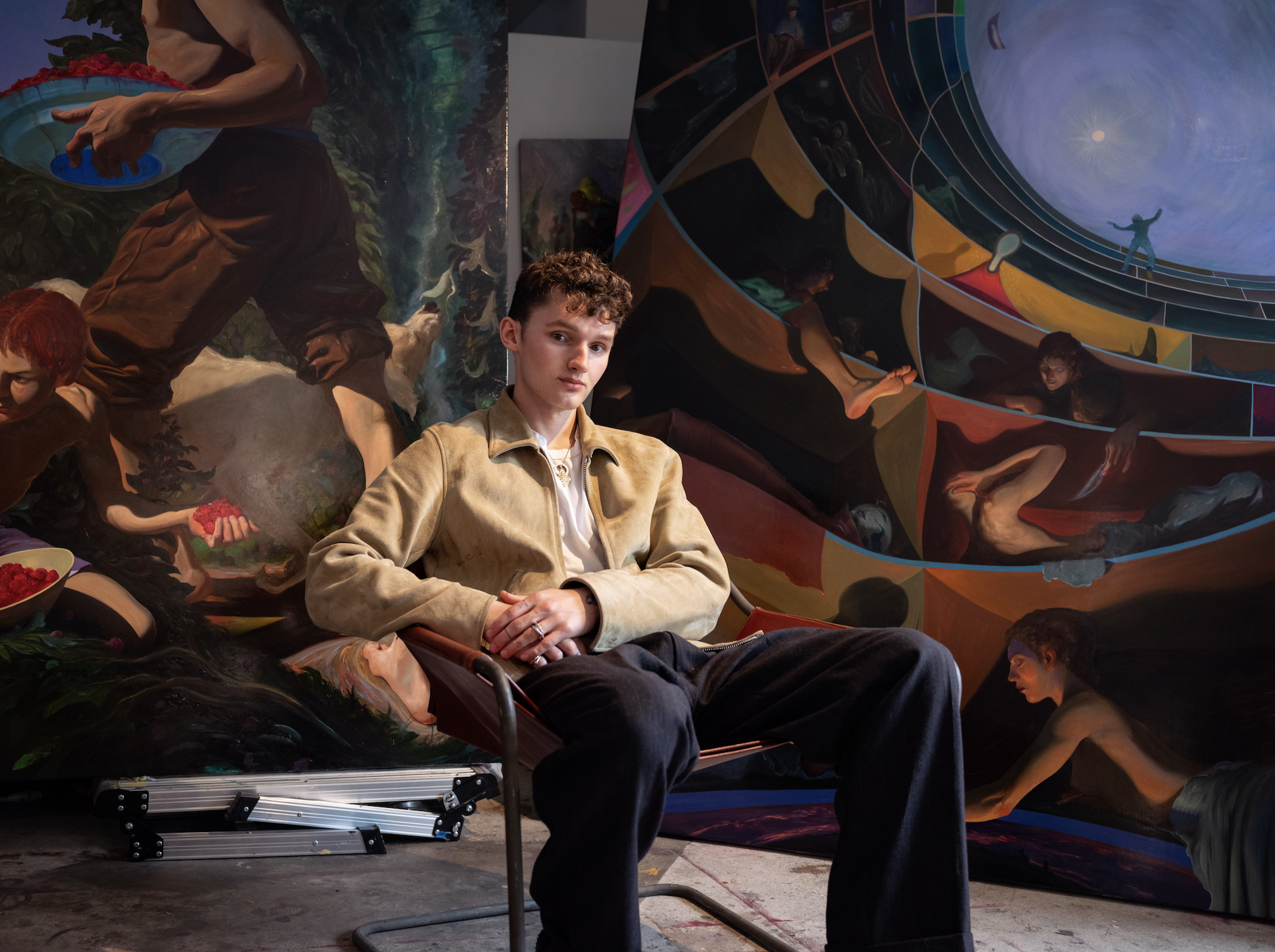
I began this body of work with an interest in time and progressions as an overarching theme, as I like to enter each exhibition through a broad conceptual lens. The paintings inevitably take on a theme of their own as the work develops, and from that initial point of departure, I found myself drawn toward ideas of endings and beginnings, inspired by the structure of a story or the anatomy of a life as it unfolds.
This line of inquiry eventually led me to consider the moments that exist between actions. In particular, with the paintings Anamnesis and Wishes, I became captivated by the interludes that shape us.
Anamnesis centers on remembrance and reflection, whereas Wishes explores manifestation and the quiet suffocation of unrealized dreams. Both paintings inhabit those suspended moments, the pauses that hold meaning before movement resumes. I began to see each painting through this lens, and I felt that it had been present from the start.
As I began writing about the paintings and the concept of “in-between,” I felt even more drawn to its significance. In our present, the moments of pause are so often occupied by our phones or media, and I thought that this show really embodies the significance of the moments we have between action. Moments of reflection or even boredom are the kindling of action, and are so often overlooked.
Your work often feels like a dream unfolding in real time. Do you see these paintings as narratives, memories, or psychological states, or something else entirely?
My paintings are rooted in lived experience and are often shaped subconsciously through the drawing process. Although I present them through a narrative framework, since the figurative and representational language allows me to communicate ideas most directly, the works inevitably shift as they develop. They become slightly distorted, sometimes kinetic, carrying an ambiguity that gives them a sense of transcendence. Some remain more grounded, but I am most intrigued by the paintings that prompt questions and envelop the viewer in a feeling that is both familiar and unknown.
In many ways, the works feel like a convergence of the present and the past, filtered through my own psychological state. Ultimately, I like for the paintings to act as metaphors or offer thoughts that are both connected to our world and distant enough to provide an escape.
You’ve described these works as “liquid narratives.” What does narrative fluidity mean to you as a painter?
A fluid or liquid narrative, to me, is one that is unbound. I always think of the painting as a scene paused or captured in a single moment. I often wonder what exists beyond the edges of the composition. I want to push the world or the idea further by adding elements in the background, creating a sense of depth both pictorially and narratively that keeps the viewer and me engaged.
It feels ephemeral, both visually and conceptually, because each viewer brings their own experience and perspective, shaping the painting's meaning in their own way. The narrative remains open and shifting, always alive.
You trained rigorously in classical draftsmanship at Otis. How has mastering tradition enabled you to dismantle or distort it in your current work?
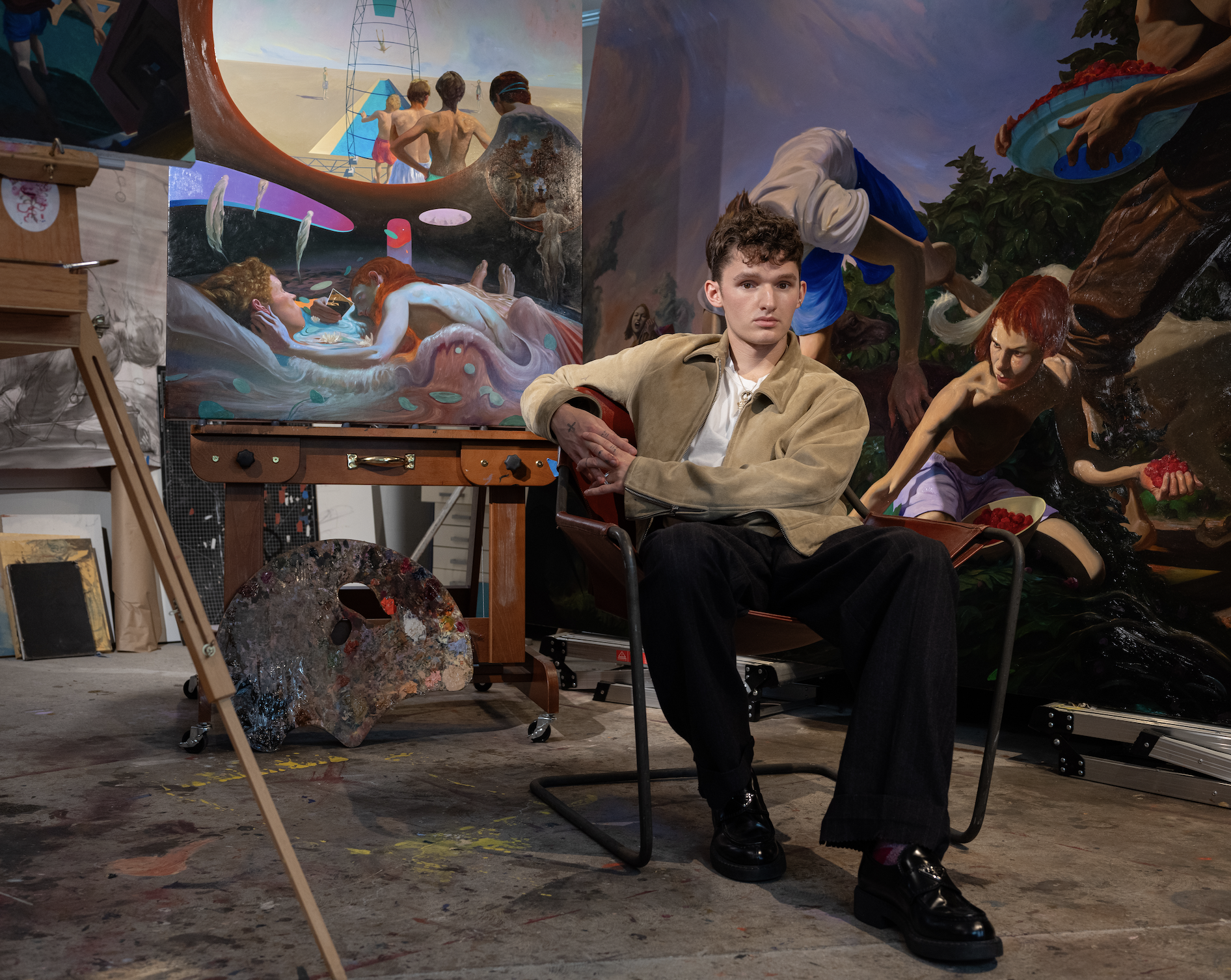
Through each painting, I hope to learn and discover new things, as the pursuit of competence is lifelong. To me, technical skill is the foundation I always maintain and strive to develop, as it gives me the freedom to represent visions that extend beyond our world. It allows me to design and invent, whether it is the background, the lighting, or the anatomy of exaggerated gestures. These choices lead to distortion and, hopefully, a representation of something not seen before. I feel this also creates the fluid narrative quality of the paintings, since the work is ungrounded and the shortcomings of invention often produce more surreal or unexpectedly interesting moments.
Your process often begins with automatic drawing, composite imagery, and live modeling — even using your own body. Can you walk us through how a painting evolves from draft to finished piece?
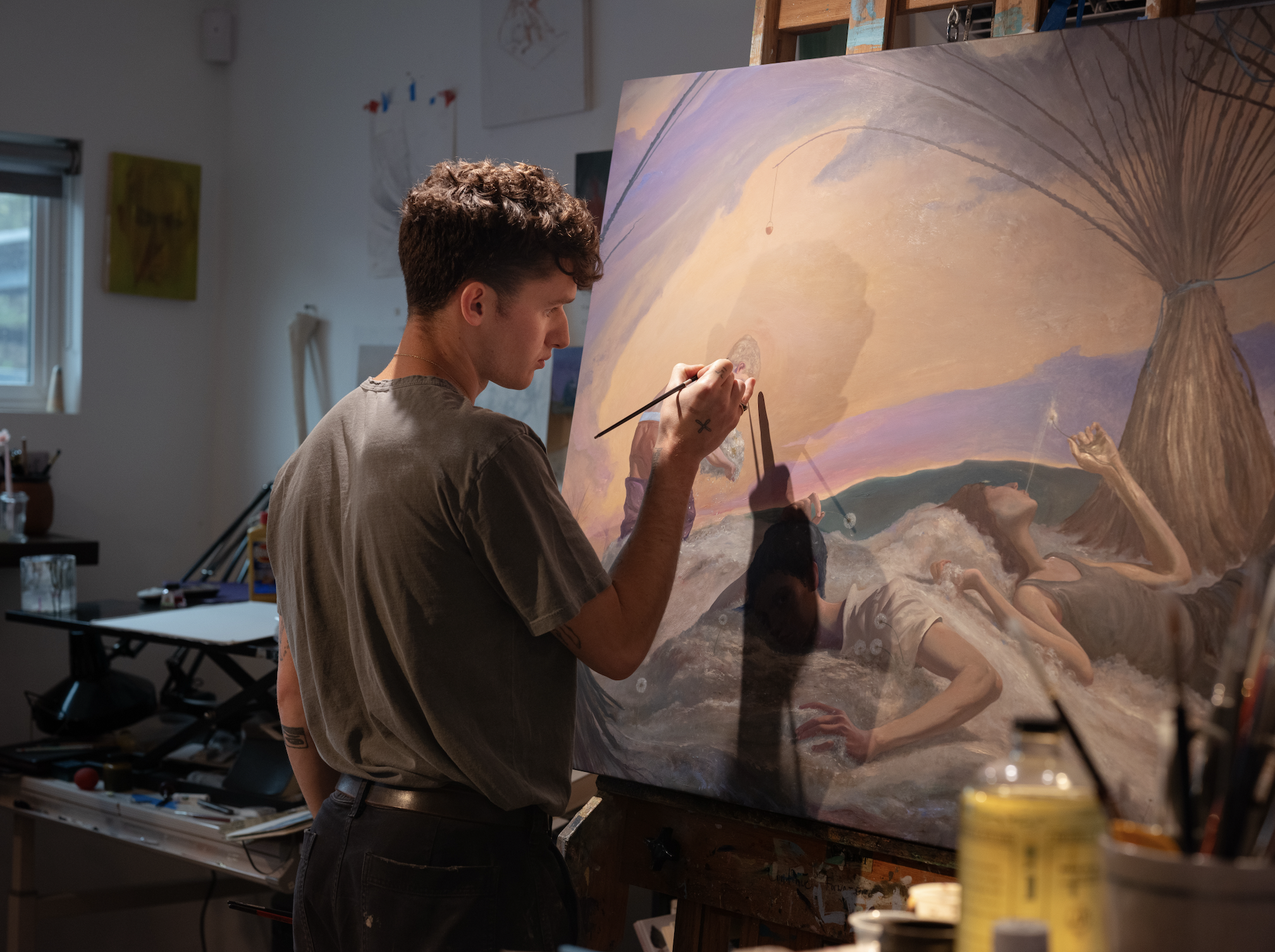
I always start in the sketchbook, and from there the idea stays in my mind for a while, since I am often working on other paintings for months before I return to it. I think of it as cooking in the background, and by the time I am ready to begin, there is much more clarity about how I will compose the image. After the initial drawing, I take photos or research reference material, which I then bring back into the sketch to inform the anatomy and lighting.
I usually make a black and white study to better understand the lighting, because there is often a lot I do not have a specific reference for. This step helps me make sense of the form and unify the composition within the same space. I then transfer the drawing to the canvas by enlarging it to scale. This drawing is known as a “cartoon,” which is a process used throughout art history.
From there, I begin painting. I typically figure out color as I work, and I follow a layered approach, moving from background to foreground until I feel the painting is fully realized.
Perspective in your paintings often compresses and disorients. What attracts you to spatial Instability?
Spatial instability introduces a feeling of movement or velocity that carries and informs both the composition and the narrative of the painting. Through the distortion of the composition and the energy in the paint application, there is a sensation that I believe is projected onto the viewer. It can create chaos and imbalance, or foster a sense of flow and harmony. I think it is a powerful way to express something psychological, and it is interesting how distortion or energetic mark-making can form its own narrative that either supports or contradicts the figures or the painting's focal point.
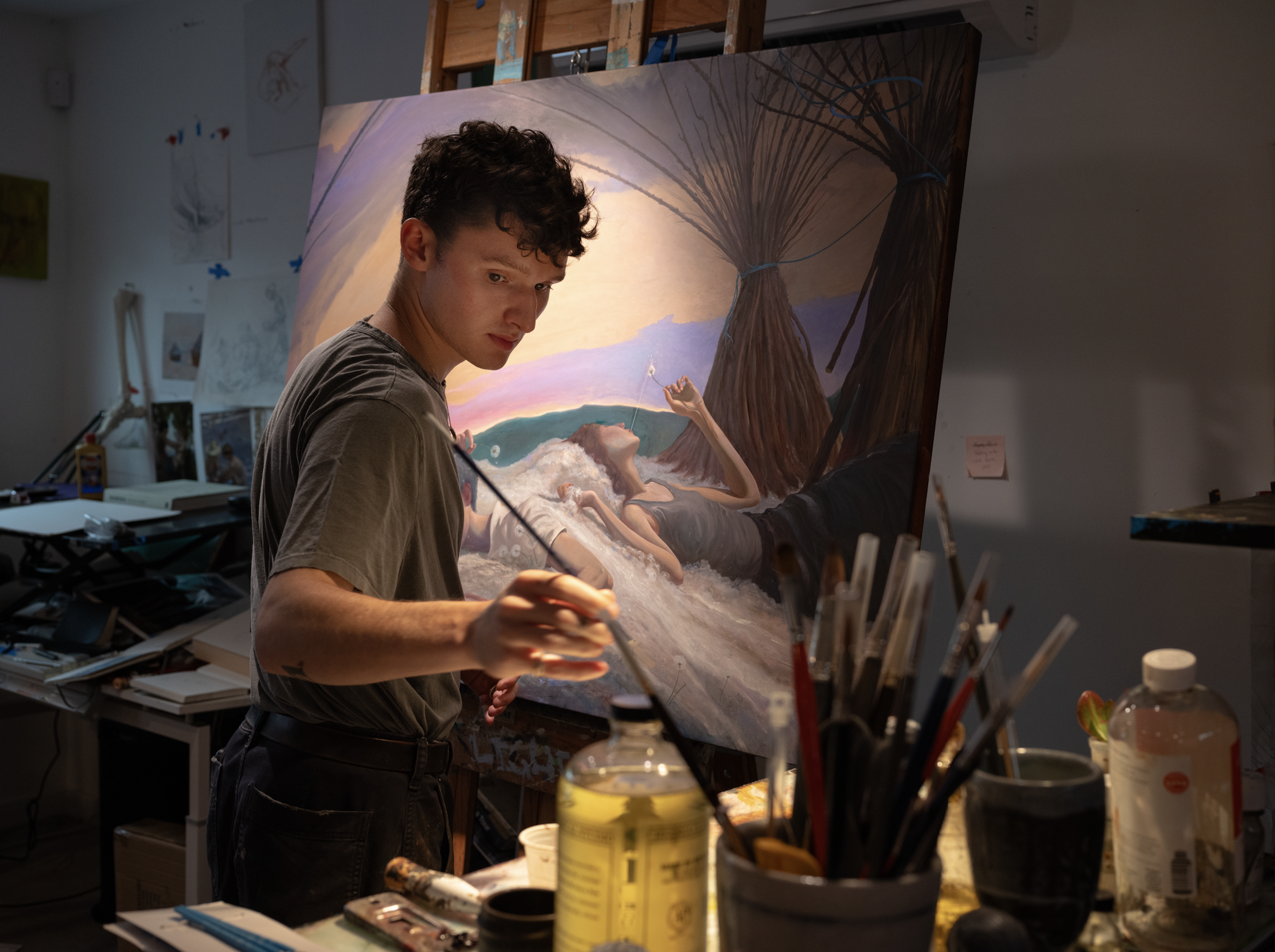
Your canvases often hold a quiet tension — a breath before action. What emotional states were most present for you while making this series?
There was a lot of anxiety behind the scenes while making these paintings. I often felt behind and disoriented, but there was also a sense of hopefulness. I am always drawn to tension, and I think it activates a discomfort in me, or sometimes a kind of excitement. When I reflect on life, I always return to the contrasts that shape each feeling. Bliss would not exist without sorrow, and that relationship informs the way I approach an image. If I have a visual that feels softer or more restful, I like to introduce elements that contradict it. I feel this creates a sense of tension, as if something is about to happen. It can reflect worry or my meditation on the unknown, which I think is deeply human and gives significance to so much in life.
Do you see your work as a way of revealing the subconscious, or more as a method of constructing imagined realities?
I feel the paintings are informed by the subconscious, which results in imagined realities that communicate or examine a thought or feeling. I see the subconscious as a shifting and evolving accumulation of all of life, almost like putting everything you have ever seen or experienced into a blender. I usually start with a visual idea or a thought in my mind that I draw from, and through the act of translating that image from the mind to paper, the subconscious shapes the final form. I think it is responsible for the distortion and the qualities in the work that are hard to describe in words.
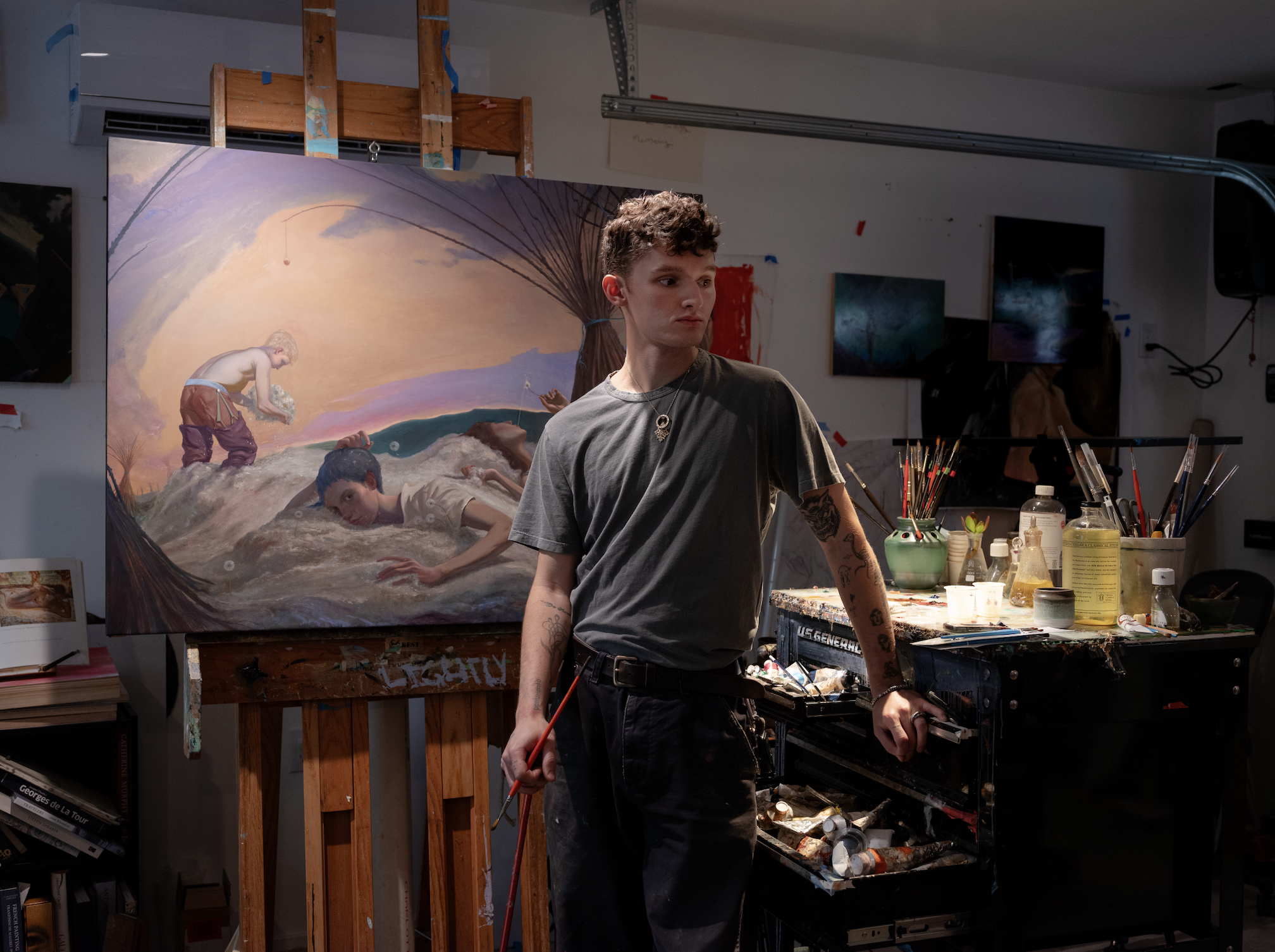
You’ve had major solo exhibitions in LA and New York in rapid succession. How has this momentum shaped your understanding of your practice at this early stage?
I feel that momentum is important to the flow and development of the work. It is interesting to see how the themes progress from one painting to the next. Often, I am already thinking about an entirely new show while I am still midway through the current one, which is exciting and also makes me feel like there will never be enough time. It can be chaotic, but it is a beautiful intensity that comes from wanting to represent something or communicate an idea. The challenge and the excitement of creating is an endless pursuit.
Currently, I am working on my next show, and I do intend to take some time afterward for more reflection and research. I feel that time is essential to my health and the development of my practice.
How do you maintain a sense of experimentation and risk as your audience and recognition grow?
I like to explore within each painting, and I try not to get stuck in any specific color palette or visual. I do not like repetition. Craftsmanship and an informed idea are always important to me, and I feel that these values create a natural through line in the work. I am also exploring sculpture. In ‘Everlapsing Interlude’, I created my first marble piece, and I feel this is an exciting new area to continue developing. With sculpture, I want to push the world and story of each work even further. In my next show, I will have three new sculptures that will connect to the paintings and actually inform the narrative of that body of work.
I think if something excites you, it is important to pursue it, because if you are passionate about it and you execute it with intention, it will hold up to criticism.
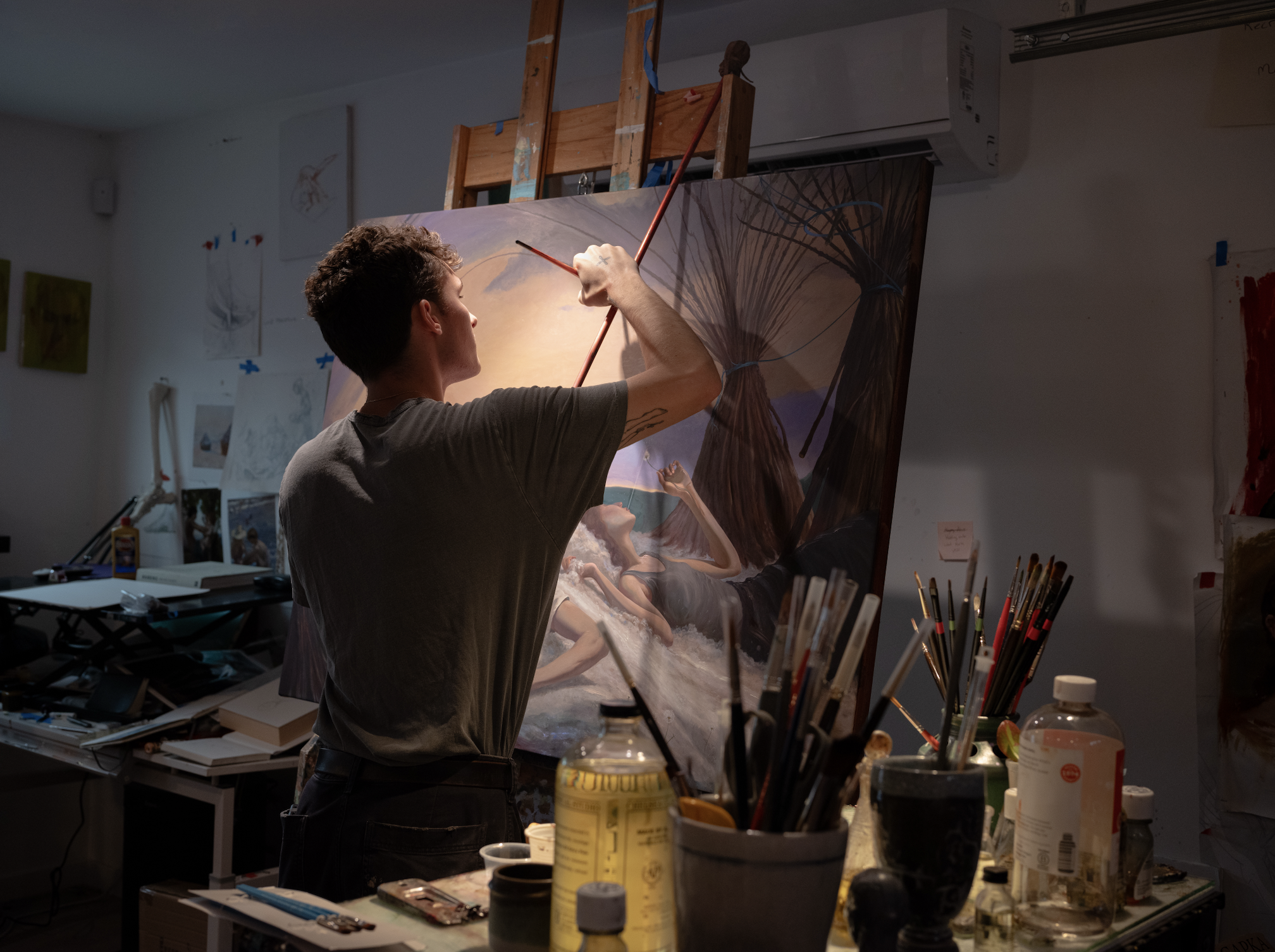
What themes or questions are beginning to pull you into your next body of work?
I am currently thinking about escapism and all the ways we are consumed, and in contrast, the pain of reality and consciousness. I am also interested in the beauty that emerges when we fully embrace reality and nature. These next works will be presented in Venice, coinciding with the Biennale, and I am noticing that the city’s environment is coming through quite unconsciously in the paintings’ visuals. I have embraced this, and I am excited to explore this influence as this body of work develops.
If viewers take one feeling or realization from ‘Everlapsing Interlude’, what do you hope it is?
‘Everlapsing Interlude’ is a play on the on everlasting or ever after, phrases we grow up with in childhood stories. Everlapsing points to a waning or decline, and Interlude, is the break or pause within a play. In the present, the capture of our attention and the constriction of our time feel increasingly aggressive. They are among the many sacrifices resulting from recent shifts in media and technology. ‘Everlapsing Interlude’ points to this loss of time.
I hope the viewer reflects on this and sees it as a reminder of the significance of the moments we experience in between everything else that fills our day or our life. The moments that contain nothing but yourself, or the moments that pass unconsciously, are just as vital. We can find a space in our awakening, and in drifting off to sleep, in bathing, wandering, daydreaming, and remembering. They are spaces to sit in, to embrace, and to use for contemplation and inquisition, and they can lead to a more meaningful step forward in our growth and existence.