
PARIS FASHION WEEK MENSWEAR FALL/WINTER 2026: DAY 2
ACNE STUDIOS
review by MARIA MOTA
all images courtesy of ACNE STUDIOS
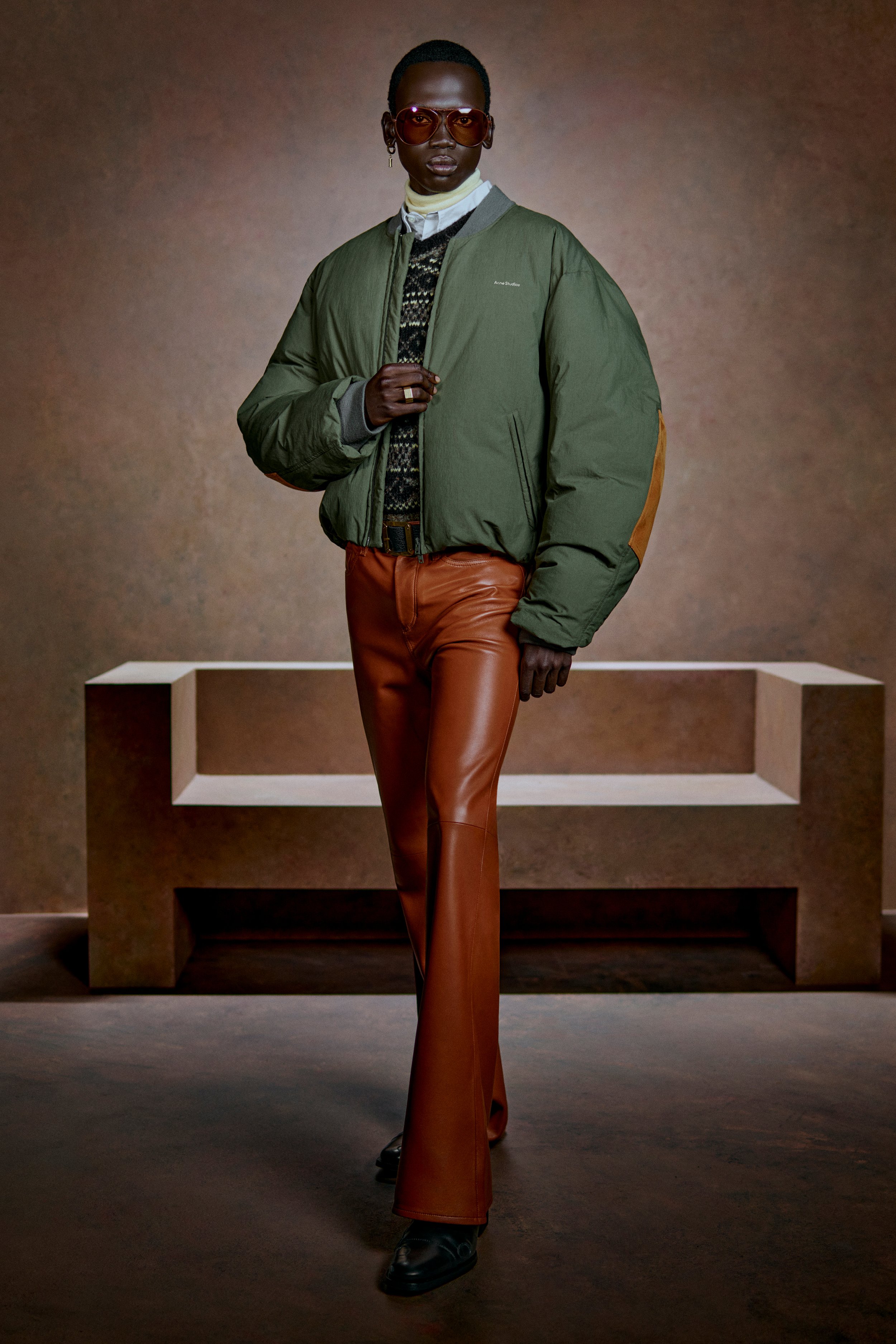
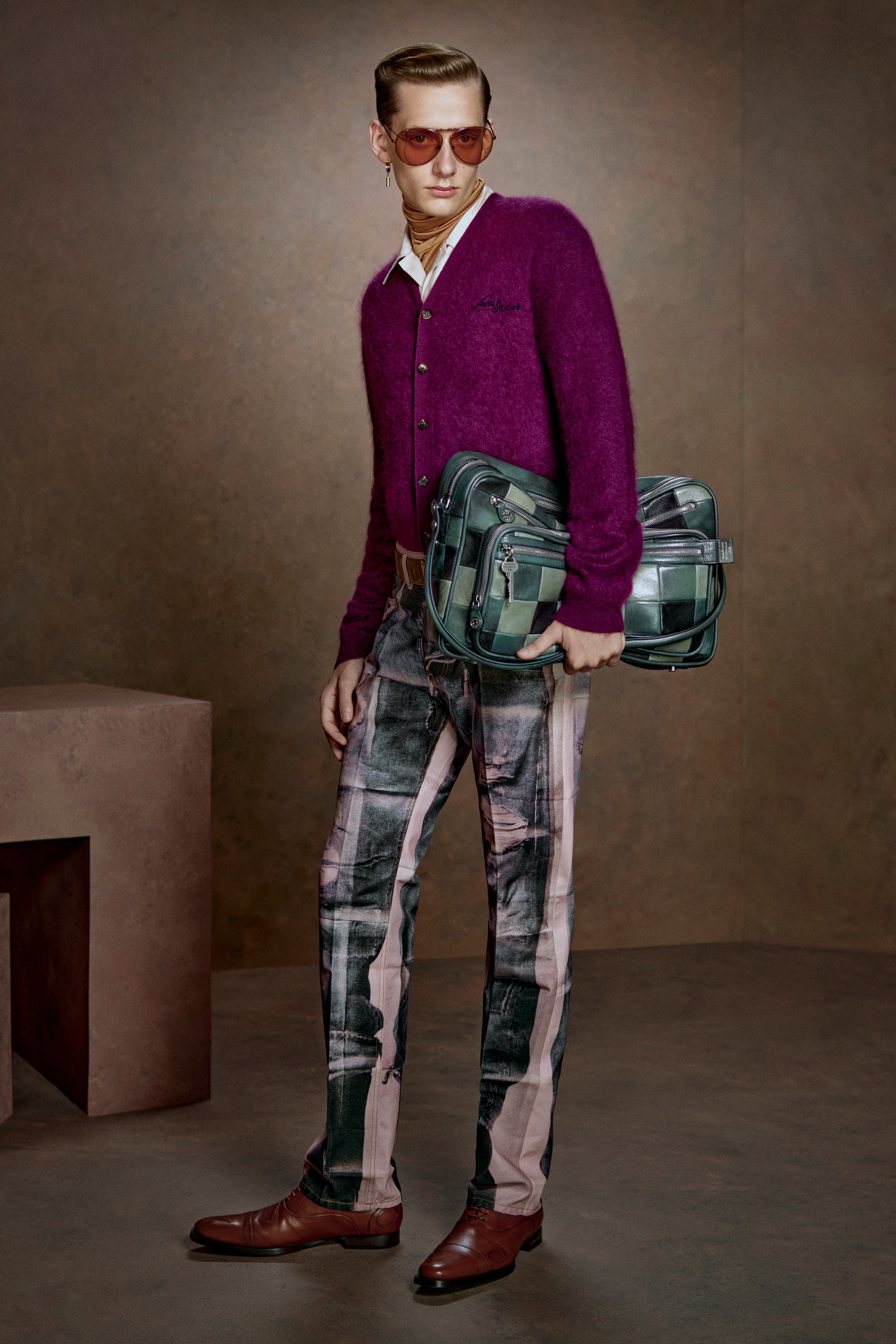
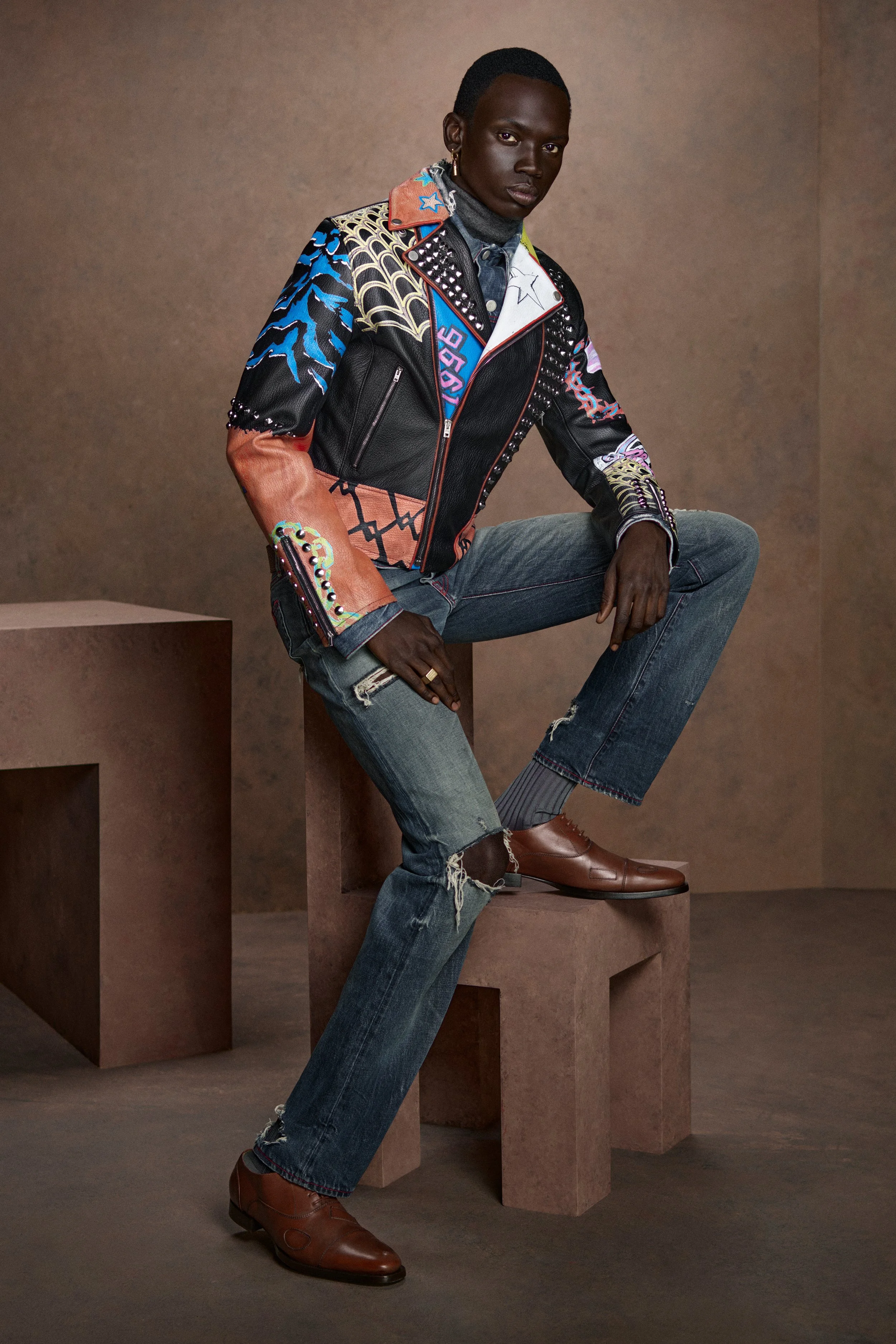
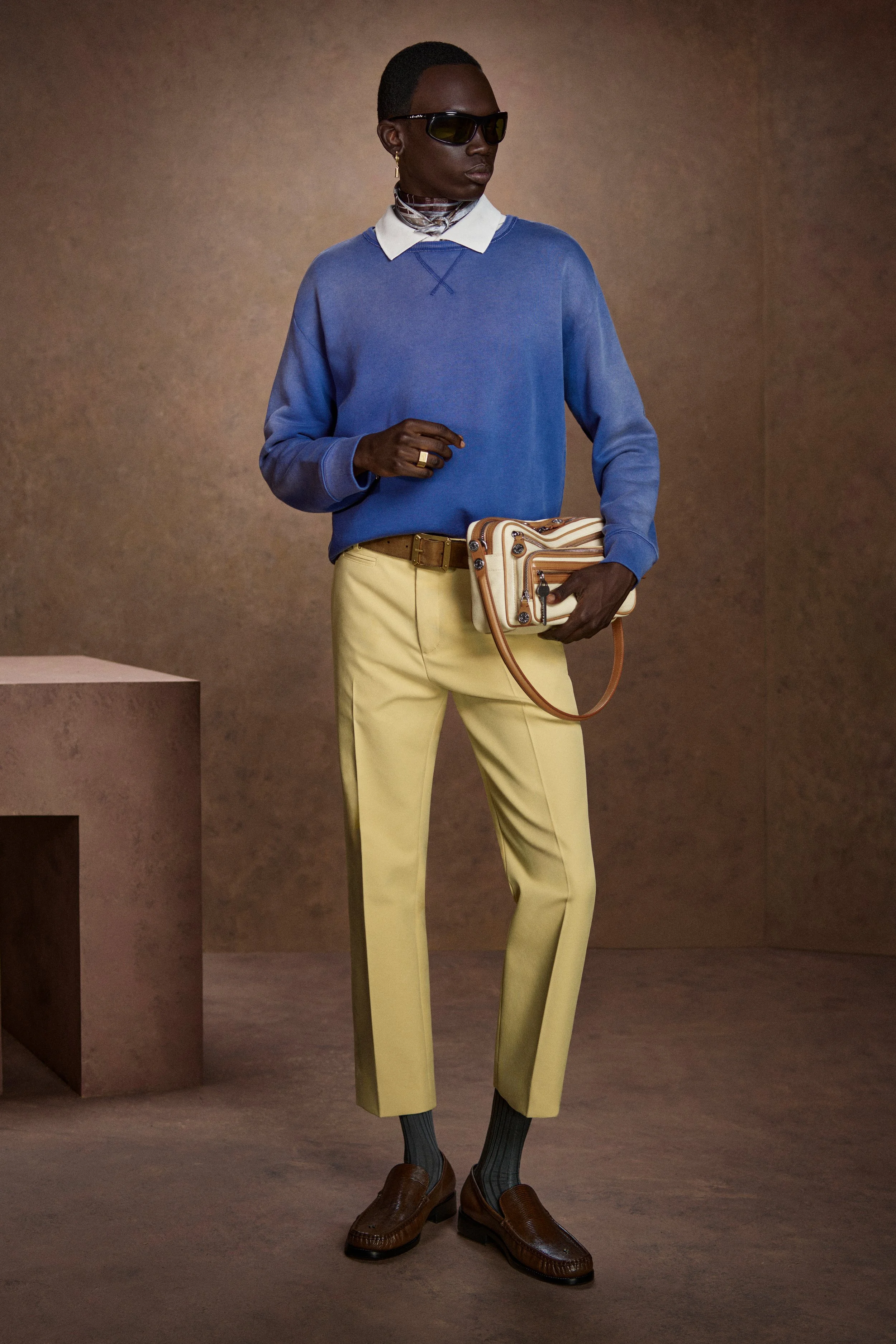
Acne Studios FW26 menswear feels like a reflection on lived experience, and on how style naturally picks up meaning as time goes by. After three decades, the brand looks inward, not to repeat itself, but to refine it. Techniques are sharpened, legacy pieces reconsidered, and silhouettes evolve without losing their soul.
The collection embraces imperfection as a form of honesty. Creases, visible tape, exposed hardware and worn washes suggest garments that have been lived in, repaired and kept close. Trompe l’œil effects imitate photocopied denim or collaged pieces, then break the illusion with real interventions, blurring the line between memory and reality. The straight leg 1996 silhouette returns, slightly updated but still faithful, anchoring the collection in memory and continuity.
Echoes of the 1970s, 80s and 90s run through the collection, filtered through a calmer, more polished lens that feels very now. Denim and leather sit at the core, joined by crinkled poplin shirts, soft jersey, layered cashmere, and turtlenecks. Tailoring hints at nobility, and high-hemmed pants reveal the ankle, while pinstripes and velvet play with formality in an easy way. Outerwear moves between suede flight jackets, Harringtons, puffers and a Loden coat cut with an unexpected slit.
Accessories are quietly essential. Scarves are integrated with ease, the Camero bag reappears in new editions, belts carry heavy hardware, jewelry stays playful and sunglasses command attention.
BLUEMARBLE
review by MAREK BARTEK
all images courtesy of BLUEMARBLE
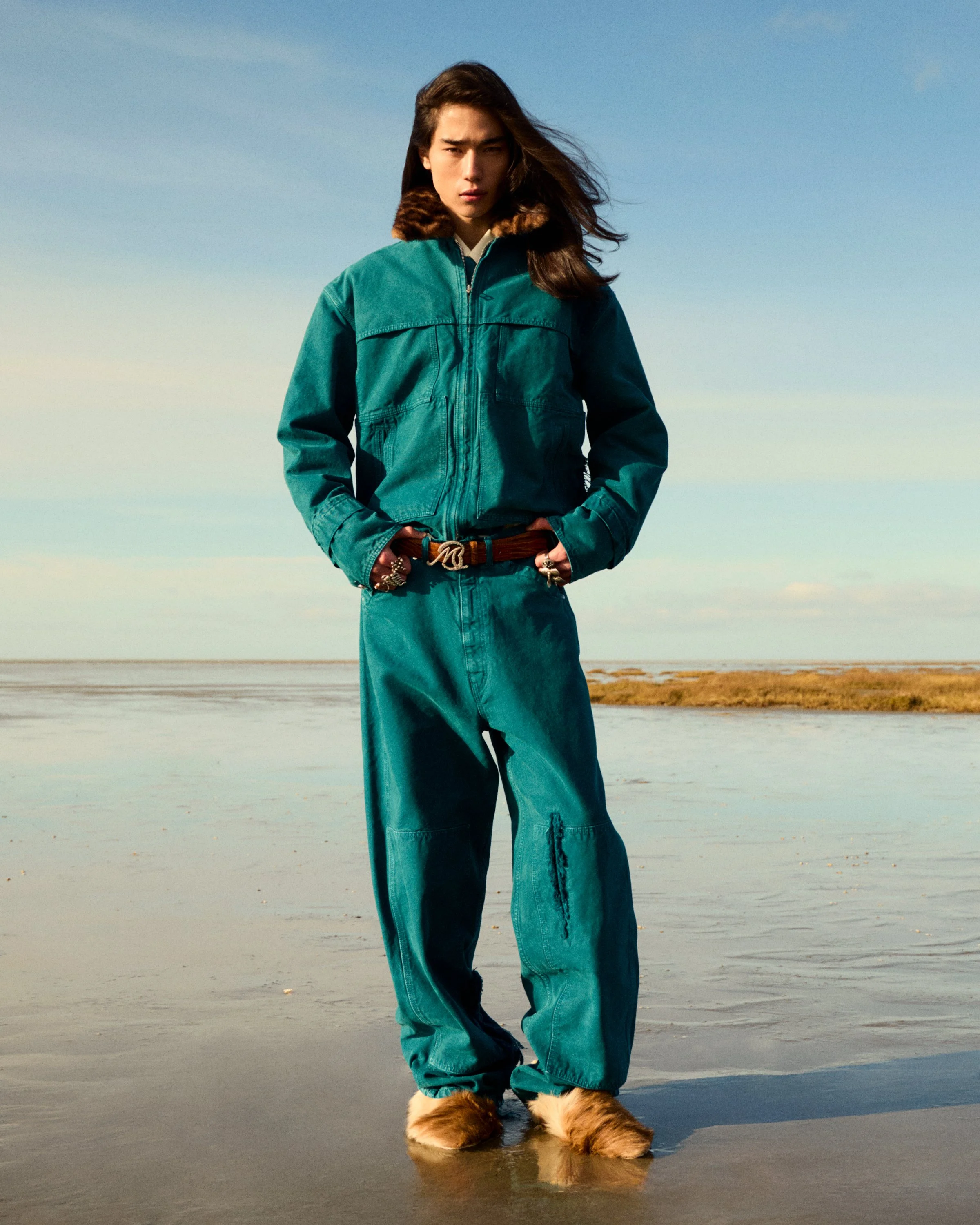
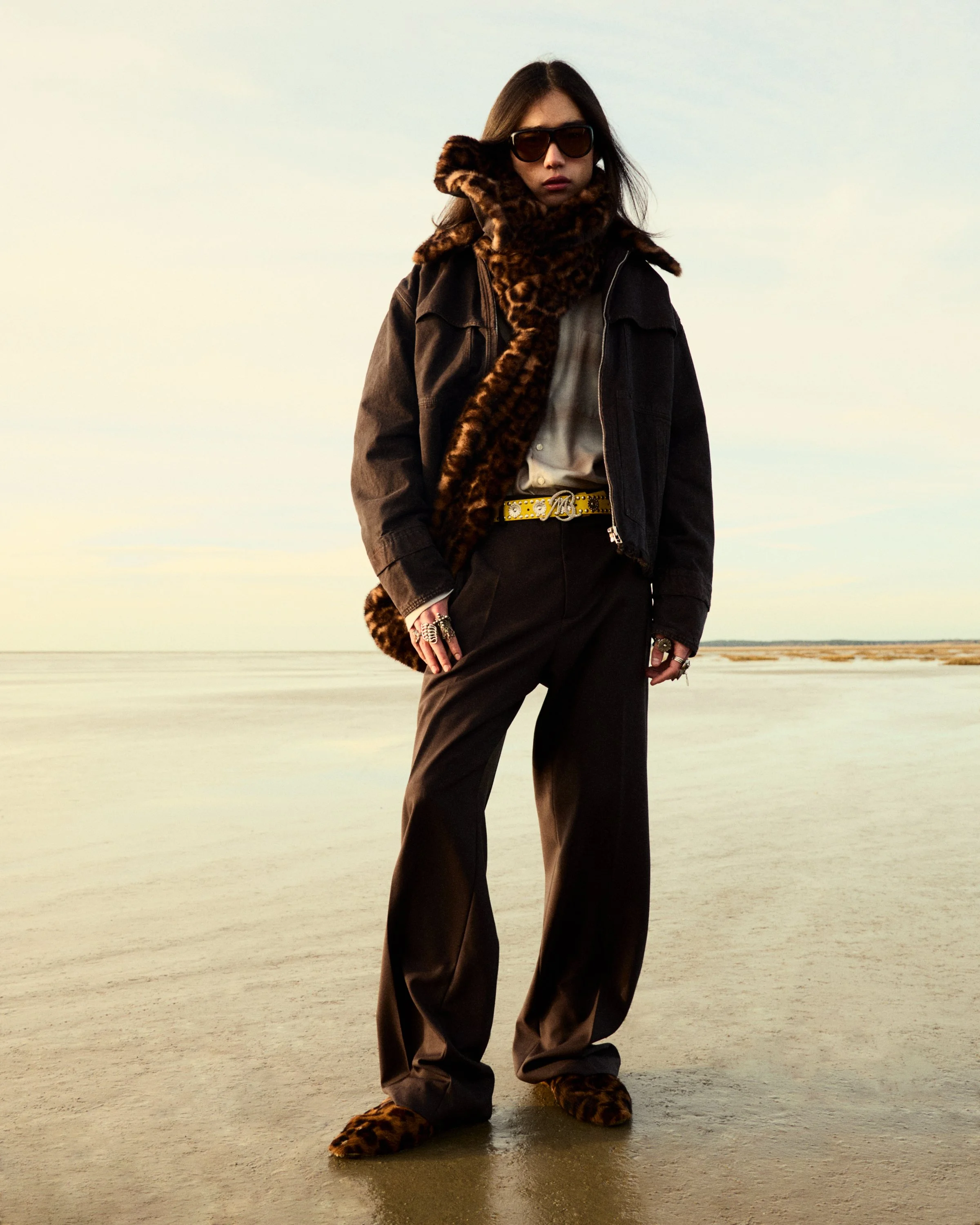
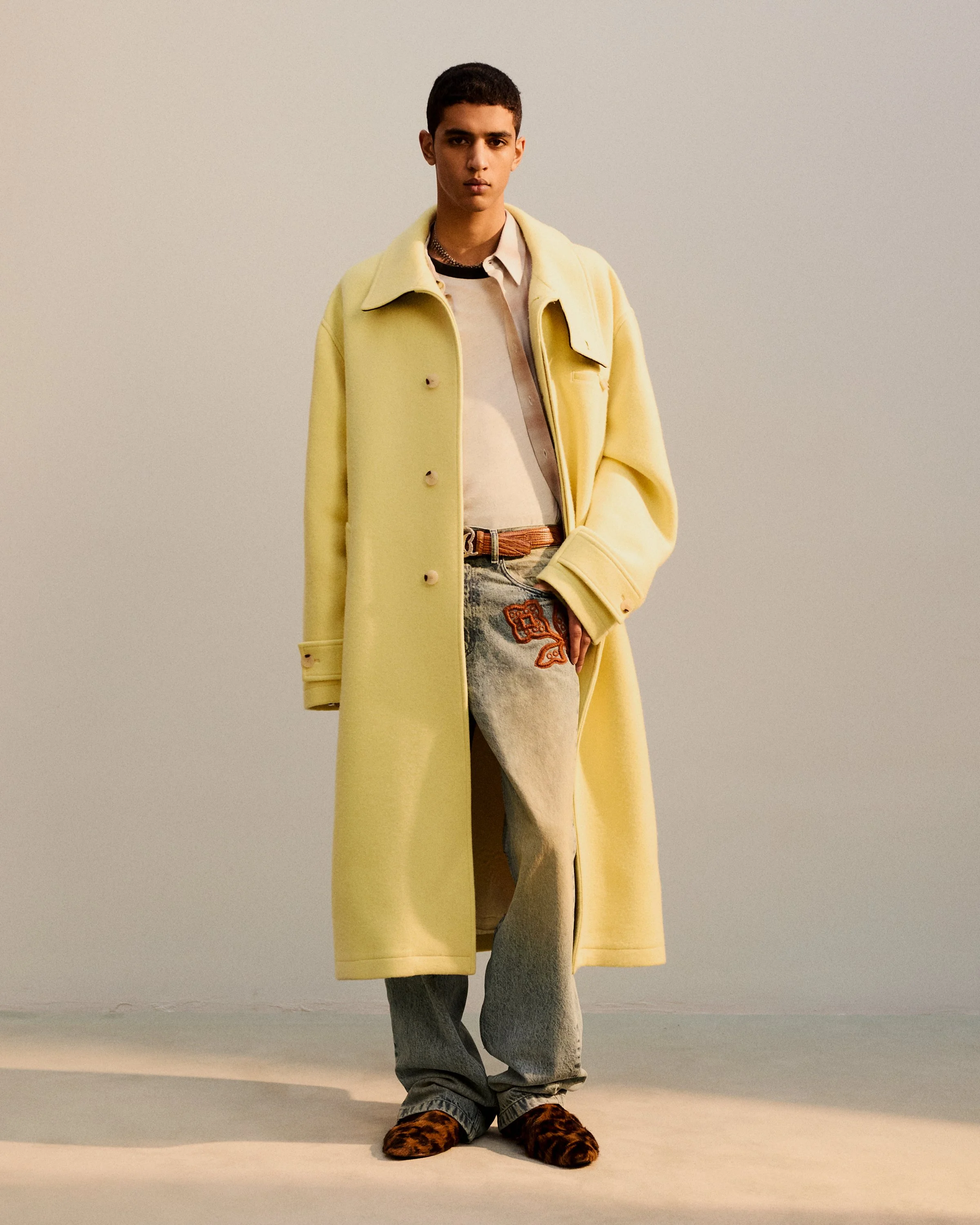
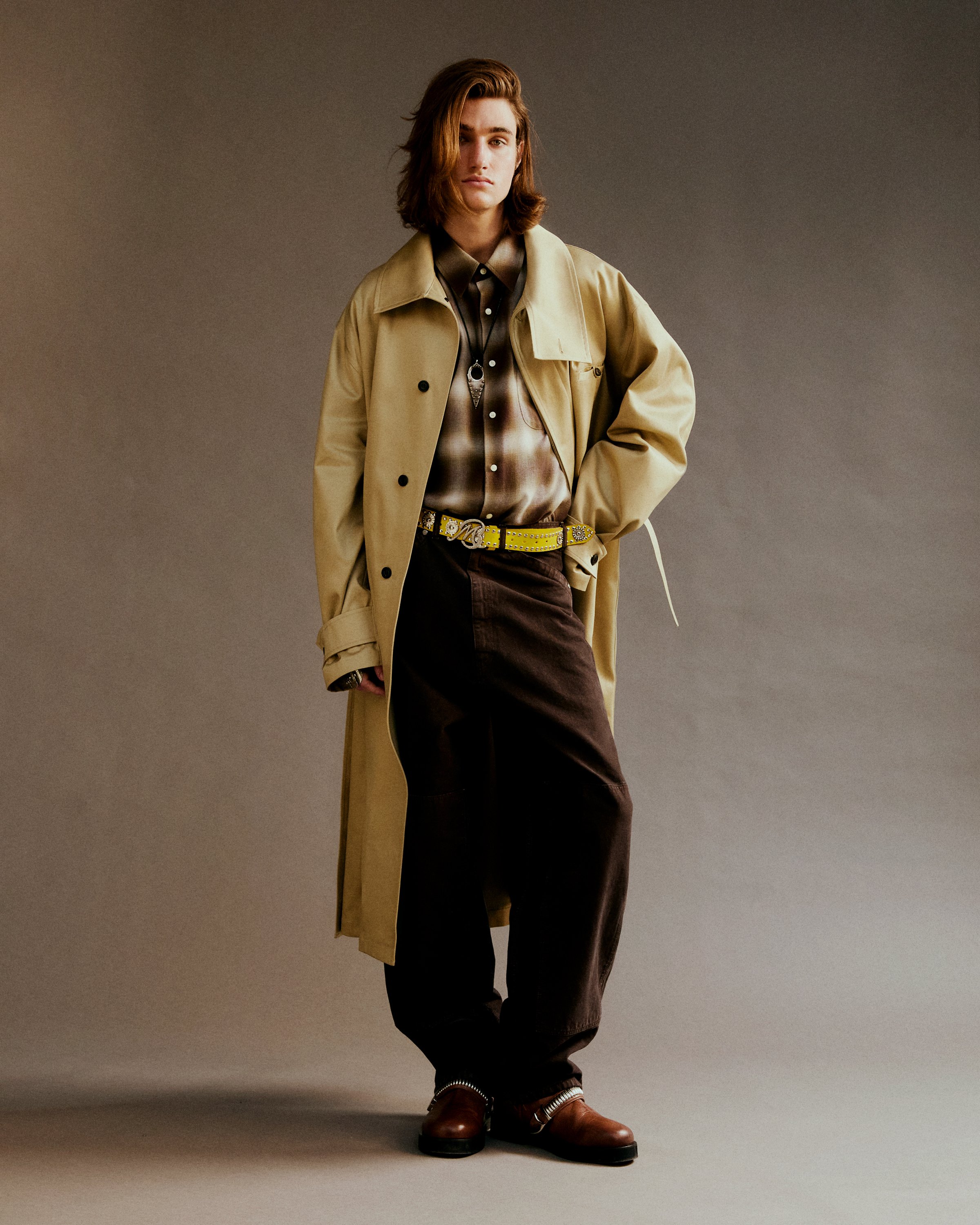
Bluemarble’s Fall/Winter 2026 collection marked a moment of refinement for the Paris-based brand, sharpening its silhouettes and focusing on a more durable, essential wardrobe. Presented under the theme Vertigo, the collection explored the moment of instability that precedes change, approached through construction, proportion, and material.
Relaxed tailoring formed the foundation, blending formal and workwear codes through fluid wool suits, rounded outerwear, and enveloping coats designed for comfort and movement. Knitwear and shirting featured raw edges and subtle piping, while denim was elevated through hand-embroidered patchwork panels and sand-washed finishes that added depth and patina. Mohair, cashmere, and tapestry-like surfaces softened the collection without losing structure.
The palette stayed grounded in browns, beiges, blues, and deep reds, drawing from soil, stone, and weathered metal. Rather than chasing novelty, Bluemarble focused on coherence — delivering a collection built around balance, longevity, and focus on modern dressing.
3.PARADIS
review by MAREK BARTEK
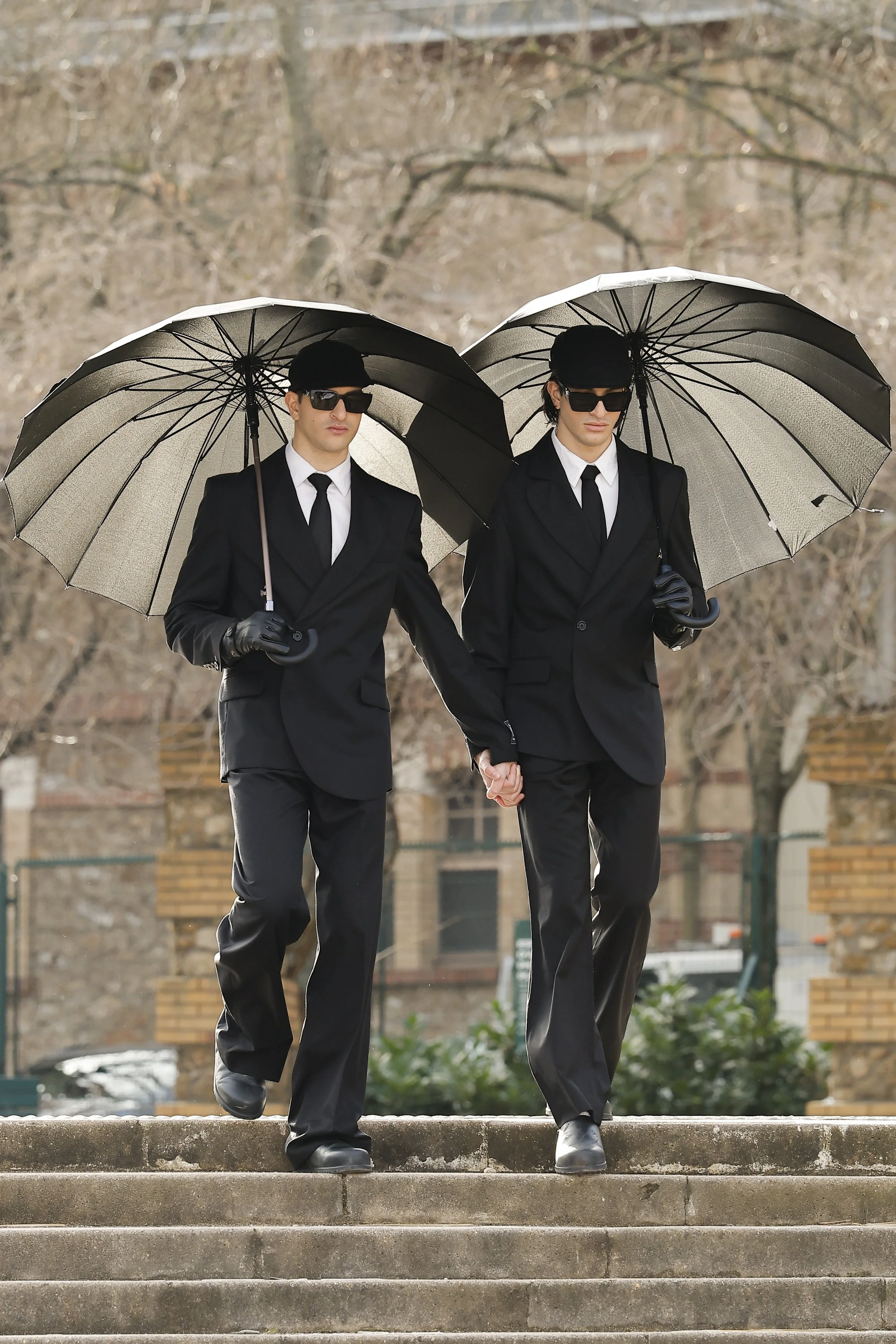
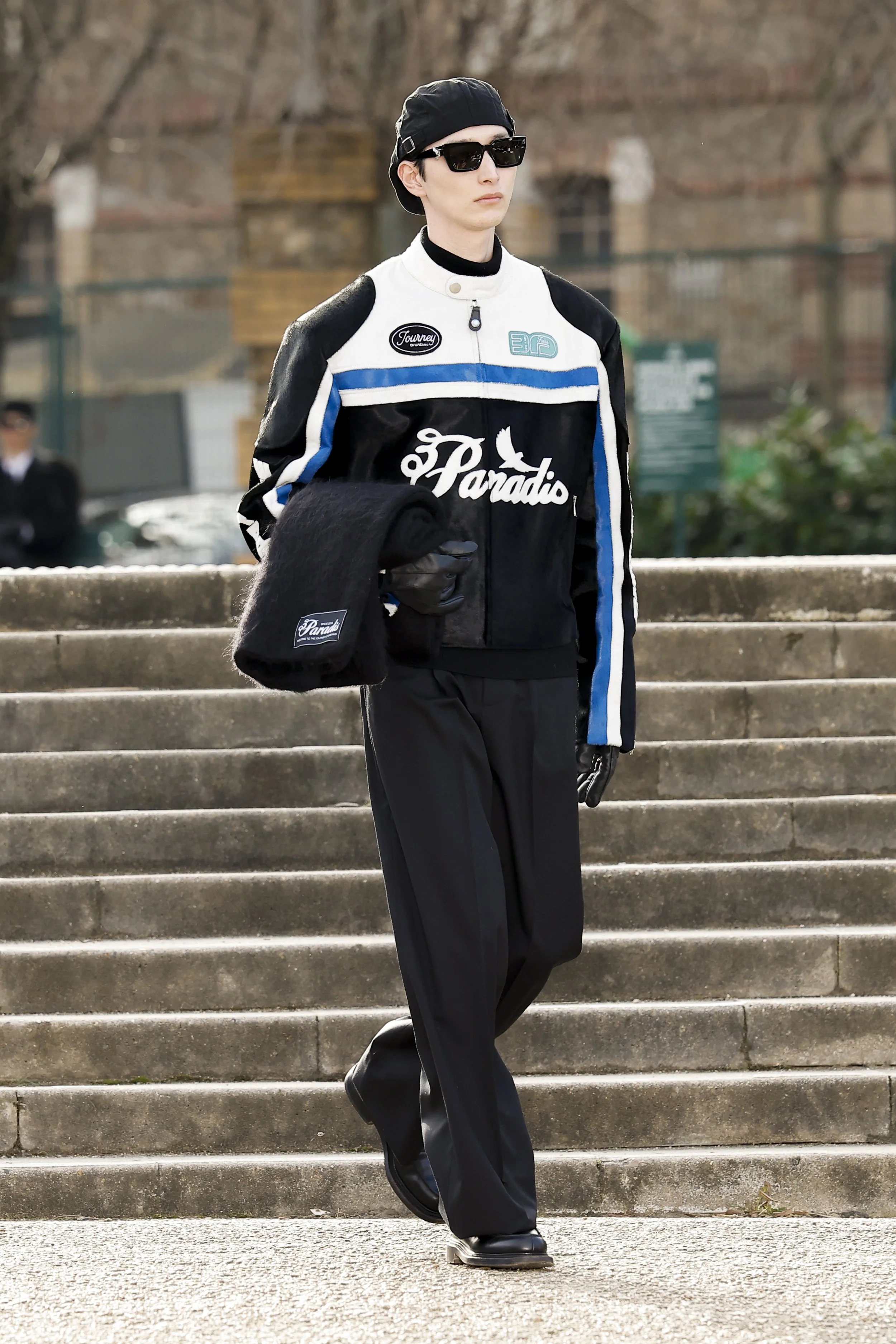
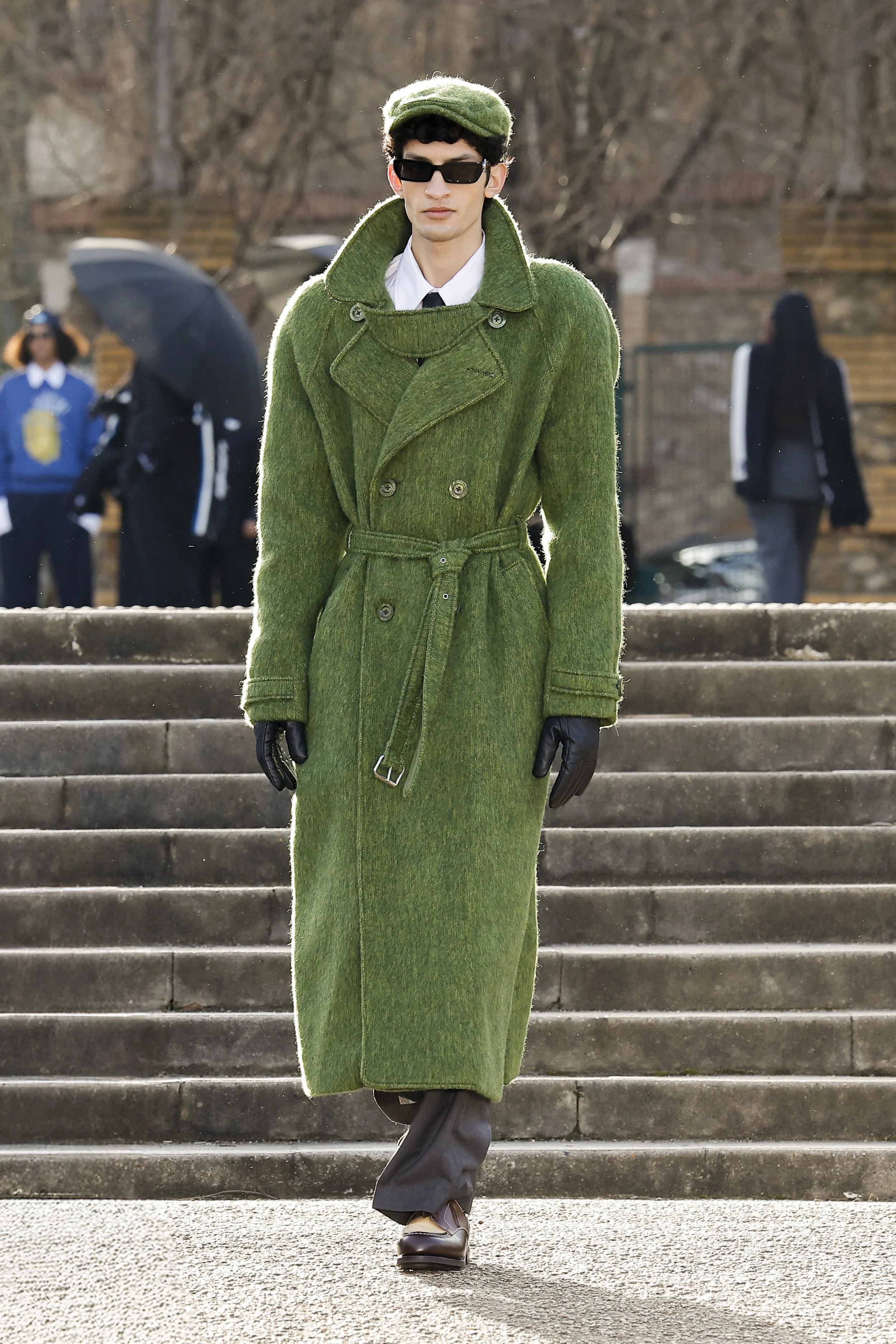
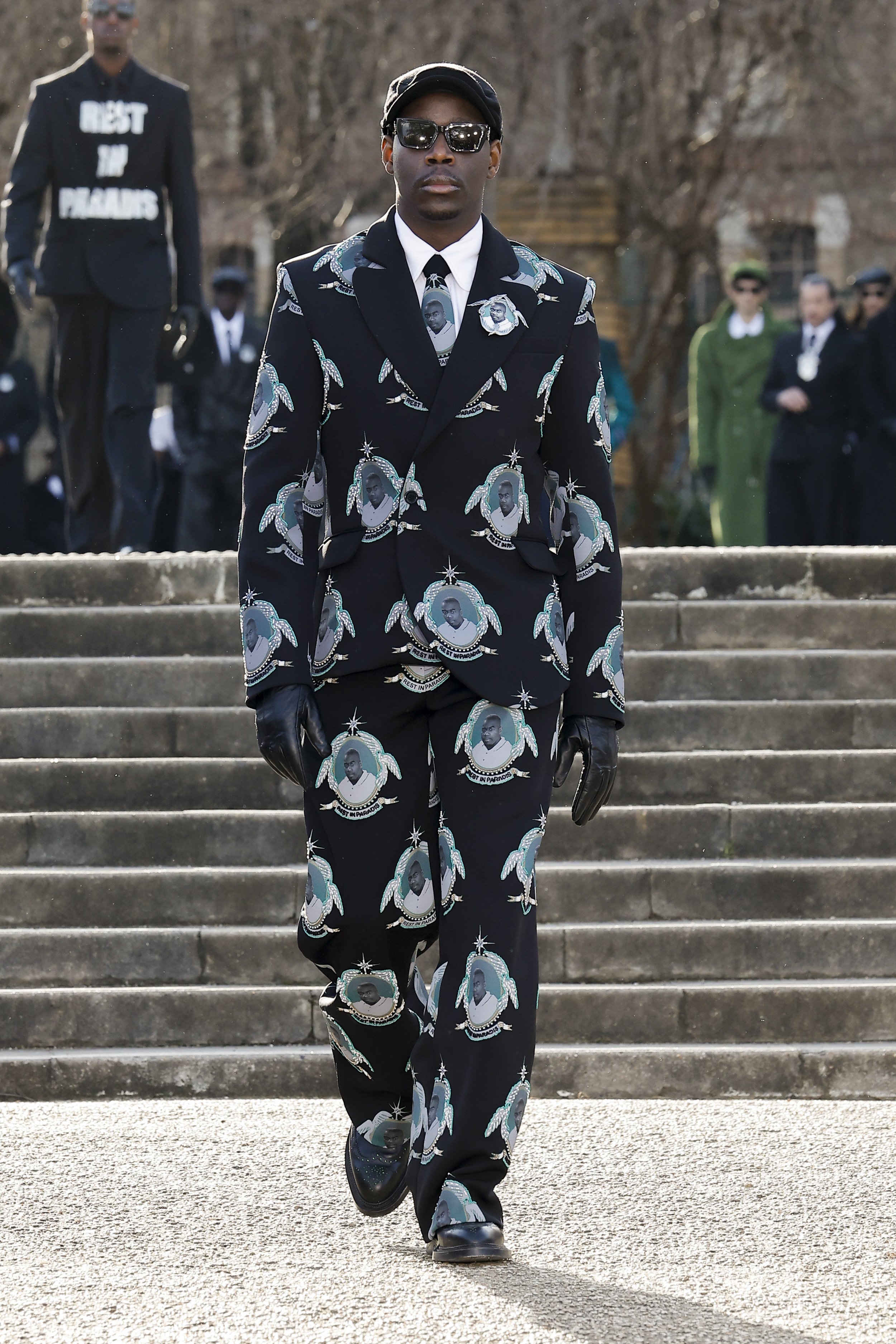
all images courtesy of 3.PARADIS
3.PARADIS’s Autumn/Winter 2026 show opened with two male models in tailored suits walking hand in hand — a gesture that set the emotional tone for the collection. Titled Rest in Paradis, the season unfolded as a tribute to memory, love, and those who remain present even after loss, shaped in part by a personal dedication to designer Emeric Tchatchoua’s late brother.
Classic menswear codes anchored the wardrobe, softened by oversized proportions and a relaxed sense of volume. Gradient colour palettes moved from dark to light, reinforcing the show’s underlying journey through mourning and remembrance. Basken-style caps, pigeon emblems, and bold, oversized jewellery appeared throughout, reinforcing the brand’s recurring symbolism.
References to Amy Winehouse were woven both visually and emotionally into the collection, accompanied by her music on the soundtrack and a dedicated collaboration that felt integrated rather than just commemorative. Presented in Parc Georges-Brassens, the show balanced intimacy, delivering a collection where emotion, memory, and identity.
LEMAIRE
review by MARIA MOTA
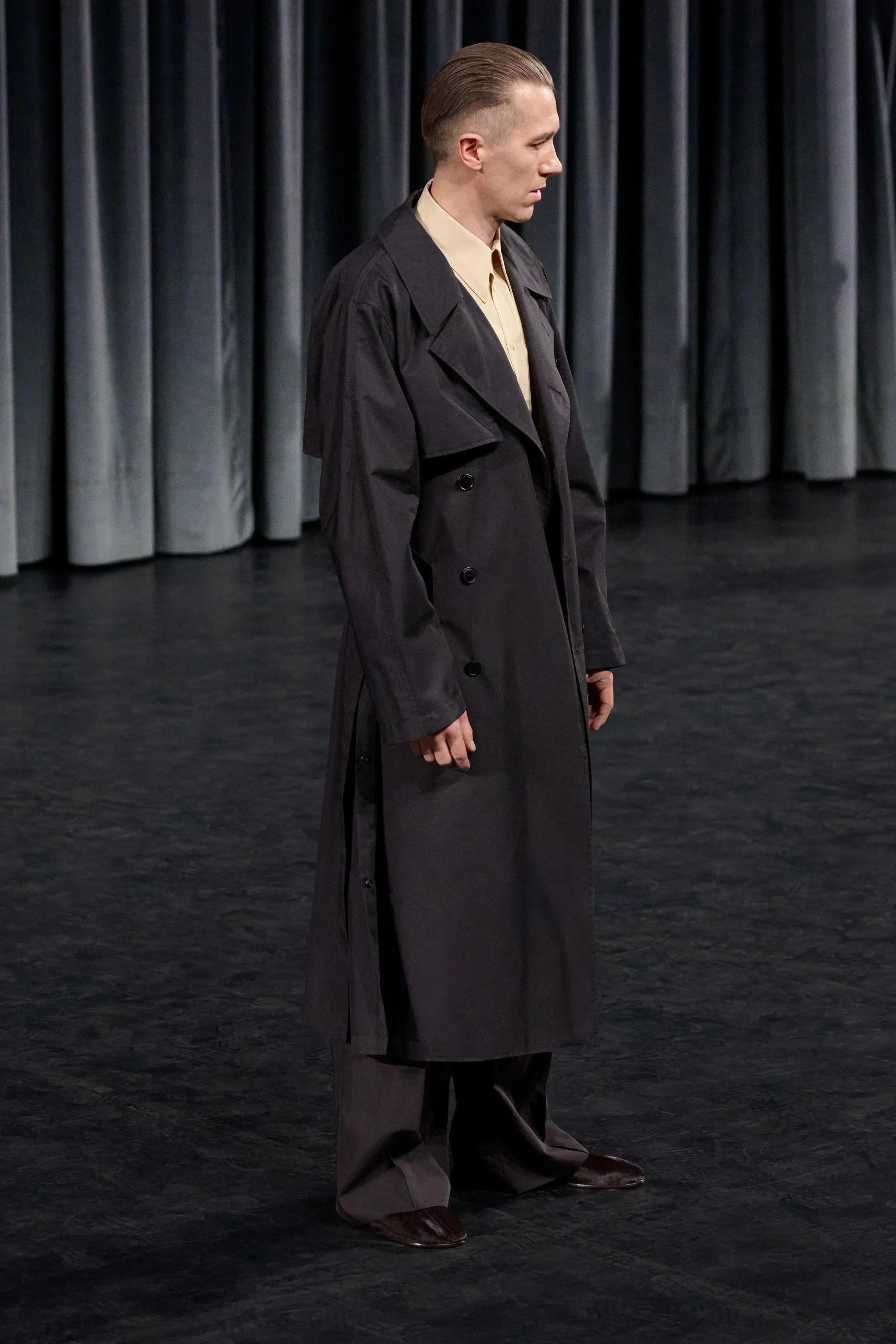
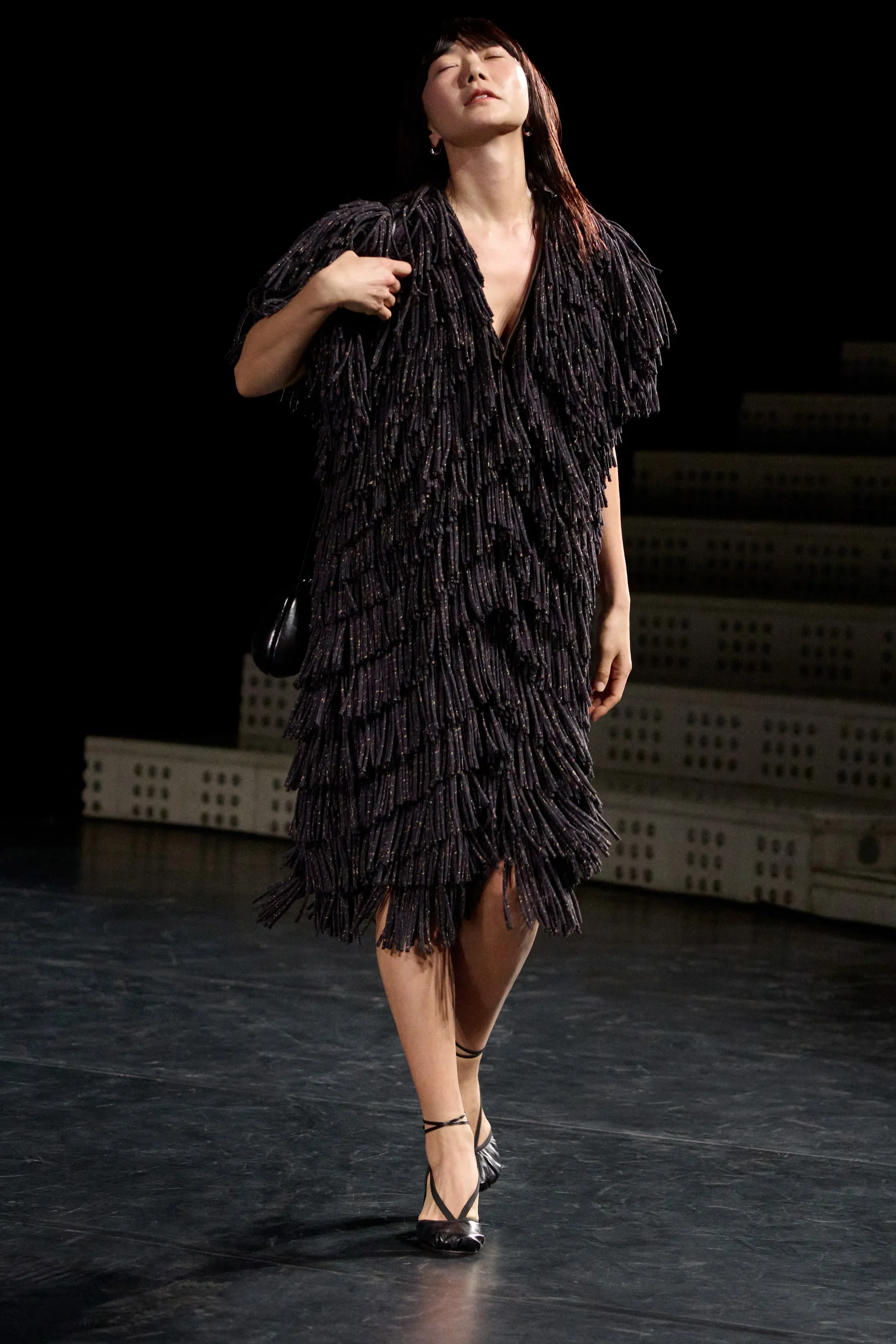
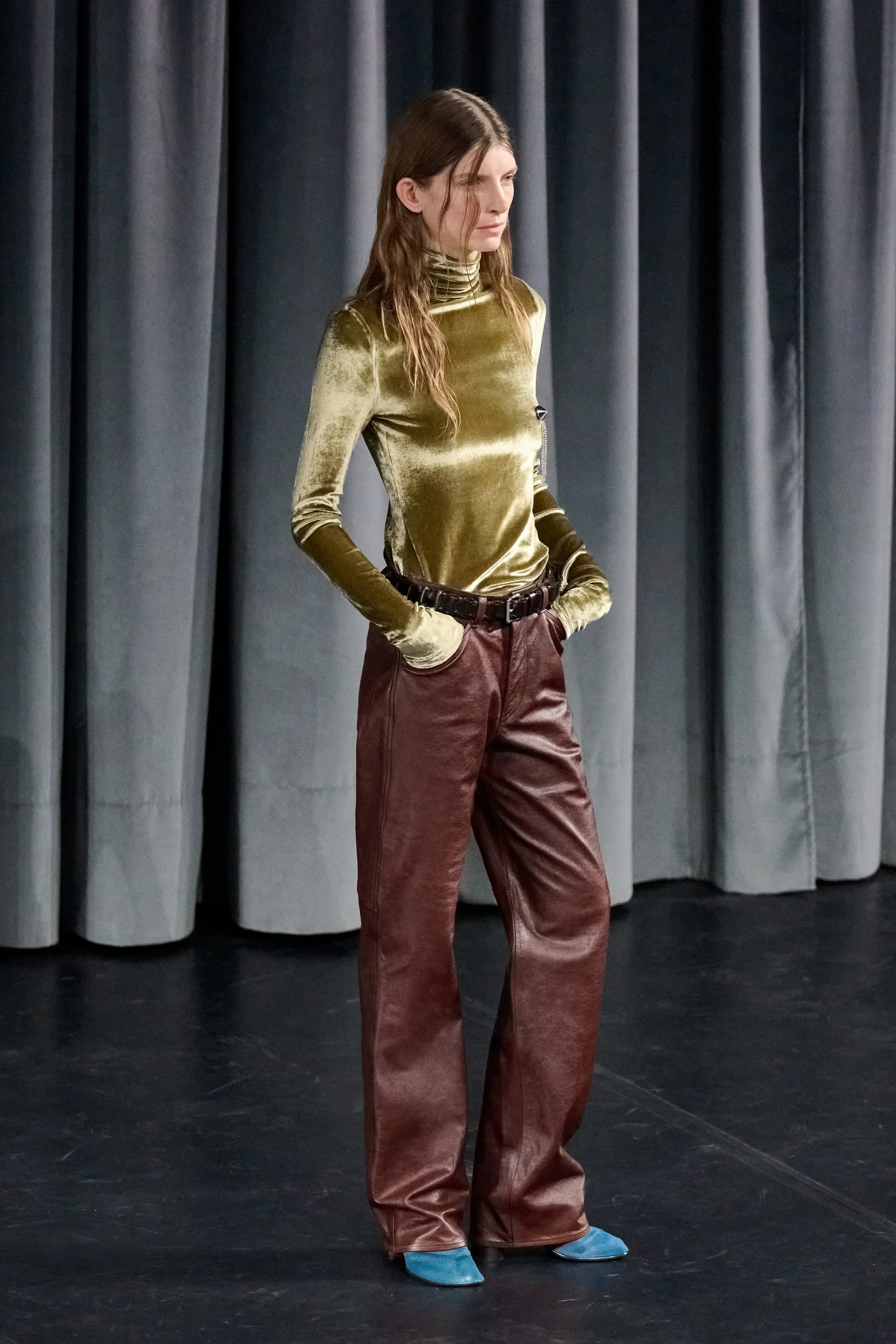
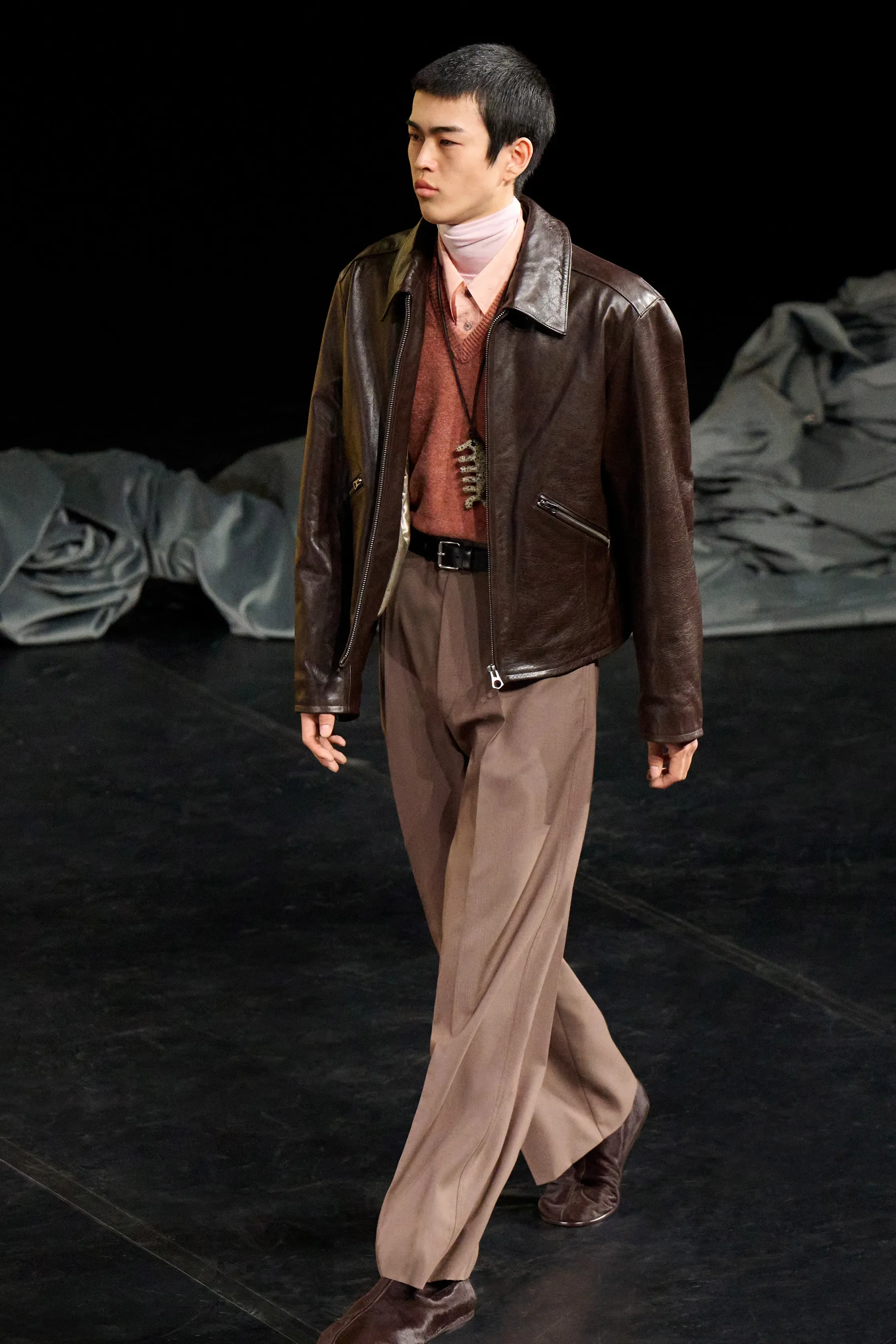
all images courtesy of LEMAIRE
Inside the Opéra Bastille, Christophe Lemaire and Sarah-Linh Tran transformed the runway into a stage alongside scenographer Nathalie Béasse, presenting mine eyes as a living performance rather than a conventional show. Models appeared, vanished, regrouped, danced, and stared, creating a rhythm that felt poetic and human. The pacing allowed emotion to surface naturally, showing Lemaire’s ability to make fashion feel lived in rather than performed.
Silhouettes floated. Fluid suits, airy dresses, and softly utilitarian layers sat easily on the body, capturing the house’s natural ease between comfort and elegance. Sensuality emerged through movement, with pleated slits opening mid-stride, asymmetrical folds shifting with each step, and deep V necklines. Lacquered denim mimicked leather, while crushed velvets took on an almost metallic feel. The Mandarin jacket was revisited in calfskin leather, while the Welding jacket returned with a stand collar in soft calf suede. Jewelry punctuated the looks, with brooches and necklaces holding surrealist pendants.
Roland Topor’s illustrations were translated directly into textiles, his rebellious spirit extending to footwear, tops, and a chapka hat, reinforcing the collection’s poetic instinct. The palette remained faithful to the house, with charcoal, browns, khaki, and butter yellow sharpened by flashes of celadon, turquoise, and glossed pink. The show concluded as a visual feast, intimate and human, reaffirming Lemaire’s quiet power to move without excess.
DIOR MEN
review by MARIA MOTA
all images courtesy of DIOR MEN
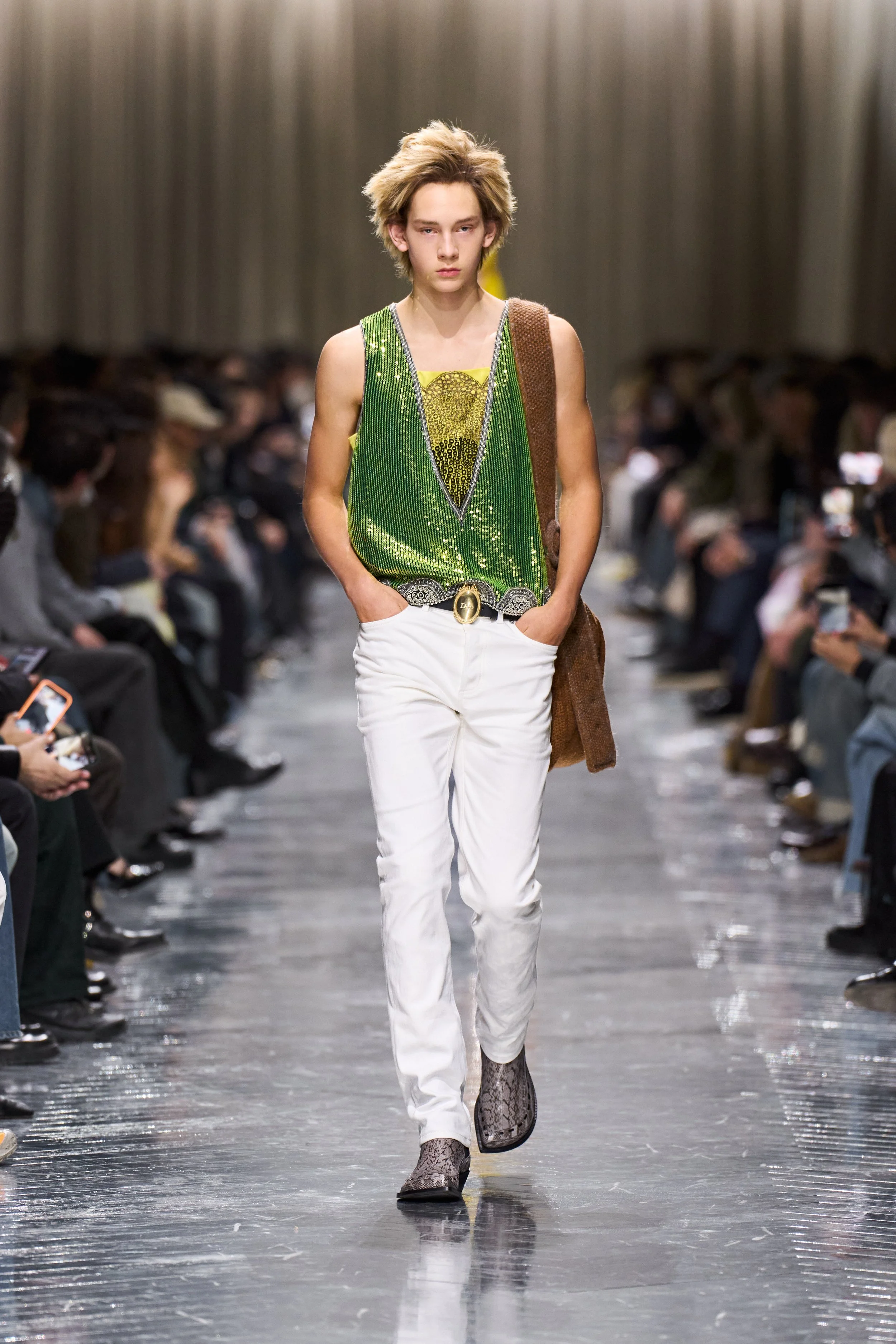
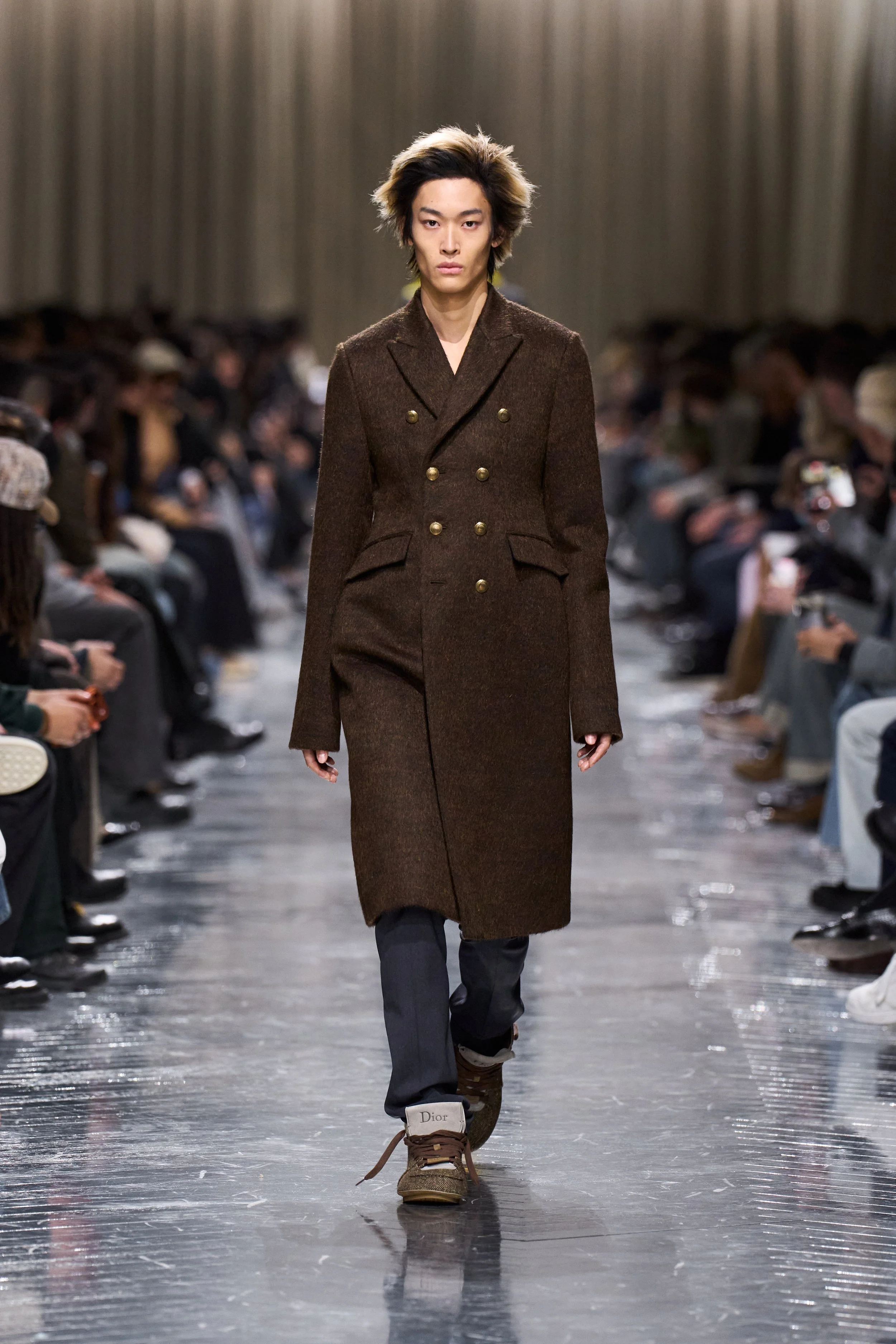
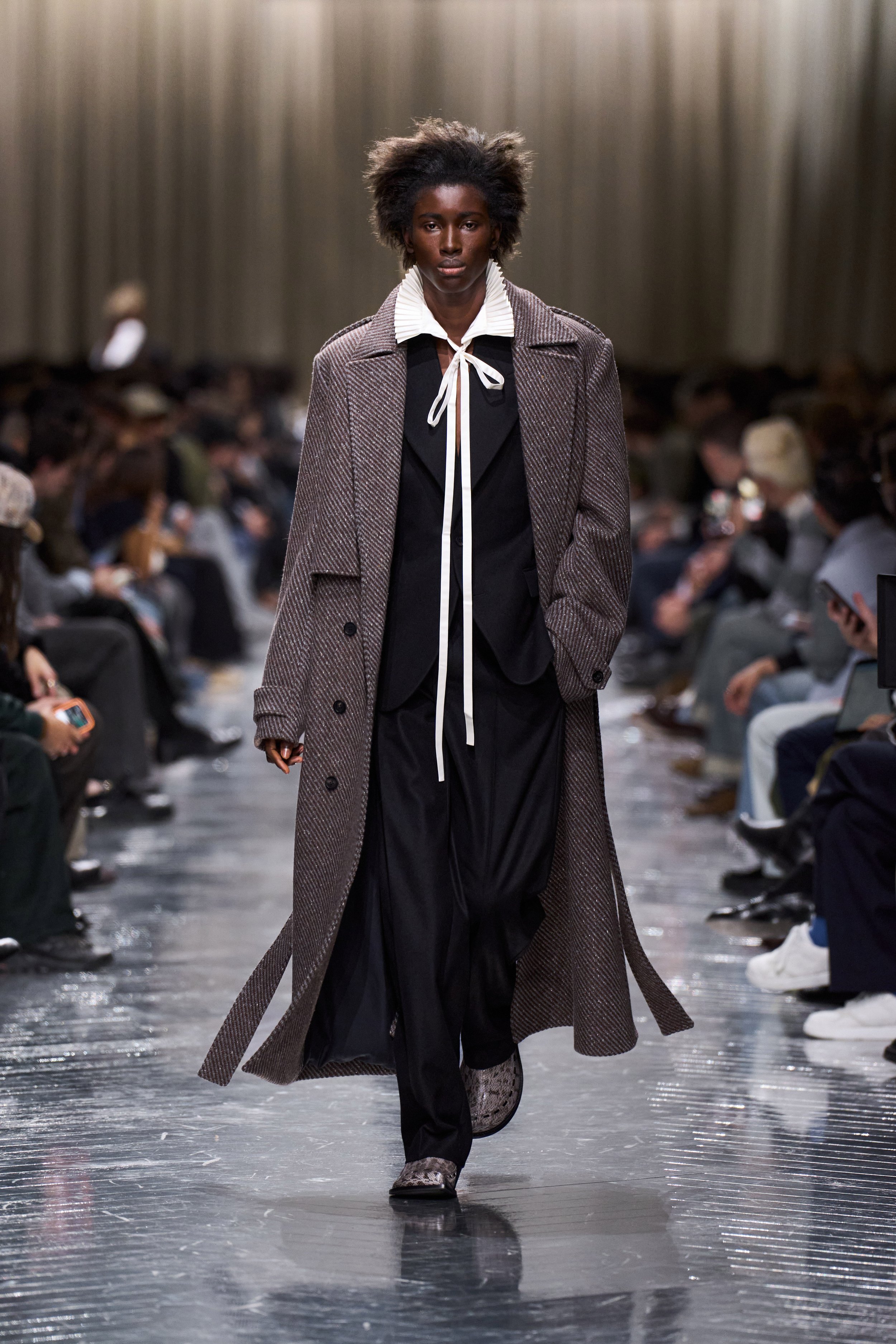
Jonathan Anderson’s Dior Men Fall Winter 2026 show marked the beginning of a new chapter for the house. From the first look, it was clear Anderson was not interested in cautious evolution. Instead, he presented 63 looks that announced a shift in attitude, one rooted in play and a deep trust in his own vision. Watching it unfold felt like being invited into a brilliant mind at work, one that understands Dior’s weighty history yet refuses to treat it as untouchable.
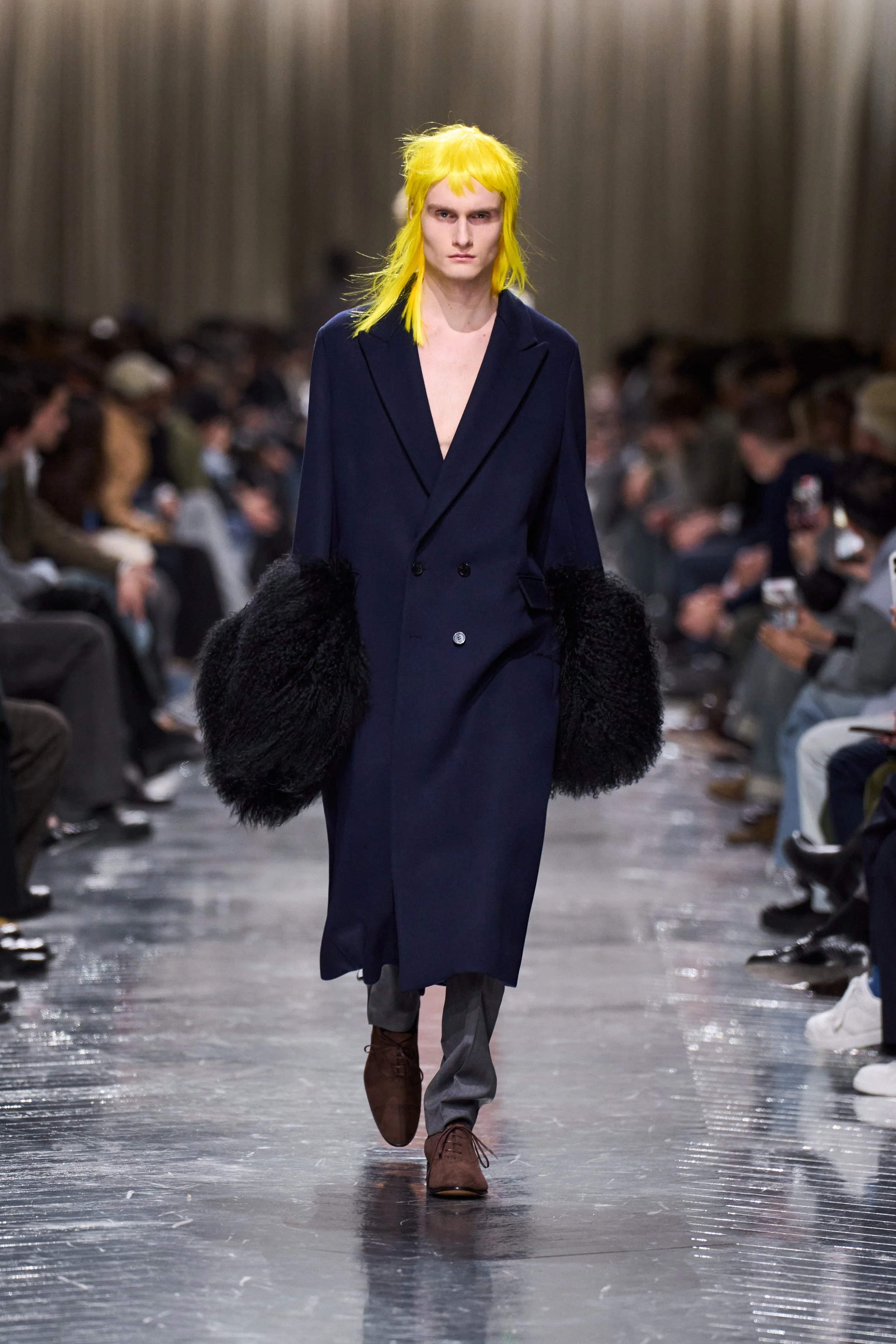
The first looks immediately caught the eye with bright yellow wings, injecting a sense of fun into the traditional mindset around menswear at Dior. It was expressive and unexpected, and it was clear we were being presented with a Dior man who feels alive, contradictory and emotionally charged.
The soundtrack by mk.gee became a quiet but powerful anchor, and his style was clearly referenced in the aesthetic. His music, intimate, raw and slightly off kilter, mirrored the man presented on the runway. A bit awkward, rebellious, a little punk, relaxed yet magnetic.
Slim fits and short proportions dominated, but they were balanced by elongated jackets, tailcoats and sweeping outerwear. There was the expected aristocratic touch throughout, seen in embroidered epaulettes, refined fabrics and precise construction, now incorporated into modern pieces, even something as casual as a polo shirt. Paul Poiret’s influence was particularly resonant, not only through his philosophy of looseness but also through the way Anderson approached volume and freedom. Recalling silhouettes once explored during Galliano’s time at the maison, these ideas were reinterpreted with restraint and modernity, creating a sense of protection and drama without heaviness.
The collection thrived on contradiction. It was at once archaic and contemporary, structured and loose, formal and punk, masculine and feminine. Tailoring was slender and precise, with cropped Bar jackets and lean trousers. Outerwear fused the pragmatic with the dramatic as bombers dissolved into brocade capes, jackets ballooned at the back and cocooning coats wrapped the body. Cuban heeled boots arrived with a twist. Sweaters stretched to ankle length. Tailcoats became cable knits. Casting and styling pushed the message further. Spiky yellow hair, eclectic layering and unexpected combinations gave the Dior aristo youth a sense of spontaneity and freedom.
Through fabrication, proportion, styling and scale, Anderson challenged what Dior menswear can be. For those who do not quite understand it yet (and perhaps you never will), let it come to you. Let the unlikely elements collide. In doing so, you begin to understand Anderson’s Dior. You enter his vision for the house, where tradition is not preserved but played with, with joy and curiosity, and where style is treated as a living discourse.
SONGZIO
review by MAREK BARTEK
all images courtesy of SONGZIO
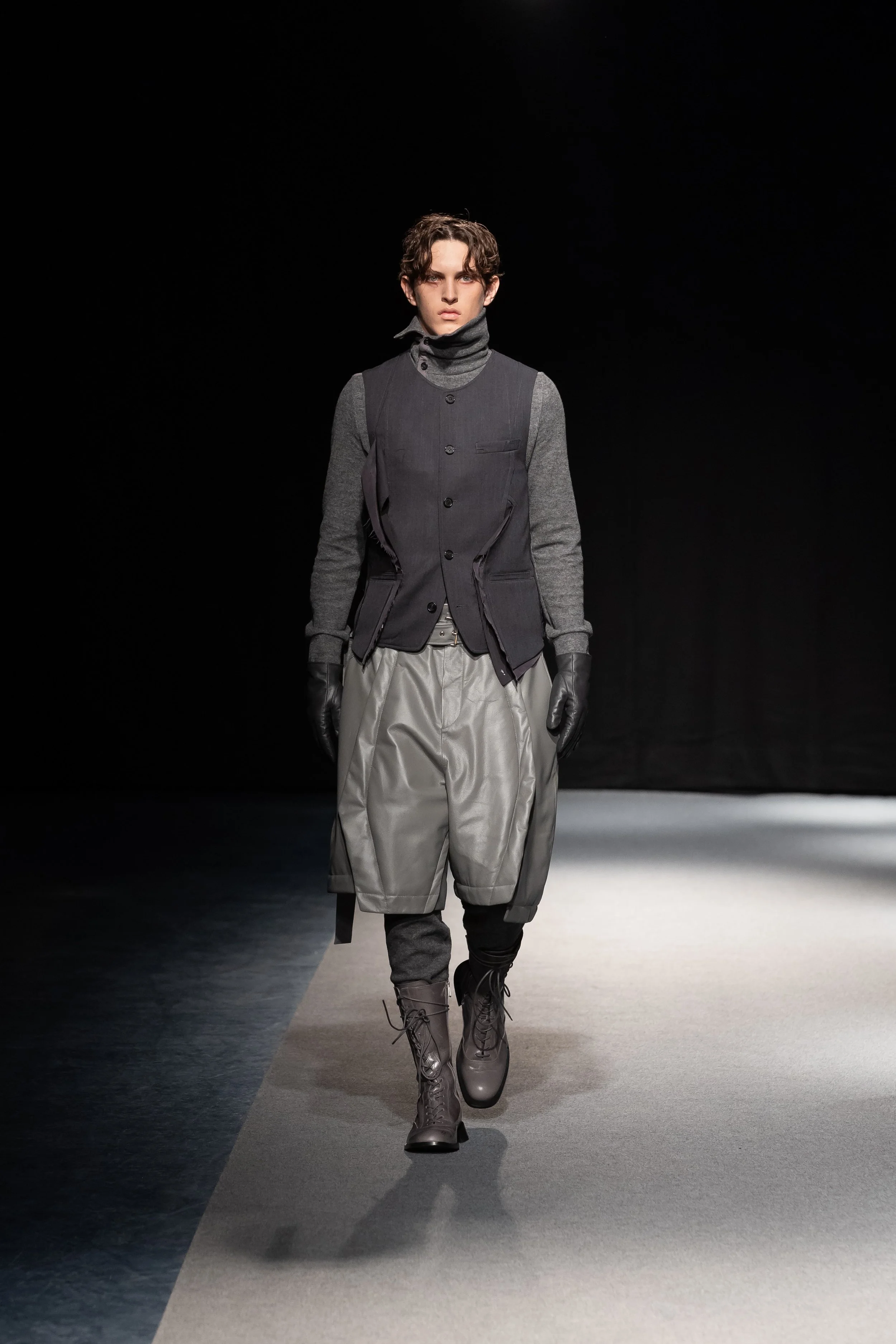
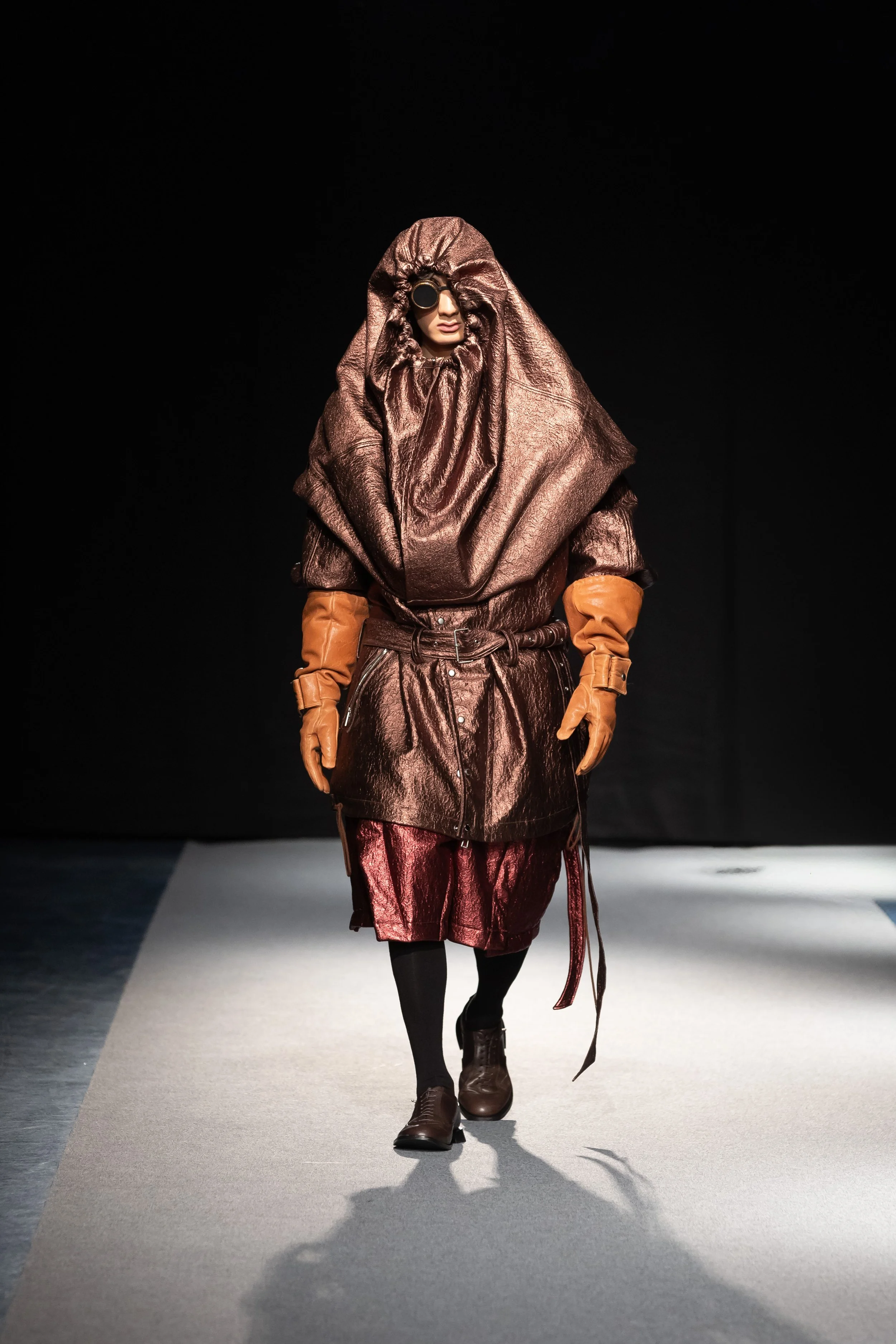
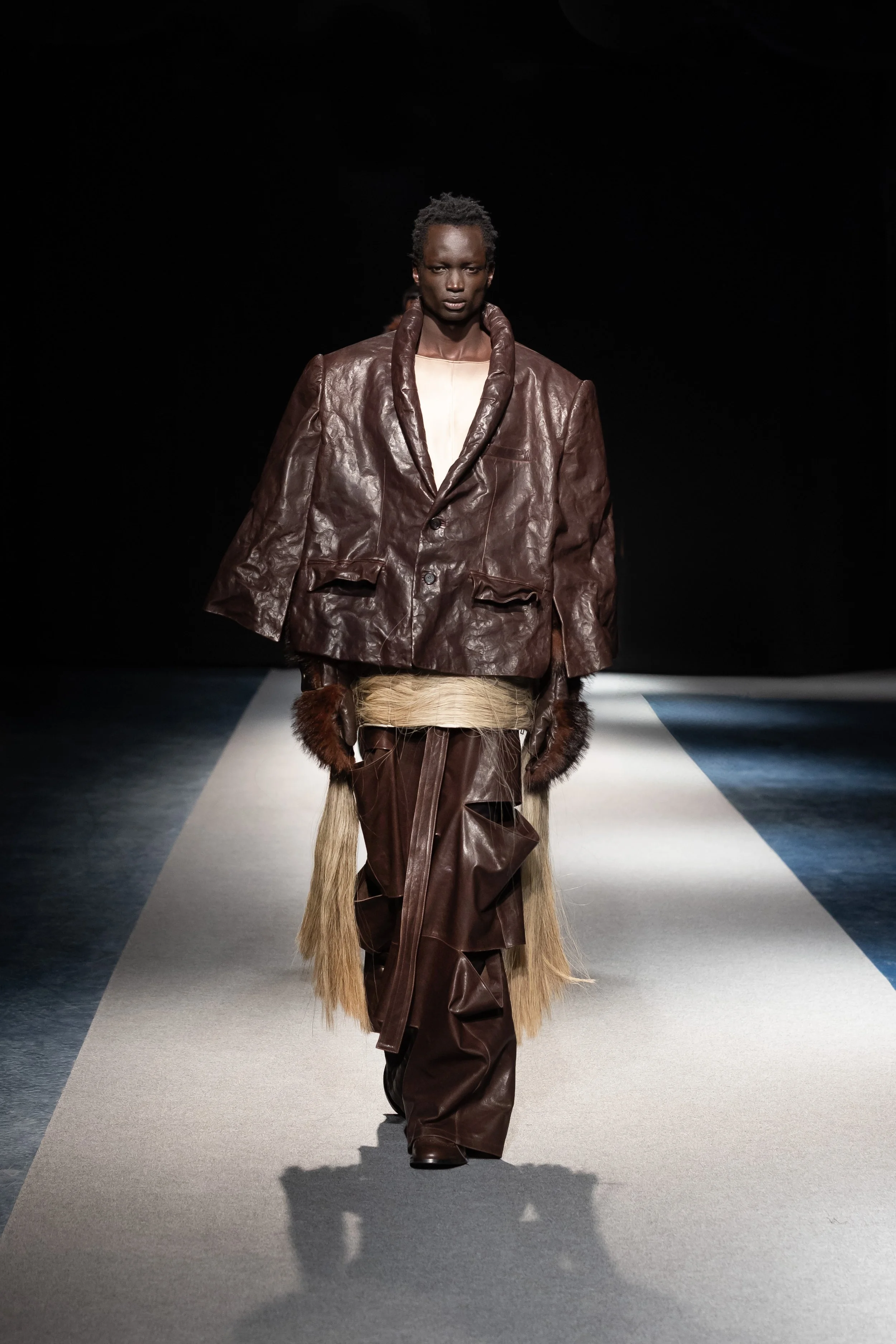
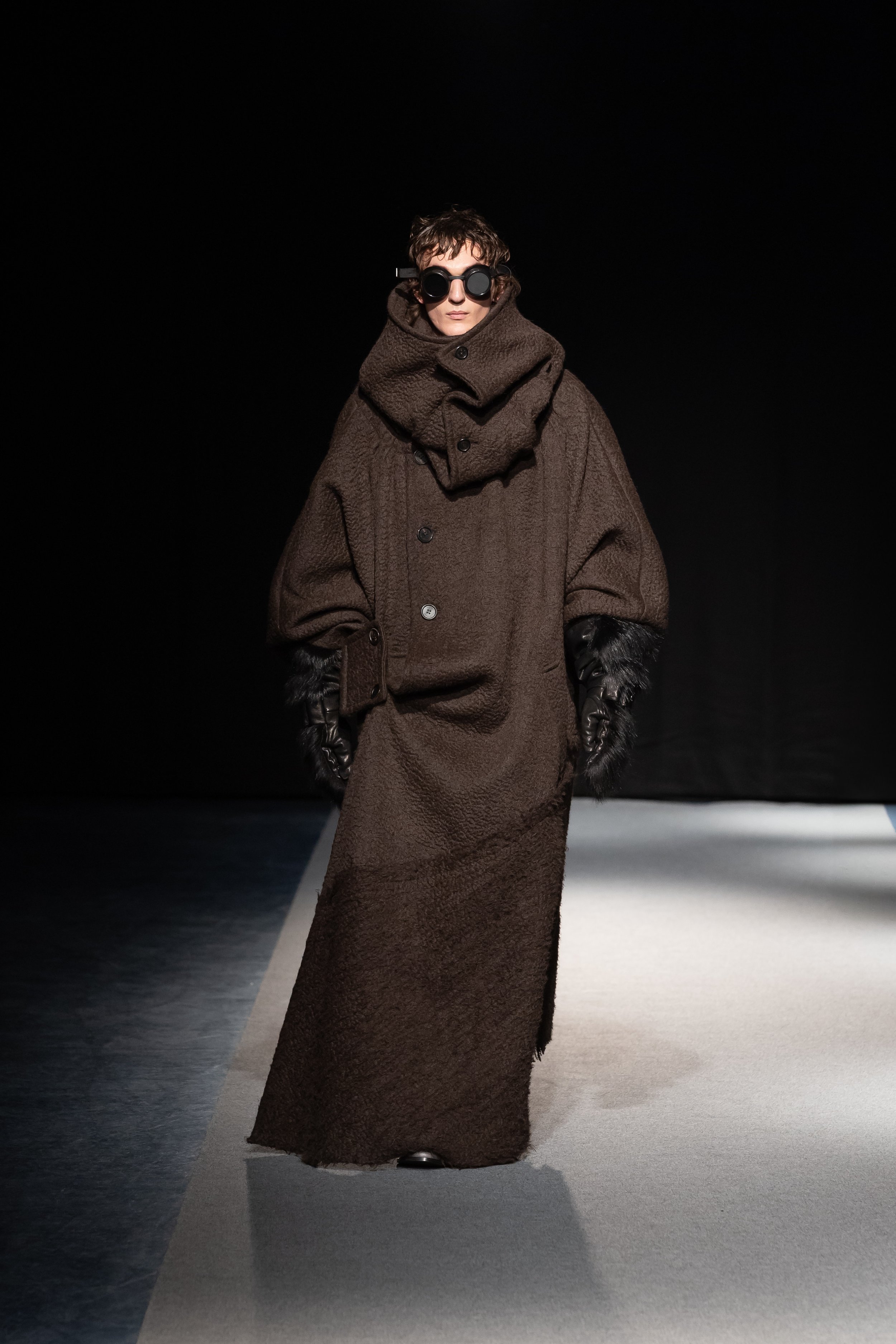
Songzio staged its Fall/Winter 2026 show beneath Pont Alexandre III, in a space kept deliberately dark, setting the tone for a collection built around tension, distortion, and controlled unease. Titled Crushed, Cast, Constructed, the season revisited early modern tailoring through a language of compression and reconstruction.
The opening look — a full leather ensemble split open at the legs — immediately introduced the collection’s physicality. Leather, raw hems left hanging, oversized knitwear, and sharply cut coats were layered into dense, protective silhouettes. Collars rose high around the face, jackets closed over mouths and eyes, and knitted pieces were pulled across features, reinforcing a sense of concealment. Punk leather chokers, balaclavas, fur gloves and sculptural accessories added to the collection’s confrontational edge.
Casting played an important role, with older models and grey hair disrupting the usual codes of youth. Tartan skirts, XXL wool coats with exaggerated collars, and gold-flecked black outerwear balanced severity with craft. Throughout, layering became both construction and concept. Truly, a wardrobe shaped by pressure, collapse, and survival.
WALTER VAN BEIRENDONCK
review by VERONICA TLAPANCO SZABÓ
all images courtesy of WALTER VAN BEIRENDONCK
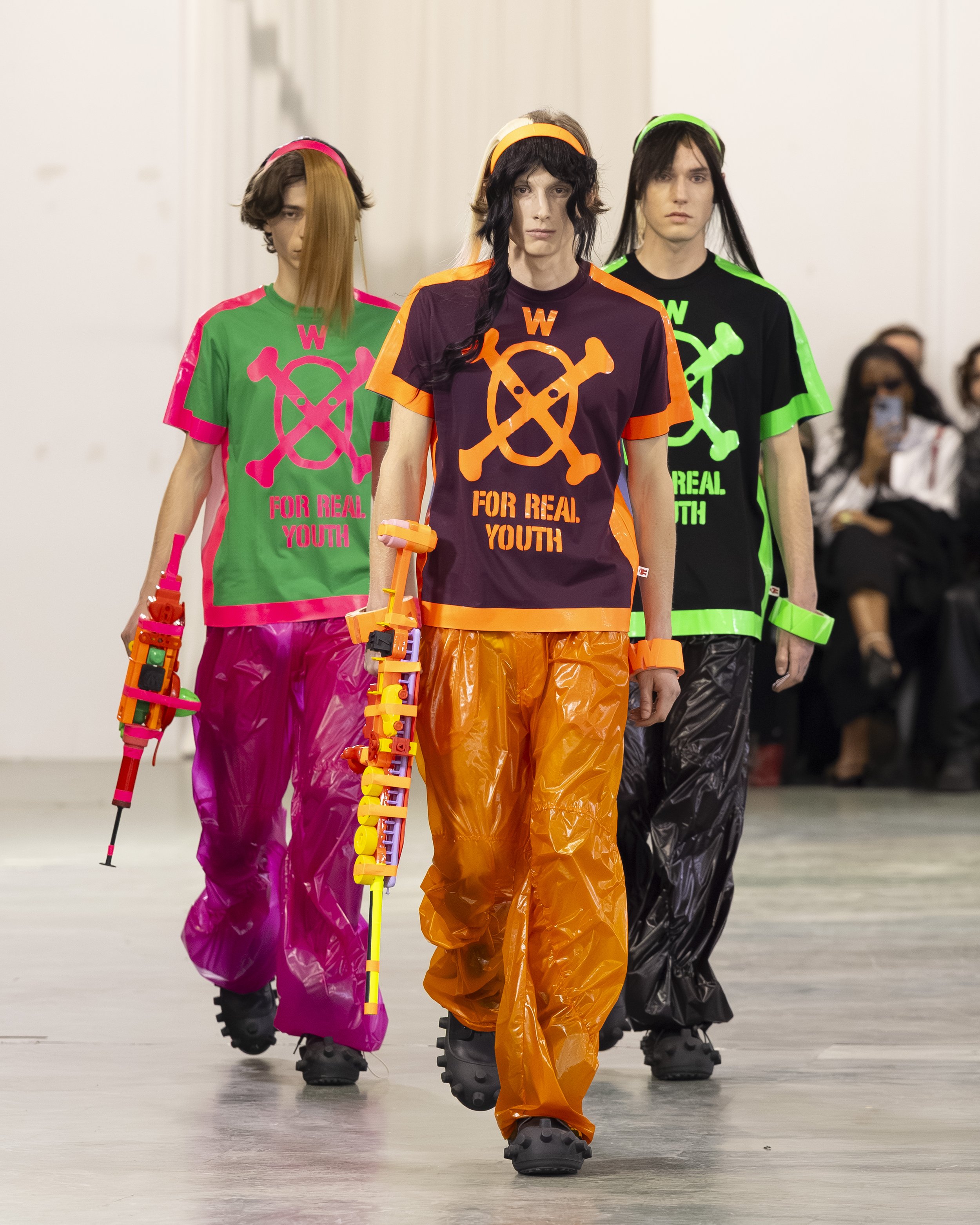
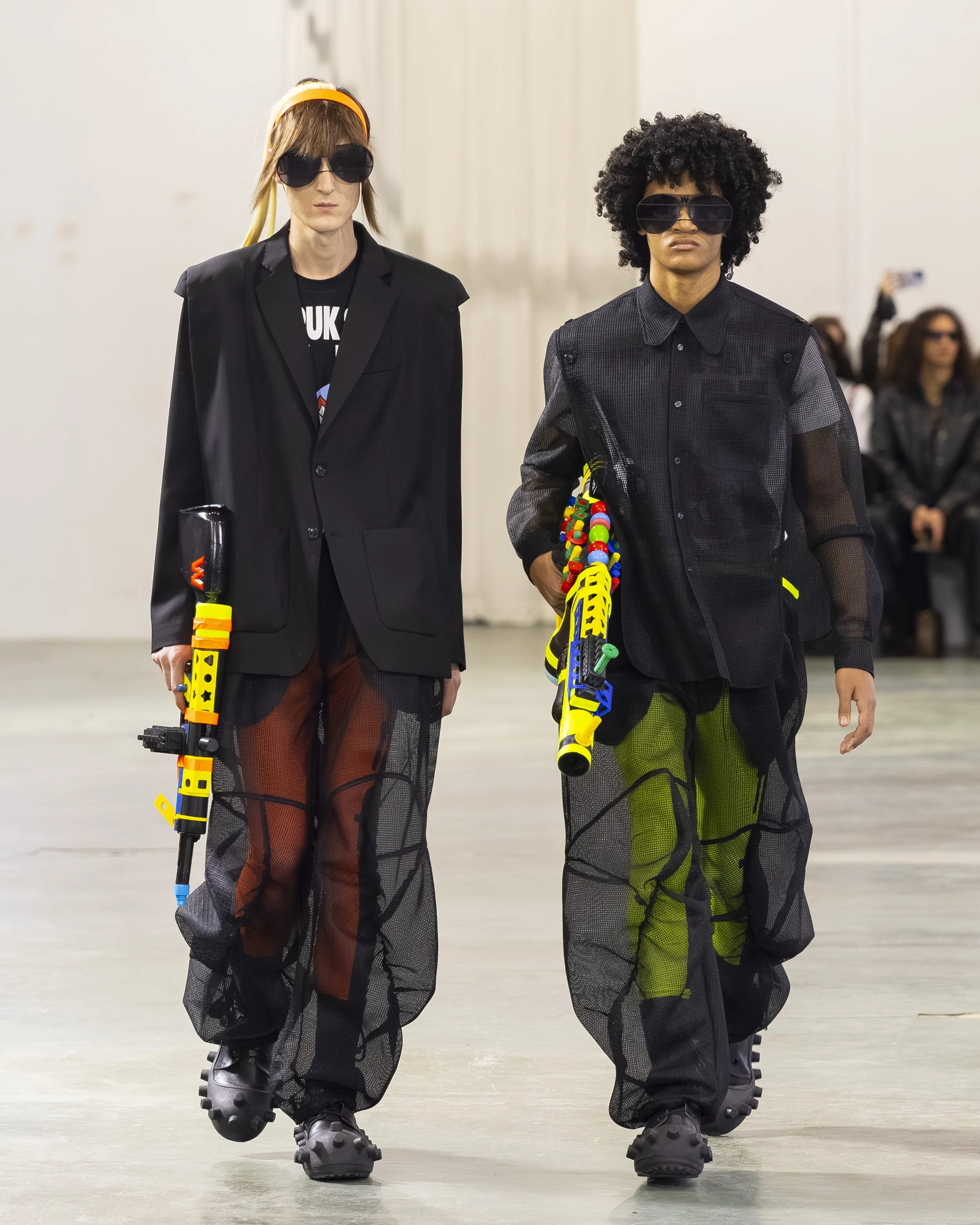
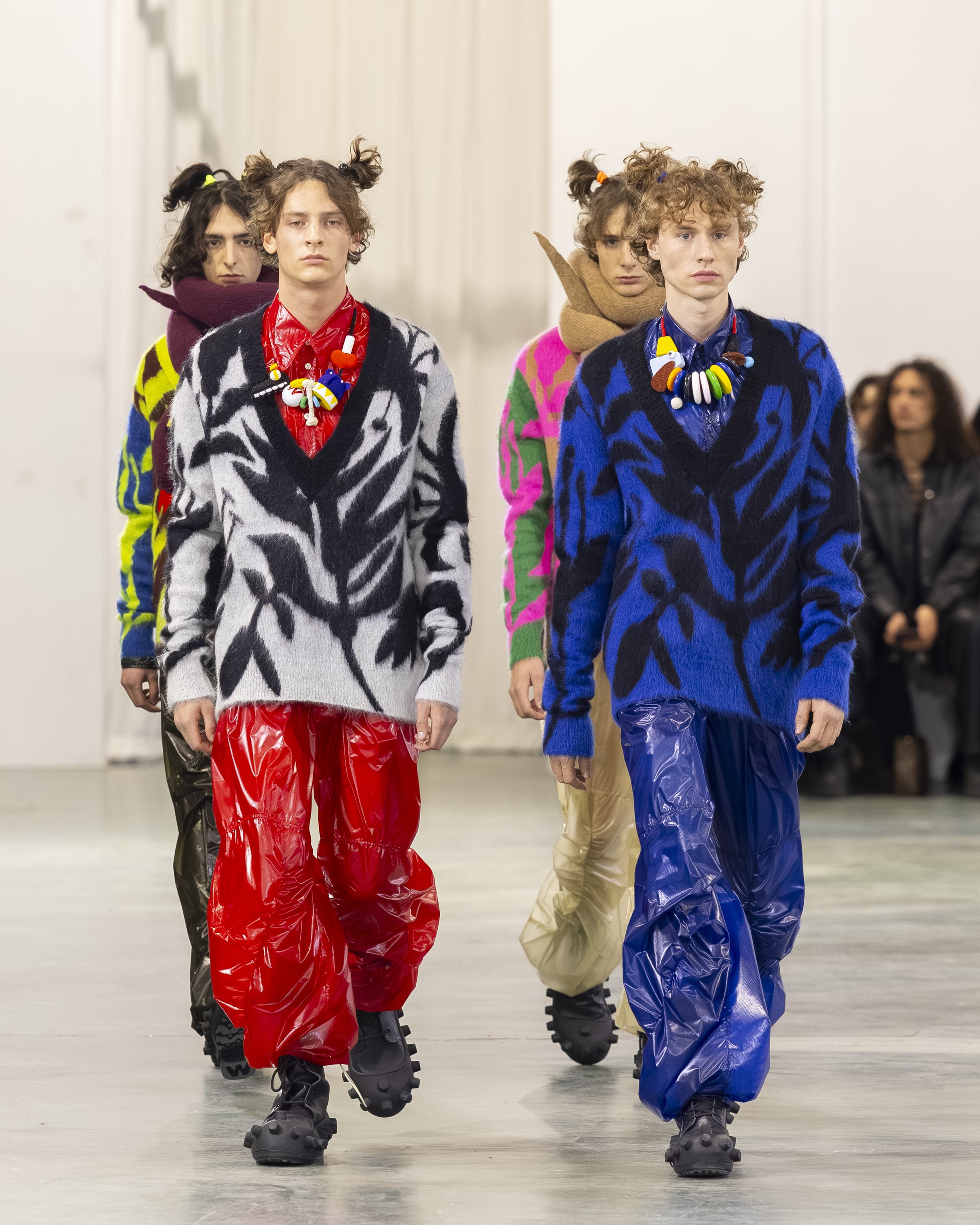
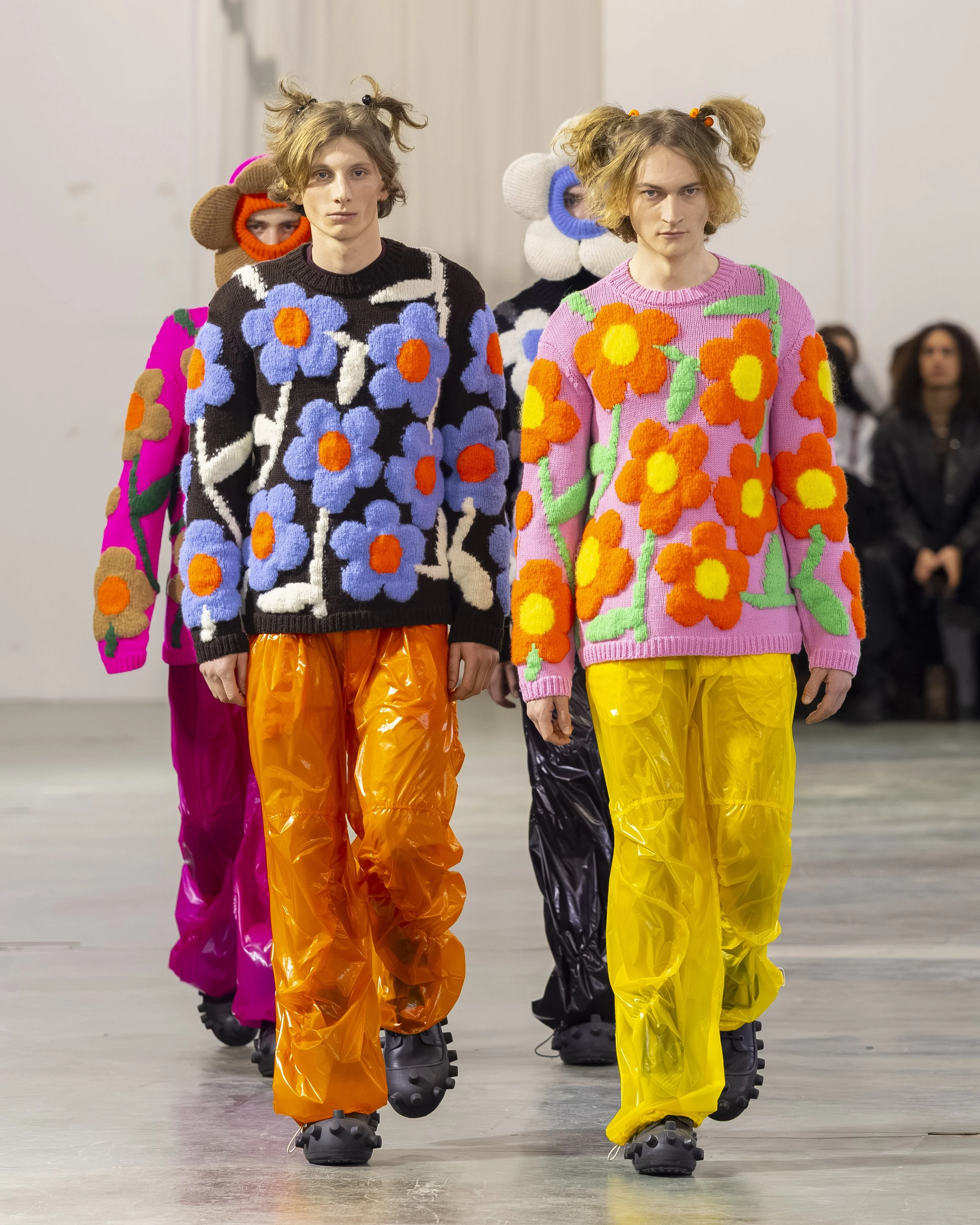
Scare the crow with your youth and your glow! This season, Walter Van Beirendonck opens his Autumn/Winter collection with a confession: “I have always felt like an outsider in this industry. I’m not complaining. It’s a place from which you can look at things differently.” It tracks, his outsider gaze, fed by a deep love for Art Brut and Outsider Art, keeps him designing from somewhere just outside our expectations season after season. This childlike spirit is everywhere, not as familiar cartoon or references but rather in the spirit as a whole.
The show kicked off with a scooter swallowed by a bright yellow parka blooming with 3D puffer flowers, driven by a matching model with riffles strapped to his back, very Beirendonck! The soundtrack pushed an apocalyptic military tempo as a troop of model soldiers marched out wearing armies of fluorescent color mixed with classic tailoring. Plastic artillery and 3D birds exploded across garments. Everywhere you look, something was answering back so much so that the eyes of the crowd dart across each look trying to catch these details, until an Eastpak collaboration flashed into view. Puffers turn into faces on backpack panels all while bodies are swallowed under the kind of protective sheets that are usually reserved for furniture. Hair becomes toy, with extensions clipped at odd angles and faux bangs dangling with a childlike play. Tailoring arrived missing arms, turning blazers into capes made from British wools combined with nylon and plastic.
The looks eventually tightened into monochromatic ton sur ton and huge top hats make for the cherry atop Beirendonck’s cake! These are the scarecrows of 2026!
EGONLAB
review by NIA TOPALOVA
all images courtesy of EGONLAB
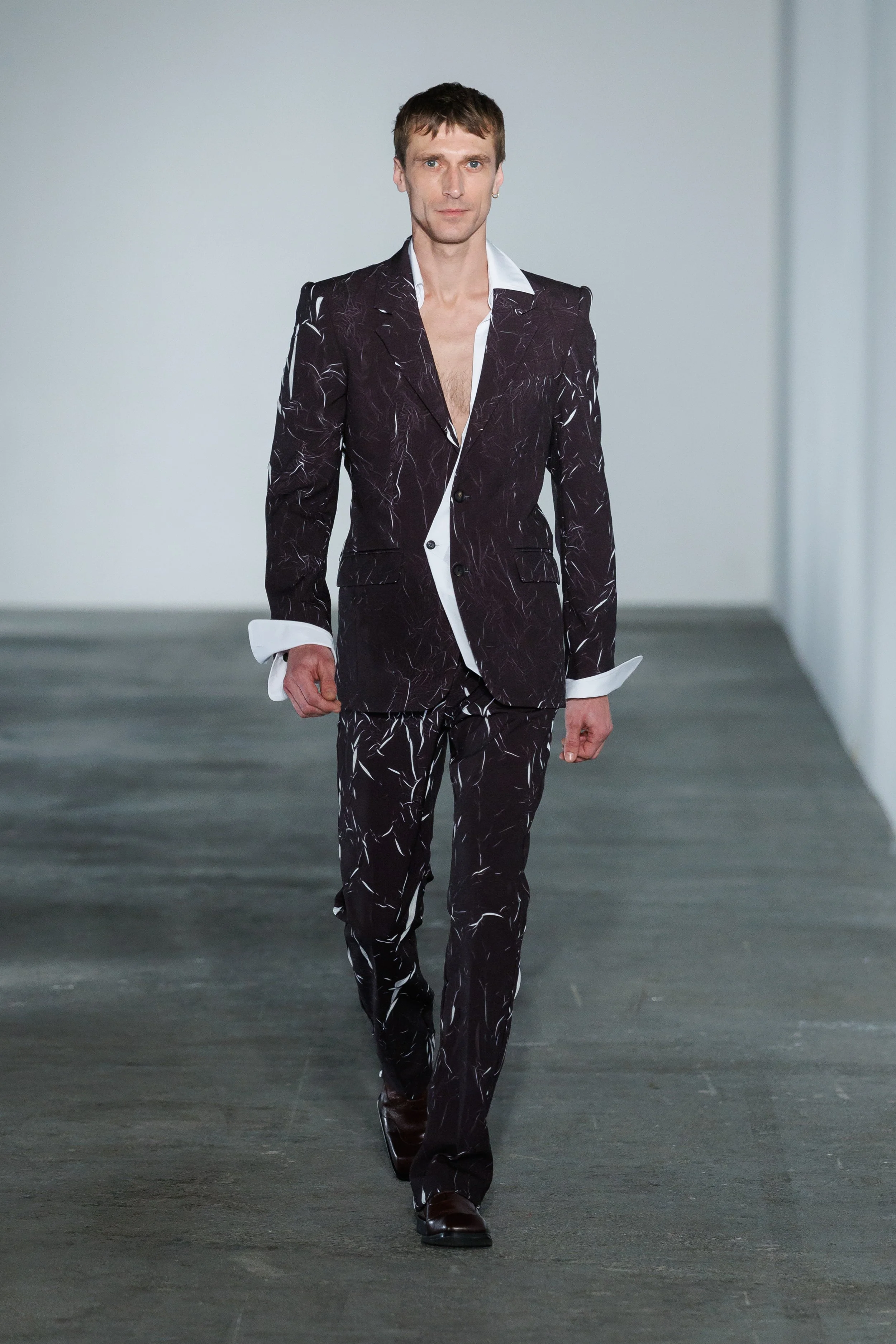
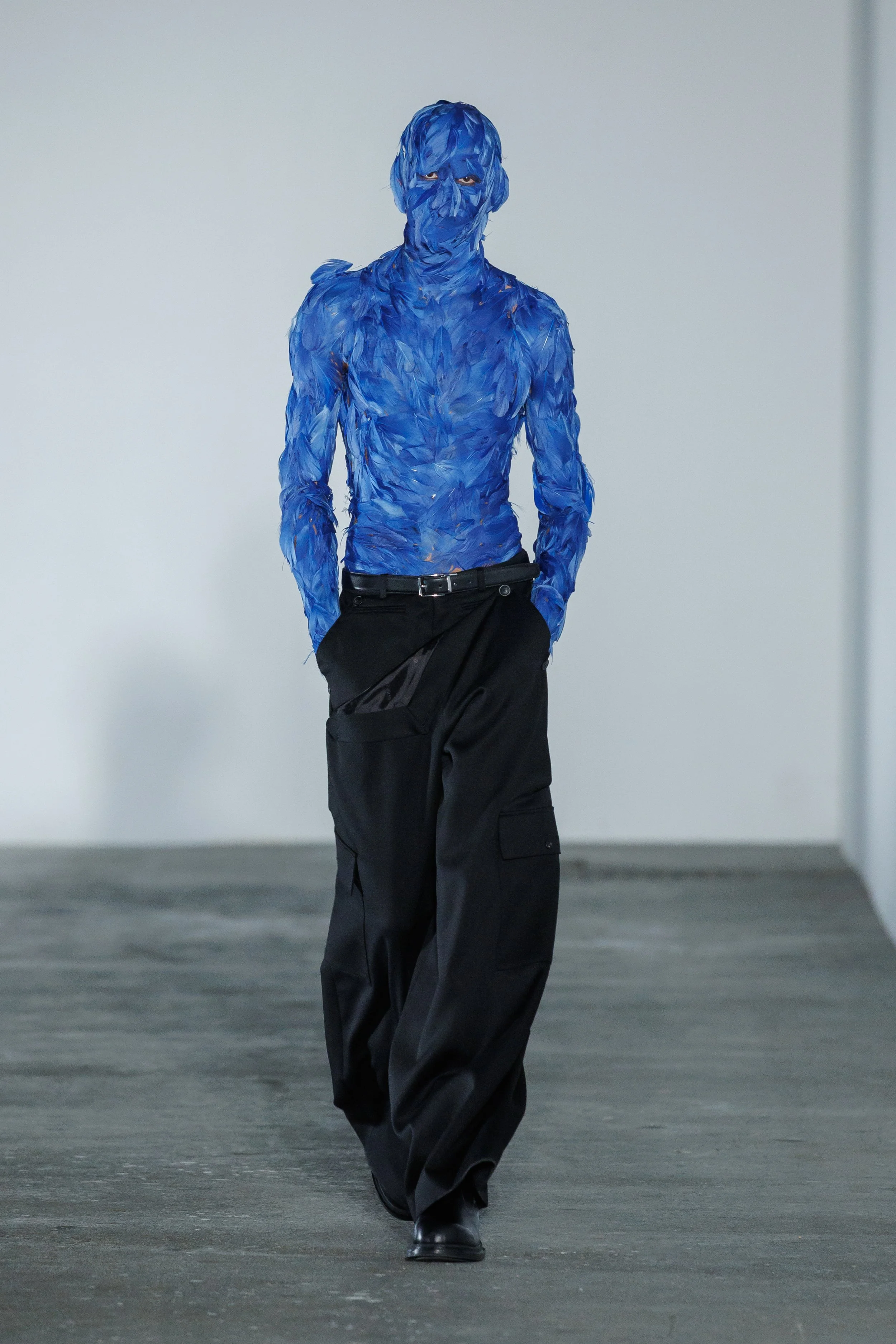
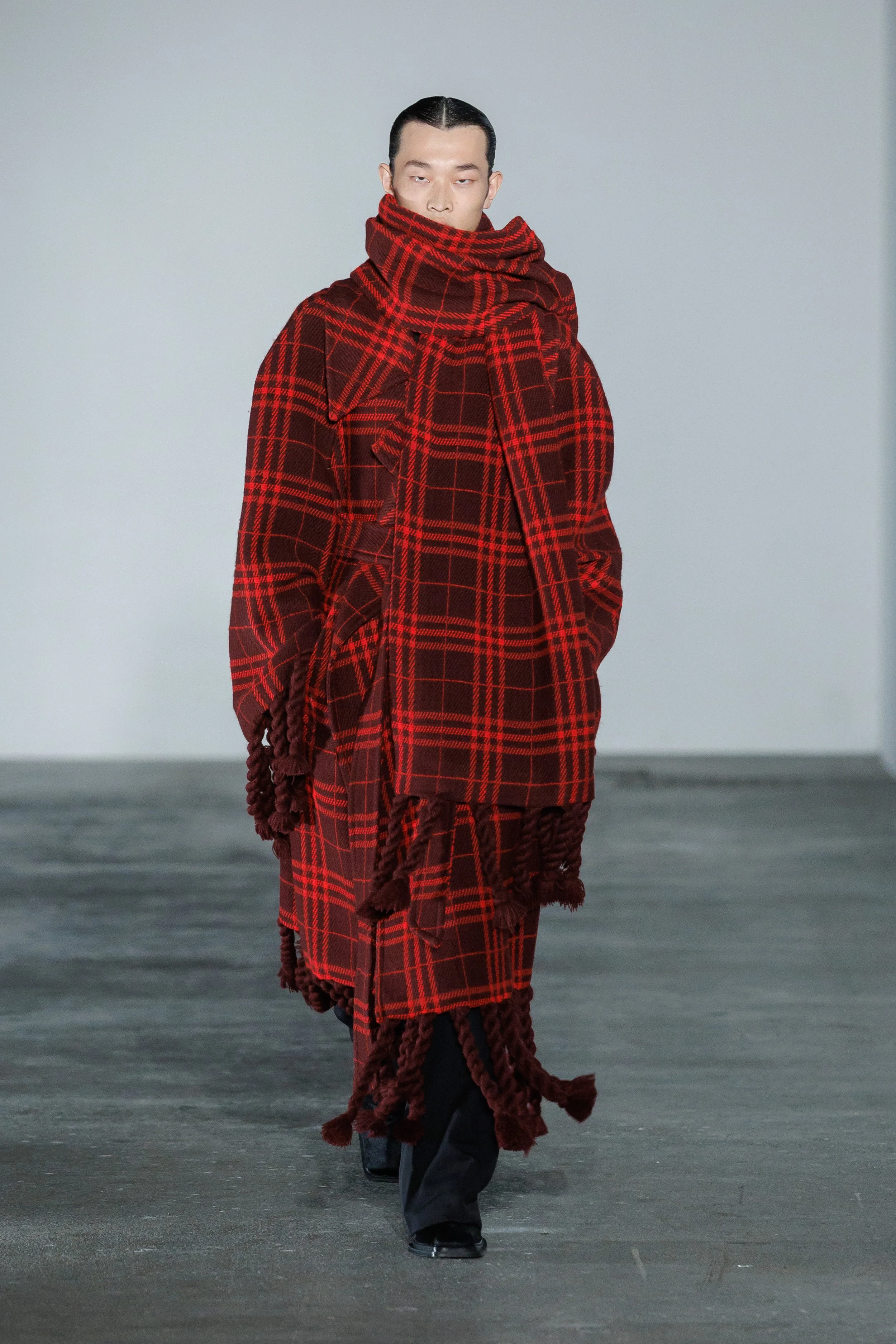
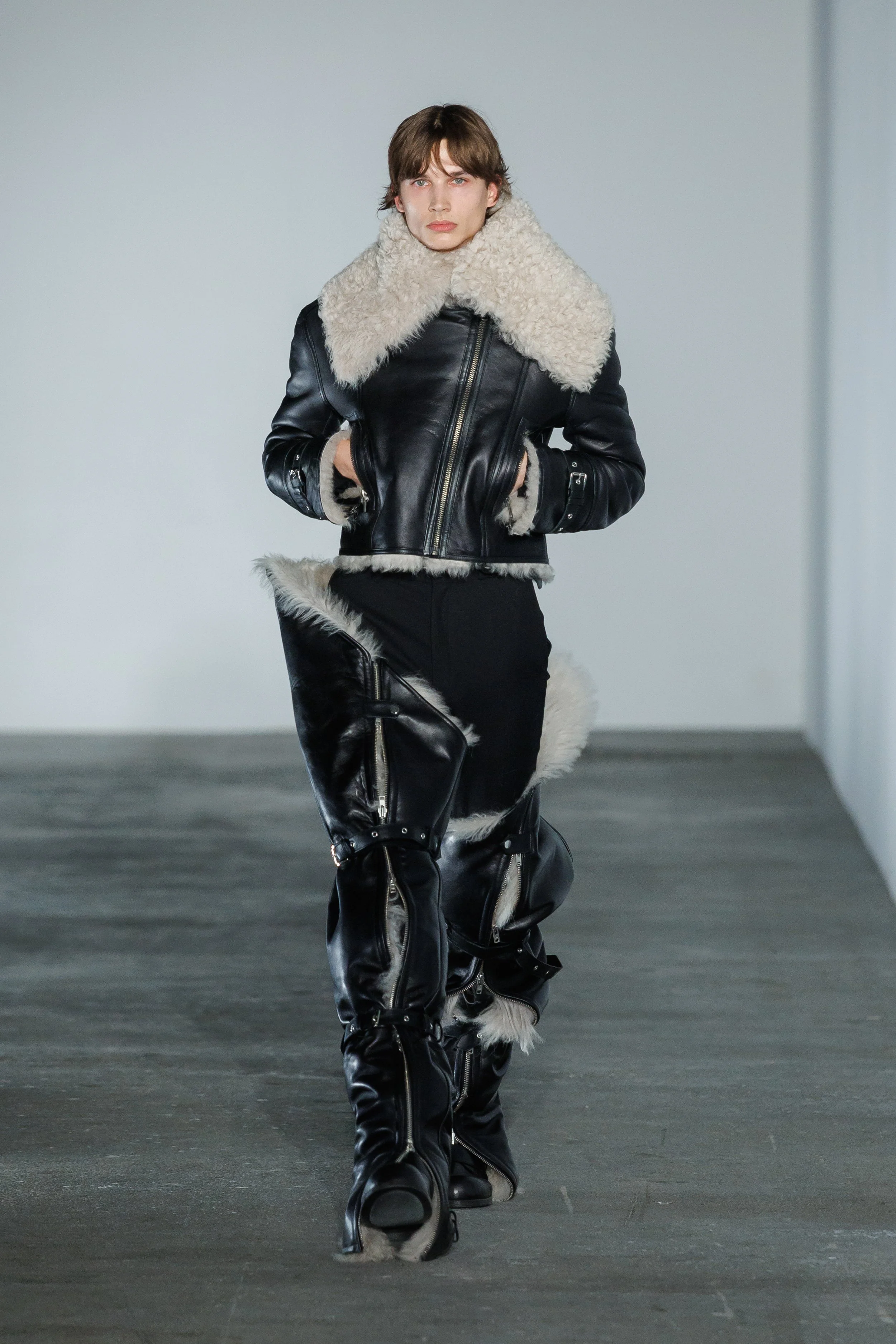
Florentin Glémarec and Kevin Nompeix frame LAZARUS as a critique of an industry that sacrifices creativity for productivity. Within this system, the role of the creative grows unstable, tolerated only as long as it remains profitable, or easily replicated. LAZARUS insists that individuality is a necessity, and that its suppression carries a cultural cost.
EGONLAB framed darkness as a place of construction and raw material for creation. The collection returns to the foundations of rebirth: multiplied volumes, broader shoulders, feathered bodysuits connected streetwear and couture. Black remained central; Denim was dismantled and reassembled, tailoring exaggerated; Oversized buttonholes and Jacron pockets, trompe-l’œil effects and asymmetry evoked forms caught mid-transformation.
Finally, the collaboration with our beloved app, one built on the gentle disposability of feeling (I think we can all guess I’m talking about Tinder) declared that LOVE WILL (hopefully) NOT TEAR US APART. With desire so easily replaceable, separation requiring no explanation, and relationships expiring before they’ve even begun, the collection insists that the possibility of real romance might still be worth the risk.
FENG CHEN WANG
review by MAREK BARTEK
images courtesy of FENG CHEN WANG
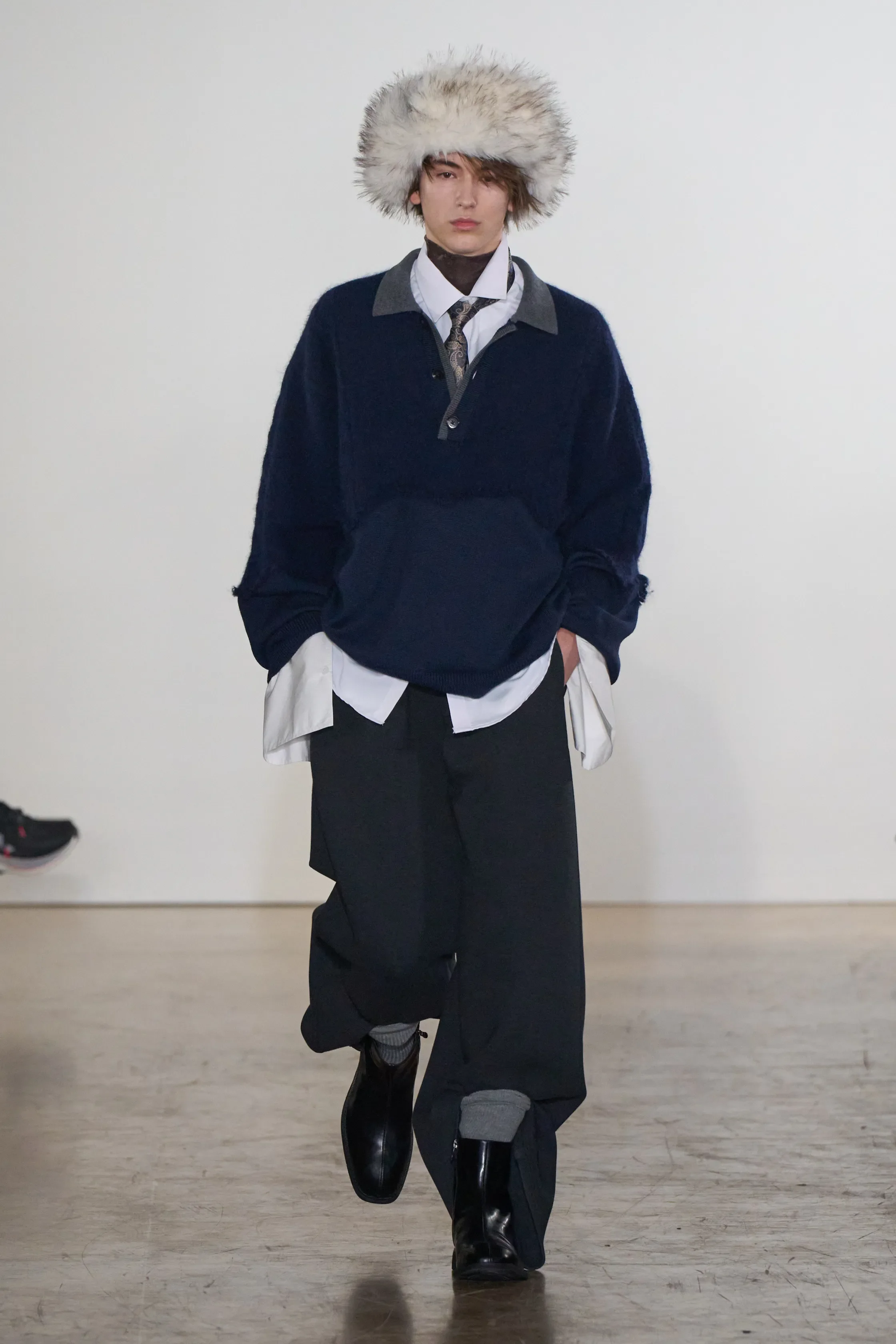
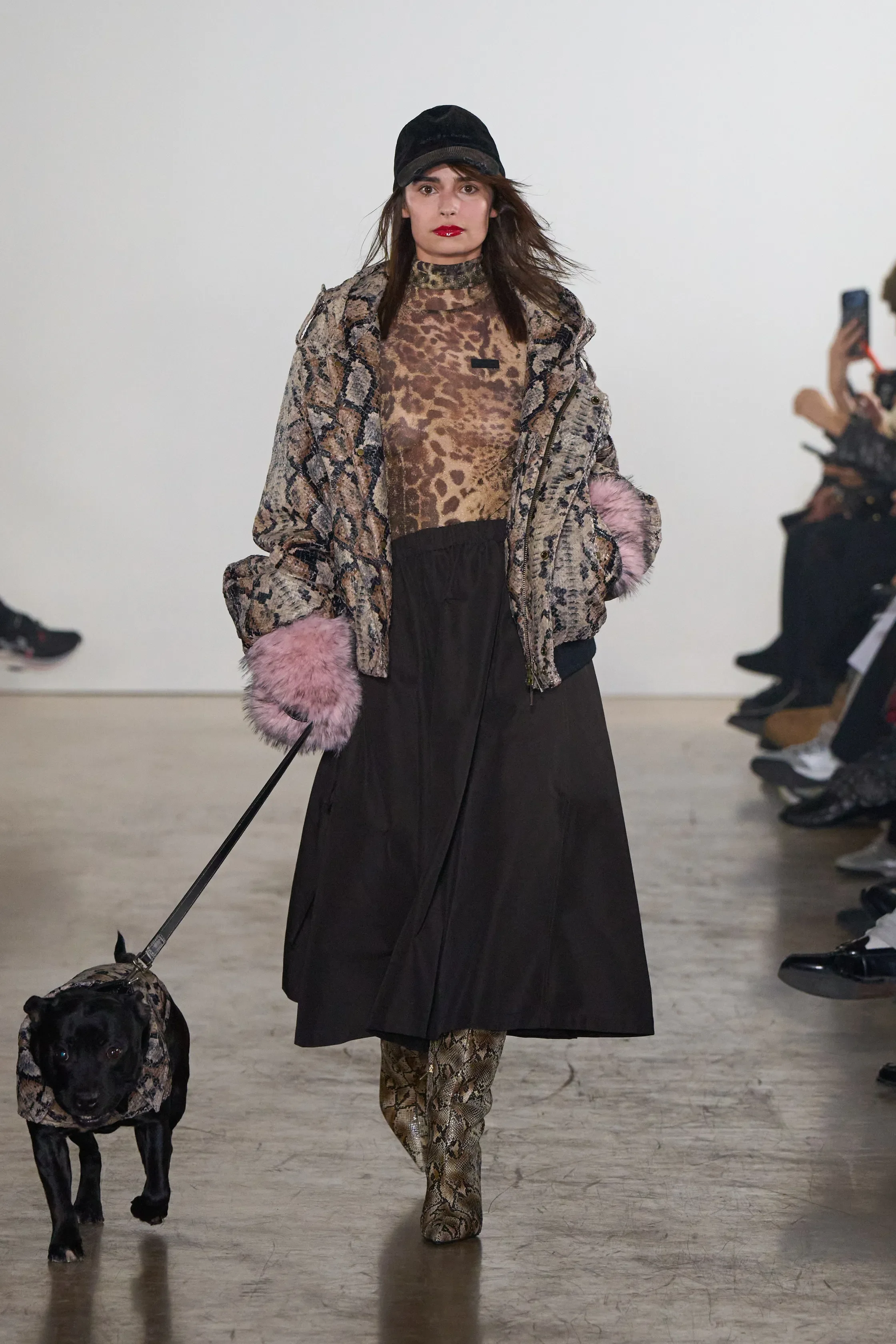
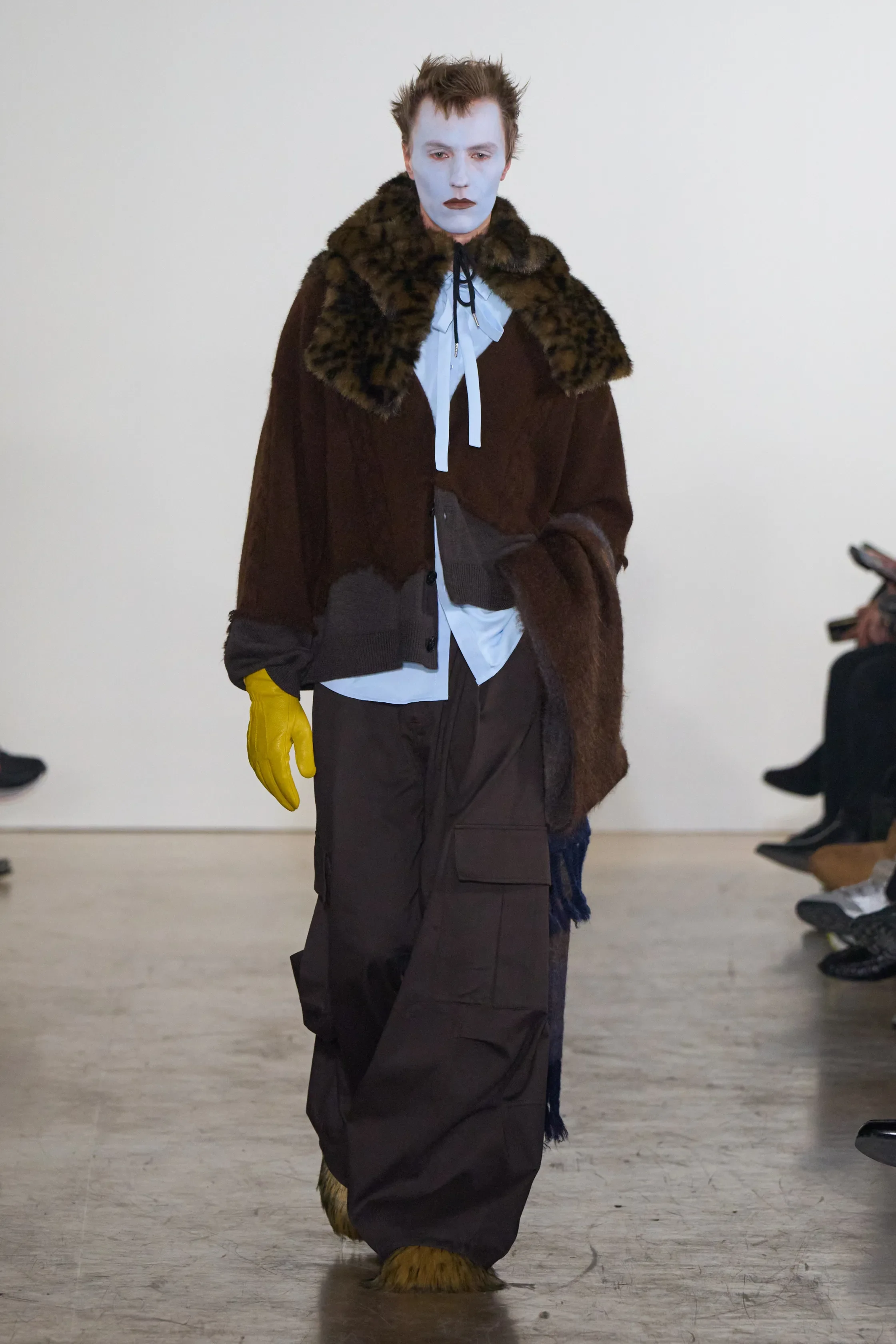
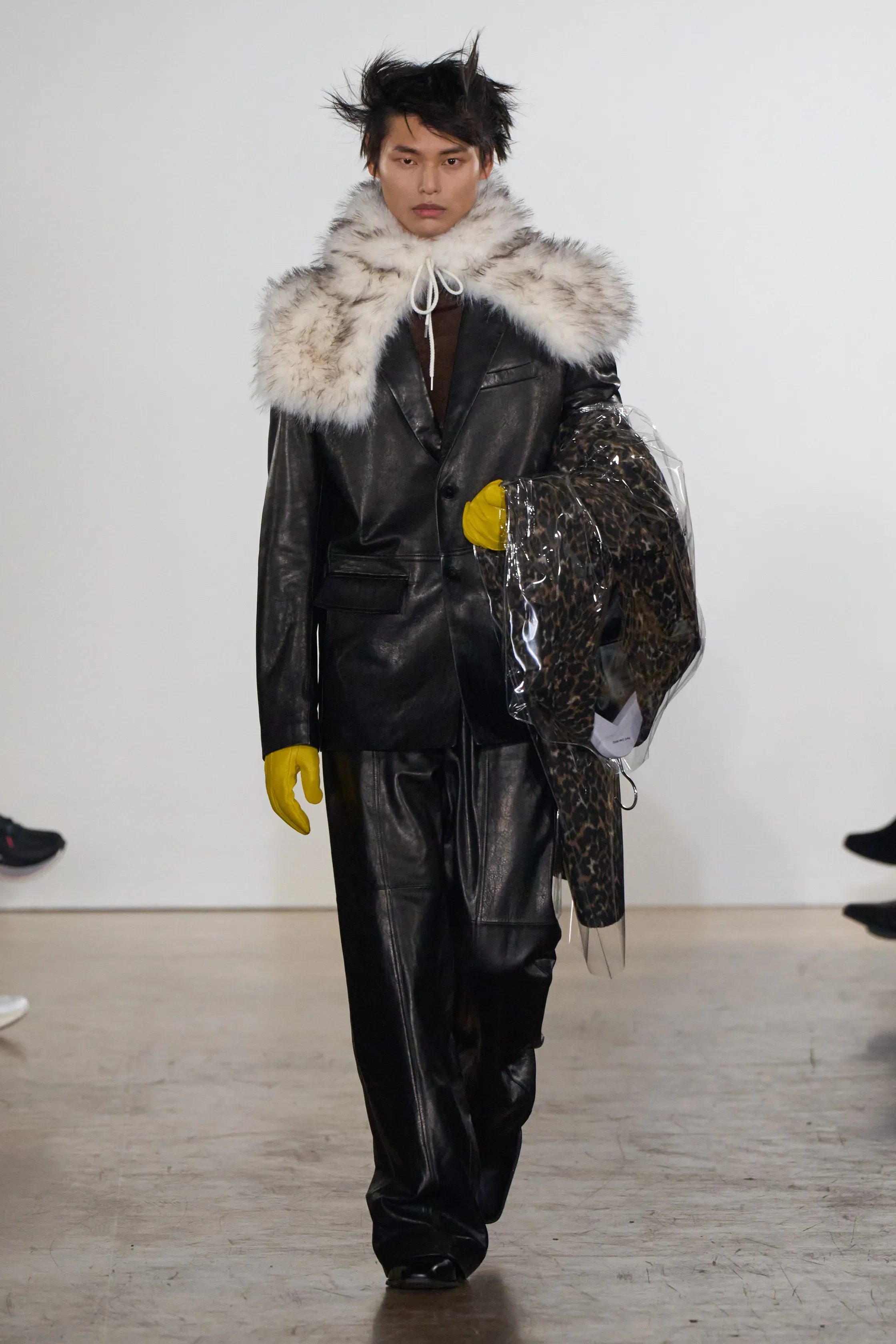
Feng Chen Wang’s Fall/Winter show explored contrast as its central language, built around the idea of balance between opposing forces. From the opening, wind-swept hair and raised collars set the collection in motion, giving the silhouettes a constant sense of direction. Fur trimmed hoods, sleeves and belts appeared throughout, often offset by clear PVC layers and glossy, waxed finishes across jackets and trousers.
Tailoring and prep codes formed a base, disrupted by animal prints, distressed knits and exaggerated layering. Snake, leopard and cheetah patterns clashed deliberately with shirting and ties, while hand-painted denim with oil-slick metallic coatings added another layer of texture. Pops of primary colour appeared mainly through gloves, cutting sharply through the darker palette.
Midway, the pace shifted. A blue-faced Callum Harper marked the transition as the soundtrack moved from classical to drum-and-bass. The arrival of dogs on the runway brought an unexpected softness, bringing the collection into the everyday life.
AMI PARIS
review by MAREK BARTEK
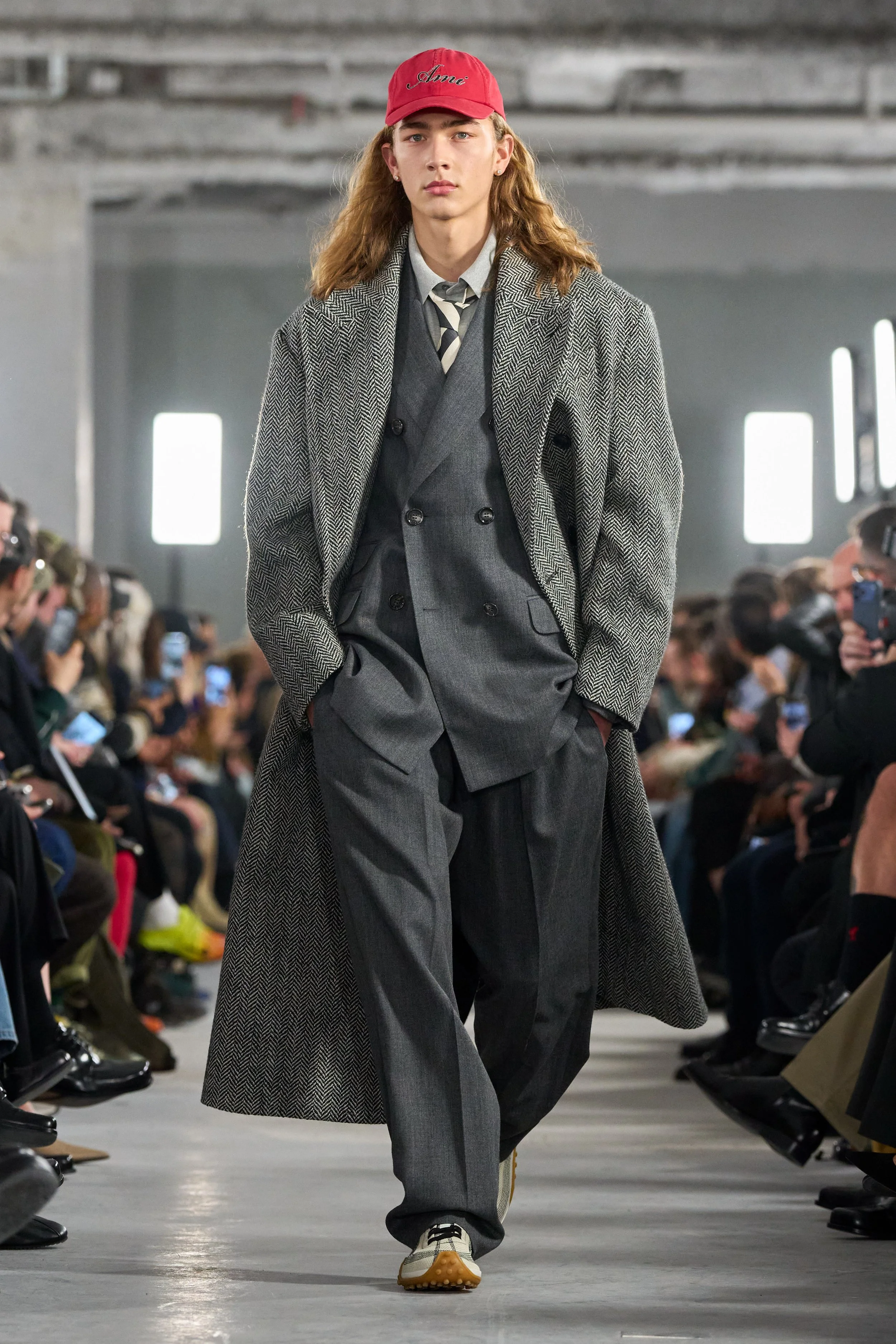
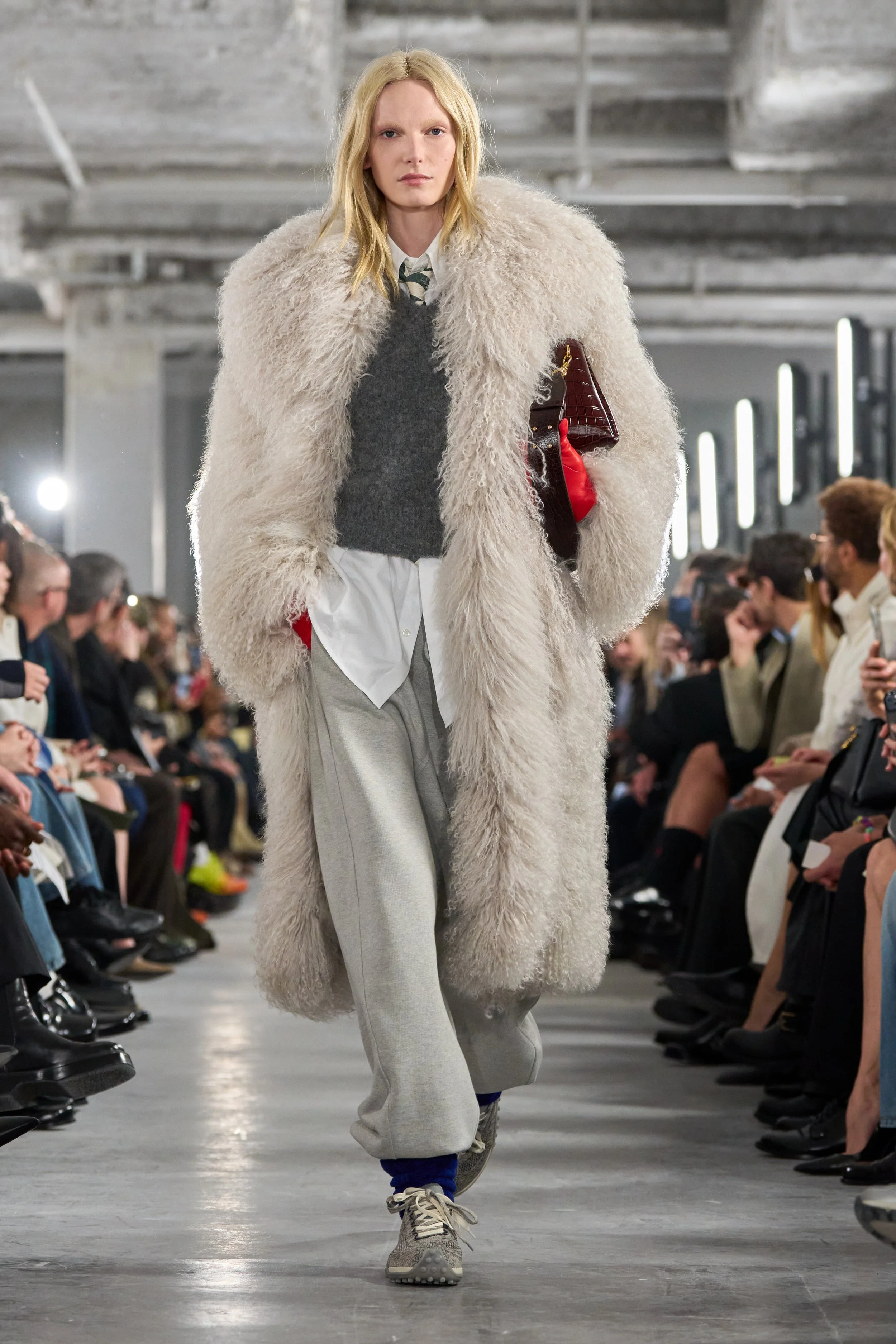
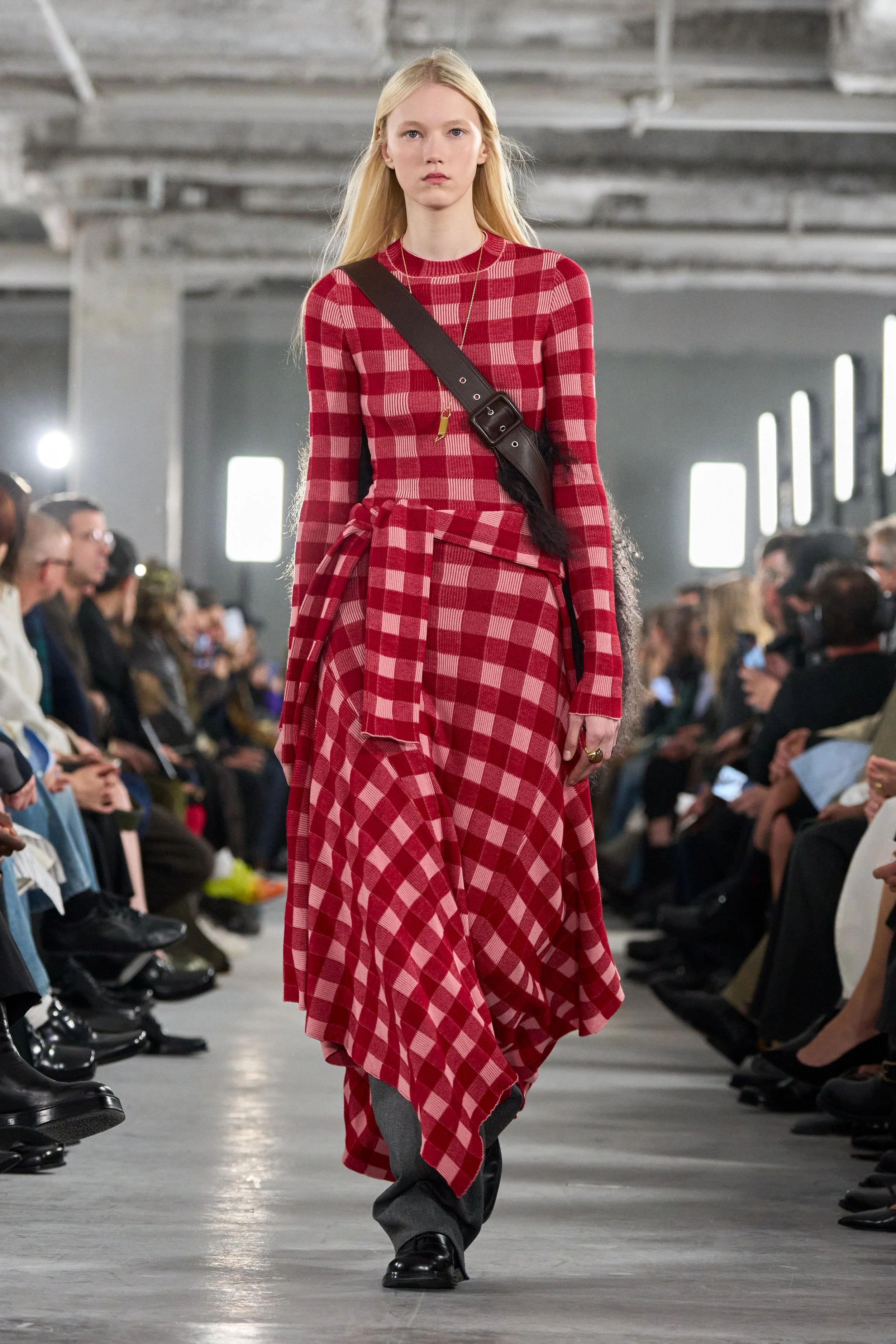
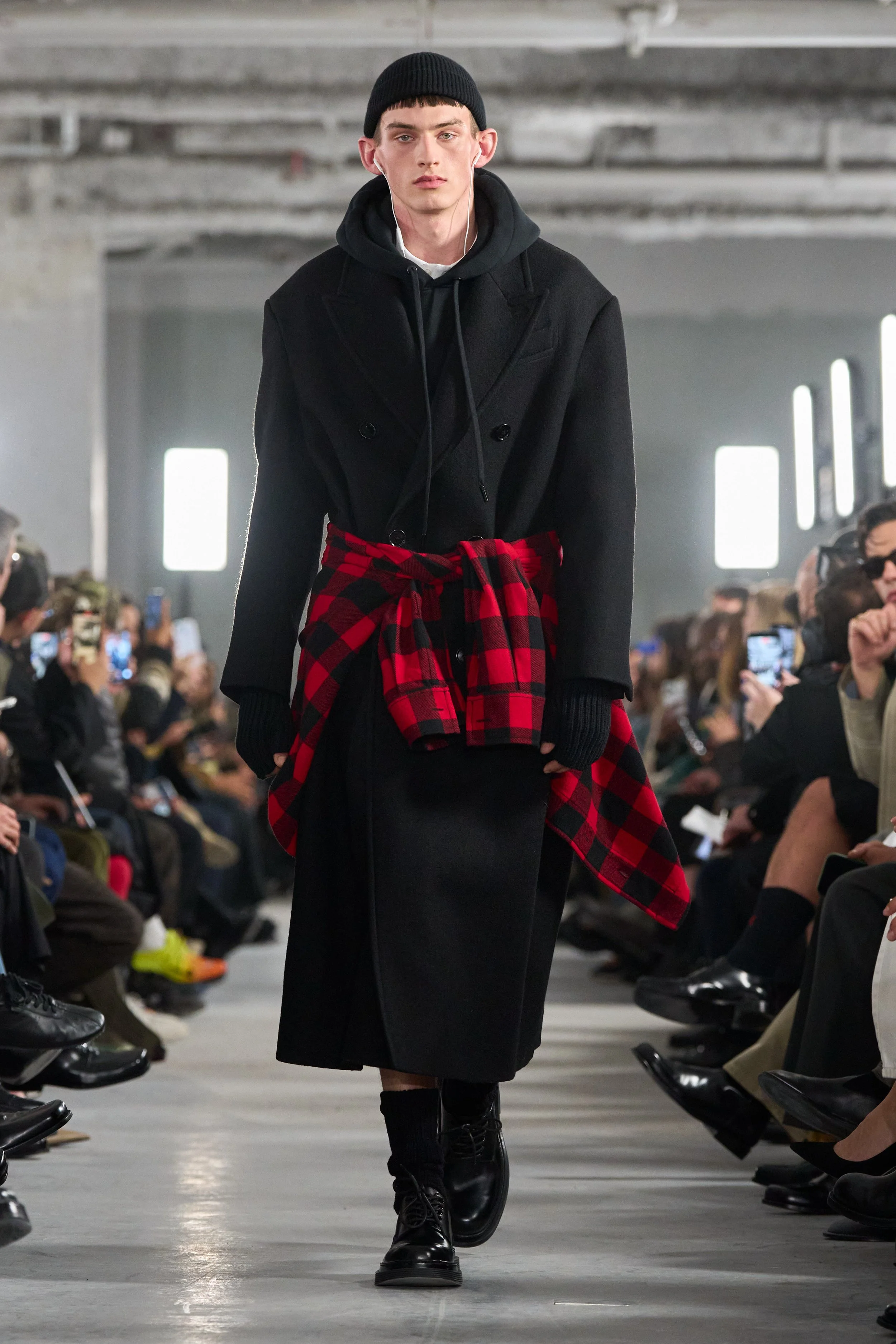
images courtesy of AMI PARIS
Ami Paris’s Fall/Winter 2026 show marked a return to what the house does best: dressing real life. Presented as a reflection on fifteen years of the brand, the collection focused on ease, individuality, and the everyday wardrobes seen across the streets of Paris.
Silhouettes were confident but relaxed with oversized coats, wide trousers, and soft balloon shapes. Cropped jackets and cleaner cuts introduced contrast in the menswear, while womenswear played more with structure, placing volume around the hips while keeping the overall line fluid and wearable. Outerwear remained central, built around durability and familiar proportions rather than statement shapes.
Colour moved between elegant neutrals and brighter accents — sky blue, soft pink, emerald, saffron and red — bringing energy without overpowering the collection. Textured knits, leathers and patterned jerseys added rhythm through checks, stripes and argyle. Truly unmistakably Parisian.