
IN CONVERSATION WITH CAMIEL FORTGENS AND REIN WOLFS
words by VERONICA TLAPANCO SZABÓ
I’ve always had a soft spot for watching clothing come alive before my eyes, from the No. 13 finale by Alexander McQueen, to the Coperni SS23 spray dress, there is something undeniably spellbinding about witnessing creation in real time. It recentres craft and momentarily resists the smooth, numbing efficiency of machinery and Fordist production that so often drains fashion of its pulse. On a Friday evening back in late November, Camiel Fortgens did precisely that, separating the garment from the machine, and then taking it one step further by inviting the public directly into the process.
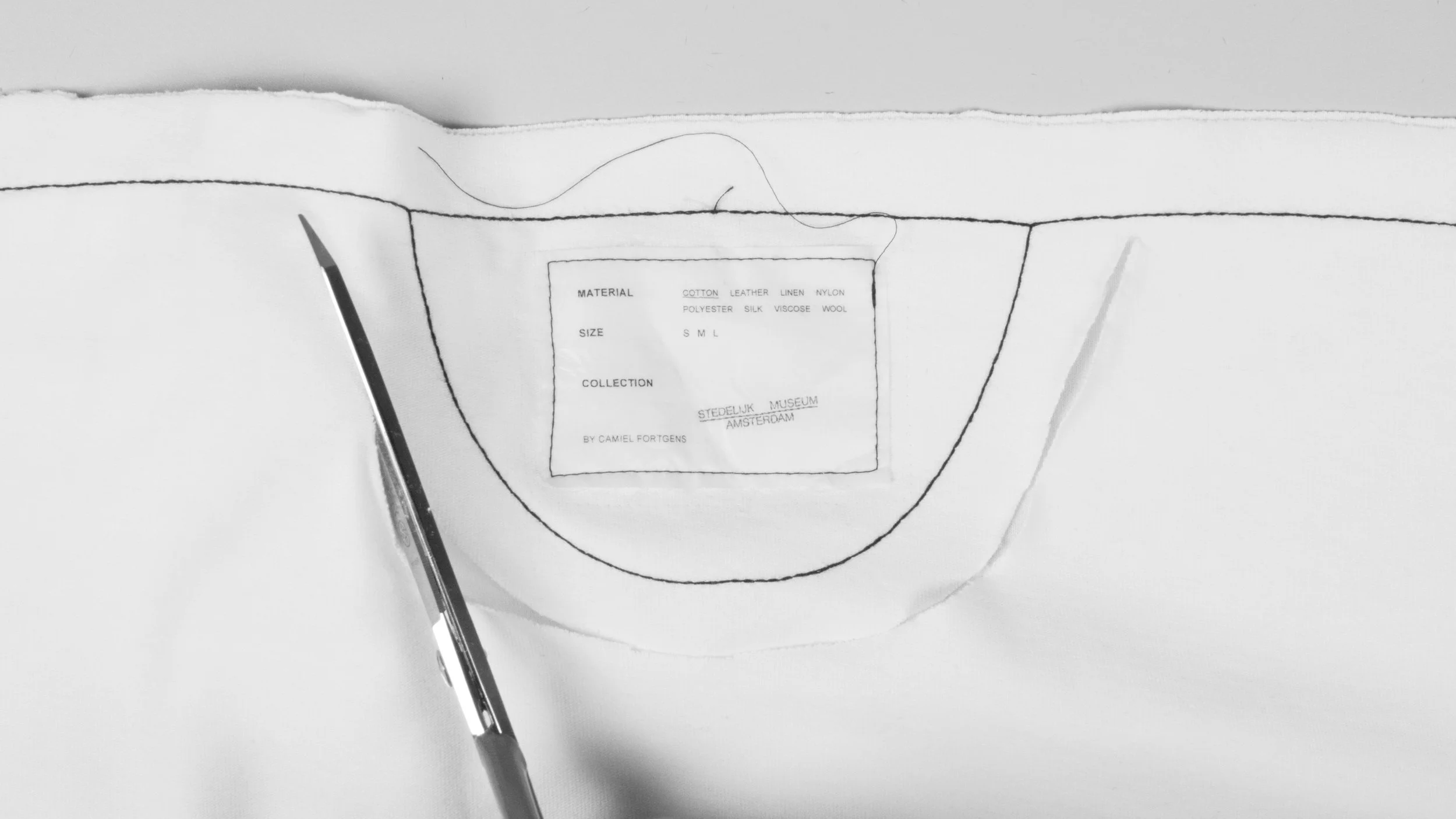
image by BAS FORTGENS
Beloved for his ode to imperfection and his insistence on visible craftsmanship, Fortgens presented the Cut to Wear T-shirt in collaboration with the Stedelijk Museum. For the launch, the museum’s main hall was bathed in the perfect shade of pink (according to me), dotted with handmade T-shirt displays, a DJ booth, and a cutting station. Staying true to Fortgens’ hands-on approach, all signage appeared in his own handwriting, a small gesture that made it all come together. As I wiggled my way to the front of the crowd watching the cutting demonstrations, it seemed like everyone's eyes were locked in on the pair of scissors swaying through the fabric. It was all so very thrilling precisely because of the unpredictability factor, no two outcomes will look alike and we all wanted to give it a go!
More on Camiel Fortgens, and how he arrived here, shortly after graduating from the Design Academy Eindhoven, he founded his eponymous brand in 2014, lending it his own name. Based in Amsterdam, the label explores materials and archetypes drawn from men’s clothing across disparate eras. His approach to staples is deliberately offbeat creating pieces that are instantly recognisable, often, openly revealing their own making.
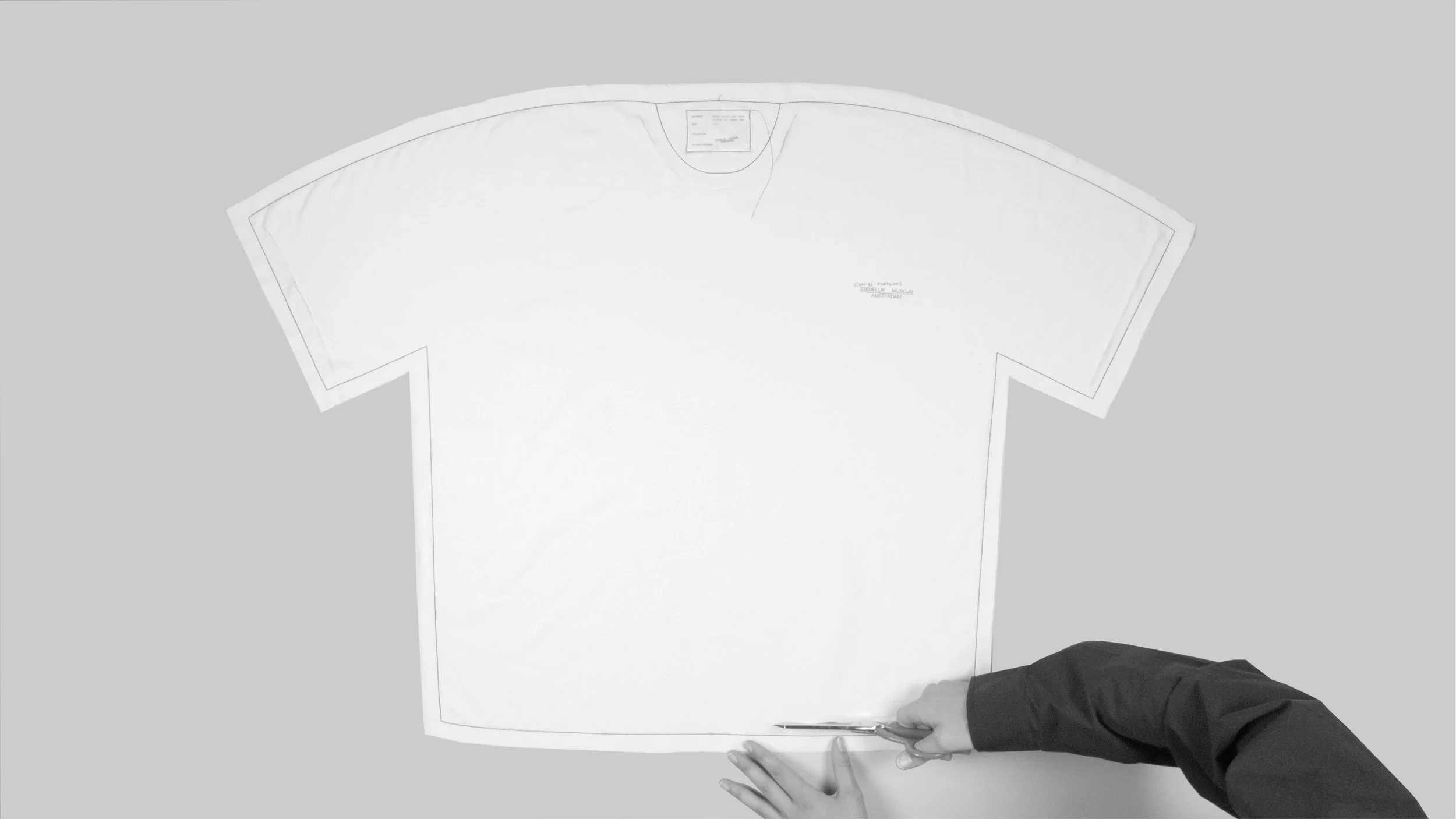
image by BAS FORTGENS
CAMIEL FORTGENS
What first inspired you to make the act of cutting an integral part of this T-shirt’s design?
In the production processes of our brand, I'm always surprised by just how much handwork goes into making each garment. Everything is made by hand, a fact that is often forgotten and goes unnoticed in the finished product, as all garments are made to be symmetrical and perfect. When you compare it to other objects, most things are made by machine and their designs are shaped by the possibilities of industrial production. I think it's crazy that clothing has stayed behind and is one of the last non-industrialised “user” products. This sparked my curiosity and I began to wonder how a garment, for instance, a t-shirt would look if the design followed the processes of the machine?
It also reminded me so much of learning to use scissors in primary school when no one could cut in a straight line haha. Is that rule-bending spirit something you value in your work?
Yes, this is a core value of the brand and of our work. Why are things done the way they are? Why not differently? Let's think about this again. Let's rethink what we know. For us, rethinking perfection is a core theme. Why are, in our case, garments always finished perfectly? Why try to make things perfect by hiding and ruling out imperfection and hiding the handwork behind a piece?
You’re Amsterdam-based, and are now presenting at the Stedelijk. How does it feel to share this project here? And do you remember your first visit to the museum?
It's amazing to be asked to work with the Stedelijk Museum Amsterdam, “The” institute of modern art in the Netherlands. It was the place where I first came in contact with modern art. I saw many mind-stretching pieces and exhibitions and it's an honour to now be able to work with them.
Does being self-taught shape the way you build storytelling into your designs?
It definitely does. I’ve always had to think for myself about how to do things, I wasn’t taught how. That pushed me to search for suitable ways on my own. Even now, this is still how I work, not taking for granted how things are done, but constantly searching for (new) ways.
I read somewhere that your motto is “Imperfection is beauty, madness is genius, and it's better to be absolutely ridiculous than absolutely boring” by Marilyn Monroe. How did you feel when you first encountered this quote?
I’m not sure where that idea originated, but it’s a charming thought. This is the first time I’ve seen the quote attached to me, and I have to admit the unexpectedness of it was quite funny.
As for the quote itself, I don’t fully identify with its message. “Imperfection is beauty” can be true in some cases, but not universally; sometimes imperfection comes simply from difference. “Madness is genius” doesn’t quite resonate with me either, though unconventional thinking can lead to interesting insights. And “it’s better to be absolutely ridiculous than absolutely boring” feels too absolute, it really depends on the situation and context.
Your clothes seem to live best in motion, like in your street shows in the Marais and het Bilderdijkpark, what draws you to runways like these?
I’m drawn to it because I’m looking for a way that truly suits what we do. Rather than sticking to how other people do things, I want to find an approach that works for us. The street or the park makes sense in that way, it’s a real environment, a real surrounding. It’s where garments ultimately end up, on people, in the streets. There is no dream world or façade of a perfect concept. Why not just do it on the street or in a park? Why does it need to be more difficult or more “crazy”?
You’ve cut up this T-shirt many times I imagine but last Friday you did in front of a big crowd, how did that feel?
I’m not usually someone who seeks out big crowds, I’m much more at ease behind the scenes. Having all eyes on me while cutting the T-shirt was definitely a bit intense at first, but once I settled into it, it turned out to be perfectly fine.


images by PIETER NUMAN
REIN WOLFS, DIRECTOR OF STEDELIJK MUSEUM
The Stedelijk has a long history of engaging with contemporary culture, yet fashion remains quite under-explored in museum contexts, what excites you about presenting a project like this?
Fashion is a vital part of contemporary visual culture, and a project like the “Cut to Wear T-shirt” lets us approach it in a way that is both playful and conceptually rich. What excites me is that this T-shirt makes the act of making visible. It reveals how a garment comes into being, invites the wearer to complete it, and reframes something familiar as an experiment. That curiosity about process and form fits very naturally within the conversations the Stedelijk fosters.
How does collaborating with an Amsterdam-based designer like Camiel speak to grounding the museum in local creative communities?
Camiel Fortgens is first of all an international designer who is based in Amsterdam. That reflects the Stedelijk's position as both an international platform grounded in Amsterdam. Collaborating with the fashion label strengthens our ties to the makers around us and highlights the creative energy of the city. It also shows how the museum can be a place where new ideas are developed together with the very ambitious community that surrounds it. Camiel Fortgens and the Stedelijk both resonated within and far beyond the city.
Looking ahead, do you see the Stedelijk expanding further into dialogues with fashion, performance, and other hybrid forms? What possibilities do you imagine?
Yes, very much. The Stedelijk has always welcomed practices that move between disciplines, whether visual art, design, music or performance. Fashion and other hybrid forms open up new ways to reflect on materiality, authorship, and participation. I see possibilities for more collaborations that foreground experimentation, bring different forms of making into dialogue, and invite audiences to engage with the ideas behind the work. These exchanges help us reflect the complexity of culture today and keep the museum open to new perspectives.


The Cut to Wear T-shirt is available on Camiel Fortgens’ webshop and at the Stedelijk Museum shop, which can be visited without a museum ticket although I must say pairing it with a stroll through their exhibitions makes the experience delightfully whole.
