interview by JANA LETONJA
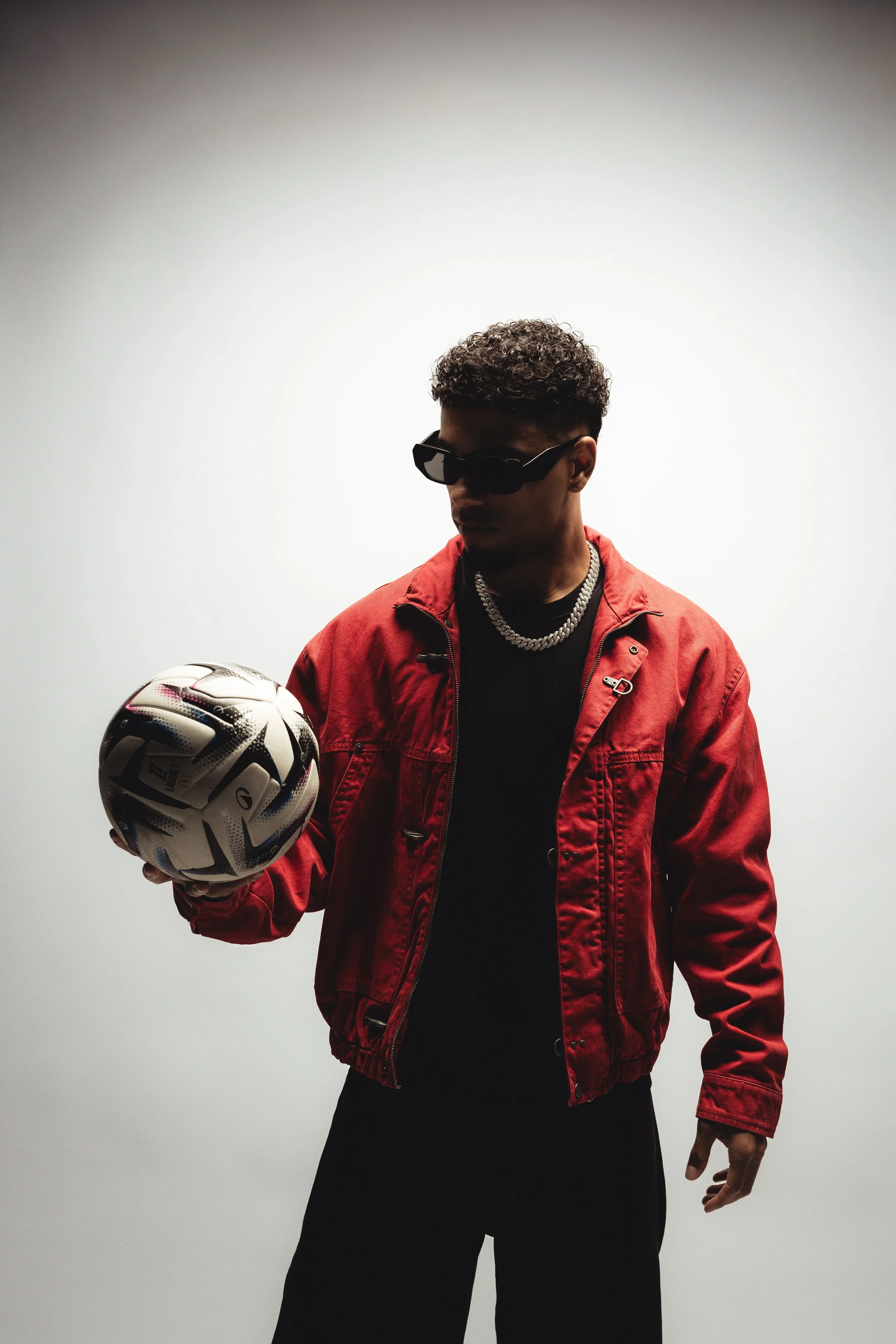
From the football pitch to the recording studio, rising Afrobeats star ELIKIA is proving that following your passion can lead to extraordinary places. Once a promising professional footballer who developed his skills at Ajax’s prestigious academy, ELIKIA made the bold decision to trade his football boots for a microphone. Drawing inspiration from his Congolese, Dutch and Nigerian heritage, he has developed a distinctive sound that has already earned him over 30 million streams, including more than 15 million for his breakout hit Mentality. Now, with his powerful new single Hitman, which delivers an important message about protecting and respecting women, and his highly anticipated debut album First Of A Kind arriving on November 20, ELIKIA is entering an exciting new chapter. Interestingly, his footballing past remains central to his artistry, with the album conceptualised as a starting XI, where every song has its own position on the pitch.
You started your career as a promising footballer at the Ajax academy. What are your strongest memories from that period of your life?
I think what I remember most is the environment I grew up in. Being at Ajax from such a young age, surrounded by some of the most talented players in the country, really shaped who I am today. I grew up playing alongside guys like Jurriën Timber, Quinten Timber, Ryan Gravenberch and Brian Brobbey, and seeing where everyone is now is pretty special.
At the time, we were just young boys chasing the same dream. You don't really realise how special those moments are until you look back at them years later. The traveling, the tournaments, playing against some of the biggest clubs in Europe, those are memories I'll always carry with me.
But more than anything, Ajax taught me what it takes to perform at the highest level. And even though my path eventually changed, that mentality never left me.
Walking away from professional football to pursue music is a huge decision. Was there a particular moment when you realised music was your true calling?
I wouldn't say there was one specific moment. It was more something that grew inside me over time. Football had been my whole life since I was a little kid, so walking away from that wasn't an easy decision at all. But I started realising that music gave me a different kind of happiness. With music, I felt like I could create something completely my own.
I remember thinking to myself, I've spent almost my entire life chasing one dream, so why wouldn't I give myself the chance to chase another? And the funny thing is, when I made that decision, I basically had to start from zero again. Nobody really knew me as an artist. But looking back now, I think that's exactly what makes the journey so beautiful.
Football and music might seem like completely different worlds, but both require discipline, creativity and confidence. What lessons from football have helped you most in the music industry?
Definitely discipline and mentality. In football, you learn very early that talent alone isn't enough. You can be the most talented player on the pitch, but if you're not willing to work harder than everyone else, someone else will eventually take your place.
I think music works exactly the same way. People see the streams, the performances and the exciting moments, but they don't always see the hours in the studio, the sacrifices or the moments when things aren't going your way.
Football also taught me how to deal with pressure and rejection. Not every game is going to be your best game, just like not every song is going to be a hit. The biggest lesson I've taken with me is that you have to believe in yourself before the rest of the world does.
Your music brings together Congolese, Dutch and Nigerian influences. How has growing up with these three cultures shaped your identity, both personally and musically?
I think growing up with different cultures has been one of my biggest blessings. I was born in the Netherlands, but my roots are Congolese and Nigerian, so I've always had different worlds around me. And I think that's something you naturally hear in my music. I'll sing in English, sometimes I'll use Nigerian Pidgin, French or Lingala. I don't really think about it too much when I'm creating. It just comes naturally because all those influences are part of who I am.
What I love is that music allows me to bring those different worlds together. Someone in Lagos might connect with one part of a song, someone in Kinshasa with another, and someone in Amsterdam might feel something completely different. But they're all listening to the same record. I think that's beautiful, and it's something I want to explore even more with my music.
You grew up in a musical family. What kind of music filled your home when you were younger, and which artists had the biggest influence on you?
Music was always around me growing up, and I've always listened to so many different genres. I remember being really inspired watching artists like Chris Brown, Drake, Lil Baby and A Boogie wit da Hoodie in the studio or performing in front of massive crowds. What fascinated me was seeing how something created in such an intimate space could reach millions of people around the world, all singing the same words but connecting with them through their own lives and experiences. That's something I've always found beautiful about music.
My influences are really diverse, from Bruno Mars and Justin Bieber to Congolese gospel, Makossa and artists like Fally Ipupa. And when it comes to Nigerian music, the list is endless. Davido, Wizkid, Burna Boy, Tems, and the newer generation like Victony and Ayra Starr.
I think over the years, I've naturally absorbed a little bit of everything, and all those different sounds and influences have helped me develop a style that feels like my own. I think the mixture is what really shaped my ear for music. I've always loved songs that make you feel something, but also songs that make you want to move. And that's still how I approach my own music today. I don't want to limit myself to one particular sound or style. I love African rhythms, melodies, good energy and music that brings people together. I think all those different influences have helped me develop my own sound rather than trying to sound exactly like somebody else.
Afrobeats has become a global phenomenon in recent years. What do you think makes the genre so special, and where do you see yourself within its evolution?
I think the most beautiful thing about Afrobeats is that you don't necessarily have to understand the language to feel the music. You can play an Afrobeats record anywhere in the world, and people will connect with the rhythm, the melodies and the energy. That's something really powerful. And I think we're only at the beginning of how big African music can become globally. There are so many different sounds and cultures across Africa that the world hasn't fully discovered yet.
For me personally, I want to contribute something different to that movement. My background, my story, the languages I speak and even my connection with football all give me a different perspective. I don't necessarily want to fit into what people expect an Afrobeats artist to be. I want to create my own lane within the genre. That's what being First Of A Kind means to me.
Your new single Hitman has a powerful message behind it, particularly concerning women's safety and respect. What inspired you to address this subject through your music?
With Hitman, I wanted to play with the meaning of the word. Normally, when people hear "hitman", they immediately associate it with violence or something dangerous. But I wanted to turn that idea into something positive. For me, the message behind the song is about protecting women, respecting them and making sure they feel safe.
At the same time, I didn't want to make a song that felt too serious or heavy. I wanted to create something energetic, something people could dance to and enjoy, while still carrying a meaningful message. I think that's one of the beautiful things about music. You can make people dance and think at the same time.
Music has always been a powerful way to start conversations about important social issues. Do you feel that artists have a responsibility to use their platforms to address subjects such as violence against women?
I think as an artist, you have to understand that your voice can reach a lot of people, and with that comes a certain level of responsibility. But I also believe it has to be genuine. I don't think every artist should feel pressured to speak about every social issue. If you're going to address something important, it should come from a real place.
For me, respect is something that should be normal, especially when it comes to how we treat women. And if I can use my music to spread a positive message while still creating something people genuinely enjoy listening to, then I think that's a beautiful combination. At the end of the day, music is about connecting people, and sometimes that connection can go beyond just entertainment.
Your debut album First Of A Kind arrives on November 20. What does the title mean to you, and why did you feel it was the right name for your first full-length project?
First Of A Kind is really a reflection of my journey and who I am as an artist. When I look at my story, from growing up in the Ajax academy and chasing a professional football career to leaving everything behind and starting again in music, I feel like I've taken a pretty unusual path. And I think that's something I want to embrace rather than hide.
I'm not trying to be the next version of another artist. I want people to recognise ELIKIA for his own sound, his own story and his own identity. The album represents that transition. It's almost like introducing myself to the world all over again, but this time through music.
One of the most interesting things about the album is that you've structured it like a football team's starting XI, with every track occupying a different position. How did you develop that concept, and how did you decide which song belonged in each position?
The idea actually came quite naturally because football has always been such a big part of my identity. I was thinking about how I could bring those two worlds together in a way that felt authentic, rather than just using football as a marketing tool. And then I thought, why not build my first album like a football team?
So the album has eleven tracks, just like a starting eleven. And in football, every player has a different role. You need defenders, midfielders, attackers, and everyone contributes something different to the team. I looked at the songs in a similar way. Some records are more energetic and attacking, others are more emotional or laid-back. Each song has its own character and purpose within the project.
And of course, songs like Mentality, Jelele and Untouchable already have strong connections to football through players like Aurélien Tchouaméni, Ansu Fati and Jurriën Timber. So everything came together quite naturally. I love the concept because it brings my past and present together. Football was my first dream, music is my second, and with this album, they're finally playing on the same team.
You've already achieved impressive streaming numbers, but success can mean different things to different artists. What does success look like to you at this stage of your career?
Of course, I'm grateful for the numbers. Having millions of people listen to something you've created is an incredible feeling, especially when you remember where you started. But I try not to let numbers define my success too much.
For me, success is about growth. It's about being able to look back at where I was a year ago and see how far I've come, not just as an artist but also as a person. I also think there's a big difference between people hearing your music and people genuinely connecting with you as an artist. That's something I really want to build. I want people to come to my shows, sing the songs with me and feel like they're part of the journey. And ultimately, I want to build something that lasts. Not just one big song or one successful year, but a career that I can be proud of twenty years from now.
Finally, imagine we're having this conversation again in five years. What would you love to have achieved by then, and what do you hope people will associate with the name ELIKIA?
That's a good question, because I actually think about this quite a lot.
In five years, I would love to be performing on some of the biggest stages in the world. Selling out a venue like the O2 Arena in London would be a dream, and performing at the 2030 World Cup would be a full-circle moment for me, especially with my football background.
But beyond the big stages and achievements, I want to have built something meaningful. I want ELIKIA to represent more than just music. I want people to associate the name with ambition, positivity, different cultures coming together and, most importantly, believing in yourself. Because if there's one thing my journey has taught me, it's that your life doesn't always go the way you originally planned.
I spent most of my childhood dreaming of becoming a professional footballer, and now I'm chasing a completely different dream. And who knows where that dream might take me? If my story can inspire even one kid to believe that it's never too late to start something new, that would already mean a lot to me.