
IN CONVERSATION WITH LILLY KRUG
interview by JANA LETONJA
Actress Lilly Krug is entering a defining chapter in her career. Already known to audiences for Shattered and Plane, she’s now taking on one of her most ambitious roles yet in the psychological sci-fi thriller April X, opposite Connor Storrie. The film sees her move between 10 different persona, a demanding performance that puts transformation, identity and perception at the centre of the story. With April X arriving in US theaters on October 2, Lilly is also building an increasingly international slate. She is currently filming Wicked Deal, from the team behind Maxton Hall, with the Scorpions musical biopic Wind of Change and the upcoming thriller Speak Up, alongside Martin Freeman, also on the horizon.

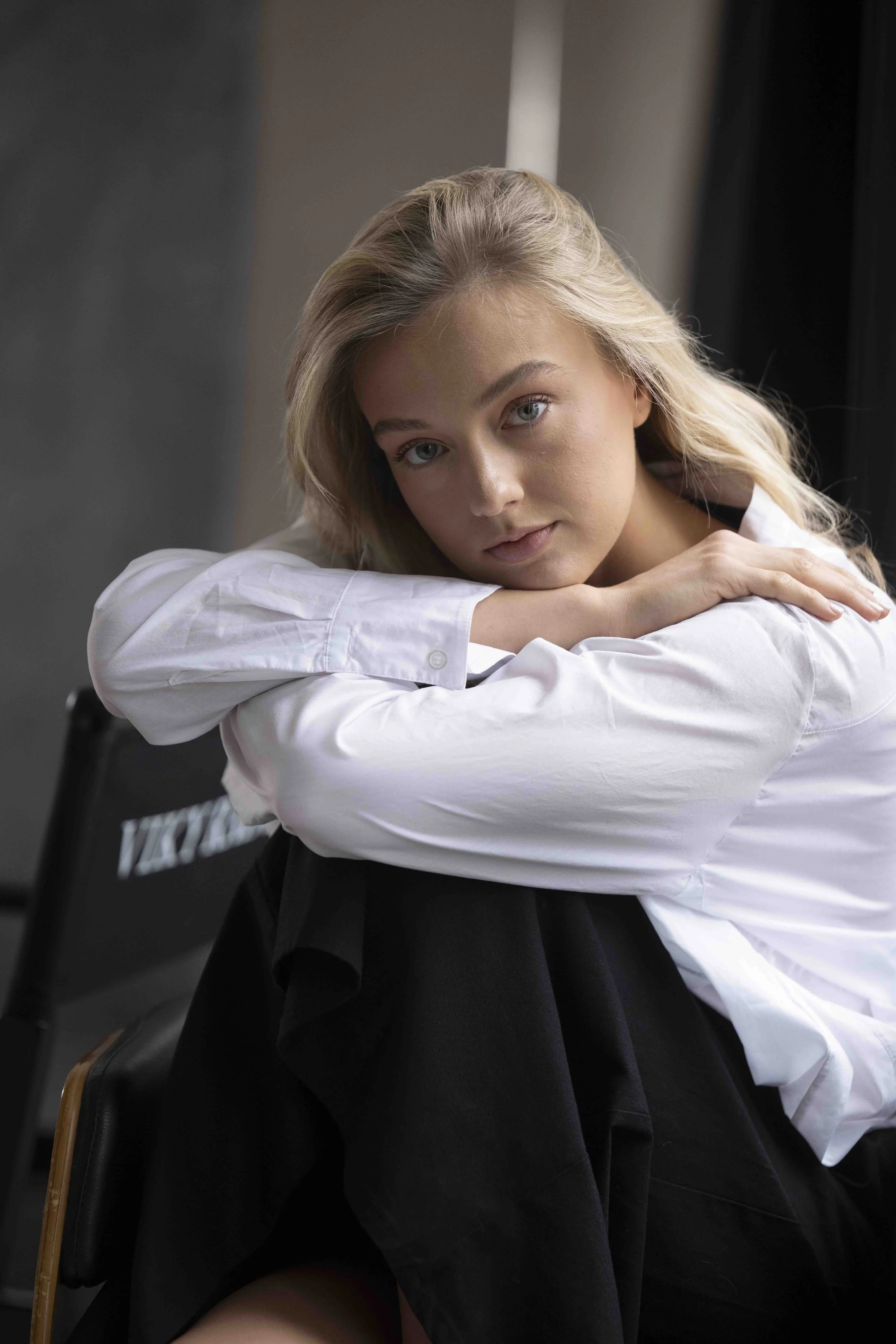
all photography by PIETER MÜLLER
April X asks you to inhabit 10 different personas. When you first read the script, what was your reaction? Excitement, intimidation, or a mixture of both?
When I first read the script, I was so struck by the concept and by how relevant it feels right now. With the advances we’re seeing in technology, I think it’s increasingly important to ask what actually makes us human. Can you ever truly replicate or clone a person? And if you try, what are the consequences? The film also raises questions about what happens when women are placed at the mercy of the male gaze, about autonomy, identity and the ways we project our desires onto other people. What I loved is that it doesn’t give you simple answers. The questions almost change depending on when you watch the film or who you discuss it with, and to me that’s always a sign of something interesting. At the center of all of it is also this idea of how incredibly strong and, at the same time, fragile human connection can be. That really stayed with me. And then, from an acting perspective, the excitement very quickly came with some intimidation. I realized how precise the ten personas would have to be. They couldn’t simply feel like different moods or cosmetic variations of the same person. Each one had to feel fully alive and specific, while still originating from April. That challenge was exactly what made me want to do it. I love roles that scare me a little because they usually force me to discover something new in my process.
How did you go about making each persona feel like a genuinely different person rather than simply a variation of the same character?
For each persona, I decided to focus on one particular aspect of April. What makes April feel alive to me is the range we all carry within: joy, doubt, fear, humor, confidence, vulnerability. We’re constantly shifting between those parts of ourselves. With each of April’s clones, I isolated one of those facets and made it the dominant part of her personality. So rather than thinking of them as completely unrelated characters, I thought of them as different pieces of the same human being, each one amplified and allowed to exist almost on its own. From there, I gave each persona her own internal logic and became very specific about physicality, rhythm, voice, eye contact, and the way she occupied space. But I never wanted those differences to feel like impressions or costumes. Each clone had to believe completely in her own reality.
I think that became one of the ideas I found most interesting in the film. We all contain all of these contradictions within us. The danger is almost in becoming trapped in only one facet of yourself. Part of what makes us human is that we’re never just one thing, we’re changing constantly, sometimes hundreds of times within a single day.
Which of the 10 personas was the hardest for you to find, and which came most naturally?
The main distinction for me was really between April and X. April came much more naturally to me because she’s so full of life, you feel her wit, her intelligence, her curiosity, and how brave she is. She has a very strong internal compass and moves through the world with a lot of conviction.
X was much harder to find because there was almost nothing familiar to hold onto. She hasn’t had a life, memories or relationships to ground her being, so I couldn’t approach her psychologically in the same way I normally would a character. She almost feels like a dangerous animal and a baby at the same time, completely raw, innocent in certain moments, but also eerie and absolutely unpredictable. You never quite know what she’s going to do next.
With X, I had to strip away a lot of the things we normally rely on when building a character and work much more instinctively and physically. That was probably the biggest challenge, but also one of the most fascinating parts of playing her.
April X mixes science fiction with psychological thriller elements and sexuality. What was it about that combination, and the questions the film raises about identity, that interested you?
What interested me most was that none of those elements exist in isolation. The science fiction, the psychological tension and the sexuality all become different ways of asking the same question: who are we when the identities, expectations and circumstances that have shaped us begin to change?
I loved that April X uses genre to explore something deeply human. There are questions around desire, autonomy, intimacy and how much of our identity is truly our own versus something that has been shaped by the world around us. April is constantly testing those boundaries and trying to understand what feels authentic to her. There’s something very liberating about a character who is willing to question the framework she’s been handed and build her own sense of self instead. And underneath all of it is this idea that something as complex as human consciousness cannot simply be replicated. There is something so fragile and, at the same time, extraordinarily resilient about being human. I think that contradiction fascinated me most.
That combination made the film feel very modern to me. It’s really about something universal, the desire to understand who you are and the courage to live in alignment with that.
Audiences may know you from films like Shattered and Plane. What do you think April X reveals about you as a performer that viewers haven’t had the chance to see before?
I think April X gave me the opportunity to show a completely new side of myself as a performer. In films like Shattered and Plane, the circumstances are very heightened and there’s a certain external intensity driving the characters. With April X, so much of the work came from within.
What I loved about April is that she’s witty, bold, and completely unapologetic about who she is. She doesn’t really adhere to the standards society puts on her, she follows her own rules, and she does that with real confidence and conviction. I finally got to explore a more edgy side of myself through a character guided strongly by her heart and her own sense of right and wrong. At the same time, she carries a lot of vulnerability. April loves fiercely, she’s innovative, instinctive, and has such a distinct sense of style and identity. She’s constantly trying to understand the world around her while also confronting herself, and that required a kind of openness and stillness that I hadn’t really been able to explore on screen in the same way before.
You’re currently filming Wicked Deal, from the team behind the hugely successful Maxton Hall. What drew you to that project and your character?
What drew me to Wicked Deal was its addictive, heightened world, while the characters still feel emotionally grounded. It also came with this incredible physical challenge of learning ballet, contemporary dance, and pointe work, which I hadn’t done since I was a child. Every role brings its own challenge, and one of my favorite parts of acting is diving deeply into a skill or world I probably wouldn't otherwise have the chance to explore to that extent.
With my character specifically, I loved that she isn’t immediately easy to read. There’s a confidence and strength to her, but also vulnerabilities and contradictions underneath that, and those are always the characters I’m most interested in playing.
Dance has also completely changed how I approach the character, because so much of who she is comes through how she carries herself before she even says anything. And there’s something incredibly euphoric about starting your day dancing.
It’s actually made me think that actors who play couples should take a dance class together. You have to learn to play off one another, find the same rhythm, surrender a little control and trust the other person, all of which translates so beautifully into a relationship on screen.
And having the series set within a ballet academy gives the whole show such a beautiful visual world. The discipline, elegance and intensity of ballet become part of the atmosphere of the story itself, rather than simply being a backdrop.
You’re also part of Wind of Change, which tells the story surrounding one of Germany’s most internationally recognizable songs. What did the project teach you about the cultural moment that produced the Scorpions’ anthem?
I grew up with the music of the Scorpions, but I learned a lot about their cultural impact and political influence. What really struck me was how much hope existed in that moment, but also how fragile everything still was. Working on the project made me understand the song less as simply this huge rock anthem and more as a kind of emotional time capsule. It captured this very particular optimism, the belief that borders could disappear, that people who had been divided could reconnect, and that culture and music could sometimes cross barriers before politics did.
You’ll also be working alongside Martin Freeman in Dakota Gorman’s thriller Speak Up. What can you tell us about that project and what attracted you to it?
What really attracted me to Speak Up is that it works as a psychological thriller, but underneath it’s a story about voice. My character wakes up after a terrible accident unable to properly speak, with only fragments of the night coming back to her. So much of her journey has to exist without verbal language, so as an actor, it’s an unusual challenge because you’re relying on behavior, breath, physicality, the eyes, all of those things we normally get to support with dialogue.
And there’s a deep tension throughout the film, so getting to explore that opposite someone like Martin is obviously incredibly exciting.
You’re building a career that doesn’t require choosing between Germany and Hollywood. Is working across both markets something you’ve always envisioned for yourself?
Yes, very much so. I’ve never really thought of it as choosing one over the other. Germany is home and has shaped so much of who I am, but I’ve also always been drawn to international storytelling and to working with people from completely different creative backgrounds.
What excites me most is being able to move between those worlds rather than belong exclusively to one. Each has its own rhythm and sensibility, and I learn something different from working in both.
There’s also something very freeing about not defining your career by one industry, one language, or one place. For me, the goal has always been to follow the work and the stories that genuinely excite me, wherever they happen to be. If I can keep building a career that allows me to do that across both Germany and the US, and hopefully beyond, that feels much more interesting to me than having to choose.
What have you learned about navigating the industry, and about yourself, since your earliest international roles
One thing I love most about my job is that I never stop learning about myself, about people, about the world, and I get to feed that childlike curiosity on a daily basis. Every project drops you into a completely different environment, culture, group of people, and way of working.
Over time, I’ve learned a lot about how I want to move through those spaces, what my boundaries are, who I want to be, and how important it is to develop a strong sense of self. I’ve learned to separate myself from those outcomes more and focus my energy on what I can control: the work, being prepared, staying curious, and being someone people want to collaborate with.
Working internationally has also made me much more adaptable. You’re constantly finding your footing again in new places, with new people and new ways of working, and I think that has made me more independent, more open, and much less afraid of uncertainty. And I think the biggest thing I’ve realized is that what you need most as an artist is courage. Courage to change, to take risks, to do the uncomfortable thing, to trust your intuition and to keep stepping into the unknown. There’s something really beautiful about being able to look back and see that evolution happening project by project.
At this stage in your career, what kind of role still feels slightly out of reach in a way that makes you determined to play it?
I’d love the opportunity to play a historical figure and immerse myself in another time, with the responsibility of understanding someone who actually lived. I’d also love to do something truly action-driven, where the physical transformation and preparation become another way into the character.
I’m very drawn to ambitious, cinematic storytelling in general, the kind of large-scale films and series that still feel incredibly character-driven. I don’t think I ever want to reach a point where I feel completely comfortable. I like having something ahead of me that excites me and lets me explore something completely new.
When you are not on set filming, what keeps you busy and recharged?
I read a lot, write, play the piano, spend time with the people I love, and I’m always curious about something new, whether that’s a place, a subject, a book, a class, or just a conversation that sends me down a rabbit hole. I do all the things that can sometimes fall away when you’re filming.
Movement is also a huge part of how I reset. I love dancing, working out, being outdoors and anything that gets me out of my head and back into my body. I think that curiosity is probably the thread through everything for me. Even when I’m not working, I’m usually learning something, noticing something or collecting little pieces of life that somehow make their way back into the work later.
