
IN CONVERSATION WITH MAR GONZALEZ FERNANDEZ
Behind the beauty of any Cirque du Soleil show lies the world of craft, passion, and relentless organisation. With more than a hundred costumes and thousands of pieces travelling from city to city, the Wardrobe department becomes the invisible engine that keeps the show alive night after night. We speak with Mar Gonzalez Fernandez, Head of Wardrobe for KURIOS, about managing costume on a global scale — from the logistics and labour behind the scenes to the artistry that brings each character to life on stage.
all images courtesy of CIRQUE DU SOLEIL
The show features more than a hundred costumes. How do you manage the logistics of wardrobe on such a large scale?
We have a large Wardrobe department that takes care of the 8,000 pieces we travel with. We have nine positions dedicated to costumes, shoes, wigs, hats, props, and make-up. Someone from the team is in the wardrobe as early as 8am to iron and repair costumes, and to paint and glue shoes; some colleagues stay until midnight to help artists during each performance and to wash the costumes afterwards. We run a tight operation: we need to be organised, communicate well with each other, and remain flexible while always putting the show and the artists’ needs first.
Could you tell us about what it takes to run this department? What does it consist of day-to-day?
There is never a boring day here, and hardly two days are the same. We might have fittings, rehearsals, PR requests, the integration of new artists or new technicians, or be preparing to move to another city — or getting all the costumes ready ahead of a premiere. It takes a lot of effort to run the Wardrobe department and to remain consistent, even when changing continents or feeling tired.
You’re constantly on the move: how do you go about finding people in each city, training them if needed, while already planning ahead for the next one?
I feel like I am always working in the future, thinking about the next city or the next artist arriving, so I must plan well ahead. When it comes to finding skilled Wardrobe staff in each city, we rely on recommendations or local agencies to help us find the right candidates.
How do you view the current costuming landscape in theatre, and where do you see it evolving?
It is hard to predict where the industry is heading, but there are several trends I am interested in following: the use of electronics and new technologies applied to costume design, as well as new fabrics and materials that offer exciting construction possibilities. There are also crossovers with fashion designers and artists that bring fresh perspectives. Minimalism and maximalism are both present, and of course there is the artisanal, highly detailed work of companies like ours, which allows us to create beautiful characters that truly make you dream.
What do you find to be the most rewarding part of the job?
The most rewarding part is probably watching the show, seeing how beautiful it looks, and hearing the laughter and applause of the audience. Personally, I love working with costumes and fabrics, and being surrounded by like-minded people is incredibly rewarding.
Do you have a favourite outfit from the show — one that was especially memorable, or perhaps a story connected to it?
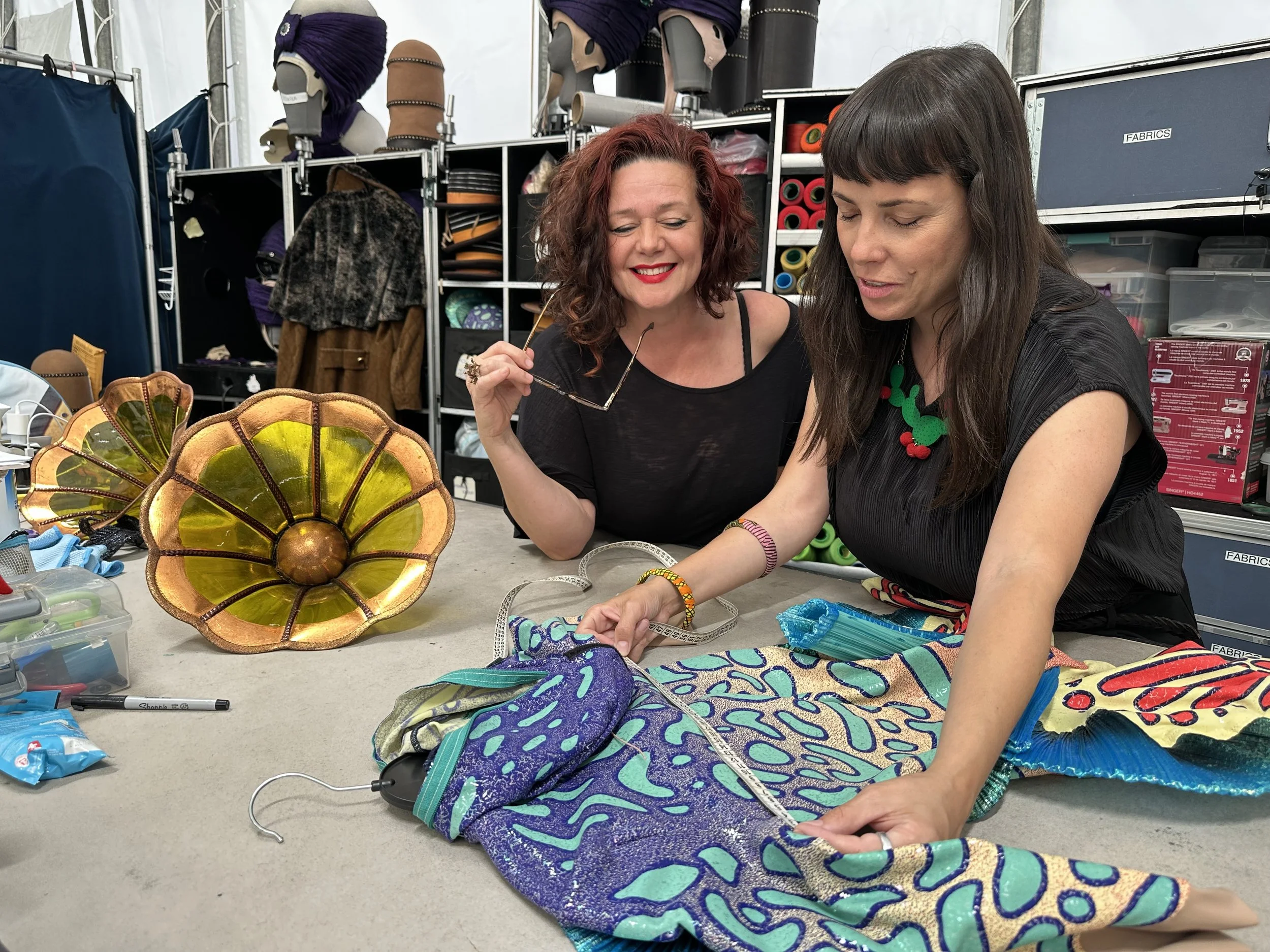
I love the Acronet costumes because of how fun and vibrant they are; they perfectly match the mood of the act and the personalities of the performers. Each costume is custom-made for every artist, after the fabric is printed, sublimated, pleated, and processed to add shine. The Accordion Man costume is also a feat of design and construction: it takes hundreds of hours of work and must be finished by hand, working inside it with a small torch. But when it moves on stage like an oversized accordion, it is all worth it.
The pieces incorporate futuristic, retro, and even turn-of-the-century aesthetics — how were these directions decided?
Philippe Guillotel is the Costume Designer for KURIOS, and he worked closely with Director Michel Laprise to create the steampunk aesthetic and a colour palette evoking Paris around 1900. Guillotel is unique in his ability to create characters that are both fantastic and exquisite, using materials and colours in unexpected combinations, with an incredible sense of elegance and proportion.
The fabrics are particularly distinctive, could you tell us more about the choice of materials?
There is a vast range of materials used in KURIOS. We use stretch-rich fabrics for acrobatic acts that require a wide range of movement, as well as durable, hard-wearing textiles that can withstand daily washing. More opulent fabrics such as velvets, silks, and faux furs help evoke turn-of-the-century fashion. For props, artisans in Montreal use foams, resin, and fibreglass to achieve sturdier construction and a more three-dimensional effect.
In what ways do the costumes reflect and reinforce the overall concept of the show?
In my opinion, costumes, hair, and make-up are central to creating the atmosphere of the show, working alongside the Props and Lighting departments, and helping the artists fully step into their characters.