
IN CONVERSATION WITH MICHAEL TRUCCO
interview by JANA LETONJA
For more than two decades, Michael Trucco has built one of Hollywood’s most quietly impressive careers. Equally at home in science fiction, horror, comedy and network drama, he’s become the kind of actor audiences instantly recognize, even if they don’t always realize just how many iconic series he’s been part of. From Battlestar Galactica and The Fall of the House of Usher to The Rookie, Fire Country and Citadel, Michael has consistently brought depth and authenticity to every role. Now, with a slate that includes season two of Average Joe, which premiered on 19th August, Amazon’s highly anticipated Carrie, Netflix’s Poser and the return of Stick, he’s busier than ever. We caught up with Michael to discuss longevity, versatility, and what it takes to build a career that’s constantly evolving.
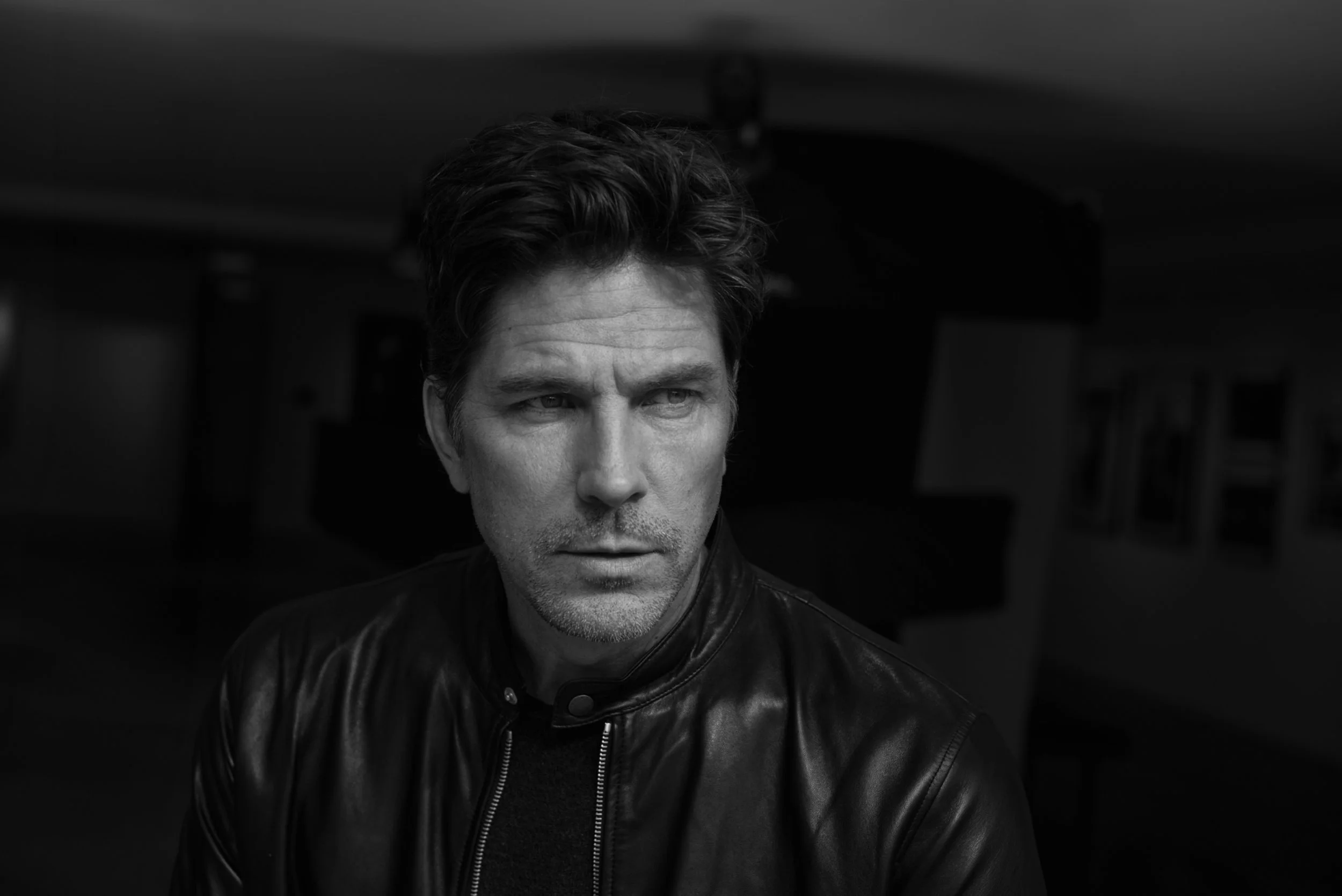
all photography by MANFRED BAUMANN
Average Joe just returned for a second season. What can audiences expect this time around, and what continues to excite you about the series?
In season 2, the audience can expect the dynamics on every level to be raised. The action is bigger, the location is vastly bigger and broader, the relationships intensify, and the stakes are higher. Whereas in season 1, the driving force was the quest for the money, to make a better life for ourselves and our families, the struggle for the survival of Joe's family is the motivation in season 2. It becomes less about the money and more about the blood that binds us.
What continues to excite me most about Average Joe moving forward is the unpredictability. The way the show vacillates between breathtaking action, heartfelt and sometimes gut-wrenching emotion, and laughout loud humor is really the show's super power. You never know where the roller coaster is taking you.
You’ve also joined the cast of Amazon’s Carrie, one of Stephen King’s most iconic stories. What drew you to this new adaptation?
Quite simply, it was Mike Flanagan that drew me to Carrie. It was a no brainer. Mike called me while I was still in South Africa finishing up the shoot on Average Joe and asked me if I'd be interested in joining him on Carrie, and told me a little about the concept of the series, and his vision for the narrative, and the character of John Hargensen, and I was like "Mike, you had me at Hello. Yes, I'm in! I'd love to be a part of this!" And fortunately, the timing worked out and as soon as I wrapped on Joe Average, I was heading up to Vancouver and prepping for Carrie.
You’ve worked on projects ranging from Battlestar Galactica to The Rookie and Fire Country. How do you approach stepping into such different worlds as an actor?
The variation and range of the projects I've worked on and the characters I've played is what brings me the most gratification. It's my drug. I love discovering little nuances to try and differentiate the various characters I'm being entrusted to bring to life. I approach every character in the same way. I start from the beginning, I build them from the ground up. I try and create the world in which the character was raised and the atmosphere in which they grew up. We, as human beings, are all a product of our childhood experiences. For better or for worse. It makes us who we are. So, I try and do the same for these fictitious characters that I'm going to inhabit for the duration of the project. I make up a world rich with details that only I know and give reasons and meaning for the behaviors of the character as supported by the script. It's really quite tedious and boring probably, but it helps me lock in and find the emotional foundation and specific point of view of each individual part that I play.
You’ve collaborated with Mike Flanagan on multiple projects. What makes him such a unique filmmaker and creative partner?
The man does not sleep. Well, I suppose he does, but even in his sleep he continues to create and wonder and perfect and orchestrate. He's an artist in the truest definition of the word. He writes, he directs, he edits, he produces, and yes, he acts. You can catch Mike making little cameos in almost all of his projects. He has great command over the project and on set, but without ever failing to collaborate with his cast and crew and all departments. His mandate on set is that everyone is prepared and totally focused on the work that day. That doesn't mean he expects perfection right out the gates on take 1. There is always room for exploration and discovery. He encourages the creative process. But he does expect everyone who's there to be present and share his enthusiasm for the work. And quite frankly, it's hard not to get excited about the work. Mike has a way of including everyone on set in the process. He makes sure everyone knows where we are in the story that we are telling and what this particular scene we're about to shoot is all about. It's infectious. It's encouraging. And it's why I hope to continue to get to work with him for many more years to come.
Horror has become a significant part of your career through projects like Midnight Mass, The Fall of the House of Usher and Hush. What is it about the genre that keeps drawing you back?
I think the thread that ties all the projects that you just mentioned together is obviously Mike Flanagan. As I mentioned before, collaborating with Mike is a major factor in deciding which projects I am drawn to, and it just so happens that Flanagan's forté is in the horror genre. So by default, I've found myself with an increasing resumé in horror. And honestly, I quite like it. Good horror is always, at it most elemental level, a story about the human condition, our most basic fears, and about loss and even sometimes love. At least in the hands of Mike Flanagan it feels that way.
You’ve worked across traditional network television and today’s streaming platforms. How have you seen the industry change over the course of your career?
This is a tough question to reduce down to a single answer, and it's one that I contemplate a lot lately. I've been doing this for almost three decades now and I have seen monumental shifts in the landscape of entertainment, particularly in the world of television and how it's produced and, more importantly, how it's consumed.
When I first started in this industry, there were only 4 major television networks. There were a few premium cable options like HBO and Showtime and some smaller cable channels burgeoning, but by large, it was the big four public TV networks that drove the machine. As an actor, if you were lucky enough to land even a small role on a network television series or movie of the week or whatnot, it was a big deal. Nowadays, you can throw a rock in Hollywood in any random direction and chances are you'll hit someone who's on a TV show. There are literally thousands of TV programs across dozens, if not almost hundreds, of platforms and outlets. There is an explosion of content and narrative and a staggeringly insatiable appetite to consume more and more of it. But it is in my humble opinion, that we've lost some of the luster and mystic and magic that television used to have. We've oversaturated the markets. Quite simply, there's too much noise out there. It is truly a wonder to me how anything can rise above the din and garner one's attention against all the multitudes of other options all vying for our attention. How does one show stand out and become a massive hit in today's society while so many others are barely perceptible on the scale?
Show business has become a lot more 'business' and a lot less 'show'. And I understand the economics behind it all and the factors that drive the 'creative' decisions at the studio and network levels. I do. I realize we all have to evolve with the market and at the end of the day, this is a business, and businesses have to be profitable to stay alive. But it has created a frenzied, insatiable monster of a market driven by formulas and algorithms and 'feeds' and it all feels a bit chaotic. But like I said, I think about this a lot, and in the midst of it all, I still love this business and consider myself blessed and beyond lucky to still get to be a part of it all. I wouldn't change that for anything. Gratitude is my attitude.
You’ve built a career through consistency rather than chasing headlines. Has longevity always mattered more to you than overnight success?
This is a great question. I don't think I really had a choice in the matter in the days when I was just starting out. Mine has always been a career of starting at the bottom and taking up every wrung of the ladder one at a time. I did not have an epiphany moment where I was discovered and instantly became an overnight celebrity, thrust into stardom and thrown into the highest level of the game. Much less sensationally, I just chipped away at the massive boulder of this business and pounded the pavement looking for representation and auditions and non-union theater castings and background work and acting classes and the whole lot of it. It's not very glamorous and perhaps doesn't make for good headlines, but as you noted, I've never really been about that anyway. I'm living my dream, I'm a working actor. And it feels indescribably good when someone comes up to me and recognizes me for something they've seen me in, and maybe asks for a selfie or just to say hello. Any entertainer who says that's a nuisance or is genuinely bothered by that is either lying, or not suited for this business. We all seek validation. This much I know. And I appreciate the people who take the time to say something because they were affected by something that I had a hand in creating. It means the world to me. Longevity is definitely the name of the game for me.
Looking back, is there a role that challenged you in ways audiences might not realize?
Each new role aways presents its own set of challenges, no matter how straightforward the character appears at first glance. The biggest challenge for me personally is not getting lazy and just phoning in what may appear to be a small role or secondary character. To paraphrase the famous quote, "There are no small roles, etc.". It is my responsibility to bring life to each and every role I take. But if I was to single out one character that challenged me in ways that audiences might not realize, I would probably say playing Touch in Average Joe. This is largely a dark comedy that has some real laughs and levity among the heavier moments and intense action sequences. And Touch has a real dark past and emotional depravity. So threading that needle to find the humorous side and the action-hero side all while never losing the torment that he feels inside was quite challenging indeed.
You’ve shared scenes with an incredible range of actors throughout your career. Is there someone you’ve worked with who particularly influenced you?
I've been very fortunate to be on a lot of sets with some real powerhouse talent over the years. Each experience different and no less educational than the last. But the name that immediately popped into my mind when I heard this question is Kurtwood Smith. He's had a long a prestigious career in major motion pictures and TV, but he's probably best know for playing Red Forman on That 70's Show. I met Kurtwood way back when I was still in college studying theater, where I met his daughter Laurie and we started dating. For me, he was Clarence Boddicker in RoboCop and the mean dad in Dead Poets Society. He was Hollywood royalty as fas as I was concerned. But he took me in and was so gracious with his time and his knowledge of the business as I peppered him endlessly with questions about his experience as an actor and any advice that he might have. He's such a formidable presence on screen, but is such a humble and generous man in person and he made a real impact on me and genuinely helped influence the direction of my career. I'm forever grateful to him for that.
Outside of acting, you’re passionate about motorcycles, music and pickleball. How important are those interests in helping you maintain balance?
I've been riding motorcycles and playing guitar for most of my life. Pickleball is something of a more recent obsession that I've stumbled upon. But I find it very important to have activities and outlets outside of the acting world. My time on the road on my motorcycle is almost meditative. I don't distract myself with earbuds and music and my phone. I'm 100% focused on the road, and the bike, and the world around me and I find it very soothing and restorative. The same with picking up a guitar. There's a zen quality to just noodling on a six string and hammering out a melody. I'm not a particularly fancy guitar player. I don't shred up and down the fretboard. But I was in a band for many years called simpleworld and in that five-piece dynamic, I was at my most comfortable. We all had a shorthand when we were writing songs and we gelled well together on stage. It was a great time in my life. I miss playing music with the band, but I still pick up a guitar every day or so even for just a few minutes to relax. And pickleball, well, what can I say? Haters are going to hate. It's a very polarizing subject. I don't understand why really. It's a ton of fun and it's active and it's social and I find it to be very good for the soul. But maybe that's just me.
After so many years in Hollywood, what still excites you about walking onto a new set?
My first real big job in television as a series regular was on a show called Pensacola: Wings of Gold. There was an actor on there with us, called Bobby Hosea. He was one of the seasoned statesmen in the cast and he shared a bit of advice and insight that has stuck with me to this very day and, without fail, I try to impart on the younger generation of actors that I often work with. Bobby said to us younger folks, "If you want to see an actor complain, give them a job." It's the mantra by which I direct my career. He was telling us to be grateful and never lose sight of the good fortune that has been bestowed upon us.
When you're a young, naive, hungry actor looking to "make it" in this business, you'll do whatever it takes and work as hard as it takes to get noticed and land that job. And then one day, when you do get the big job, that big role in that big new TV show, suddenly you don't like your wardrobe, or your call times are too early, or your trailer is too small, and on and on. Because now people are treating you different and you have people at your back and call and you have photo shoots, and hair and make-up sessions, and on and on. All the trivial things. Bobby was saying, "Don't forget how lucky you are to be here, and who you were before you got here." And that’s what I feel like every single time I have the privilege to walk onto a new set all these years later, like it's the first time, the first job, and all the wonder and excitement that I felt way back when. That I truly am lucky to be here.
Is there a dream role, filmmaker or genre that’s still on your creative wish list?
This is a question that I get asked a lot, and I never know quite how to answer it. I suppose when I was a bit younger, I would've have said to play Superman was my dream role. But that ship has sailed. Really, it's about gratifying experiences that I can challenge myself and learn from those around me. To get to work with one of the "greats" whose work I've admired would be a dream. Directors like Martin Scorcese, Ryan Coogler, Paul Thomas Anderson, actors like Meryl Streep, Denzel Washington, Jeff Bridges. The lists could go on and on, and I don't know if I'll ever be in a position to make those happen. But in terms of a dream project or genre, I'd love to do a good old fashioned romantic comedy. Something along the lines of the classic Hugh Grant or Paul Rudd type roles. That always looked like a lot of fun to me.