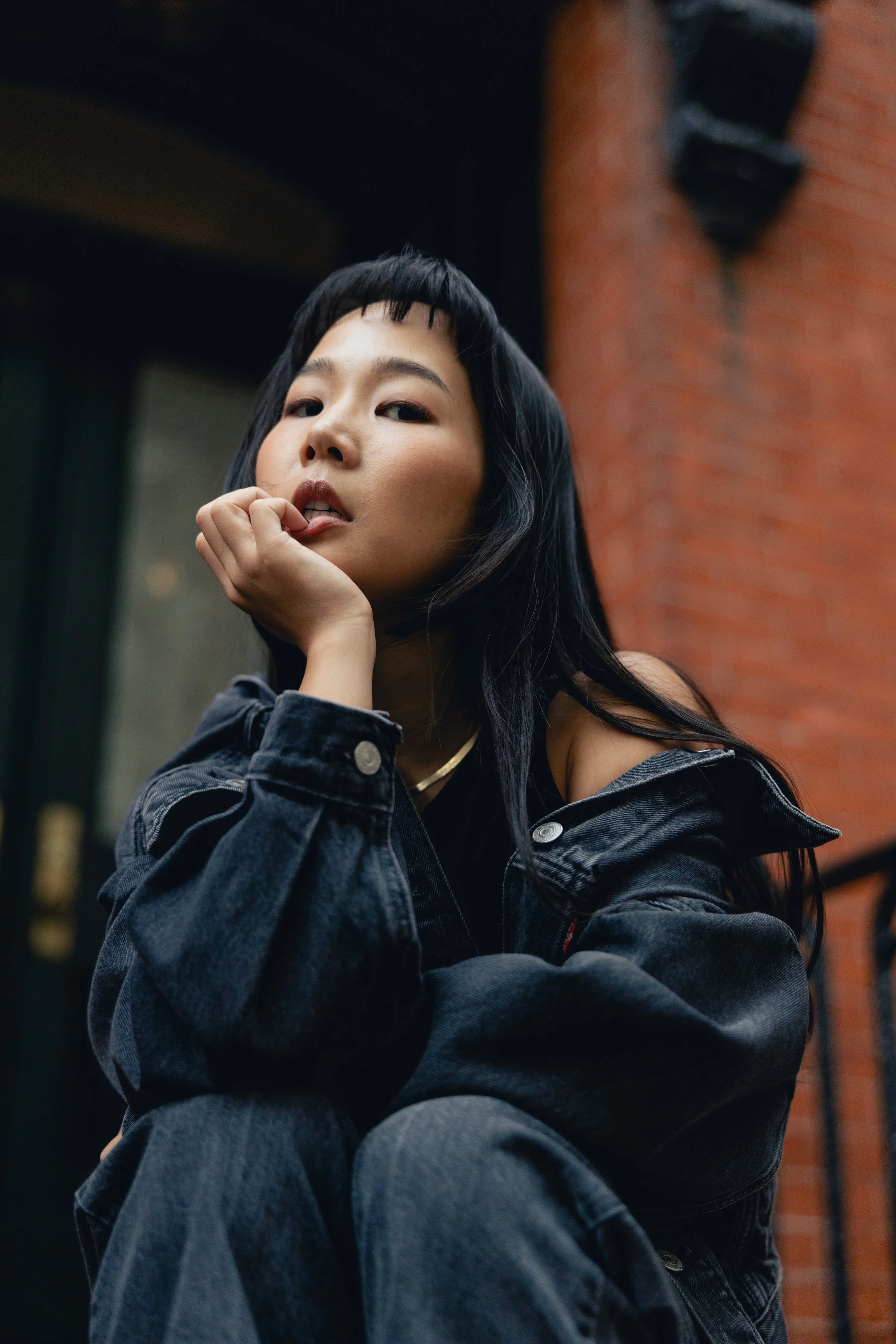
interview by JANA LETONJA
Juilliard-trained actor Naomi Okada is entering an exciting new chapter in her career with two major television projects on the horizon. She will next star as Claire Watanabe in Netflix’s limited series The Altruists, opposite Julia Garner and Anthony Boyle. Set against the dramatic rise and collapse of crypto firm FTX, the series explores the people and relationships at the center of one of the most notorious financial scandals of recent years. Premiering November 19, The Altruists arrives as Naomi is also filming a recurring role in Season 2 of FX’s acclaimed SHŌGUN.
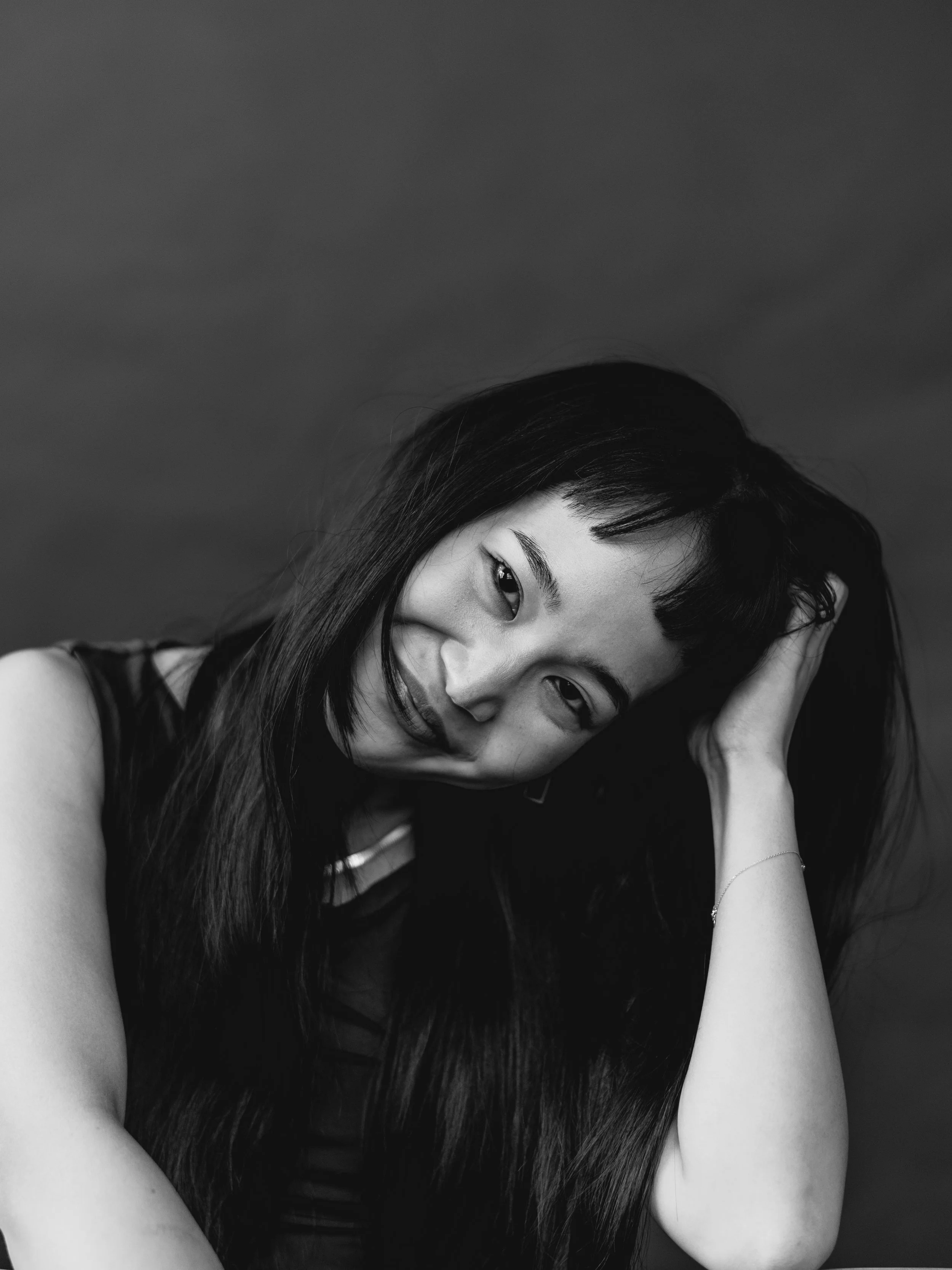
photography by KAELA KU
You’re at an especially exciting point in your career right now. How does this moment feel from your perspective?
To put it simply, I feel grateful and lucky. To have spent a good majority of my adult life incubated as a student of acting, never really knowing what would come of it, I feel privileged to have already been trusted to be a part of some of the coolest projects coming out in near future and to collaborate with people that I’ve been inspired by for years. It feels reassuring to know that the years I’ve spent training are worthwhile and prepared me for moments like these, and has me feeling more than ready for the next project.
What initially drew you to The Altruists and to the role of Claire Watanabe?
I have a few friends and family members who followed the collapse of FTX in real time. I admittedly knew very little about it so when they gave me the crash course I was like, “Oh, the story writes itself.” When I read Graham Moore and Jacqueline Hoyt’s scripts of the series, I was immediately drawn to how heart-driven their story is. Claire Watanabe as a character stood out to me because to me she represented the heart and humanity amidst the themes of immense greed and deception.
What can you tell us about Claire and where she fits into the world of the series?
Claire Watanabe is an executive at FTX who sees the company through from beginning to end. Her story reveals how twisted personal relationships can get when your colleagues are also your best friends. To me, she is a source of levity and hope in the series which was a really fun character to track.
The FTX story involves ambition, idealism, enormous wealth, and ultimately collapse. What aspect of that story did you find most fascinating from an actor’s perspective?
With Claire, I found it particularly exciting to lean into the friendship and romance aspect of the story. Of course, the story is about everything mentioned, but it is also about these eccentric characters who are, for better or for worse, best friends who handle each and every crisis presented to them in wildly unexpected ways. To me, what was most fascinating to excavate as an actor were the moments of unexpected intimacy and levity amidst the catastrophic circumstances and those moments were primarily found in the investment of her personal relationships.
How did you approach finding the humanity in your character amid a story that audiences may already associate with headlines, court cases, and scandal?
Graham and Jacqueline expertly wrote Claire as a character whose central theme is grounded in her loyalty to friendship, which made humanizing her very easy for me. There was a lot of room for my imagination to grow with this character, as there was very little information I could draw from real life, so to me, she embodied the antithesis to the themes of deception that are associated with the larger story. That was an exciting direction to explore and made the process incredibly fun.
What do you hope audiences will discover about this story that they might not have understood from following the real-life events in the news?
For me, the series is an unconventional love story between two people who desperately want to love and receive love, and succeed and fail at it over and over and over again, while simultaneously claiming to do the most good in the world. In the age of the exponential growth of technology and the obsession to optimize, I hope that audiences are reminded that human relationships shouldn’t follow that trend.
You’re also currently working on Season 2 of SHŌGUN. What has it been like entering the world of a series with such a distinctive scale and identity?
It felt mostly surreal entering into the world of SHŌGUN because it’s entirely foreign to me. I couldn’t tell you how many times people have responded with utter shock when I told them that the way they speak in the series is not how I normally speak in Japanese at home. It’s an archaic version of the Japanese language that is so far from the way I embody my Japanese identity. But it was definitely the most exciting challenge to take on in my acting career so far and I hope to encounter many more opportunities like this in my life.
Without revealing anything you can’t yet share, what excites you most about your role in SHŌGUN?
I’m most excited about stepping into this specific time period and world that the creators of the first season worked tirelessly to get right. Immediately when stepping onto set, I observed an expert level of attention to detail depicting this time period of Japan as historically and culturally accurate while also serving its story and characters. I’m most excited about that being recognized and celebrated by audiences globally.
Did Juilliard prepare you for the realities of working on large-scale productions, or were there things you could only learn once you were actually on set?
Although Juilliard prepared me for many things, it did not prepare me for how scary a high-budget, large-scale production set could feel like. There are some things that you just have to experience for the first time, and for me, nothing could have prepared me for how high pressure a TV set can feel. I was so amped though. I spent as much time as I could observing the mechanics, the social dynamics, watching the monitors, listening to the advice of everyone else there who had more experience than me. I’ve been lucky to have been surrounded by incredibly supportive and kind people on these sets that helped me approach these high-pressure environments with curiosity and fascination and I left with an eagerness to experience it again and again.
Has your relationship with Japan, or with your own identity, changed as your acting career has developed in the United States?
Absolutely. I’ve spent the majority of my life toggling between my Japanese home life and American school life and eventually my career, and I saw these things as completely separate. My acting training was done primarily in the United States and I learned techniques and skills that would make me marketable as an American actor. I couldn’t even describe to you how many years I’ve spent toiling over Shakespearean text to make it make sense to me. I learned Western traditions of acting and studied Western texts, but when I got home to Facetime my parents, the language I joke and laugh and philosophise in is Japanese.
My relationship to acting felt solely American until I got the request to send in a tape for SHŌGUN. I looked at the sides and I thought “This is harder than Shakespeare, but I know how to break this down.” Of course, I immediately call my parents seeking help and advice, while also leaning on the methods I learned while training. This was the first time that I experienced my journey as an actor as truly international and multicultural and it gave me a sense of pride to know that my identity as an artist is not solely about code-switching but also about borrowing, sharing and melding.
With your profile growing quickly, what are you looking for when deciding whether a character is worth pursuing?
I am just so viscerally moved and inspired by smart, tactful and heart-driven writers who develop three-dimensional female characters that I feel compelled to borrow traits from. Recently, I’ve been excited to read scripts and watch films and shows that involve characters who are undeniably intelligent and have a shameless sense of ambition and self-knowing but are deeply flawed. There are so many kinds of characters that tug at me, but the crux of what inspires me to pursue a character is when she is written with heart, dignity and tact.
What keeps you busy and fulfilled in your free time?
I’ve recently loved experiencing, consuming and learning from art and artists that have nothing to do with acting. My mom has been teaching me how to sew for the past few years on her 30+ year old sewing machine and I’ve found a lot of mental solace and creative fulfillment from thrift flipping, tailoring and making clothing and accessories from scratch. My pinterest board goes hard. I have a close friend in the city who owns a serger sewing machine and you can’t imagine how long I spent geeking out about it. I’m lucky to know and have close relationships with non-actor artists that make my life feel fulfilled, creative and inspired outside of employment.