
IN CONVERSATION WITH SALIM GREEN
interview by JANA LETONJA
Salim Green has emerged as one of the most compelling voices of his generation, working across painting, sculpture, writing and installation. His work has quickly gained international attention, with exhibitions ranging from SculptureCenter in New York to François Ghebaly in Los Angeles, and inclusion in Berlin’s Boros Collection. This September, during Berlin Art Week, he presents Sugarshack at Société, his first solo exhibition in Europe. The exhibition explores themes of privacy, opacity and the politics of visibility, drawing on the speculative concept of Dark Forest Theory and the histories of Waterloo, Iowa, where part of his family is from. Rather than offering easy narratives, Salim’s work invites viewers to consider what it means to remain unknowable in an era defined by surveillance and constant exposure.

photography by PELUMI SOKUNBI, courtesy of Salim Green and Société, Berlin
Sugarshack marks your first solo exhibition in Europe. What does this moment represent for you personally and artistically?
It's my first solo exhibition with Société, which is really exciting. We’ve been working together for a little while now, and they've been incredibly supportive. It feels good to land in a new city and already have people there.
This show is coming on the heels of my first real experience teaching as well. I was teaching at Wesleyan University on a fellowship, which means I spent a lot of time in Connecticut. This show, the residency at Callie’s following it, and everything else, all feel like a way of re-entering the world after trying out academia.
I’m not sure what this moment represents fully yet, in all honesty. I have some ideas for where this could lead, but I'm trying not to get caught up in all that. Just taking it a step at a time.
The exhibition takes its title from Sugarshack. What does that word or place evoke for you, and why did it become the title of this project?
It's a word I stole from my dad. I've learned it has a lot of different associations for different people, but for me, it's a term he’ll use if you get him to reflect on his life in Iowa.
My dad uses “sugarshacks” like a barometer. The term describes both a literal thing — houses that have fallen into disrepair, and in his case, specifically houses on the east side of Waterloo where he’s from — and the idea that those homes, and the communities around them, were once something other than what they are now. The number of “sugarshacks” he sees acts as an index of the economic and social health of the city. They’re a symptom of larger issues at play.
The show spiralled out of that condition. I was thinking about what's physically and visually present to be interacted with and what underlying circumstance or charge those visual cues might reflect. I tend to operate in that way in my work. I try to define things by their edges until something clarifies.
The show is a group of signifiers and hints that nod toward a social condition. It started with what I observed in the Midwest socially and architecturally. I was thinking about deterioration and grief too.
Then, moving these ideas to Berlin starts to open up that conversation in an exciting way beyond the Midwest.

Salim Green, Untitled (GS1), 2026
Oil pastel, charcoal, spray paint 52 x 41 x 2 cm,
courtesy of Salim Green and Société, Berlin, photography by Trevor Good
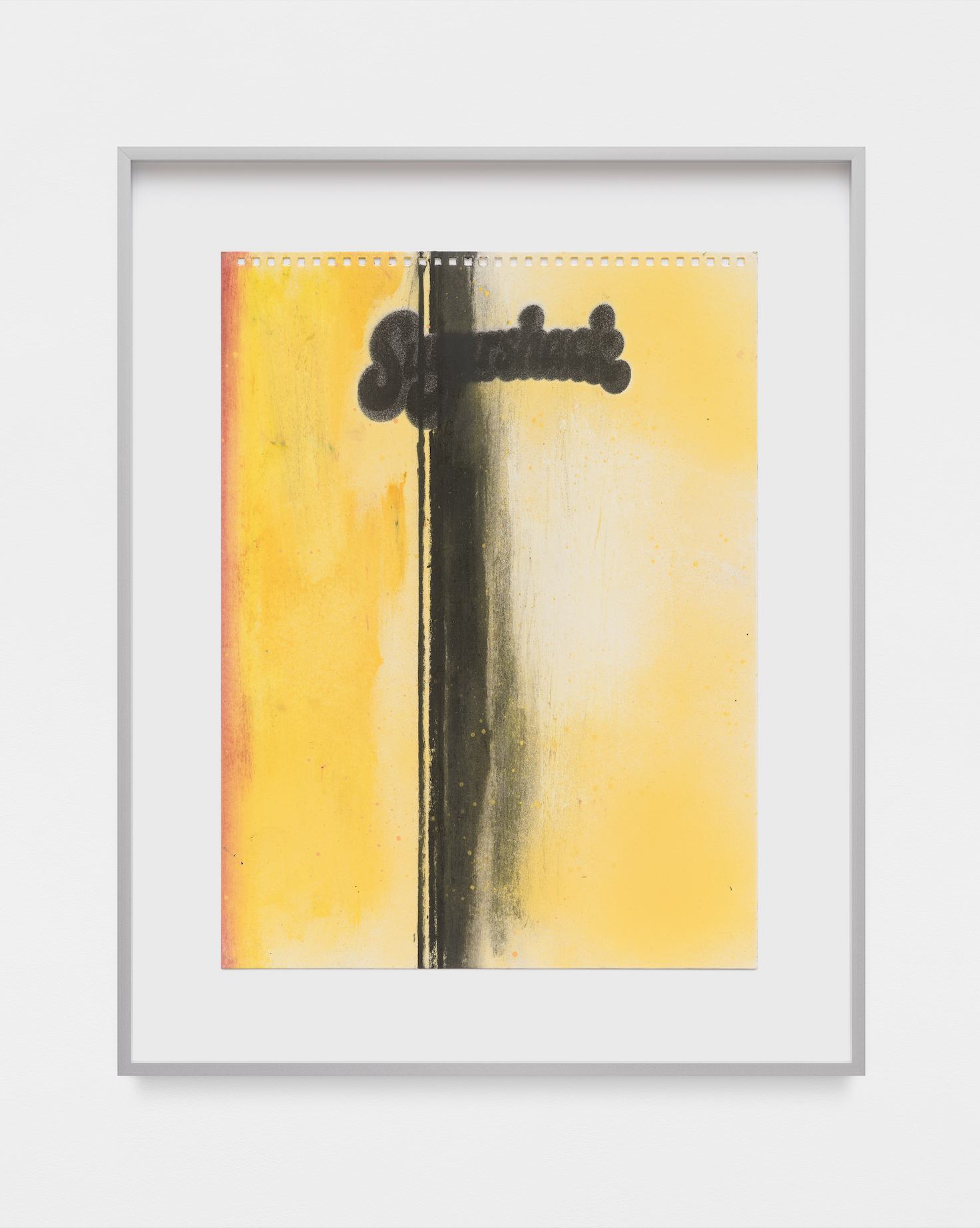
Salim Green, Untitled, 2026
Oil pastel, charcoal, spray paint 52 x 41 x 2 cm
courtesy of Salim Green and Société, Berlin, photography by Trevor Good
Waterloo, Iowa, plays a central role in the exhibition. What drew you back to your family’s history there, and how did those stories shape the work?
I've been spending a lot more time in Waterloo over the last couple of years. I live a completely different life there than I do in LA or whatever other bubbles I run around in. I really love it.
I feel like I was raised in the wake of my dad's experiences in Waterloo. Whenever I'm back, I have access to stories and histories that just wouldn't come up in conversation elsewhere. I've started to understand Waterloo as both part of the foundation of an absurd, hyper-Black American family origin story in a broad sense, and a highly sentimental place where I have roots, and community, and memories in real time.
My family got to Iowa by way of Mississippi. The railroad company in Waterloo had a special deal where if you were Black and willing to move to Iowa to work, they'd give you a boxcar from a train to live in on land. That's what my dad's grandfather did. He took the train north, got his boxcar, converted it into a home on the east side of Waterloo, and things have been evolving from there ever since.
The work for Sugarshack came out of me trying to reconcile my interests and ideas with the intense, sometimes otherworldly, nature of Waterloo. Waterloo feels both deathly serious and lighthearted at the same time. I like when my work feels the same.
You’ve described the exhibition as being interested in architecture, ritual and memory. How do these elements intersect in your practice?
I think a lot about social choreography. Architecture is important to me, but in the sense that I'm interested in how specific spaces and architectures shape the ways people organise themselves, navigate physical bounds, and interact socially.
I saw The Social Life of Small Urban Spaces, William H. Whyte's film, some years ago and have since thought about exhibition-making as a way to engineer my own small social spaces.
In exhibitions, each work becomes part of a larger ecosystem an audience has to navigate. I like to play with that navigation. The more opportunities I've had to show, the more I've learned about how people "do" art exhibitions, and what choices I can make to shape that doing. There’s definitely a ritual or pattern to it.
Though I wouldn't say this show is about religion specifically, the goal was to export the Fellowship Hall at Payne Memorial AME Church in Waterloo, Iowa, to Berlin. That space, though not “holy” in the way a church sanctuary might be, does contain its own ritual logic in how it's used. The fellowship hall is recreational space, it’s where you eat, it’s where you gossip. I wanted to recreate as much of the logic of that space as I could in the gallery and see how a new audience might deal with it.
The Fellowship Hall is its own kind of sugarshack. How the space is used day to day is a marker of how engaged the community is at any given time. The space is an accumulation of all the social residue from years past. It’s lived in. Parts of this show should feel that way too.
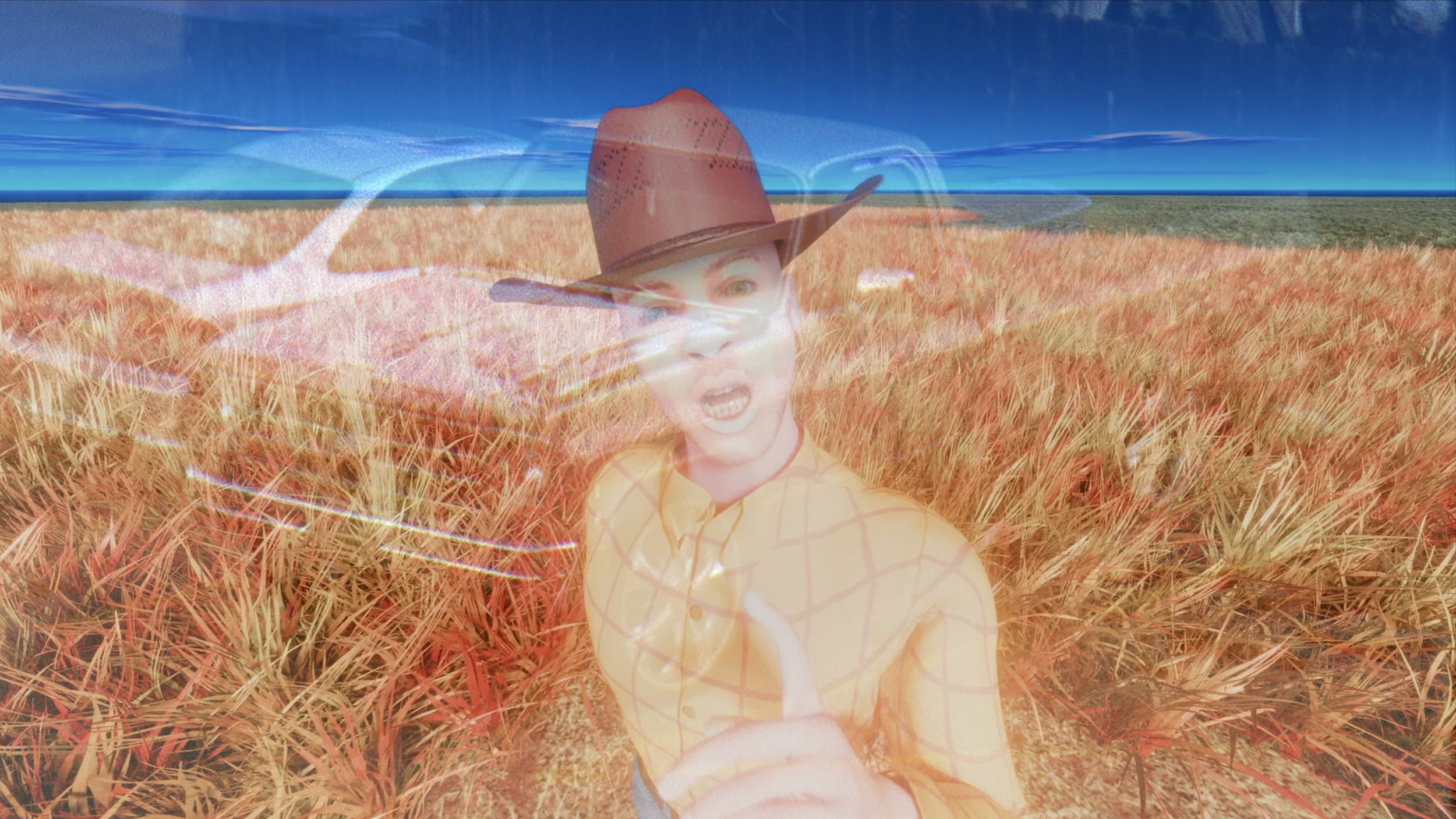
Salim Green, Sugarshack, 2026 (Video still)
courtesy of Salim Green and Société, Berlin
Dark Forest Theory appears throughout your work. What first attracted you to this science fiction concept, and why has it become such a productive framework for thinking about contemporary life?
When I first came across it, it felt like I was already living the theory in a really bizarre, paranoid way. It was jarring and even embarrassing, to be honest. I felt like I was becoming a doomsday prepper.
I'm in a different space now, so it's opened up into a set of ideas I get to interrogate instead of a code to live by. It's architecture for me to play inside, rather than something I feel trapped in.
The theory itself has roots in sci-fi, and I reinterpreted it as speculative social theory. Now it operates as an undercurrent for my work. It’s less about enacting the theory literally in every show or every piece and more about using it as a filter to metabolise my own experiences and that of other folks around me. It's something I can lean into or work against. It helps me ask better questions of my practice right now. I’m grateful for that.
Your work suggests that invisibility can be a form of protection rather than a limitation. How do you think about privacy in an age when visibility is often treated as success?
I'm just trying to make decisions that feel right for me and keep my focus on the studio. Some people thrive on visibility, I'm sure, but I'm not there right now. That doesn't feel like success to me.
If I'm honest, a lot of this boils down to control. I'm really careful not to use words like "invisibility," or any other language that hints at erasure in relation to the work. When I've written about hiding in the past, it's not about disappearing, it's about acknowledging the agency present in hiding. To hide is to define the bounds and circumstances in which you're willing to be seen and met by others. I'm really into playing with that legibility in life and in my work. It's not about invisibility for me. It’s an opportunity to toy with the spectrum between legibility and illegibility.
Your paintings often resist straightforward interpretation. How important is ambiguity to the experience you want viewers to have?
Painting is really, really important to my practice. I think there's a generosity to making work that can hold its own without forcing a specific narrative or leading a viewer. The paintings each have their own logic. Sometimes that logic pulls from the real world in a really literal way, but the audience doesn’t need to know what I'm pulling from or referencing to deal with the work. That's really important to me.
The paintings can be about themselves and how they operate within exhibitions. They manage to be formal, referential, illegible, and open all at the same time rather than being about me, how well I can demonstrate my understanding of art history, or which artists I'm looking at and stealing from. My favourite painters manage to open up space in that way, so I'm slowly learning to do the same.
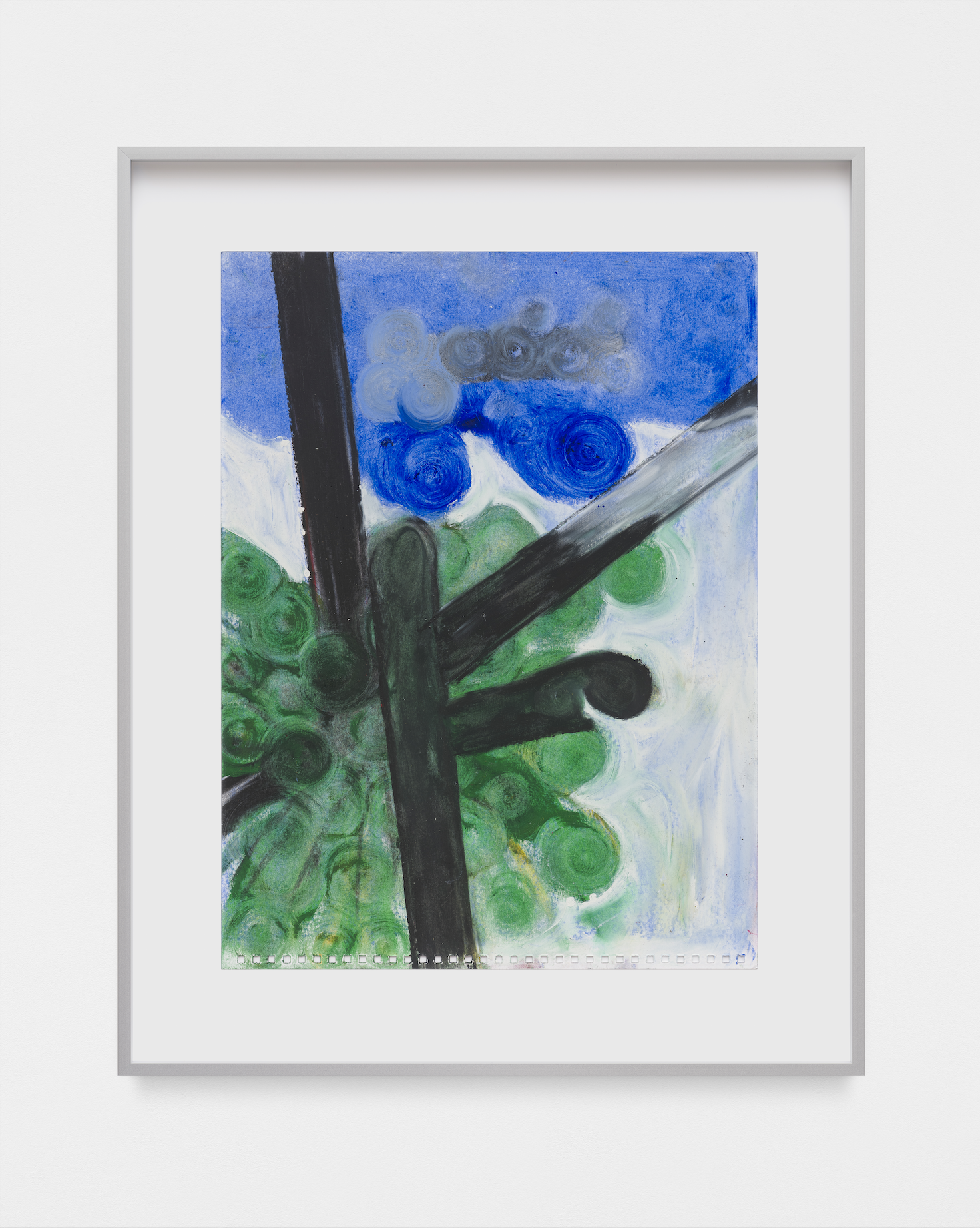
Salim Green, Untitled (Tito), 2026
Oil pastel, charcoal, spray paint 52 x 41 x 2 cm
courtesy of Salim Green and Société, Berlin, photography by Trevor Good
You work across painting, sculpture, writing and installation. How do you decide which medium a particular idea belongs in?
As I mentioned before, this all operates as an ecosystem for me. The work feeds off itself. The paintings and their relationship to illegibility relate to my interpretation of DFT. How I process DFT opens the door for things like my video work. The videos always go well with books. The books are full of reference images and ideas I use to make sculptures and other works. Everything sort of loops and intersects. Writing probably plays the most straightforward role for me because I can use it to better understand everything else happening in the studio. It keeps me honest but, because of that, I tend to be most guarded about the writing. Maybe I'll get bolder about it in the future.
Ideas dictate the form of the output. This time around I wanted to make work about Iowa. The felt paintings didn't quite fit, so I landed at wall works, sculptures, videos, and installation. I needed that mix of things to speak to the dynamic of what I wanted to get at. Trying to recreate parts of Iowa's physical and social landscape in Berlin felt like the most exciting thing I could do both for my practice and for a new audience.
Berlin has its own complex history of surveillance, borders and memory. Did presenting this work here create new meanings that wouldn’t exist elsewhere?
I’m not well studied enough on the history of surveillance in Berlin to talk about it thoroughly, but from what I do understand, I get why a practice that positions DFT as an undercurrent could feel heightened here. For this show, I was interested in witnessing its reception in real time. I can’t predict what parts of it will land, what will feel opaque to a Berlin audience, and so on. That's the whole experiment.
DFT is great in that way, though. It’s a really flexible framework. It’s something I’ve been able to funnel my own experiences through. But it also is something others can project onto and navigate on their own terms alongside my work. Seeing different audiences deal with it always teaches me a lot.
I’m also fortunate to have time in Berlin after the show opens to make work at Callie’s. As I get to know Berlin, I’m sure I’ll start to think about Sugarshack differently in retrospect.
Looking back at your rapid trajectory—from institutional exhibitions in New York to your European debut—has your understanding of your own practice changed?
I was talking to a friend recently who's in his 50s, and he mentioned he's been having two or so shows a year for the last thirty years. That’s really incredible to me. Things have been happening for me recently, but the goal is always to keep working.
I think I'm just growing up. I think I've gotten smarter over time. I've been getting better at editing my work. I give myself a lot of freedom in the studio, but I feel myself at least trying to get wiser about how that translates when I have the chance to show the work. My pace is getting better.
In some ways I'm still circling the same core questions I've always had. In other ways, the work and what I bring to it is drastically different from where I was. The growth is fun. I really like making my work.
When visitors leave Sugarshack, what questions or feelings do you hope stay with them?
What was that? Should we go back?
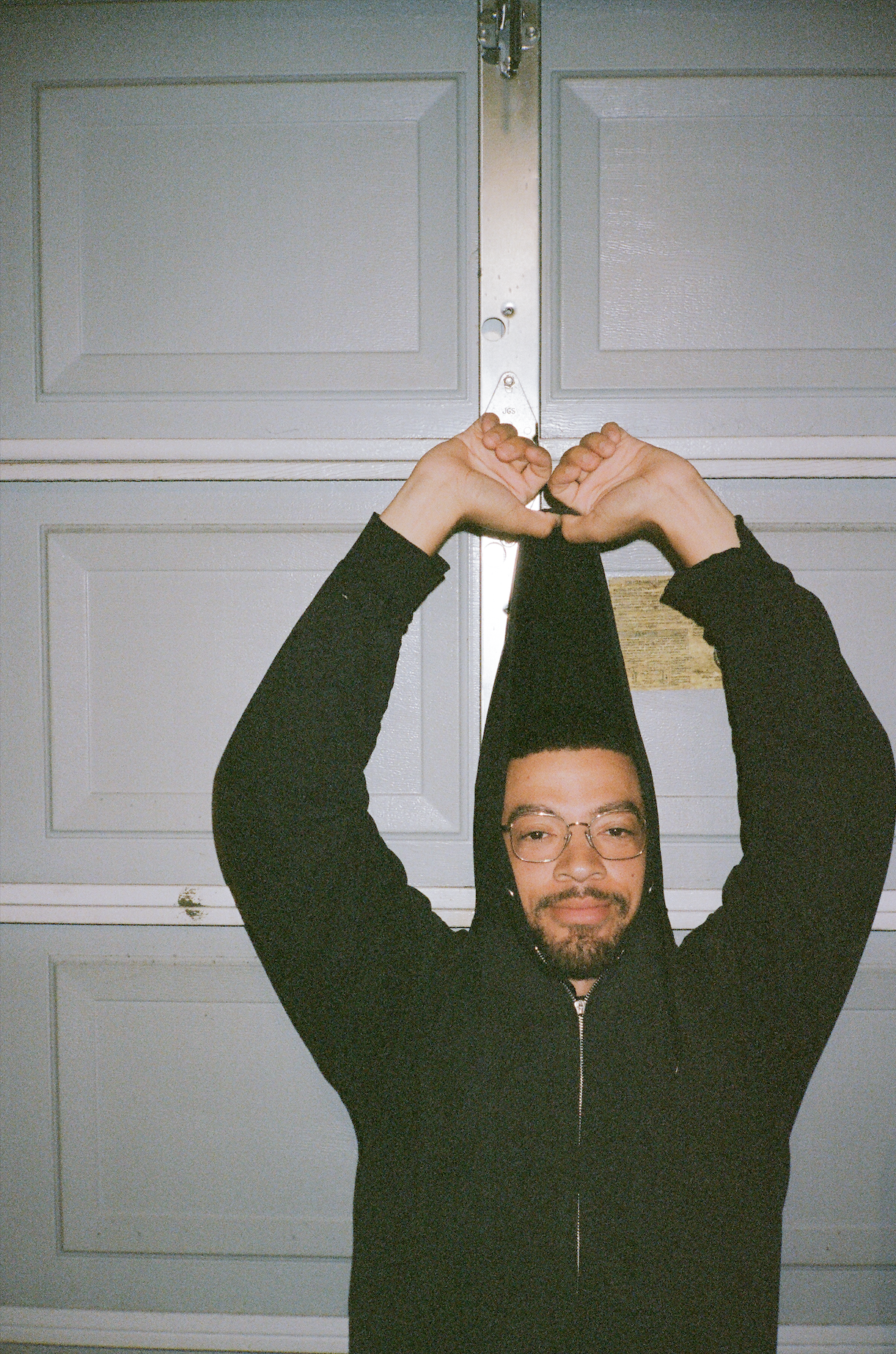
photography by SHANI STRAND
Is there a particular work in the exhibition that you see as its emotional or conceptual anchor?
The video. Video is the slowest part of my practice. This one took a few years to come together. I tend to accumulate footage, then carve the video out of it later. The lack of urgency in making video is important. I think they feel more saturated because of it.
I started shooting Sugarshack (the film) in 2022 during a trip to Waterloo and continued over my next couple of trips. I made a few other films in the meantime, including Taileater, which I showed last September at François Ghebaly in LA. That was the first work I made that combined CGI and Super 8 film, which was huge for me. My friend Uday Narayanan and I have continued working out the kinks of the CGI process since then. Eventually, after some trial and error, I felt ready to revisit the Iowa footage.
So much life happened between 2022 and now. A lot of experiences and ideas are consciously and subconsciously packed into Sugarshack because of it.