
IN CONVERSATION WITH TADHG MCMAHON
interview by JANA LETONJA
Irish actor Tadhg McMahon is starring in The Westies, MGM+'s gripping new crime drama inspired by the real-life Irish-American gang that dominated New York's Hell's Kitchen in the 1980s. Born in Dublin and now based in Toronto, Tadhg has built an impressive career spanning Ireland, the UK, and Canada, with credits including the Academy Award-nominated Brooklyn and his award-winning short film Shooting Oliver. We discuss joining this stellar cast, bringing Cliffie to life, filming Toronto as 1980s New York, and what's next with Law & Order Toronto: Criminal Intent and Boston Blue.
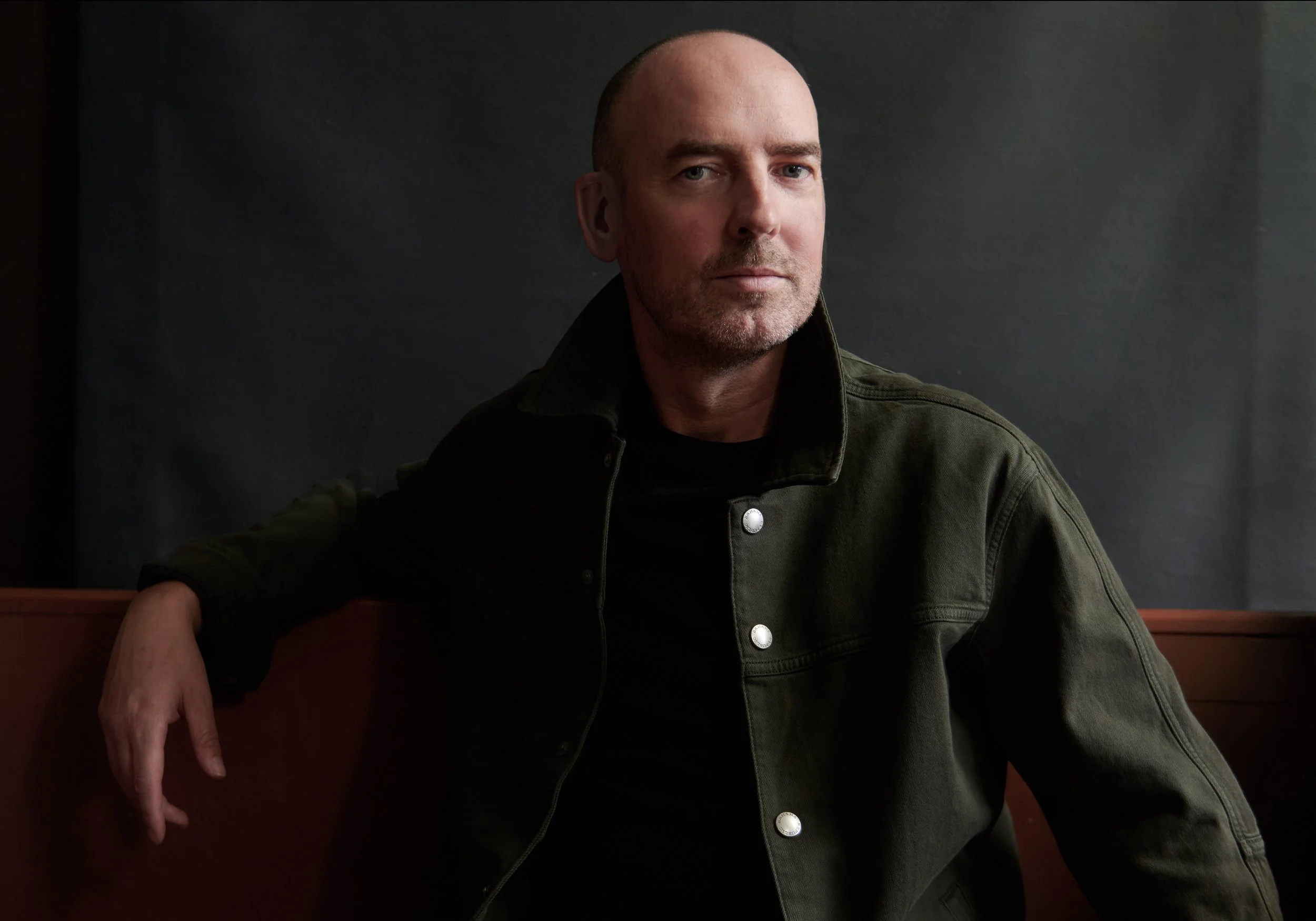
all photography by TIM LEYES
Congratulations on The Westies. What first attracted you to the project and to the role of Cliffie?
Well, funny enough, the role of Cliffie came about as the audition process went along. I had initially auditioned more generally for the show, knowing it was a good fit for me because it was dealing with Irish immigrants and the Irish immigrant story, which I have a strong cultural connection to. Cliffie was a role they were developing, and they asked if I'd be interested in being part of the project.
I'd known about The Westies for a long time. State of Grace, with Sean Penn and Gary Oldman, was a film I loved growing up. While everyone else was watching Goodfellas, I was fascinated by State of Grace, so I already knew about The Westies and their history.
I've always been interested in that dark gangster world of Hell's Kitchen. I've always been drawn to film noir, so when this project came along, I knew exactly what kind of territory we were stepping into.
Without giving away spoilers, how would you describe Cliffie, and where does he fit into thi dangerous world?
Cliffie is really sort of the strong, silent type.The series takes place around the construction of the Javits Center, which was a massive construction project happening on Irish turf in Hell's Kitchen New York City in the 80s.
What becomes very clear, pretty quickly, is that the numbers rackets, the union rackets, the no-show jobs, all the sort of old-school gentleman gangster type of stuff was being replaced by this new generation of gangsters who were involved in the cocaine trade.
So what happens within The Westies is that the young Westies are more interested in dealing coke and making that quick money, and the older Westies, who Cliffie runs with, have this sort of, "This is not the way we do gangsterism " attitude. They're trying to preserve this old culture in the Hell’s Kitchen as the neighbourhood changes. So yeah, Cliffie's neighbourhood is eroding, and I think he's trying to hold on to his turf any way he can. Those methods become increasingly brutal.
The Westies is based on a real-life Irish-American gang. Did you do much historical research before stepping into the role?
Yes, I read the book by T.J. English essentially as soon as I was cast. One thing that was clear to me as we started the process, and I know Chris Brancato and Michael Panes, show creators, have talked about this, is that although the project is based on a real gang, some of them are still alive.
Part of it was realizing that this story was going to take the truth as a leaping-off point and was going to have a fictional component to it. So I think what I really understood at first was historically where New York was at the time. I'd also read a lot about John Gotti and the rise of John Gotti, and had done my own kind of stitching together of how that worked with the Irish gangs as they were losing their grip on their neighbourhood.
Again, I took that more as a leaping-off point. I think a lot of my work in building Cliffie was building this inner life of what kind of a person thrives in this kind of dangerous world. So it was more character-based than necessarily historically based.
The show explores the power struggle between the Westies and the Italian Mafia during the construction of the Jacob Javits Center. What makes this period of New York history so compelling?
I think what makes this part so compelling is that in the period leading up to the 80s, New York was a place people were trying to get out of in favour of the post-war suburban life.
For years, these were areas where you had Irish families practically living on top of one another. The power struggles are interesting because you see how the marginalisation of different ethnic communities can make them stronger in these areas as certain other ethnic groups start to move on. In some ways, the Irish are becoming weak in this neighbourhood, but ironically, it’s because they're becoming strong in other places. By this time, there’d been an Irishman in the White House in JFK.
Then, of course, at the same time, the gentrification of New York is happening. Hell's Kitchen has gone from tenement houses to these young Wall Street guys starting to come in and build condos.
And of course, the cocaine, the drugs. We know what a massive effect that had on American culture, and the ensuing war on drugs, the crack epidemic that decimated marginalised communities, particularly Black communities in New York in the coming years.
So yeah, maybe it's the fascination of watching the match being lit and put to the fuse of the powder keg that was the cocaine boom and the crack epidemic.
You’ve trained and worked across Ireland, the UK, and Canada. How have those experiences shaped your approach to acting?
I started working when I was 12 years old. Acting was my job. It was something I was good at. I was able to go into auditions and get the job, so I didn't think about it that much. It was like, you show up, you do what you think they need, and you get the job.
I took a little break in my late teens and then came back to professional acting in my 20s. At that time, it was the text that drew me in. I was working mostly with Irish writers. It was all about the rich language, the use of the spoken word in the theatre. When I went to drama school, there was a big focus on your voice as an instrument, your body as an instrument. So that was my discipline at the beginning.
As I've transitioned from theatre into screen work, it's become so much more about the inner life of these characters. You start to realise, as you get cast in certain roles on shows, how people perceive you, what archetype you seem to fall into, and that can actually help. I try to find those people in real life. On the street. How do they move? How do they talk? Then try and figure out how they think. It's the behaviour that drives my process now.
So I think, if I was to describe the arc, it's gone from a job, to something that I felt was very text-focused, to now being focused on behaviour and relationships.
Did you have a particular scene or moment filming this season that really challenged you as an actor?
I don't want to give anything away to people who are watching the episodes week by week or who want to be surprised by what they're going to see.But yeah, I did have a scene like that. It was one scene towards the end of the series that really helped me internalise the values of the gang we try to emulate in the show. The values of strength and loyalty. You got my back, I got yours, regardless of what situation we end up in.
Rationalising that kind of belief is sometimes not possible. I think when I first started rehearsing the scene with J.K. and talking it over with Chris and Michael, I tried to rationalise it. To rationalize how someone could behave a certain way. Then you realise that when people get into situations that are so dangerous, where the stakes are so high, there are certain behaviours that you can't rationalise. You just have to have faith and loyalty and just jump.
Your career spans acting, writing, and producing, including your award-winning short film Shooting Oliver. How has working behind the camera influenced your performances?
I think what is so fantastic about being able to collaborate, write my own projects, work behind the camera, and be involved in what it takes to get a project from being a concept to a finished film—then, in our case, a festival run—is just how much you learn. How much other people bring to the table. To a certain extent, what you're doing is setting people up to be able to run with ideas.
I think the collaborators I really like the most are the ones who are able to take the kernel of an idea and run with it, and make something essentially out of nothing. When I was young, I never really understood what people meant when they said, "Everything happens for a reason." But I think, as you develop your own work, you sort of can live that way because every experience you've had in life becomes the material from which you create your art.
Is storytelling something you always knew you wanted to pursue, or did writing and producing develop naturally over time?
I would say that the storytelling and writing component has happened as I've gained more experience in the industry. I think it's one of those situations where, when you put yourself out there, when you show you're willing to collaborate, and maybe sometimes if a project is struggling and you can help it get through a certain phase, you start to realise, "I've got a lot to offer to this type of relationship."
I don't see myself as an author. I don't necessarily see myself as someone whose home is behind the camera. But I do feel that when the stars align, and when the timing is right, there are skills that I can bring to the table that can help projects move forward. I'm really proud of that.
If I was to say there's one goal that I can control over the next while, it would be to develop those skills even further. I have some shortcomings in terms of being an open collaborator at all times, and that's another one of my goals, to work on that and become a better facilitator of everyone's creativity within a project.
Looking back at films like Brooklyn, how do you think your career has evolved since those early roles?
Brooklyn is a fantastic example because, obviously, to be involved in a big project that was about the Irish in New York, it was really my first time where I was able to use my Irish immigrant experience and bring that to the table.
That project does feel like that was a turning point for me.Since Brooklyn, because not every project is an Irish project, and as a Canadian actor auditioning for American projects or Canadian projects, it's sometimes difficult to figure out where you fit in. I certainly struggled with that over the ten years after Brooklyn.
I think now I have a better idea where I fit in within the industry. I think that's what it is. If I was to say what's evolved, my focus has gone from being completely on my own internal story, my own emotions, and my own feelings, and how important it is that I bring those to a character, to more understanding, what roles am I aligned to play? What roles am I needed to play? How do I fit into the frame of a project in a way that makes sense and tells the story?
You’re also appearing in Law & Order Toronto: Criminal Intent and Boston Blue. Can you tell us a little about those projects and how they differ from The Westies?
On Law & Order: Toronto Criminal Intent, this is my second season playing Officer Russell. Officer Russell is a guy who works the streets. He's still a beat cop in his 40s, so he sees a lot of the day-to-day challenges that are out there in a modern big city like Toronto. He's got scars. He jumps to conclusions sometimes as a result. He's flawed. I like that.
On Boston Blue, I play a politician who represents the South Boston Irish. For me, that's something I'm really looking forward to, just because I love that Boston Irish world. We’ll see how flawed that character is as we go I suppose.
What kinds of roles excite you most at this stage of your career?
Funny enough, I think the roles that excite me the most right now, that I'm starting to come up for auditions for, are these guys who are caught in these morally ambiguous circumstances. I see them in situations that I would describe as dilemmas, not problems, where there is no clear course of action, it's a damned-if-you-do, damned-if-you-don't situation. I'm really drawn to that. I think it has a lot of parallels to where we find ourselves in the world right now culturally. And I find that really resonates with me.
What keeps you creatively fulfilled outside of acting and producing?
When I lived in Dublin as a kid, my parents had a Victorian semi-detached house, which we left when we moved to Canada. When I returned to Dublin to attend drama school, and for a short time afterwards, I worked as a roofer and did odd carpentry jobs all the while wishing I had acting gigs.
And, some things come full circle. I now own a Victorian semi-detached in Toronto that needs a lot of love. All of those skills that I thought I would never use, now come in handy. Everything happens for a reason. My partner is an architect by profession, so together our creative pursuit is bringing this Victorian semi to a place where it's our little corner of the world.