
interview by TIMOTEJ LETONJA
For the Eternal Line, Pablo Lücker turns to his own family history: seven generations of artists, their work, their stories and the things that have been passed down. The project is about what we inherit, what we choose to carry forward and how we find our own voice within it.
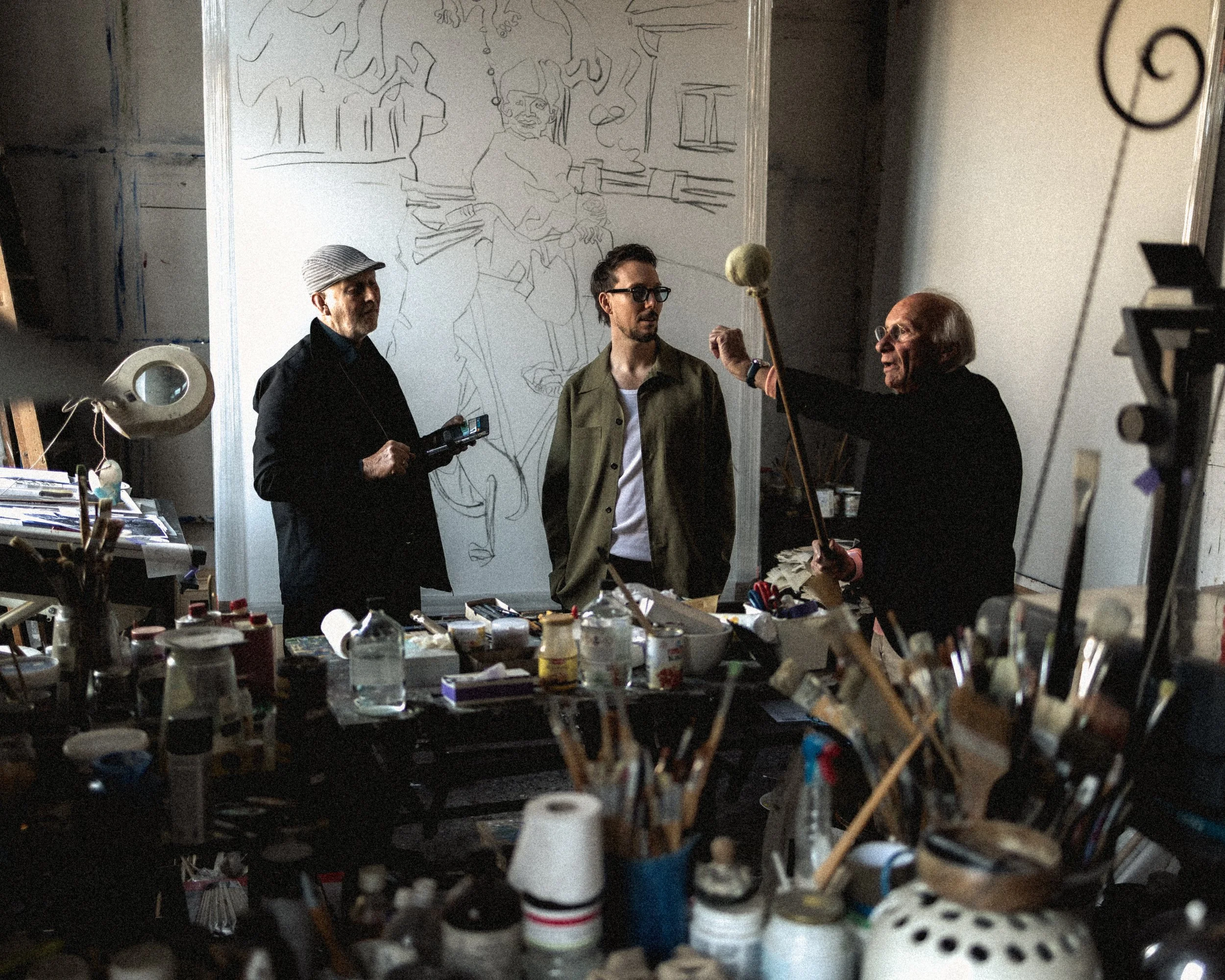
image by DANIEL SARS
The Eternal Line is rooted in your own family history, but it speaks to something far more universal. At what point did you realise this project was truly about exploring the nature of artistic inheritance itself?
PABLO LÜCKER: As the project evolved, I realised that people weren’t moved because it was my family, but because it reminded them of their own. Through my research and the conversations I had, I discovered that almost everyone is either continuing a legacy or creating one.
You describe inheriting not only a name but a way of seeing. Do you believe creativity is something that can truly be passed down through generations, or is every artist ultimately forced to reinvent that inheritance?
Every generation inherits a language, but each person has to find their own voice within it. I often compare it to receiving a map. You still have to navigate the journey yourself. Growing up in a creative family gave me the privilege of being surrounded by craftsmanship, curiosity and making from an early age. But my parents never told me who to become; they gave me the freedom to discover that for myself.
This project arrives at an emotionally charged moment, with your father turning 75 and your uncle facing terminal illness. How has the awareness of mortality changed the way you approach image-making?
I believe art becomes most powerful when it’s rooted in something deeply personal. Art also allows us to carry stories into the future. We still have paintings in our family that are more than 175 years old. They remind me that life is short, and that we should make the most of the time we’re given.
Many artists spend their careers trying to distance themselves from their predecessors. You seem to embrace your lineage instead. Has carrying such a rich artistic family history ever felt more like a responsibility than a privilege?
My ancestors made it possible for my generation to create in the way we do today. There is a belief in some cultures that a person dies twice: once when they physically pass away, and again when people stop speaking their name. That idea has always stayed with me. For me, continuing the Lücker legacy is about carrying forward a way of seeing the world, while adding my own chapter to that story.
Your visual language moves between archival material, intimate family moments and your own contemporary Dreamscript works. How do you balance honouring the past without becoming nostalgic?
I’m interested in understanding what still resonates today and translating it into a contemporary language. My Dreamscript has become a tool for absorbing stories, emotions and memories, transforming the invisible into something tangible that people can connect with in their own way.
Silence seems to play an important role in your work. Do you think there are emotions or memories that images can communicate more truthfully than language ever could?
Images invite people to feel and create their own meaning. There’s a saying that an image is worth a thousand words, and I believe that’s true. Images invite the viewer’s imagination to participate. Every person brings their own memories, emotions and history to what they see. Words tend to guide you towards a specific meaning, whereas an image leaves room for personal interpretation.
Looking across seven generations of artists, do you notice recurring themes or sensibilities that transcend style and period? Is there something unmistakably Lücker that connects all of you despite changing artistic languages?
Although the artistic styles changed dramatically over seven generations, I do recognise a shared spirit. Every generation was independently minded; they all wanted to do things in their own way. What connects us isn’t a visual style but a way of looking at the world, a shared curiosity, a desire to create and the courage to follow our own path.
If the Eternal Line is ultimately about what survives us, what do you hope viewers carry with them long after they leave the exhibition, not about your family specifically but about their own histories and the legacies they are creating?
I hope people leave the exhibition thinking about their own story rather than mine. Maybe they’ll call a parent, ask a grandparent a question they’ve never asked before or look differently at an old family photograph. If the exhibition encourages someone to reflect on what they’ve inherited and what they, in turn, will pass on, then I feel the work has done exactly what it was meant to do.
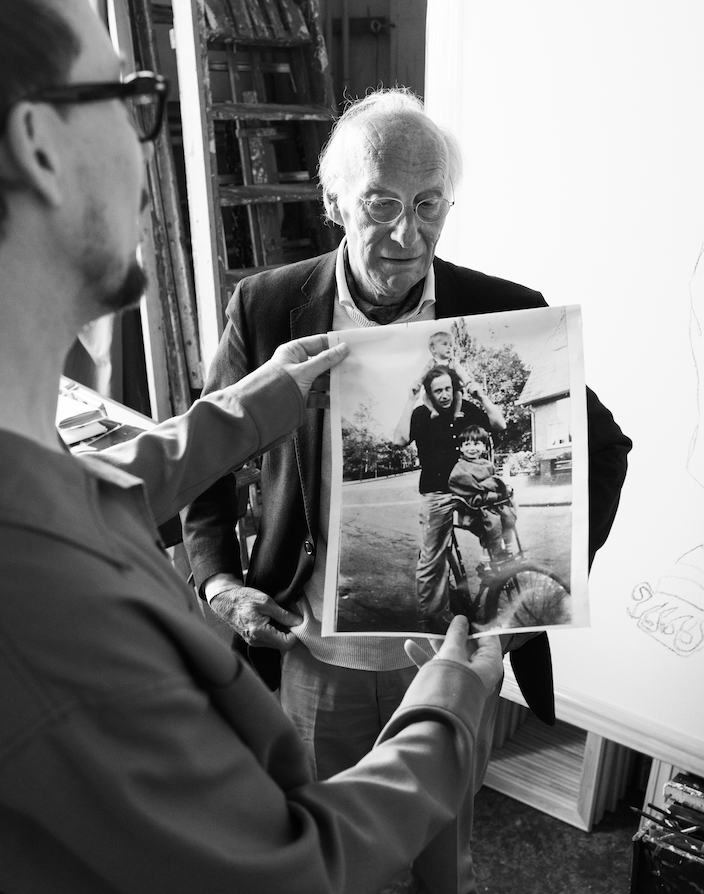
image by DANIEL SARS
Could you share with us the ideas, values or elements that keep your creativity connected to who you are and where you come from? Do any of those continue to appear in your work, even when they are not immediately visible?
JEROEN LÜCKER: Of course, it is difficult to judge this myself... but, here towards the end of my life, I would like to make a modest attempt.
In one way or another, my art has always been steeped in philosophy, intertwined with my aesthetic search: a search that had already begun when I was in primary school. Much of that came through the old art history books belonging to my grandfather that were lying around our house, almost entirely illustrated in black and white. Through them I became captivated by Dürer’s graphic work... by the paintings of Holbein, Velázquez and Michelangelo, and by the Italian Renaissance.
Later, when I grew older and moved to Amsterdam, I became absorbed by Picasso, Braque, Pollock, Calder, Tinguely, and so on... From a young age, I was searching for the ideal form through which to express my work, without relying too heavily on the examples that had come before me in art history. Over the course of my career, I wanted to develop a signature, a style of my own something in which I could recognise myself and which could give me a sense of fulfilment.
That mixture, that search, has always fascinated me far more than success ever has. In that sense, I feel detached from ambition. I want the work of art in itself to reveal, through several layers, what is taking place in my mind at a particular moment, while at the same time being able to stand entirely on its own, carrying its own signature. I have always considered myself privileged to have been able to give shape to my life in this way... even though the reality of the world today often weighs heavily on me and can make creating my work difficult.
And yet, making art is also an escape from reality, and always has been. Even as a child, I would retreat into my own mind and into my drawings. (In my drawings, I can live.) In that way, I entered other worlds. I think, perhaps, that this is how I have always remained a child... although others will probably have a different opinion about that.
Now, standing here towards the end, that thought continues to give me a sense of fulfilment and contentment...
So, don’t forget to live.
With love, Jeroen
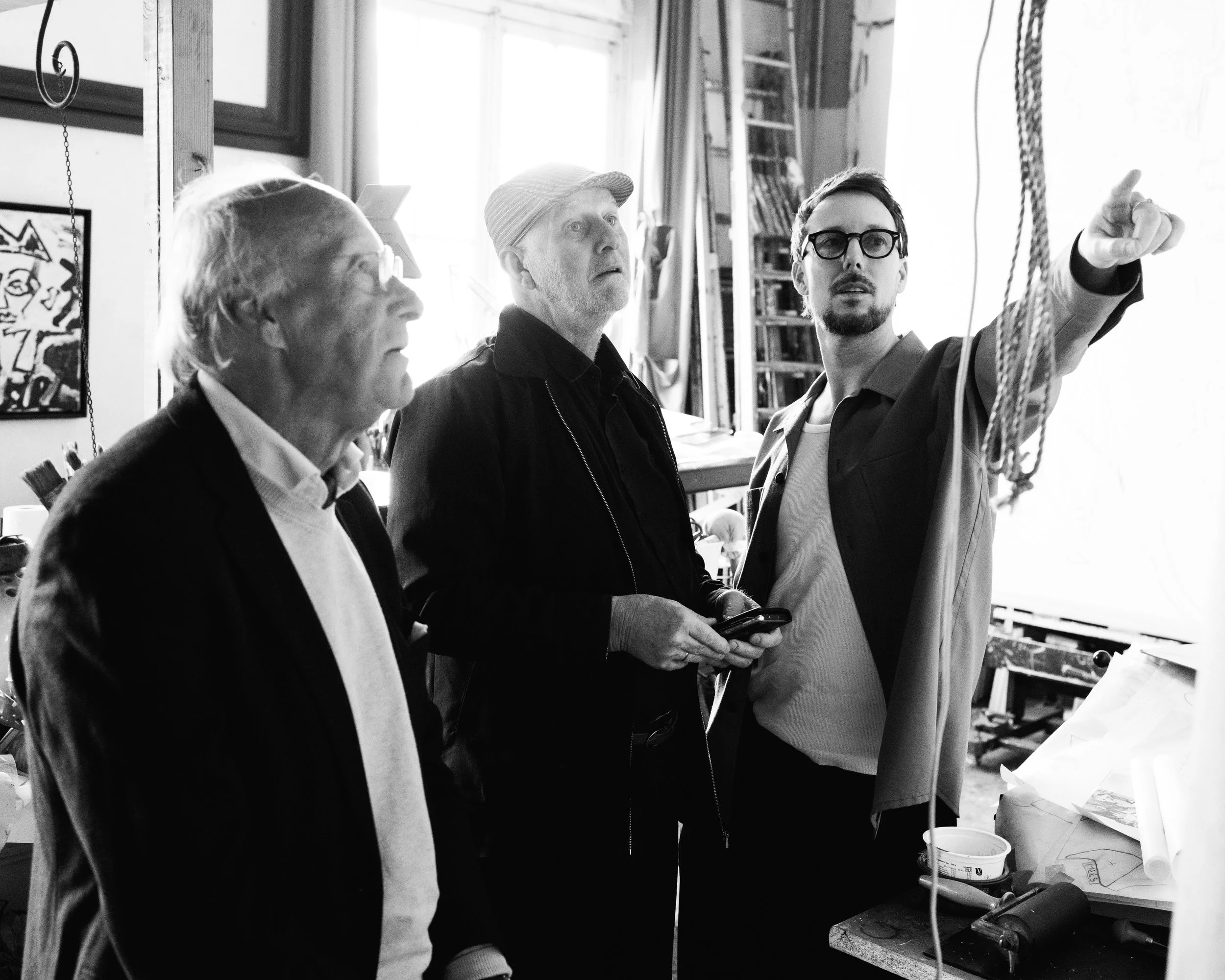
image by DANIEL SARS
Pablo grew up surrounded by generations of artistic influence. Looking at his work today, where do you most recognise the family’s artistic DNA, and where do you see him breaking away to follow his own path?
CARL LÜCKER Not only were there many artists in our family, but artists also tend to attract other artists. We regularly had artists visiting our home, and we often took our children along when we visited artist friends.
Something else I recognise in Pablo is the way he has built his life and career as an artist. For example: how do you build a business around yourself as an artist? That was something I was never taught during my five years at the Rijksakademie van Beeldende Kunsten in Amsterdam. Once the doors of the academy closed behind you, you were essentially out there on your own. I had to figure everything out for myself.
That is why I have always considered diversity an important principle. I successfully built a business in which art remained at the heart of everything, while at the same time designing many, many books, creating sculptures, making original graphic work, and taking on almost anything that crossed my path and interested me artistically. I certainly recognise that broad and entrepreneurial approach in Pablo as well: designing and creating in the widest possible sense. That is something I am very proud of. I also recognise a great deal in the way he works.
As a child, Pablo drew constantly. There was always paper lying around our house, ready to be used. He filled sketchbooks, often using them as the first starting point for an idea or a new work. I recognise that way of working in my own father, and certainly in myself as well. And then there is the sheer drive, almost an obsession. Once an idea gets into your head, it has to come out, whatever it takes. You keep working on it until it feels right. That passion and determination behind making something is very familiar to me.
When I look back at Pablo’s early drawings now, I can also see that he was already beginning to form a style of his own at a very young age. Fortunately, I have kept a number of those drawings. In them, you can already see something beginning to emerge that would later become increasingly recognisable as his own signature: his DREAMSCRIPT. Our collaboration has also continued throughout the years. Right at the beginning of Pablo’s colourful career as an artist, he had a major exhibition in Amsterdam. At the time, as I like to call it, I helped him with the preparations ‘as his assistant’. I thought that was wonderful: father and son working together, but entirely under Pablo’s direction.
For me, that really felt like a special moment: a new generation of artists had been born.
