
BLUE MOON REVIEW: ETHAN HAWKE SOARS AS A BROKEN SONGBIRD
words by SONNY NGO
As a writer, you hope that your work is able to move people in some shape or form: for your words to convey certain emotions, and for such feelings to endure long past your initial pen to paper. You perhaps wish, as Ethan Hawke’s portrayal of legendary lyricist Lorenz (Larry) Hart boldly proclaims in Blue Moon, that your words may cheat death. Hart is indeed amongst a lucky few whose oeuvre has lived on far beyond himself. From The Lady Is a Tramp and Manhattan to My Funny Valentine and the film’s eponym, the American writer has cemented himself within the Broadway canon, yet his extensive partnership with Richard (Dick) Rodgers has largely been eclipsed by Rodgers’ own collaborations with writer Oscar Hammerstein II. Whereas the latter’s dynamic is often celebrated, the former is stained by a tragic separation marked by severe alcoholism. And it is here, in Richard Linklater’s captivating picture, that we are transported back to a melancholic New York encounter between Hart and Rodgers: the premiere night of Oklahoma!
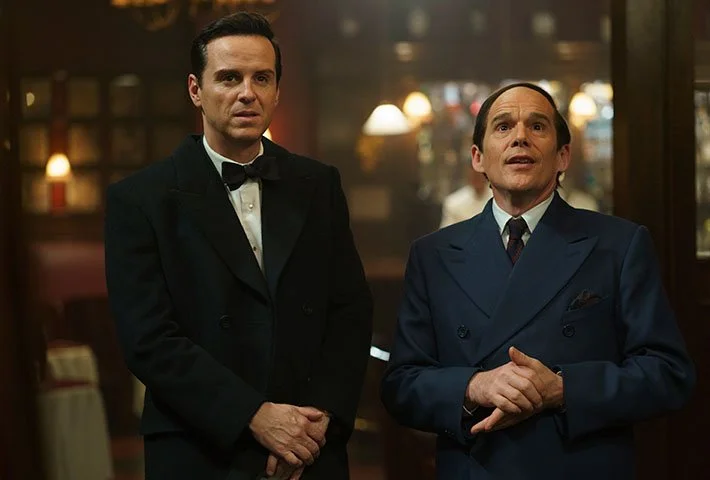
image via SONY PICTURES CLASSICS
It’s 1943 and we enter the famed Sardi’s restaurant in downtown Manhattan, where Hawke is transformed into an accurate representation of Hart – 5’5”, appalling haircut, suit and all. He plays the person – it feels weird referring to Hart as a character, though of course he had plenty – with utter radiance. His dialogue is sharp-witted and Hawke delivers the jokes like a true wordsmith. But it’s his livewire performance and commitment to Hart’s eccentricity that steals the show. Back in the day, it was often speculated that Hart was a homosexual, or at the very least queer. In the film, however, he refers to himself as ambisexual: a lover of beauty. And it appears that he’s as much in love with the world as he is with himself. He smugly pokes fun at the exclamation point in “Okla-homo!,” is blissfully self-aware of his acidity, and goes tit-for-tat with the barman. At times, it feels as if Hart is doing entirely too much, not just for the audience watching the film but also for the people around him. Rodgers, who we meet later during the evening and who is played by Andrew Scott, surely can’t hold a conversation with him that lasts longer than five minutes. Hart’s constant mockery, and his increased alcoholism, makes it impossible for anyone to stand him anymore; it’s proven difficult, even for his 20-year long collaborator.
The only person who can bear his speech is Elizabeth Weiland – protegé, student, and desperate crush of Hart, played by the brilliant Margaret Qualley. She is the only person who captures Hart’s ear, and who is an absolute gem. Weiland often talks to him about her college life, sexual activities, and more importantly, her career ambitions in Hollywood. You can’t help but feel downcast seeing Hart drool and voyeur over the young talent, who obviously does not envision a romantic relationship between the two. Still, you feel a little vexed with him too: why can’t he properly express himself and his wishes? For a man so excessive and voluble you’d think that he’d spit it all out, but if there’s one thing he can’t do, it’s to be vulnerable.
At one point in the film, Hart shares that writers wear their vulnerabilities like a cloak for all the world to see. And he is clever with his words, as most writers are, because wearing a cloak usually means that you conceal rather than reveal yourself. For most of the film, despite his constant rambling and magnetising delivery, Hart reveals little of true vulnerability. Yes, he might sweep you up in great fanfare of stories and quip, but peel away the snarky remarks and you will find a deeply struggling man. A person who finds it difficult to place his admiration for others into action; a person who is afraid that others might not love him the same way; and a person who is too prideful to admit that he hates to see his longtime partner move on without him.
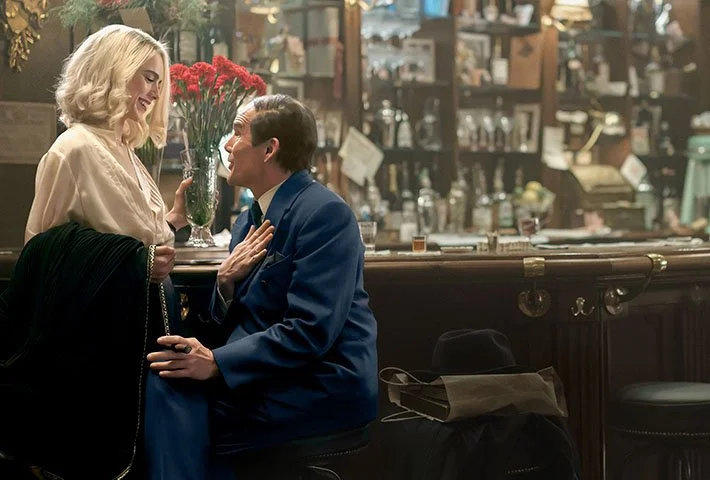
image via SONY PICTURES CLASSICS
In the film’s title, the two O’s in Moon are looped together like a small magic trick, infinitely bound to one another, an echo of Hart’s relationship with Rodgers even after their falling out. Much like them, Linklater and Hawke have also been longtime collaborators – Blue Moon being their ninth film together – and they are both at novel heights here. At what is basically a one-night, one-man show by Hawke, the film persistently wavers between comedy and tragedy. Hawke essentially plays a man unraveling and crucially avoiding silence: we see Hart try to stretch a single evening into a neverending show, so that he doesn’t have to sit with his wounds and feelings. In the end when he is bound to leave the bar, however, he jokes that he might finally have to start wearing a cloak – he had in fact not done so before – while Sardi’s piano man plays one concluding song.
The beginning of the film already told us how Hart’s story would come to a close. Quotes tell us how he was both dynamic and fun to be around, and “the saddest man I knew.” Yet despite his tragedy, Linklater opts to let his curtain fall in Sardi’s instead: under the charming notes of Blue Moon, and its sung melodies – “Now, I’m no longer on my own / Without a dream in my heart / Without a love on my own.” It’s a soft, respectful continuation of the night, where for a brief suspended moment the heart can linger around just a little longer, and where Hart can stretch the evening just a little further.
Blue Moon premiered at the 75th edition of the Berlin Film Festival and will open in Dutch theatres starting January 15th.