
words by DEBORAH DRENOFCI
There are films that make you laugh, some that make you cry, and some that do both. The 2026 comedy-drama Club Kid is the third kind. It's the directorial debut of Jordan Firstman, who also stars alongside Cara Delevingne, Diego Calva, and Reggie Absolom, with Shygirl and Jack Cameron Kay making brief, memorable appearances. Shown at the 2026 Cannes Film Festival under Un Certain Regard and later acquired by A24, Club Kid invites us into a not-so-typical coming-of-age story: a navigation of parenthood, and a journey toward self-love that stems from the unexpected.
The opening scene takes us back to 2016, inside a sweaty, chaotic, purple-lit jungle of a New York underground club, where Peter (Firstman), a club promoter, is having the time of his life. He has no idea that this one night will become the catalyst of it. What's particularly captivating about the club scenes throughout the film is how the flashing lights and the push-pull of fast and slow movement build a physical sensation, as if the viewer is inside too. You can almost feel the crowd, the dancefloor, the smoke.
Ten years later, Peter is still in the same loop, sobriety nowhere in sight, temporarily housing Nicky (Eldar Isgandarov) in the apartment his late mother left him. Nicky, an aspiring philosopher who spends his days swearing at kids over Xbox, provides most of the film's wittiest randomness, eventually marrying Peter's seventy-something neighbor for her inheritance. Sophie (Delevingne), Peter's club-promoter partner, looks put together but is quietly battling her own addiction. Peter's phone keeps ringing. He never answers, so the call shows up at his door instead: Edison (Kirby Howell-Baptiste) and a shy, curly-haired kid named Arlo (Reggie Absolom), looking both curious and scared. Edison, the late mother's best friend, drops the news: Arlo is Peter's son, and Peter has to take him in or an abusive stepfather will. Peter insists this is impossible, he's never even been with a woman, or at least not that he remembers. The dark humour lands, helped along by Edison's British accent making even the worst news sound almost charming. Edison bolts back into the New York night, and Peter, kid in tow, goes after her. That's how Arlo meets the city, and he falls for it instantly.
What's most disarming about Club Kid is how little resistance it lets Peter put up. This is a man who two days earlier saw double climbing his own stairs, and yet his fatherly instincts arrive almost embarrassingly fast. He and Arlo bond first over music. Peter's friends, showing up for a pre-game he'd completely forgotten was happening, fall instantly in love with the kid; Saffron (Saturn Risin9) takes him under her wing and teaches him to DJ, well enough that he talks his way into opening a set under the name Nightshift. It's the coolest scene in the movie, no contest.
After that mini DJ debut, Peter tells Arlo, with a rawness bordering on fascination, that he's spent his whole life trying to be cool, and Arlo doesn't have to try at all. Then they say "I love you," out loud, and mean it, two people who didn't know they were waiting for each other, finally not waiting anymore.
Clubkid doesn't stop at the father-son thread. Oscar (Diego Calva), the social worker assigned to help with Arlo's integration, becomes something more, first by helping haul a ridiculous piano up the stairs, then by seeing something in Peter worth loving. Then the film lets the floor drop out: Sophie, high and furious that Peter's checked out of their partnership, calls child services, and Arlo is sent back to the UK. Peter fights it, goes to trial, says everything he means, but his past has already made its case for him, and custody goes to another friend of the mother's instead. We never get Peter and Arlo back in the same room. What we get instead is smaller and sadder: a shared playlist, one phone call on Arlo's birthday where Peter breaks down and Oscar just holds him.
Perhaps a happy ending would have stripped the film of its real-life element. Club Kid doesn't leave you wanting more. It leaves you hoping, a little bruised, still smiling as the credits roll, proof that becoming a father, a son, sober, or just a grown-up was never going to be a straight line, and that the film never once pretended otherwise.
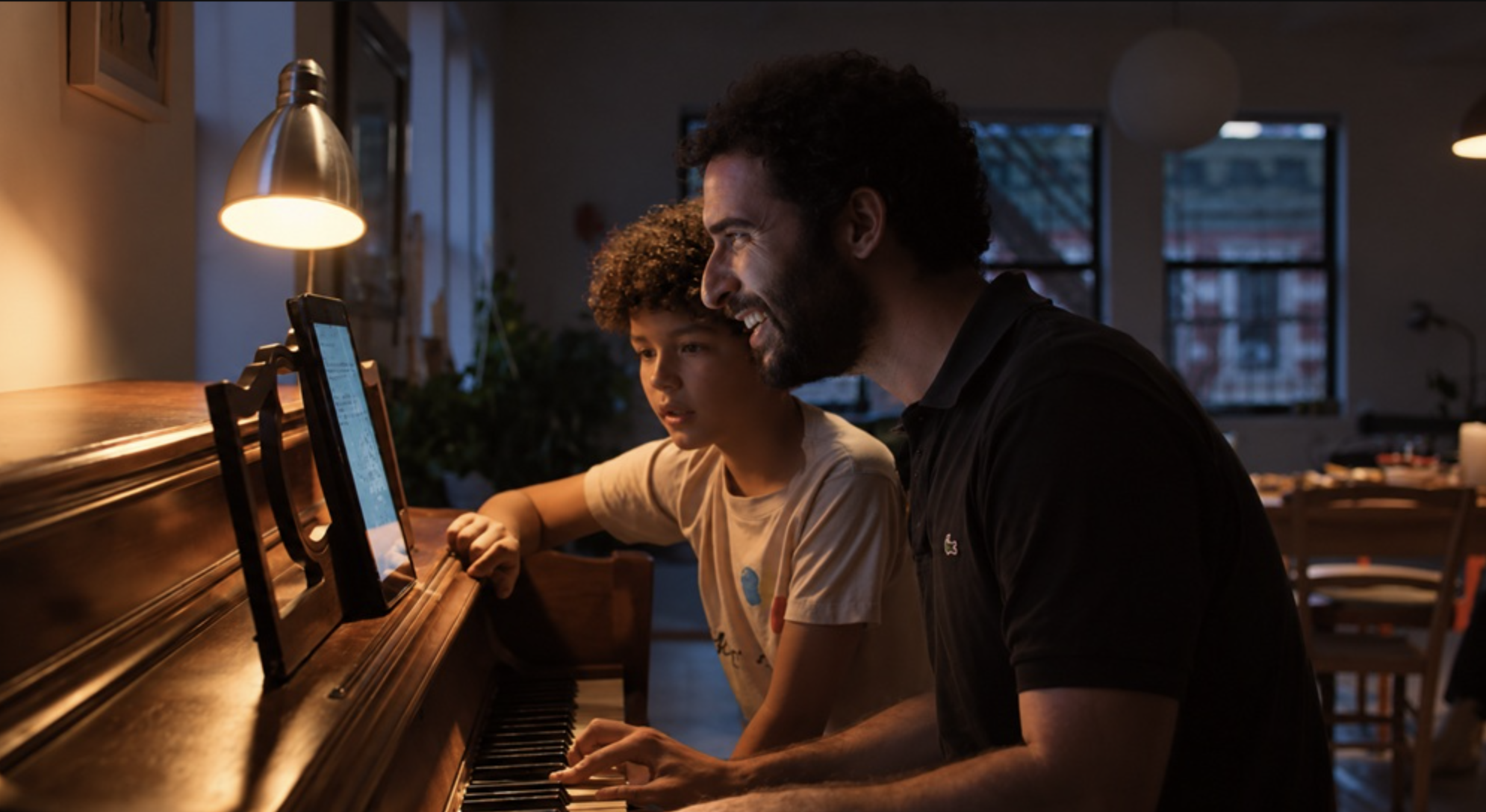
stills from CLUB KID (2026)
