
THE SECRET AGENT REVIEW: KLEBER MENDONÇA FILHO’S MOST TRIUMPHAL THRILLER YET
editor MAREK BARTEK
Kleber Mendonça Filho has always had a talent for making menace feel domestic. In Neighbouring Sounds it crept through apartment corridors and gated streets; in Aquarius it arrived as polite harassment costumed as progress. With The Secret Agent, he turns that sensibility into something bigger, stranger, and more intoxicating: a political thriller that feels almost like a fever dream, shot through with absurd humour, bursts of violence, and a deep affection for the mundaneness of everyday life. Set in 1977 Recife, under Brazil’s military dictatorship, the film opens with an ominous understatement: “a period of great mischief.” It’s a line that lands like a smirk, because Mendonça Filho knows exactly how authoritarianism operates. It isn’t always enforced through a parading spectacle, but through routine, intimidation, and the quiet, continuous normalisation of rot.
all images THE PUBLICITY COMPANY
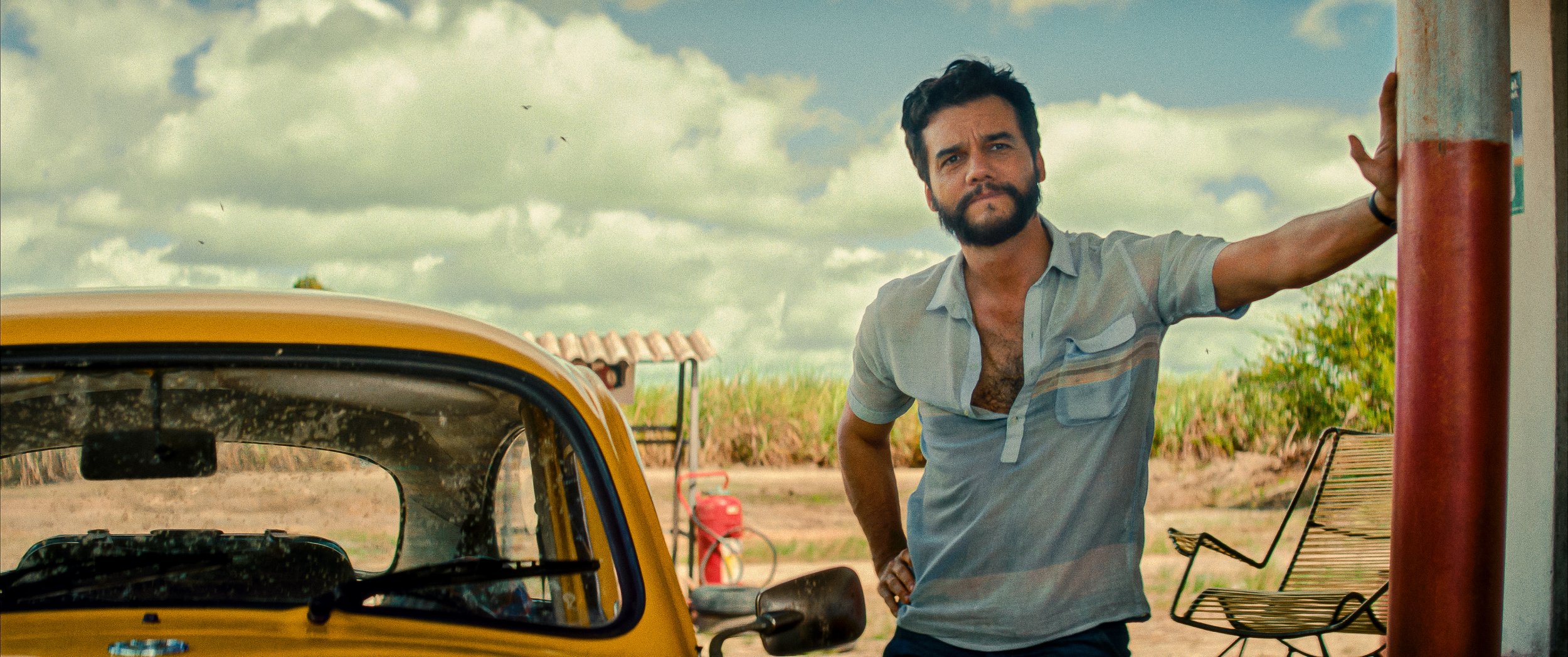
The opening sequence is one of the year’s best: Marcelo (Wagner Moura), travelling under an alias, stops at a rural petrol station where a corpse lies in the dirt, half-covered by cardboard with flies circling on it. The police arrive, uninterested in the dead man but deeply invested in shaking down the living. It’s grim, grotesque, and somehow almost humorous in a very queasy manner, making you feel immediately guilty that you even for a second considered it entertaining. Mendonça Filho’s genius lies in that discomfort. His dictatorship isn’t staged as a distant historical lesson — it’s an atmosphere. It’s dust, sweat, bureaucracy, bribes, and the constant sense that language itself has become dangerous. People talk around what they mean because someone might be listening.
Marcelo eventually reaches Recife in a bright Volkswagen Beetle, slipping into a city vibrating with Carnival energy: music, bodies, colour, beer, sex, and celebration as if joy itself were an act of defiance. Yet death keeps interrupting the party. Marcelo is a former academic, recently widowed, trying to secure forged documents so he can flee Brazil with his young son, Fernando, who is staying with his grandparents. The details of his past arrive slowly in fragments, as though the film is assembling itself from scattered files. Mendonça Filho structures the story like memory — incomplete, evasive, sometimes contradictory — and even moves to a moment of digitalising the archival contents that suggest the future will have to reconstruct this era from recordings, clippings, and damaged testimony.

If Marcelo is the quiet centre, the film’s real thrill is its sprawling ensemble: Dona Sebastiana (Tânia Maria), the chain-smoking guardian of a refugee safe house, is a saint, a street philosopher, and an unforgettable character. Corrupt cops circle like vultures, including the grotesquely charismatic chief Euclides, whose small-time cruelty embodies how authoritarianism survives: through men who treat power like a personal hobby. Hitmen drift in from São Paulo. Bureaucrats flirt lazily in fluorescent offices. Udo Kier appears as a Holocaust survivor, his body marked by history, and his presence a reminder that fascism repeats itself, if allowed.
And then there is the leg. A severed human leg, discovered inside a shark, becomes the film’s running grotesque joke and political metaphor, fuelling local hysteria and even morphing into a surreal stop-motion horror sequence that plays like midnight cinema inserted into a prestige drama. Jaws is screening in town, naturally. Mendonça Filho isn’t mocking tragedy; he’s exposing the absurdity of living under repression, where the horrifying becomes everyday’s normal, and the ridiculous becomes the only safe way to speak.
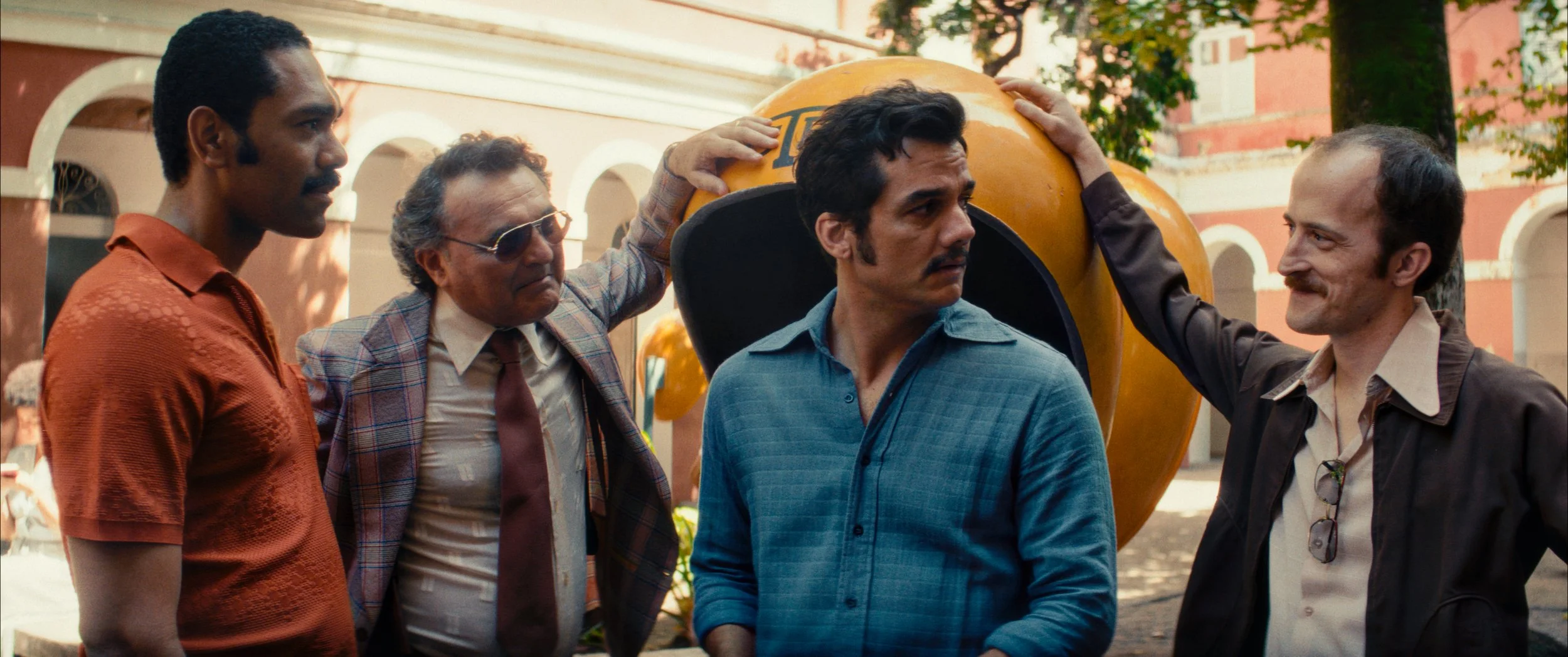
Moura’s performance is remarkable precisely because it refuses grandstanding. He plays Marcelo with a watchful softness, a gentle decency that feels almost radical in a world designed to crush it. He isn’t a revolutionary archetype, nor a heroic action figure — the title is ironic that way. He’s simply a man trying to survive, trying to remember, trying to leave.
At nearly three hours, The Secret Agent is expansive, sometimes deliberately unruly, but never indulgent. It moves with shaggy confidence, drifting away from plot to linger on faces, songs, street corners, the humid air of Recife itself. By the time it reaches its final recall of loss and unfinished history, the film feels less like a thriller than a living archive — a reminder that dictatorships don’t just kill people, they try to erase them. Mendonça Filho’s answer is cinema that refuses to forget.