
ALI CHERRI EXPLORES THE POLITICS OF SEEING IN ‘SOUL WITNESS’ AT WIELS
words by EMMA CLARKSON
"We are all witnessing, all the time. And even if we are witnesses it doesn't necessarily mean that we truly understand. And even if we understand it doesn't necessarily mean that we are able to do much about it," curator Helena Kritis shares, as she leads us into the first gallery at WIELS. It is a statement that serves as a quiet thesis which unfolds as one moves through Soul Witness, Ali Cherri’s major solo exhibition. Across two floors and five rooms of the former industrial brewery, the role of the spectator is exposed, observed, and interrogated.
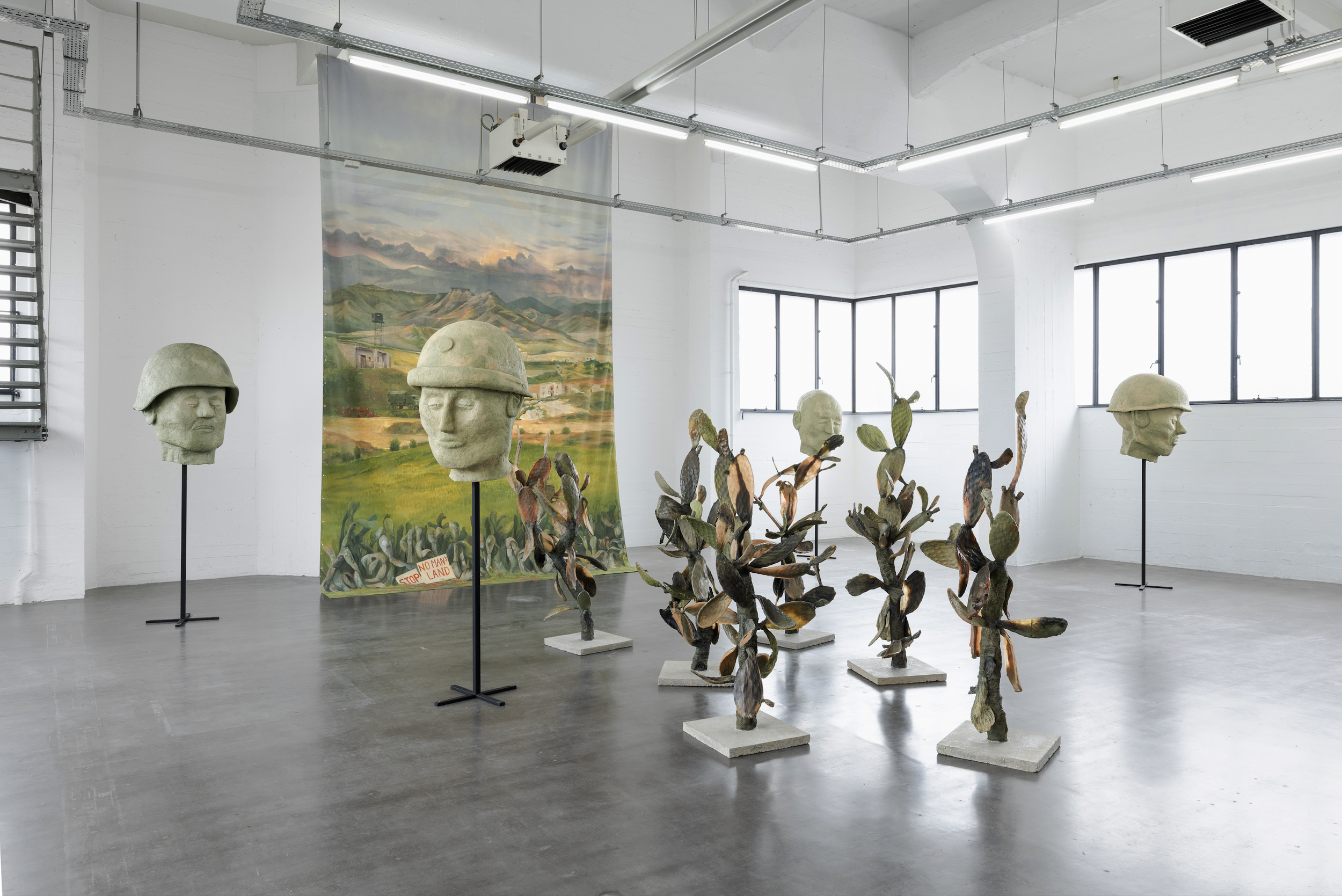
Exhibition view of ‘Ali Cherri: Soul Witness’, WIELS, Brussels, 2026. Photo: Eline Willaert
In the opening gallery, a large three-channel video plays on a loop across three expansive screens. A multilingual narration — moving between English, French and Arabic — recites creation myths from across various religions and cultures, each recalling primordial tales of humans being sculpted from earth. The work, Of Men and Gods and Mud (2022) is the same eighteen-and-a-half-minute-long video work that earned Cherri the Silver Lion Award at the 59th International Art Exhibition of La Biennale di Venezia. Shot in Northern Sudan, the camera lingers upon brick makers as they carve their essential building blocks from the wet clay, firing them on open kilns kindled by dry bush, as smoke drifts up towards a beating sun.
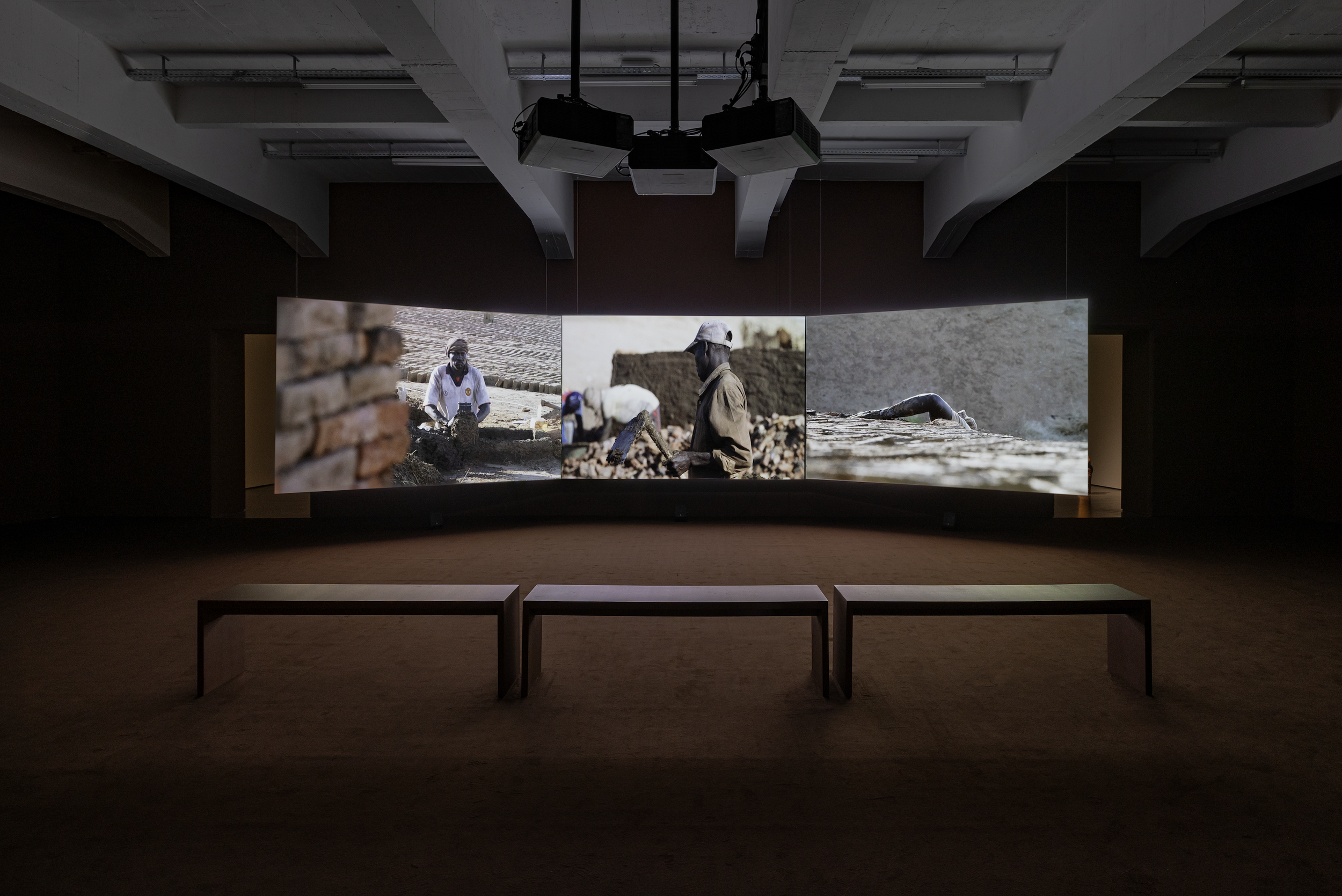
Exhibition view of ‘Ali Cherri: Soul Witness’, WIELS, Brussels, 2026. Photo: Eline Willaert
In the middle distance, the Merowe Dam, looms silently over their labour. As Africa's largest hydroelectric plant, constructed on the River Nile in the early 2000s, the dam's creation and presence is a testament to structural violence: found responsible for the displacement of over 50,000 people, massive ecological breakdown, and has been credited with the flooding and ultimate submersion of Nubian cultural sites and historical artefacts.
Cherri was born in Beirut in 1976, and grew up in parallel with the severe violence of the Lebanese Civil War (1975–1990) and within the capital's booming post-war art scene. Now Paris-based, Cherri has developed an oeuvre which lends a soft-handed focus to the individuals and objects upon whose lives, histories and landscapes, state or institutional violence is etched upon.
Moving further into Soul Witness, it becomes apparent that within Cherri's work there is an intentional choreography: major institutions of authority — the nation-state, the military, the museum — create the backdrop. Anchoring each frame are those who have their lives defined by the terms of the establishment, as they, in turn, attempt to erode the symbols and materials of power through any means available. Simultaneously, Cherri functions as an archeologist, unearthing myths and relics which themselves act as custodians of historical trauma.
This duality reaches a crescendo in the adjacent darkened gallery. Four hybrid sculptures stand arranged in the corners, staring inward toward two towering humanoid figures at its centre. These assemblage works merge mud-molded bodies with masked faces — sourced from England, Nigeria and Mesopotamia, to name a few — which Cherri has acquired through several visits to various auction houses.
“He undoubtedly purchased some objects that weren't real — they're forgeries,” Kritis explains, “but that wasn't really the main point for him; even those fake objects actually possess a certain kind of value, depending on when and why they were made. So, during a number of museum residencies, he brought in the objects — whether genuine or not — and gave them a place within the institution of the museum.”
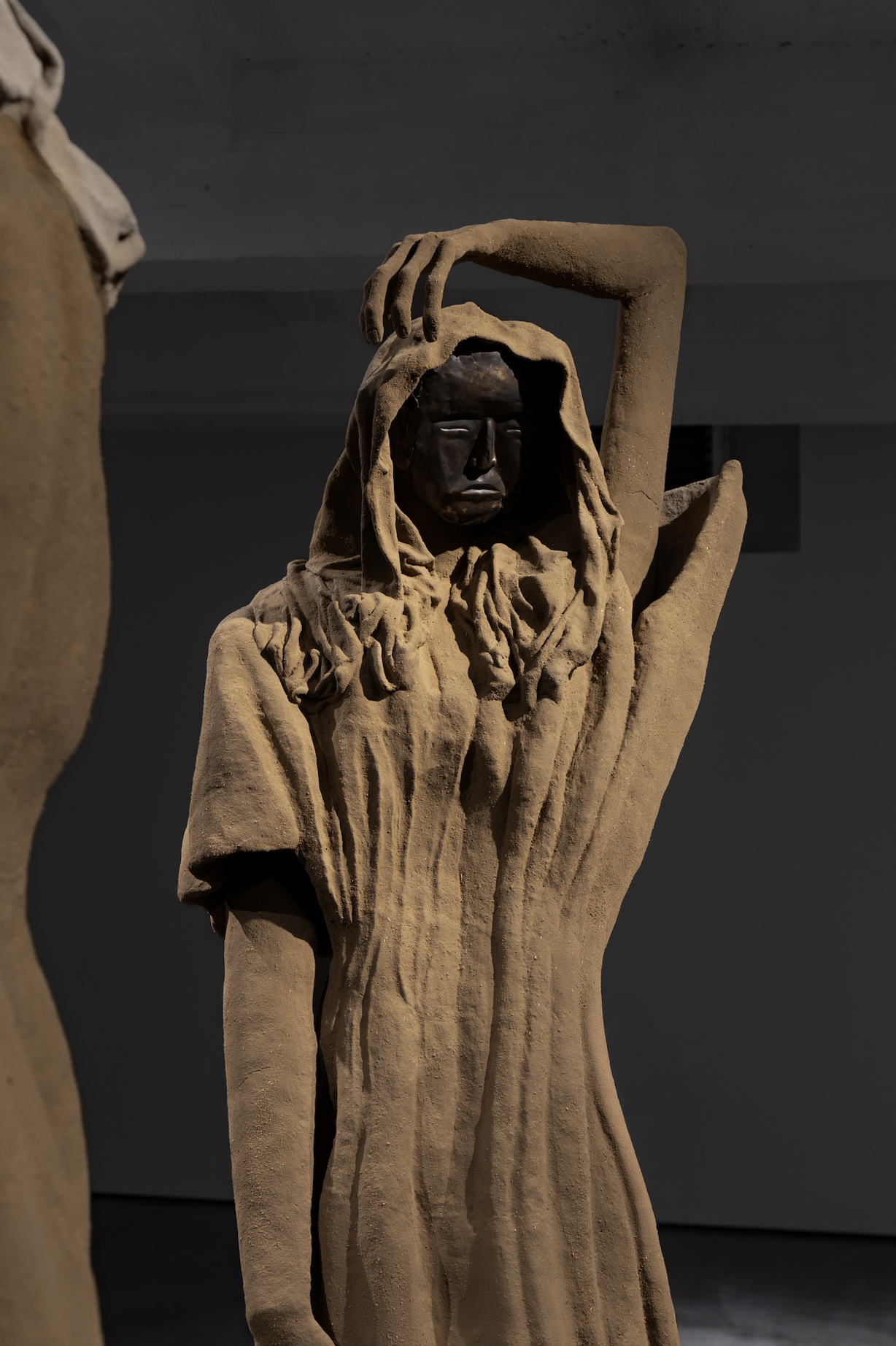
Exhibition view of ‘Ali Cherri: Soul Witness’, WIELS, Brussels, 2026. Photo: Eline Willaert
At the centre of the tableau stand two gestural, cloaked figures titled The Earth Heard Their Lament (2026). They evoke professional mourners — a ritual occupation rooted in the SWANA region, where women are hired to vocalize collective grief and guide communities through public anguish. Surrounding them are other Cherri's statues that become witnesses of witnessing, blurring the invisible boundary between authenticity and fabrication.
The remainder of the exhibition takes the original thesis and builds up this question around a particular, and perhaps contentious, 'spectator': the soldier. A recurring motif throughout Cherri's work, (perhaps a relic of his having grown up in militarised Lebanon), his soldiers often deconstruct the rigid masculinity expected of and enforced by the military fabric. Smaller, slighter, wider-eyed, and occasionally asleep, these men are not easily extracted from the structures they represent, but instead are stuck between the two currents of being actors and tools for the oppressive military or nationalist structures, and living as citizens at the whim of the establishment.
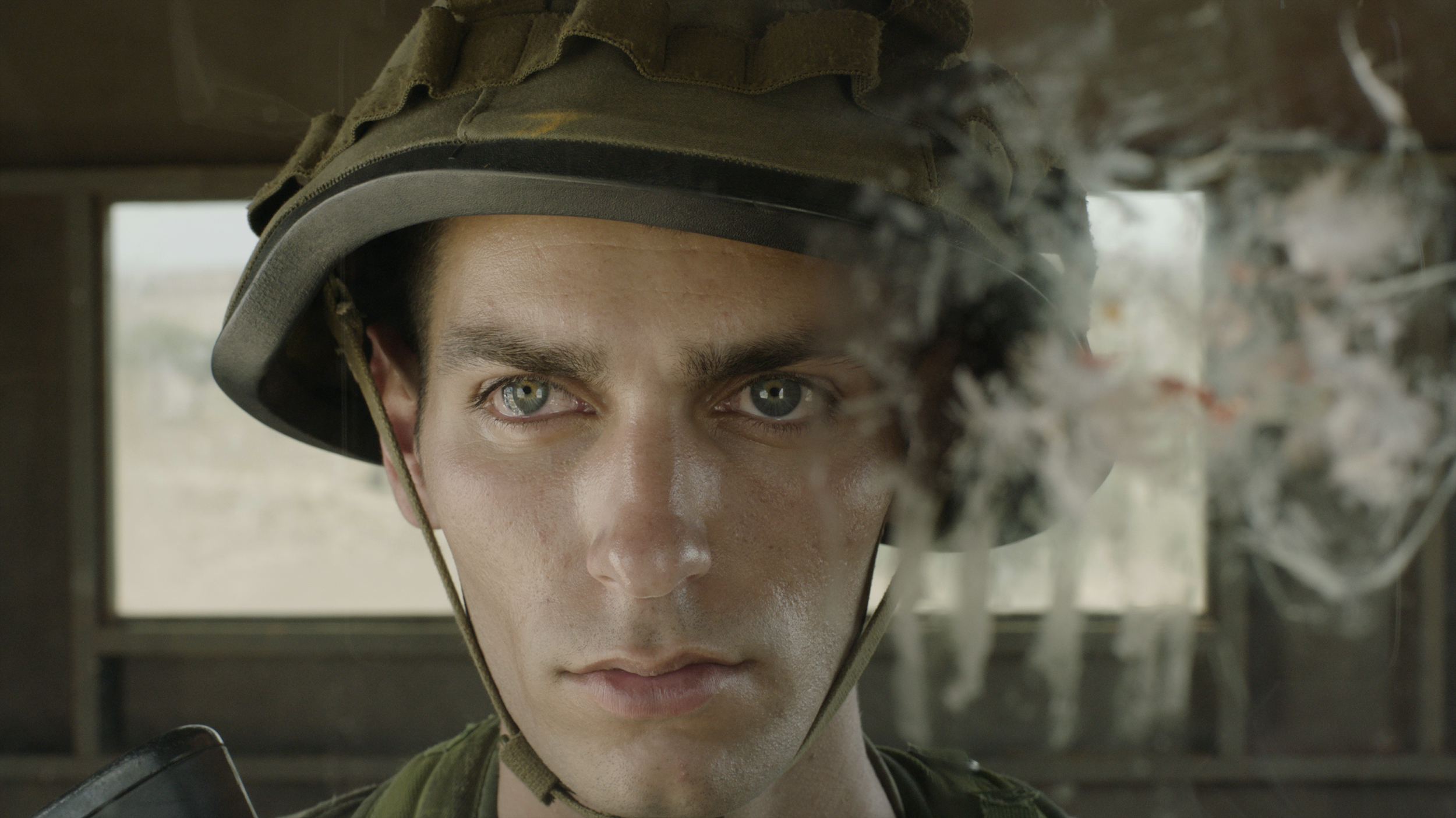
Ali Cherri, still from The Watchman, 2023. Courtesy of the artist, Fondazione In Between Art Film and Galerie Imane Farès
Two separate videoworks The Sentinel (2026) and The Watchman (2024), observing a French and Cypriot soldier respectively, differ more than they are alike. The first is highly staged, dream-like and watch the fictitious Sargeant Lafleur on Bastille day as he follows his doctor's (played by none other than footballer Éric Cantona) orders to spend an evening off duty after an incident at work. The second videowork, The Watchman orbits instead around a remote watchtower along Cyprus' divided border's buffer zone, as a weary soldier's perception is brought into question. Through day dreaming, dozing off, and essentially failing as watchmen, the two soldiers resist, through these micro-gestures, their roles as instruments of violence.
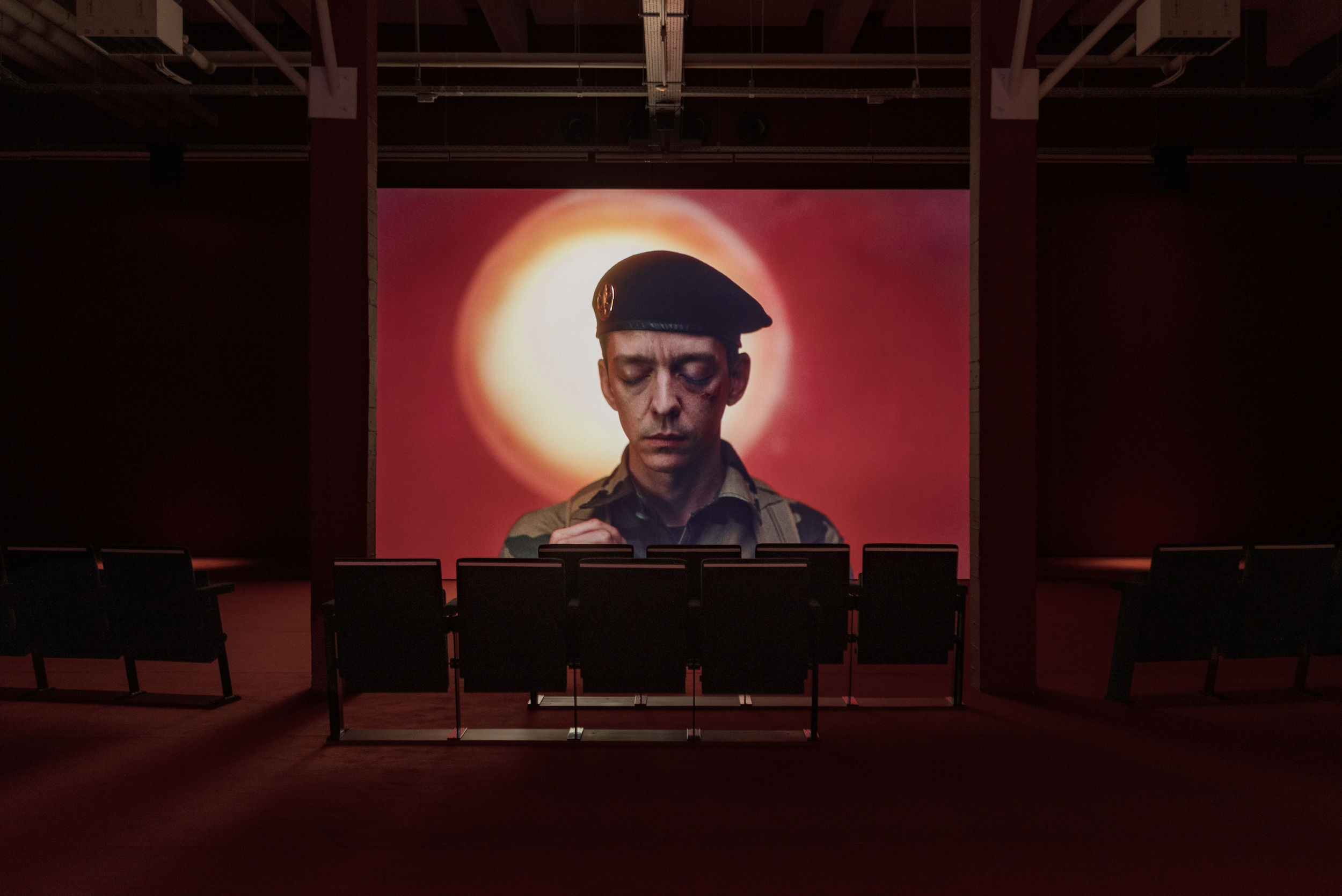
Exhibition view of ‘Ali Cherri: Soul Witness’, WIELS, Brussels, 2026. Photo: Eline Willaert
Ultimately, Soul Witness forces a confrontation with our own contemporary condition. In an era where hyper-mediacy turns every screen into a micro-doser of brutality interrupted by recipe videos, we are pushed into a state of perpetual observation. Through his use of the soldier, Cherri dismantles the false hierarchies that neatly separates the establishment and the inhabitant, the active perpetrator from the passive onlooker, revealing how impossible it is to separate. This is the tension at the heart of Soul Witness, one which insists on an understanding that to exist is to witness, and to witness is rarely a neutral stance.