
PARIS FASHION WEEK FALL/WINTER 2026: DAY 3
COURRÈGES
review by ANOUK WOUDT
all images courtesy of COURRÈGES
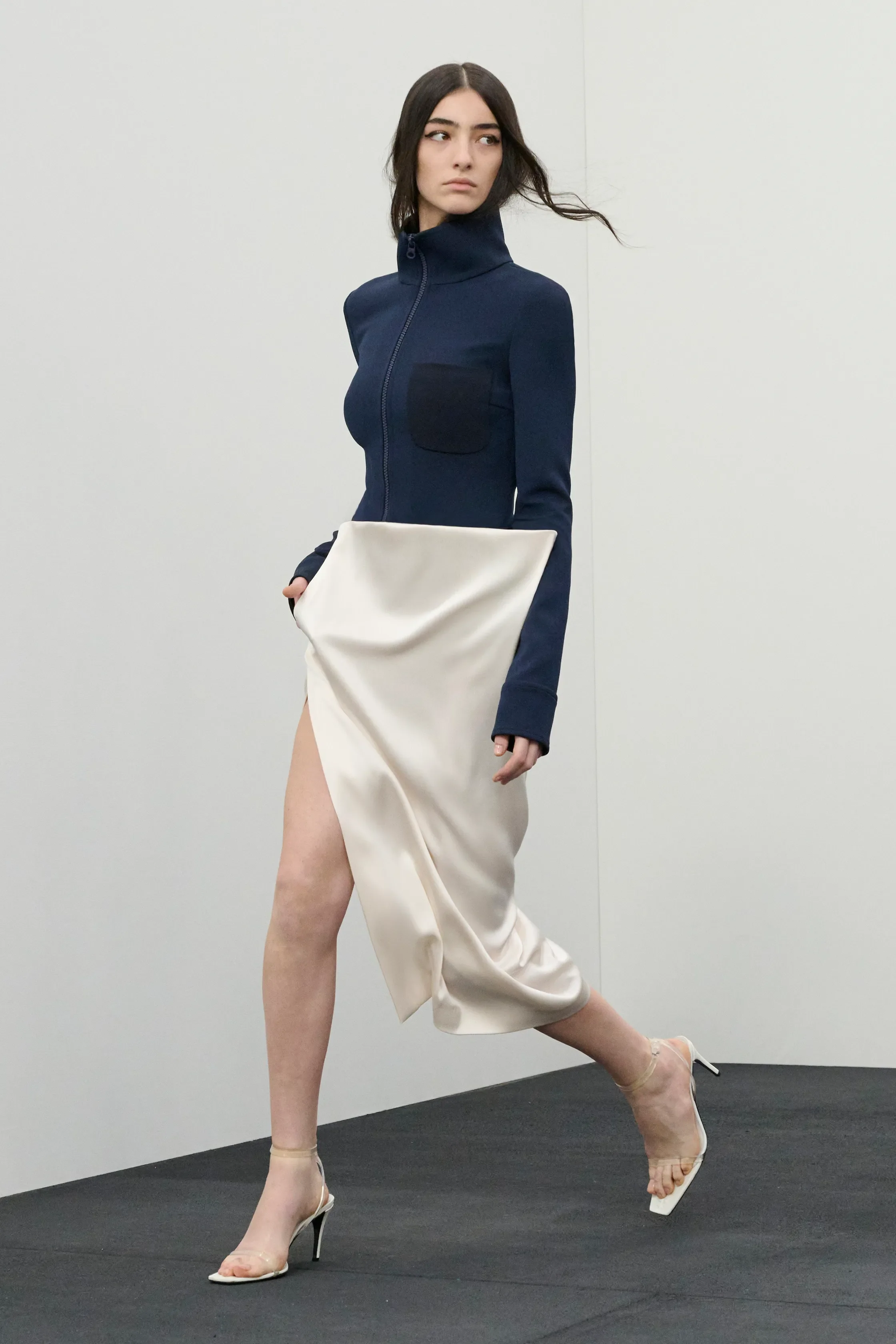
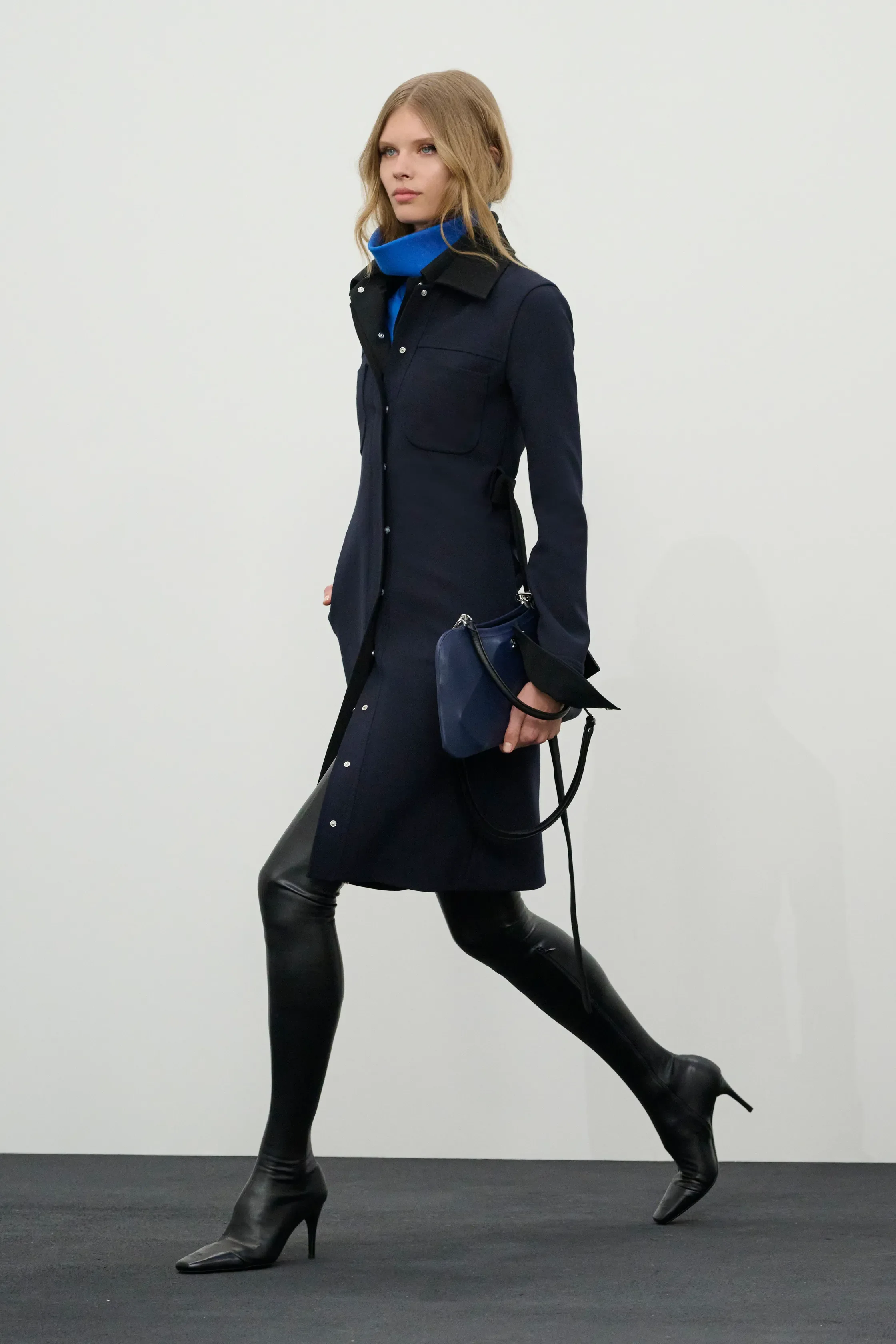
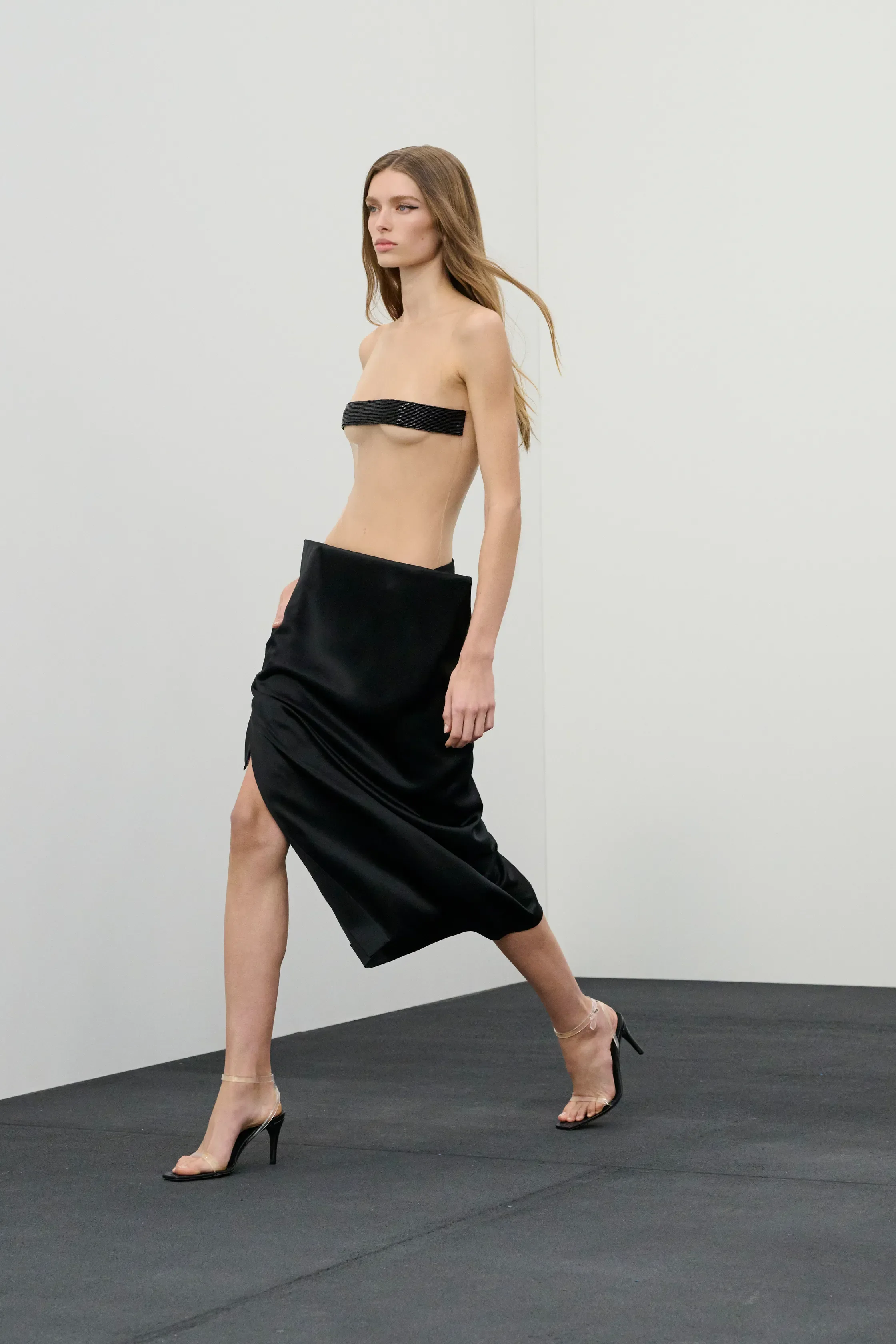
Ticking clocks and alarm bell rings overwhelm the atmosphere as you are suddenly ushered into an everyday woman’s routine. Keys jangle, metro speakers blare, cars gently hum– all of this immerses you directly into the bustle of the Parisian quotidien. There you are faced with Courèges’ fall collection, reframing the ordinary with dashes of retro-futurism. Overbearingly geometric silhouettes immediately take to the runway– in classic Courrèges fashion– though they manage to keep a certain casualness through their sophistication. Bringing in the drama, high-cowled necks and slits crowd the collection, which is only accentuated by retro squared sunglasses and heightened stilettos.
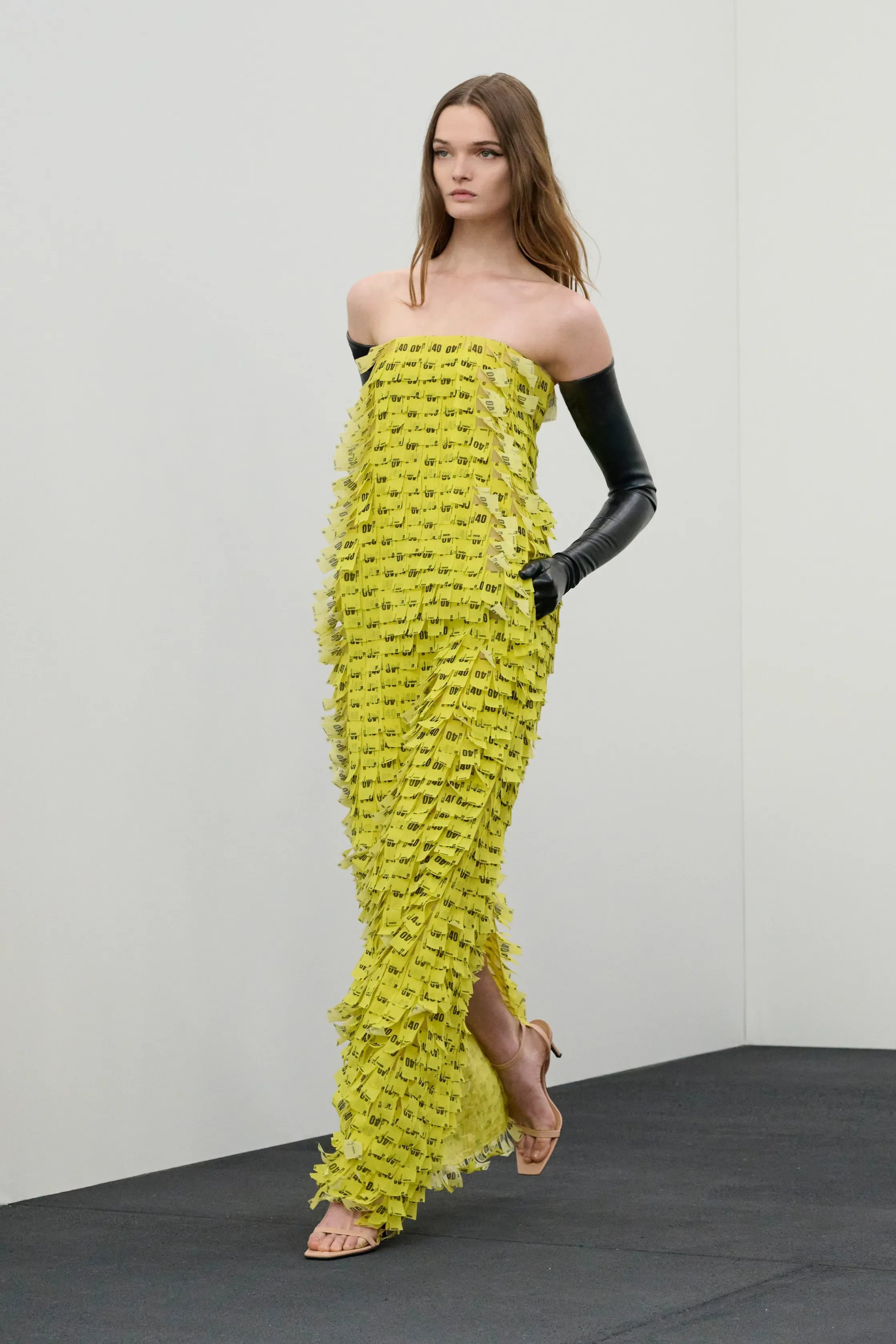
Materials are varied, giving us latex and reflective gleams amongst structured cotton and woolly turtlenecks. All-black looks sometimes border on Matrix territory with long trenches and a futuristic bite. Emerging through the depths of routine, garments made entirely of bright coat checks appear. The soft paper fluttering adds a mesmerizing dimension, immediately standing out among its orderly peers, serving as both the complete embodiment and disintegration of daily monotony. Throughout it all, the most intriguing moment comes at the show’s close, with each look trailing out in its white counterpart, catching you completely off guard with a clean slate to start the day anew.
Celebrating five years under tenure, Nicolas Di Felice continues to amaze us as he deservedly positions himself as the driving force of the house’s revival, after falling from its heights in the early ‘60s. Imbuing André Courrèges’ creative style while tweaking it for the modern audience, he manages to stay true to the house’s identity while keeping innovation near and dear to its heart– a motto this collection captures perfectly.
BALMAIN
review by FRANCESCO PIZZUTI
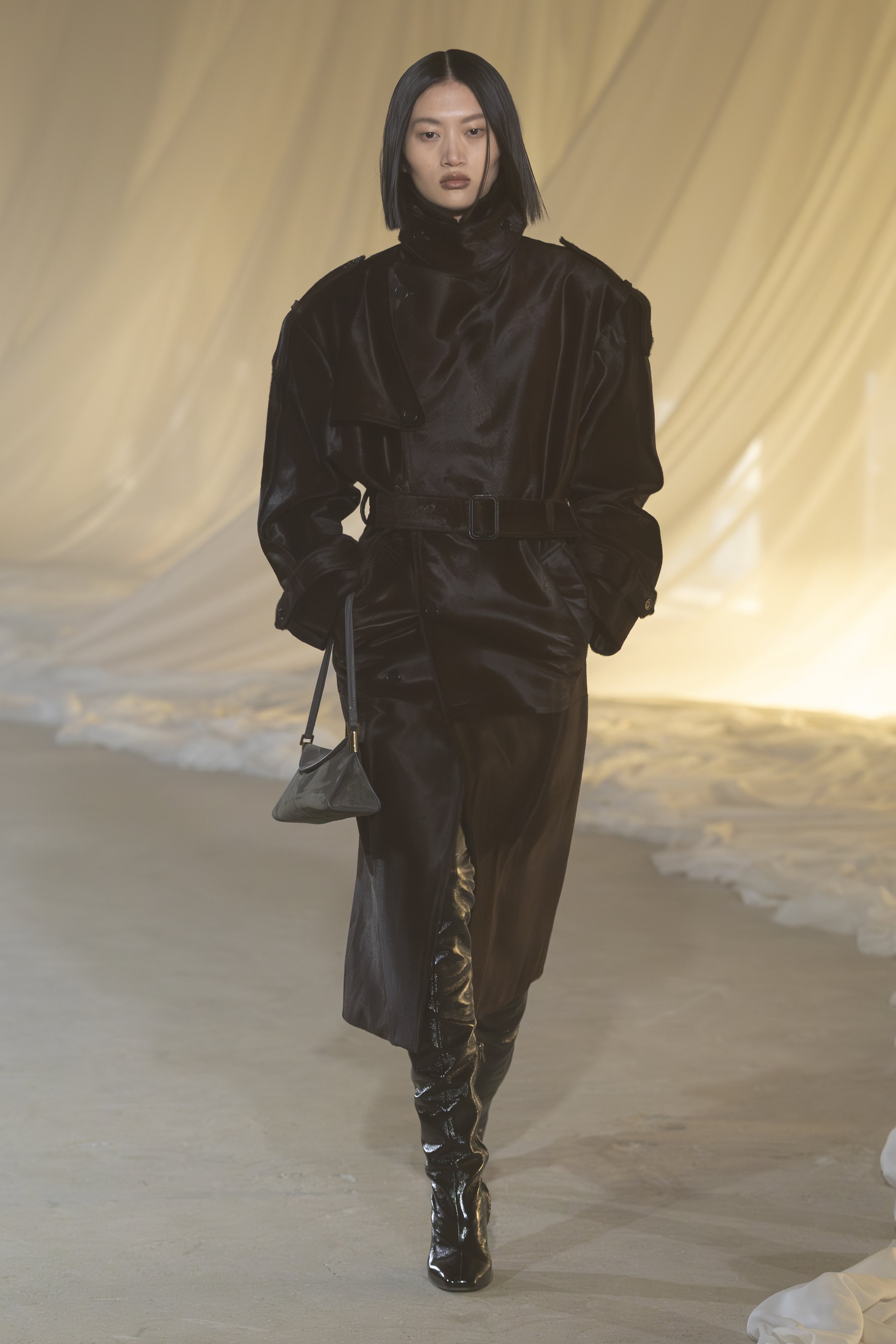
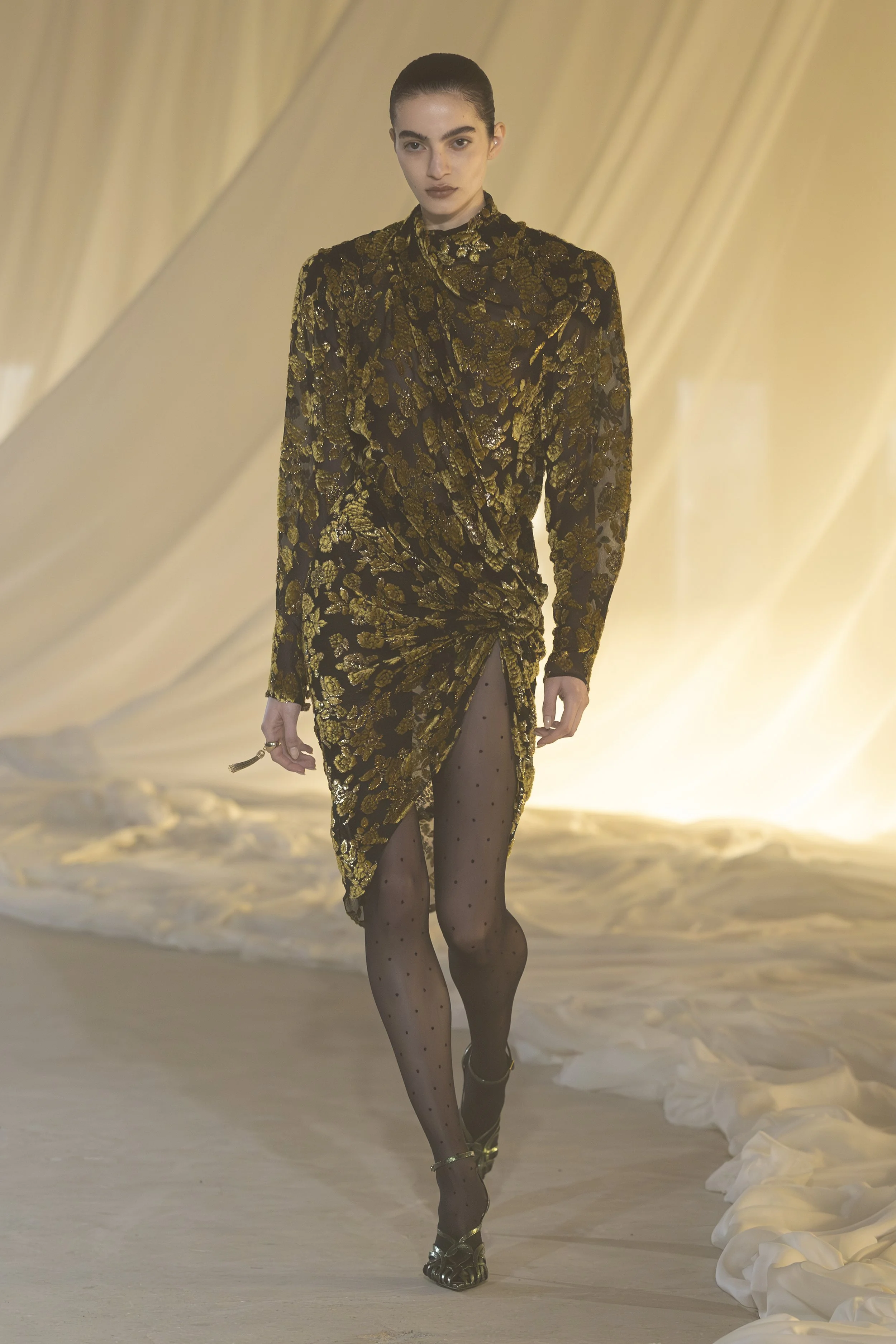
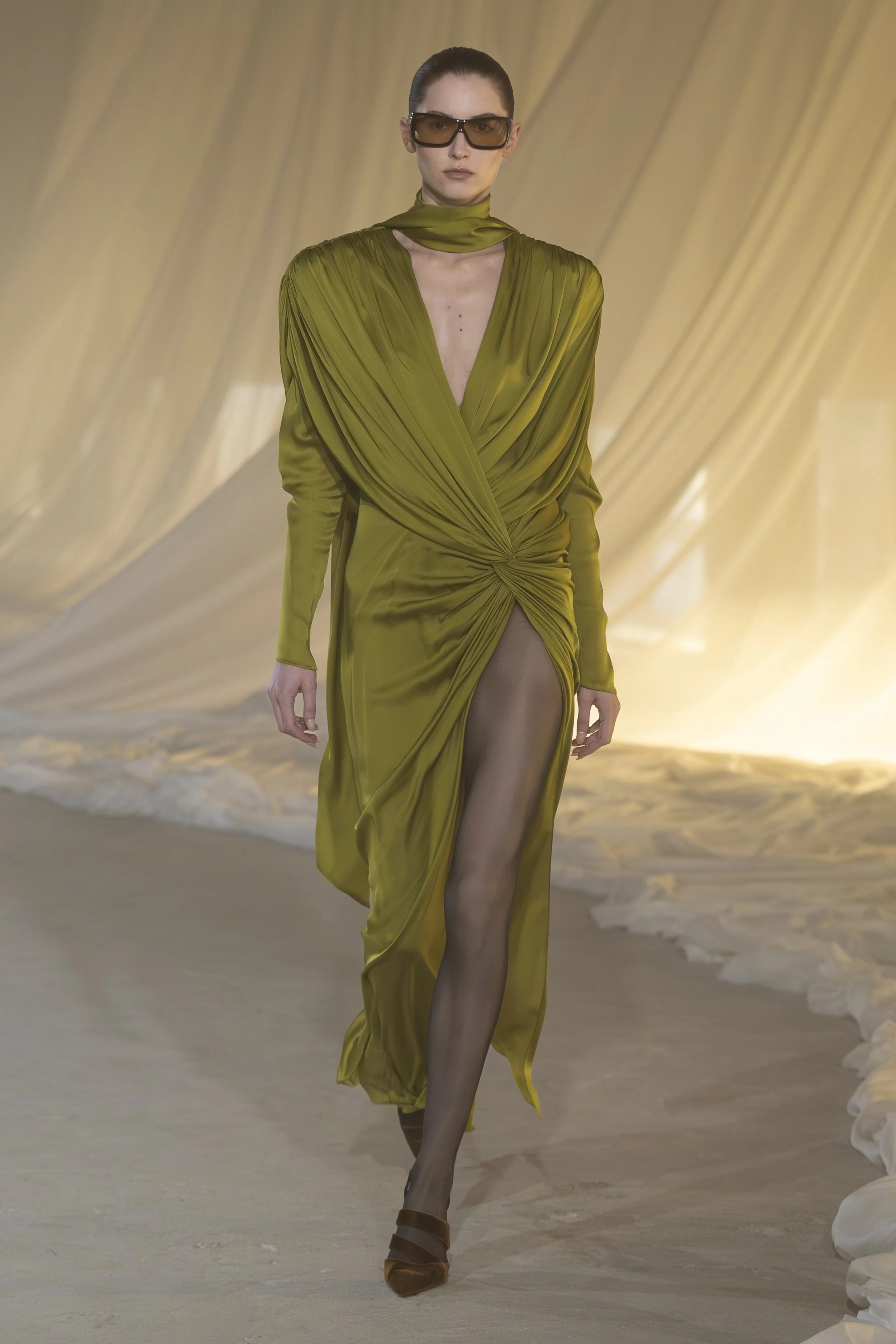
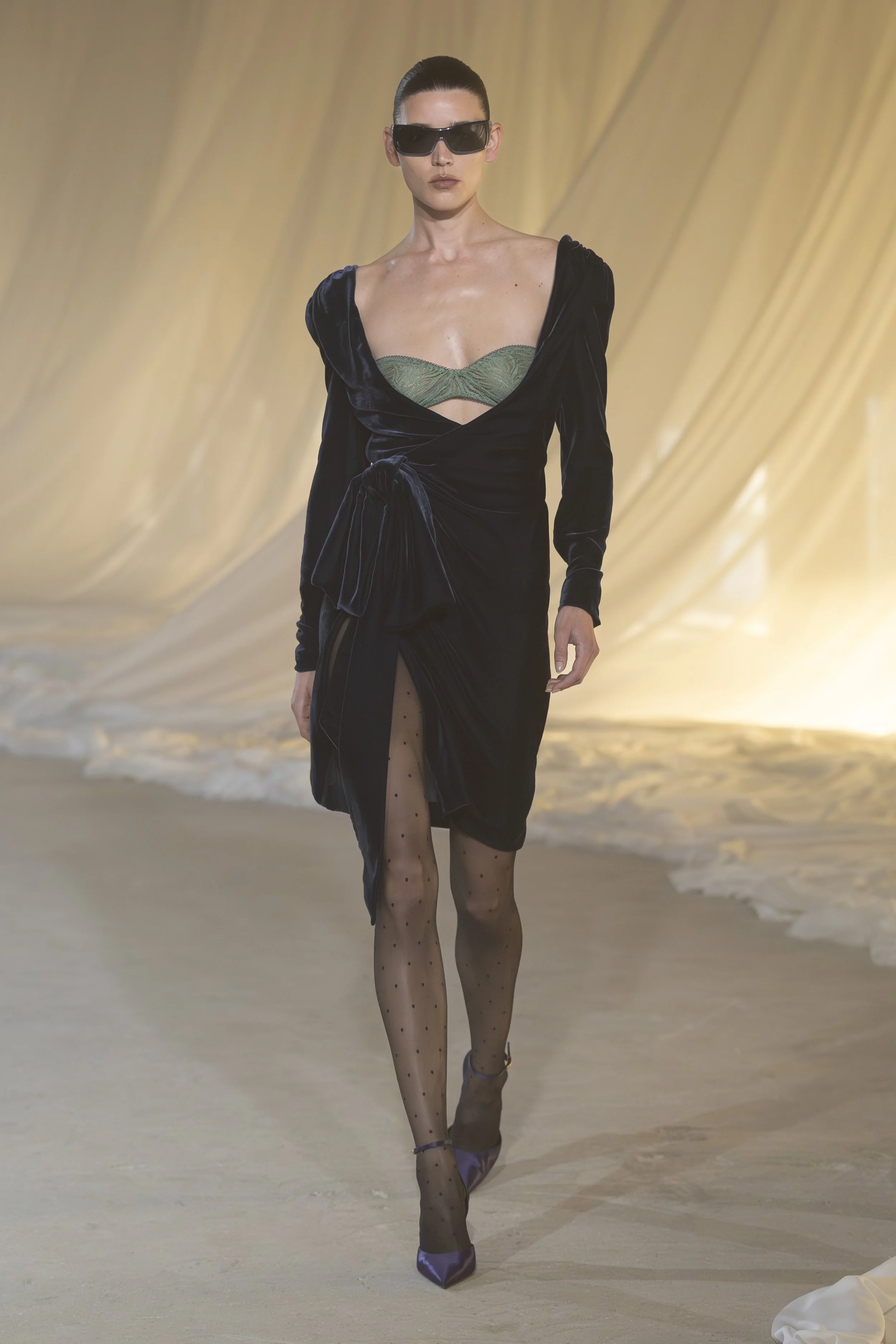
all images courtesy of BALMAIN
Antonin Tron delivered a cinematic debut at Balmain during his Fall 26 show that unfolded like a carefully composed scene. White drapes enveloped the space while the atmosphere shifted from dark and nocturnal to a room gradually flooded with sunlight. It was a fitting metaphor for the collection itself that revisited the house’s foundations through a more contemporary lens.
Drawing inspiration from Pierre Balmain’s vision in the mid-1940s, Tron tapped into what he sees as the essence of the house: the exaltation of the female form, expressed through opulence, power, and sculptural precision with sensuality undeniably at its core.
Silhouettes appeared one after the other: cinched waists, structured shoulders, and architectural lines that reshaped the idea of strength. Archetypal pieces associated with toughness were reimagined with elegance: bomber jackets tightened around the torso in corset-like constructions, while biker-like leather pants with knee padding, usually rigid, were softened into lighter and tailored forms. Throughout, rich gold hardware reinforced the opulent house codes, glinting from necklaces, belt buckles, and the handles of sharply designed bags.
Black dominated while occasional bursts of cheetah and tiger prints appeared across dresses, coats, and skirts, injecting notes of unapologetic luxury. Fringed hems heightened movement, amplifying the collection’s sensual essence, while 1980s influence was unmistakable with pronounced shoulder pads, dresses with tigethened wrists, and powerful silhouettes.
All in all, it was quite the sexy collection, flirting with questions like: what’s strength without sensuality and what’s opulence without restraint? Maybe this new era of Balmain will see this through.
DRIES VAN NOTEN
review by MAREK BARTEK
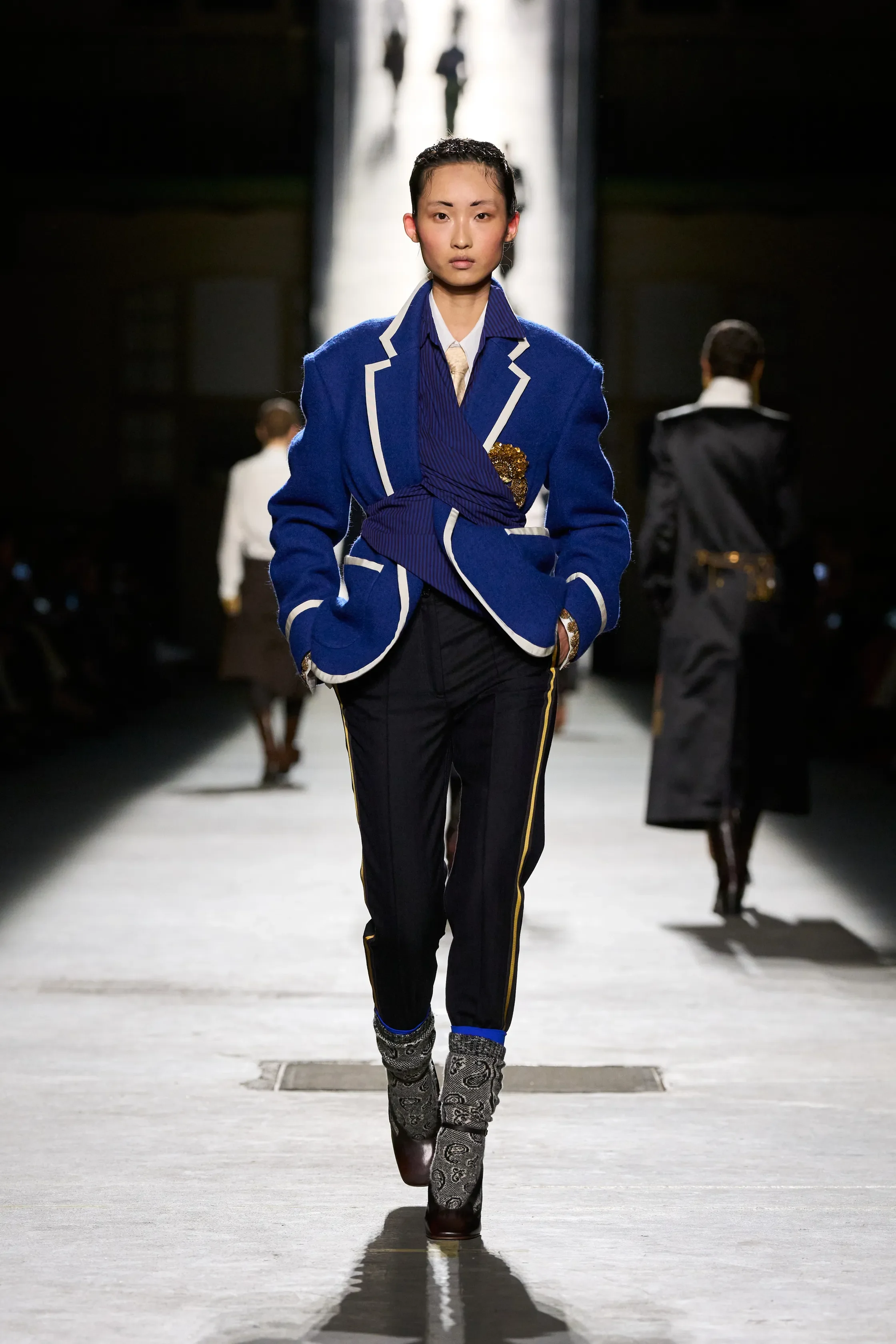
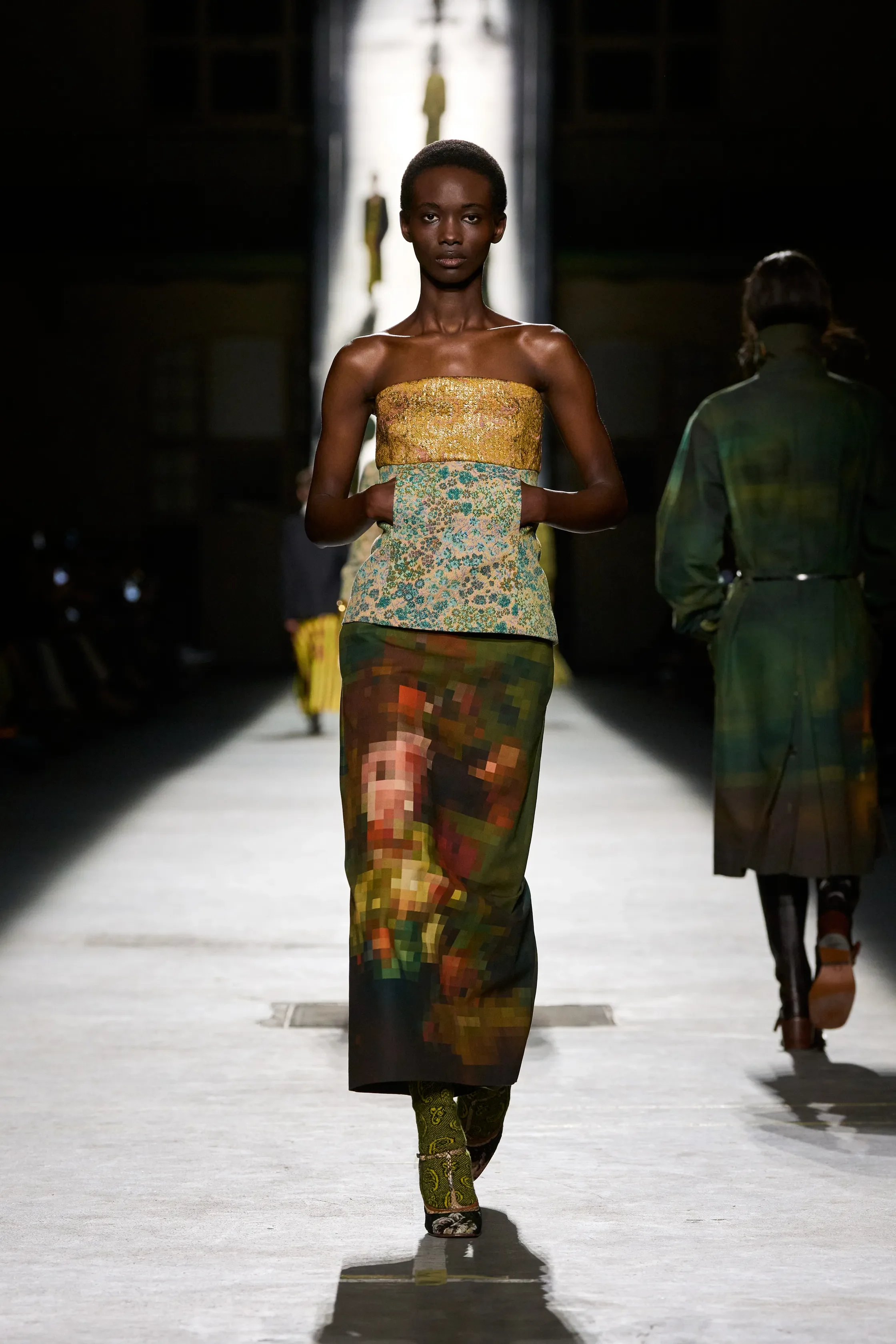
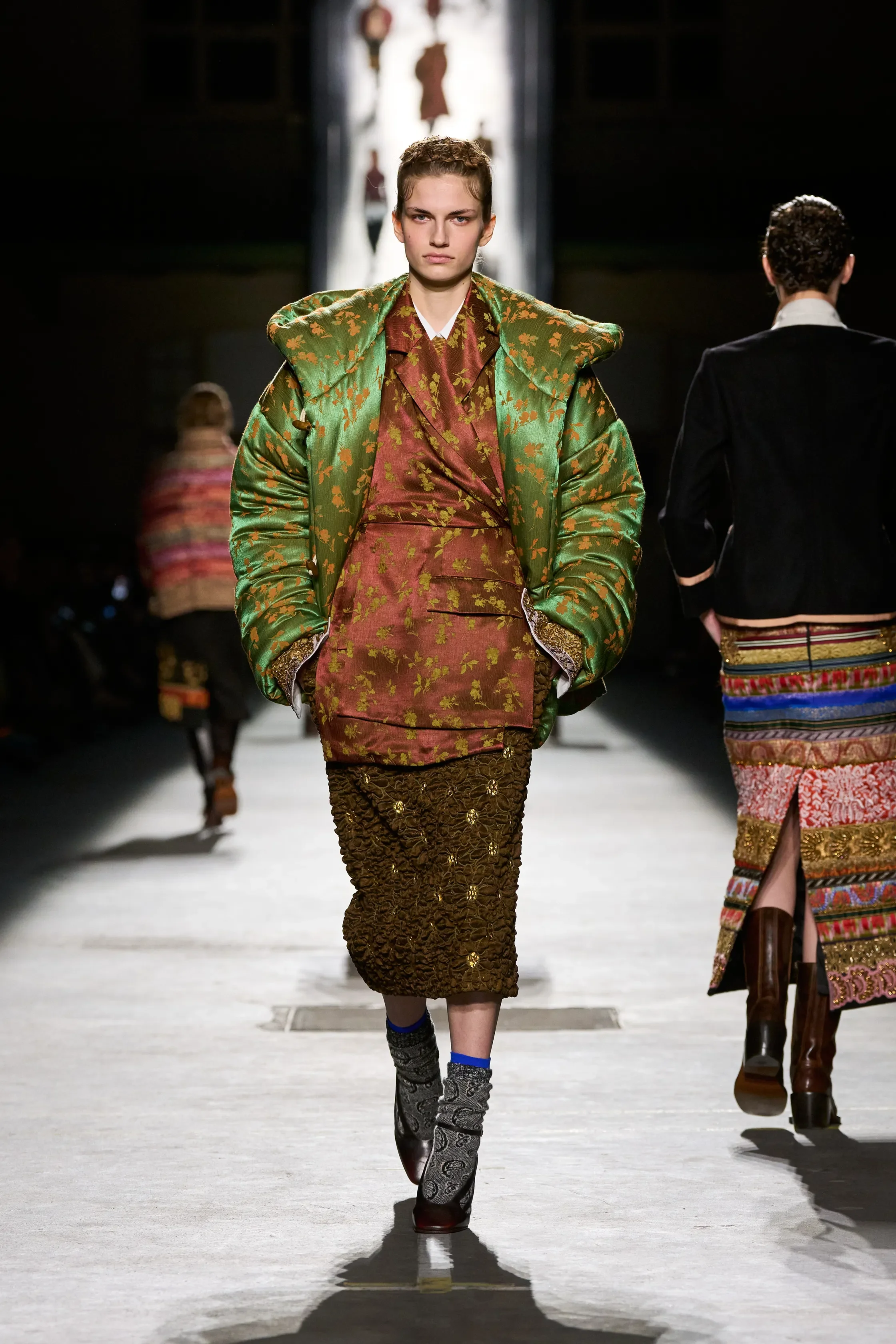
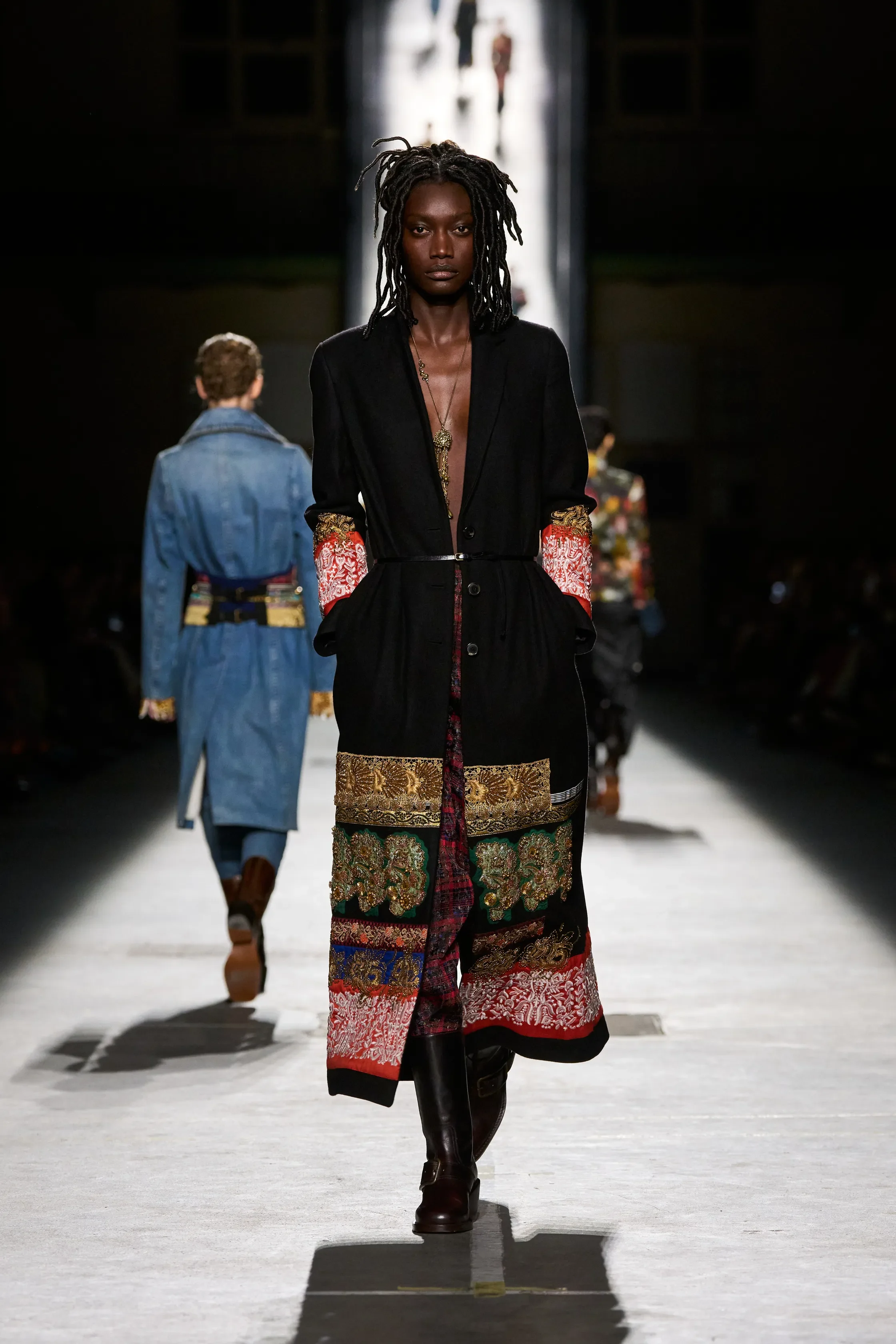
all images courtesy of DRIES VAN NOTEN
At Dries Van Noten, memory has always been a powerful design tool but Julian Klausner’s latest collection approached it with a lighter touch. Returning to the Lycée Carnot, the setting of house's historic show from the late 2000s, the designer revisited a place associated with adolescence, identity, and the peculiar theatre of people experimenting with identities though dressing up.
The opening looks hinted at the codes of school uniforms: precise tailoring, blazers, shirts and ties, and outerwear that felt slightly disciplined. Yet the order didn’t last long. Soon, the collection began to unravel into something more expressive, as if the rigid rules of a dress code were slowly being rewritten by the students themselves. Plaids clashed with delicate embroideries, denim appeared next to opulent jacquards, and varsity references collided with ornate textiles more commonly associated with eveningwear. Klausner seemed interested in the moment when experimentation begins — when a wardrobe becomes a testing ground for personality.
What made the collection compelling was the way these elements were layered rather than forced together. Jackets spliced with embroidered ribbons, coats combining rich fabrics with casual knit sleeves, and denim pieces adorned with intricate beading created the kind of visual tension that has long defined the Dries universe.
The soundtrack, featuring young Belgian jazz singer Gala Dragot, added another layer of youthful introspection, echoing the uncertainty and curiosity of adolescence. This most definitely wasn’t a collection about nostalgia — but a collection about possibilities. It felt lived-in, adaptable, and open to interpretation inviting the wearer to continue the story themselves.
STELLA MCCARTNEY
review by ANOUK WOUDT
all images courtesy of STELLA MCCARTNEY
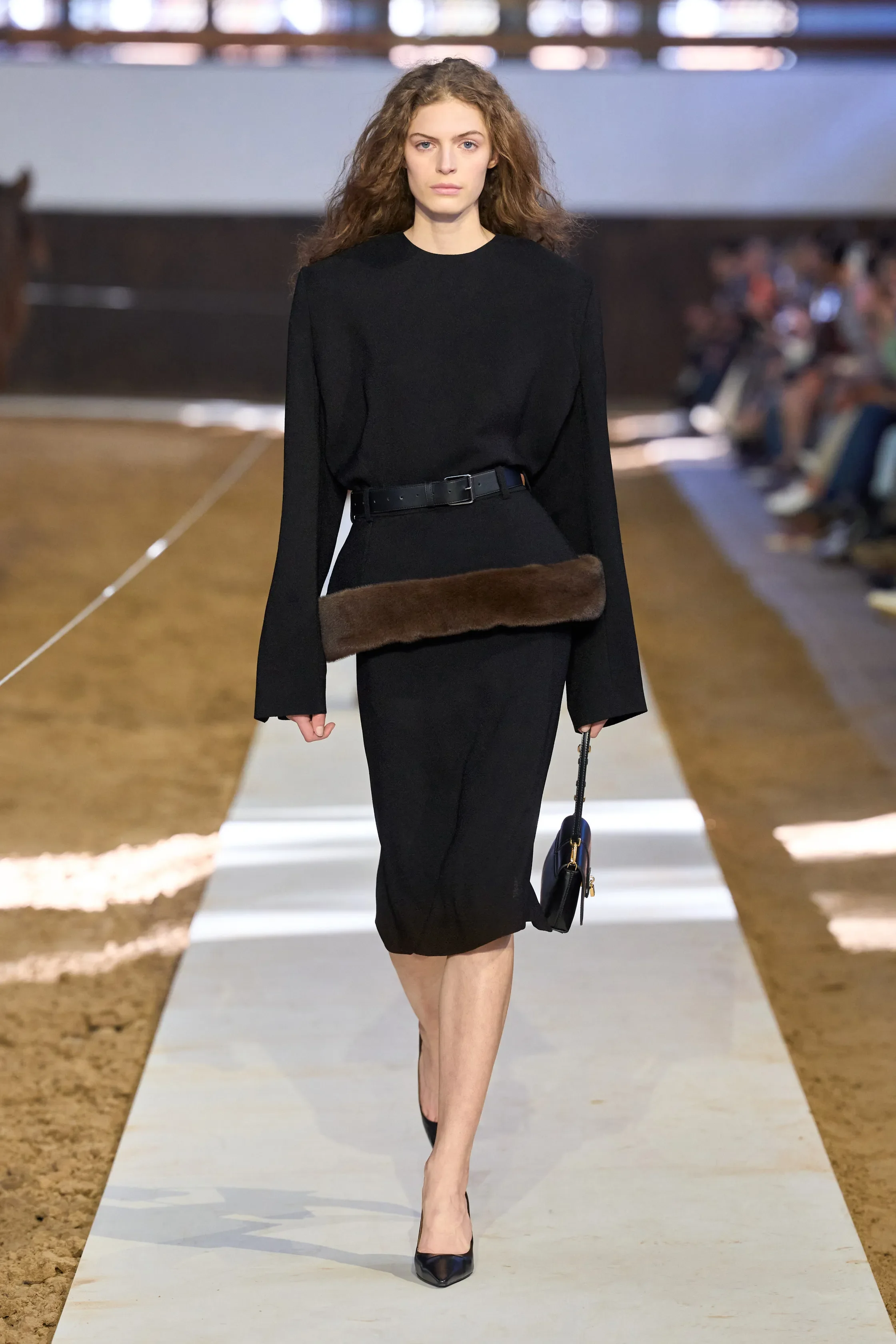
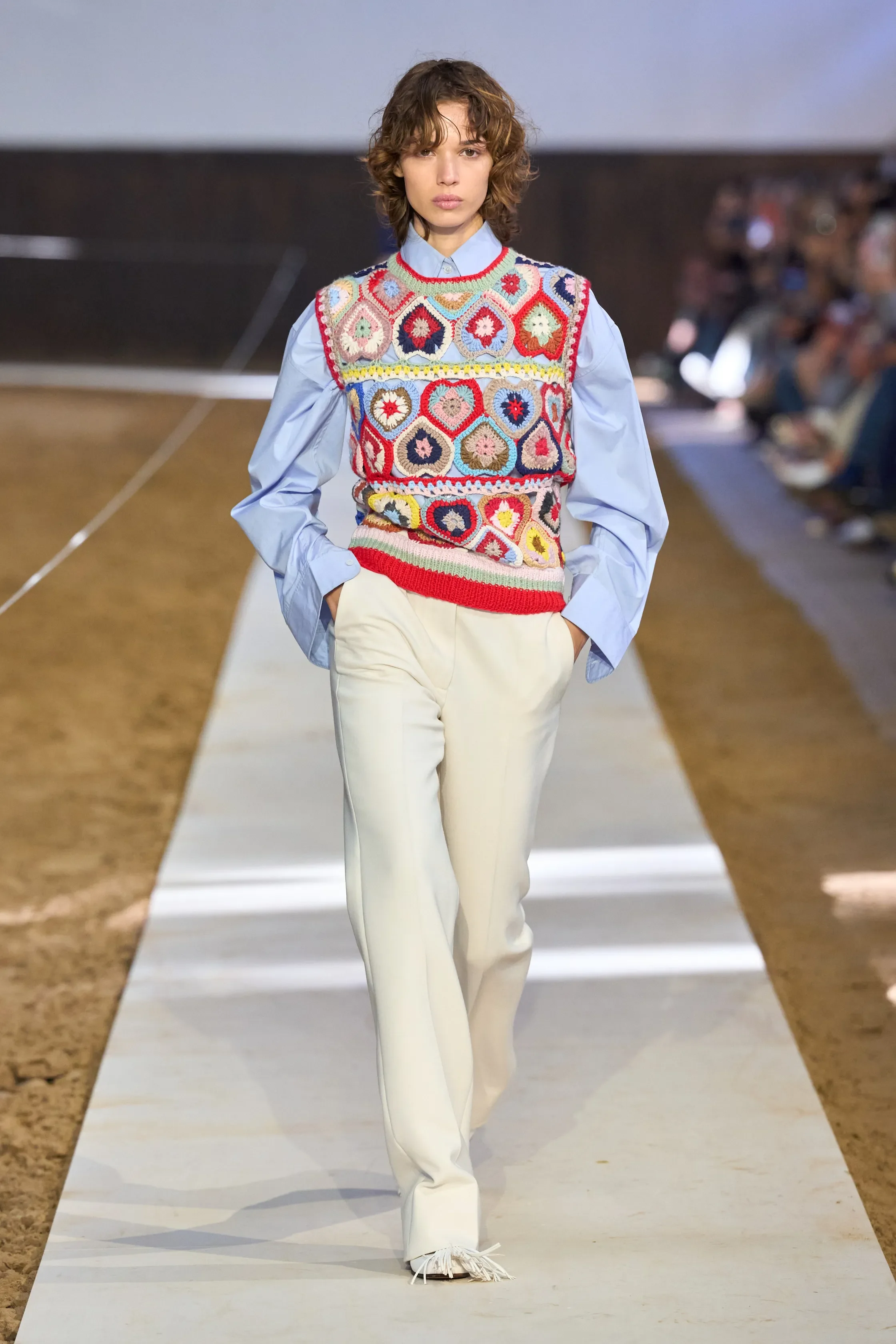
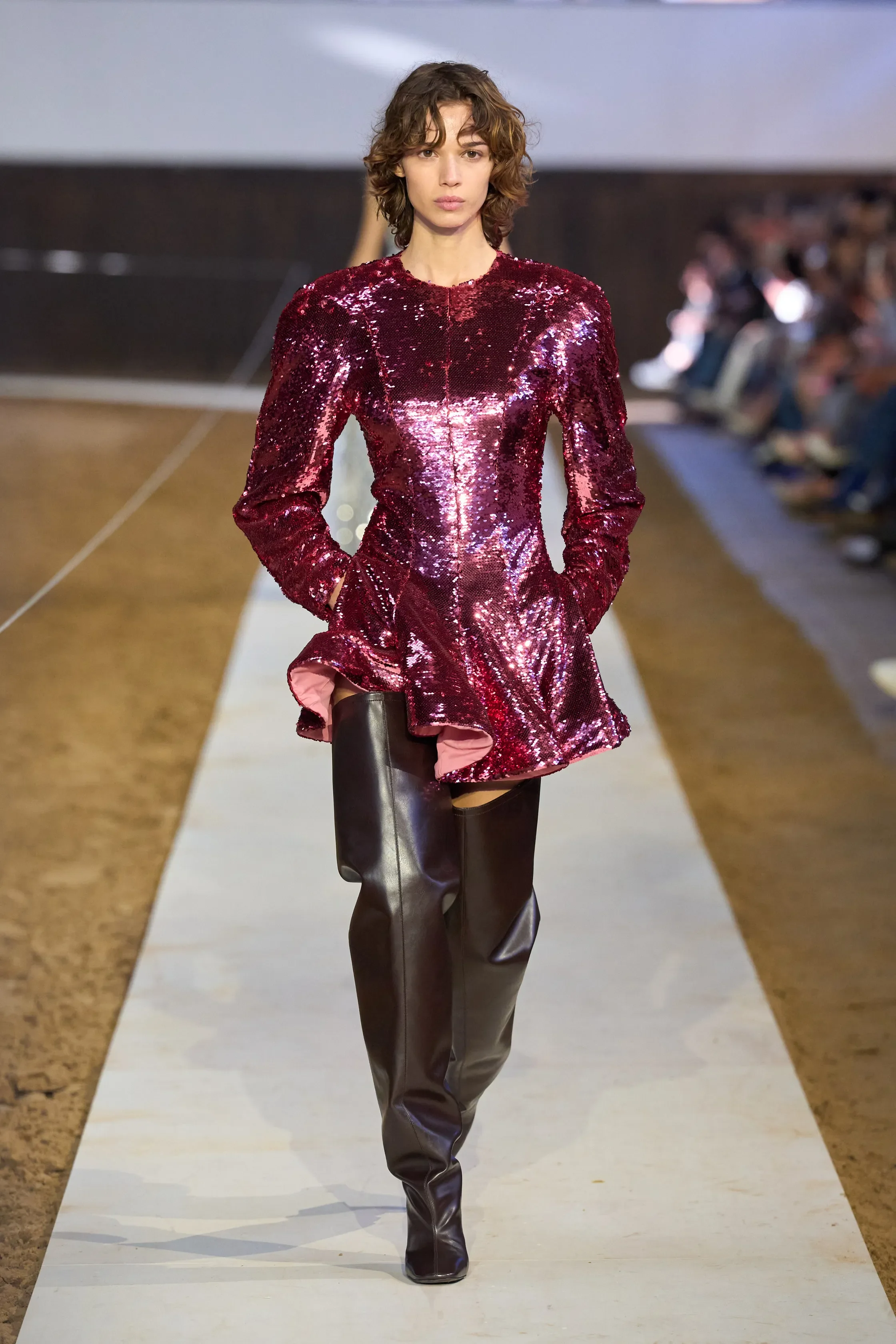
Taking the year of the horse with the utmost seriousness, Stella McCartney showcases her 2026 winter collection in an equestrian arena, circling real horses in a performance led by famed trainer Jean-François Pignon. As a collaboration with MY LITTLE PONY, the show emits a playful childhood nostalgia, outlining the stages of McCartney’s life in and outside of fashion. As a self-proclaimed lifelong horse-girl, it really is the perfect way to express her creative identity, whilst staying true to her love of nature.
Doubling down on her usual environmental sustainability, the materials used were sourced through all kinds of new innovations to maintain her cruelty-free fashion mission. Knitwear was derived from yeast proteins rather than wool, eco-leathers are made from fermentation rather than skin, while only faux furs dominated the runway.
Phases of style eras were shown in a slow evolution as the show marched forward. We’re first surrounded in a warm coziness in the form of bronzed neutrals and overwhelming furred layers. Accentuating an hourglass figure, fur-trimmed peplums and cinched high-waists create trad-femme proportions in a glamorously rustic way. This era is a nod to McCartney’s Scottish countryside upbringing, transitioning slowly into influences from teenage internships at Christian Lacroix and Yves Saint Laurent.
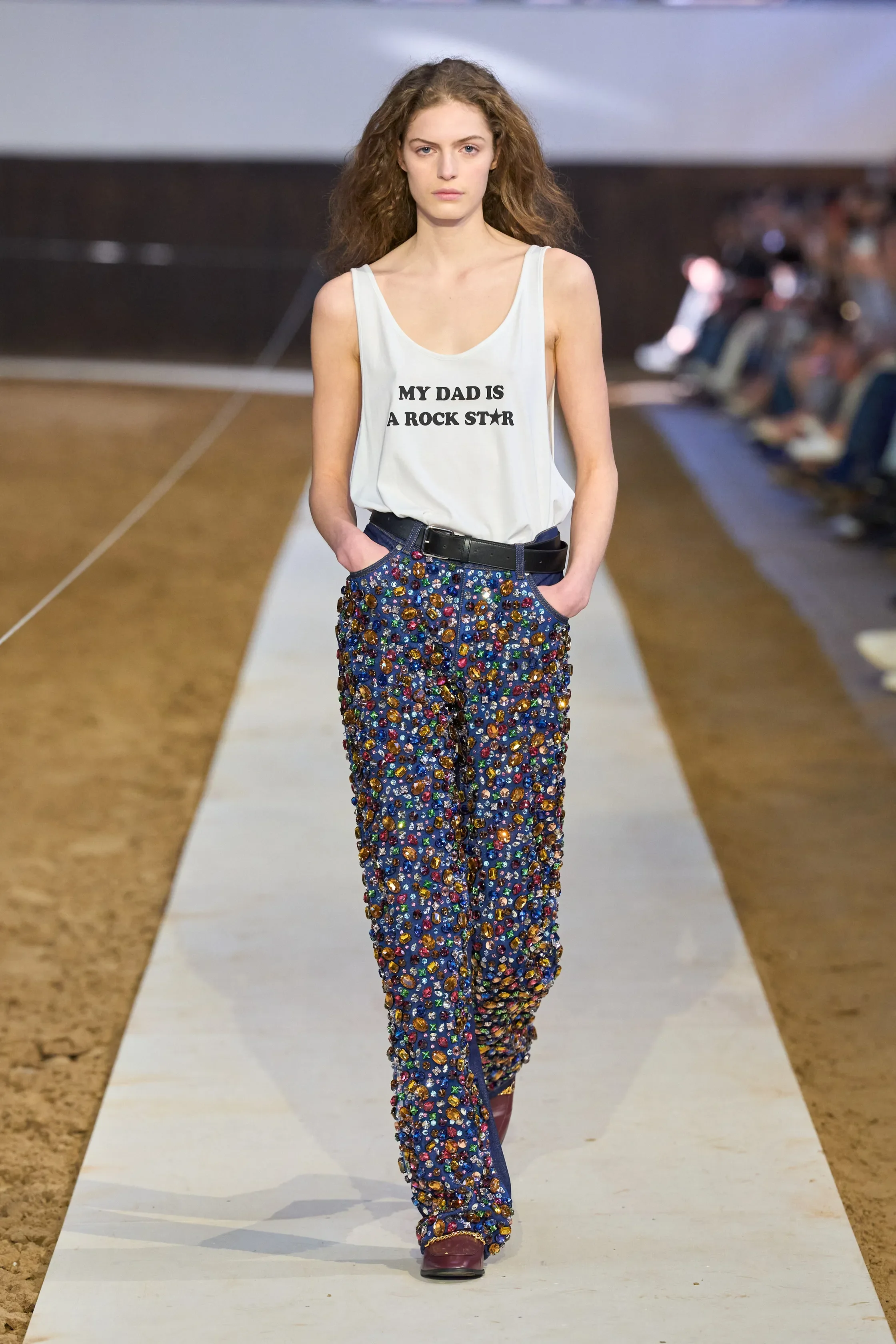
As the show continues, the lumberjack chicness fades away, replaced with glitzy evening attire. Sustainable silks bare lace-covered skin, leading into bedazzled corsets and flashing gowns dripping in tinseled fringe. Colour creeps in at the tail-end, adding the playful fantasy of MY LITTLE PONY and her own creative twinkle that has followed her 25 years in fashion. In a campy close-off with the “MY DAD IS A ROCKSTAR” tank, she knew exactly how to direct our attention for one final strut.
ACNE STUDIOS
review by FRANCESCO PIZZUTI
all images courtesy of ACNE STUDIOS
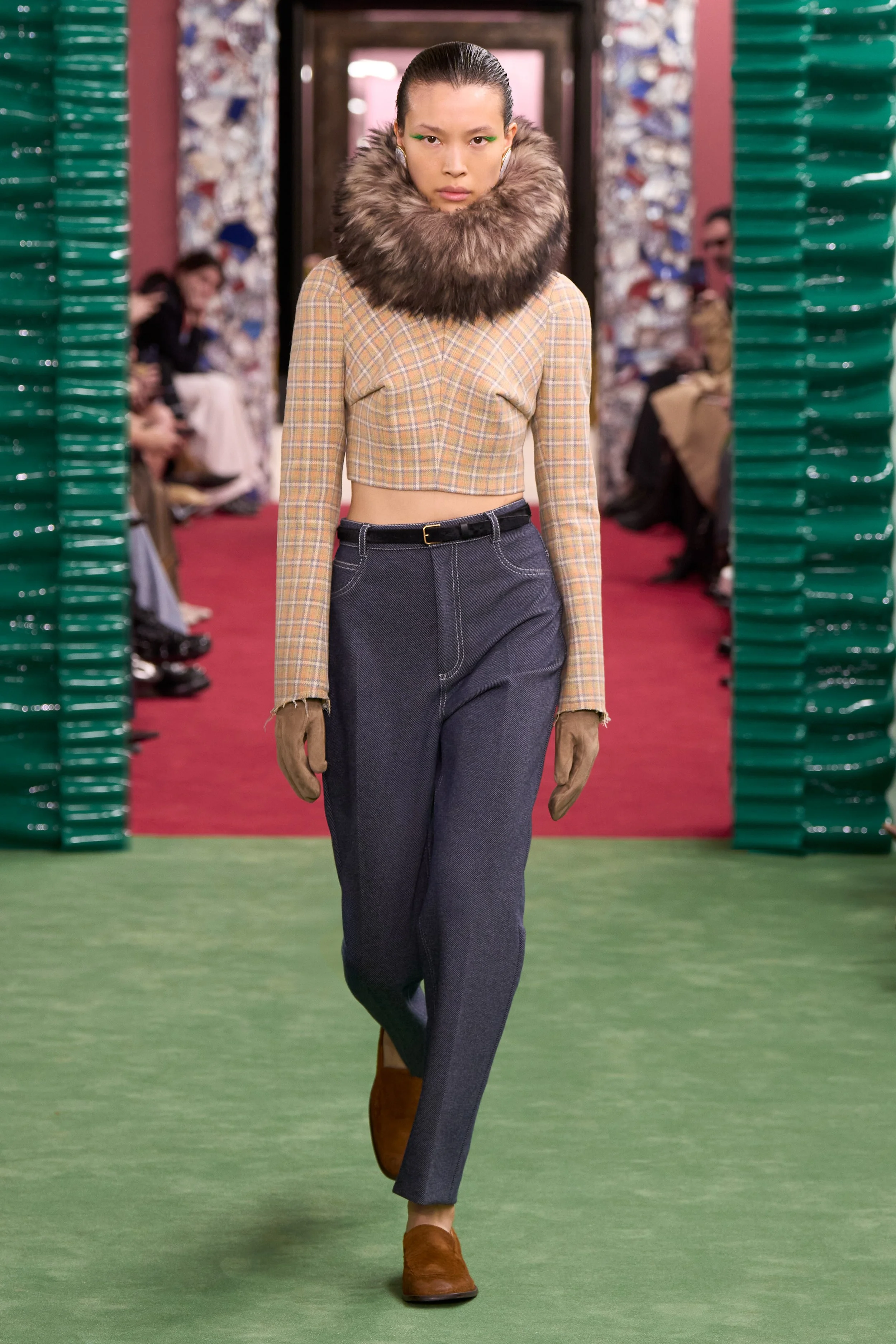
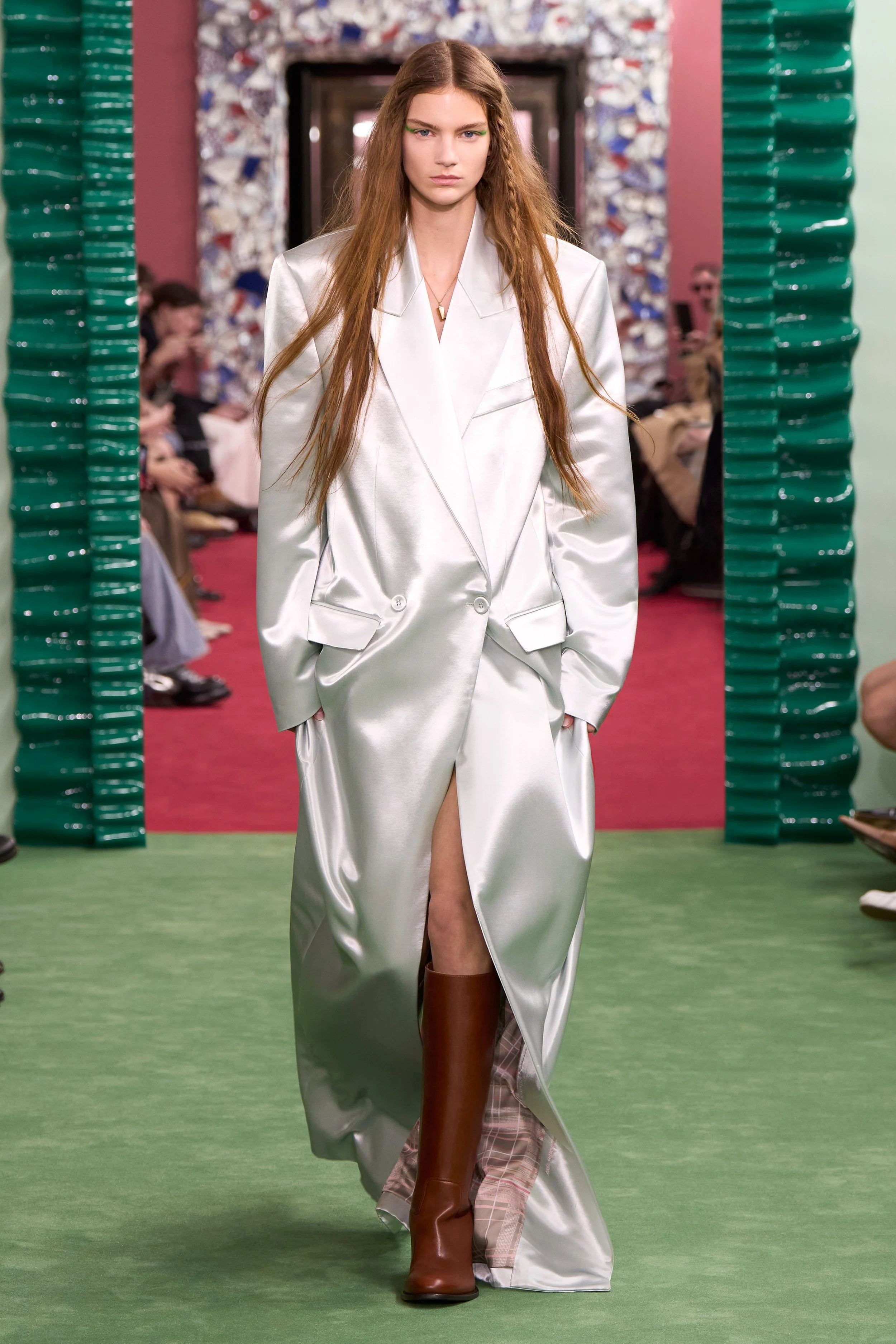
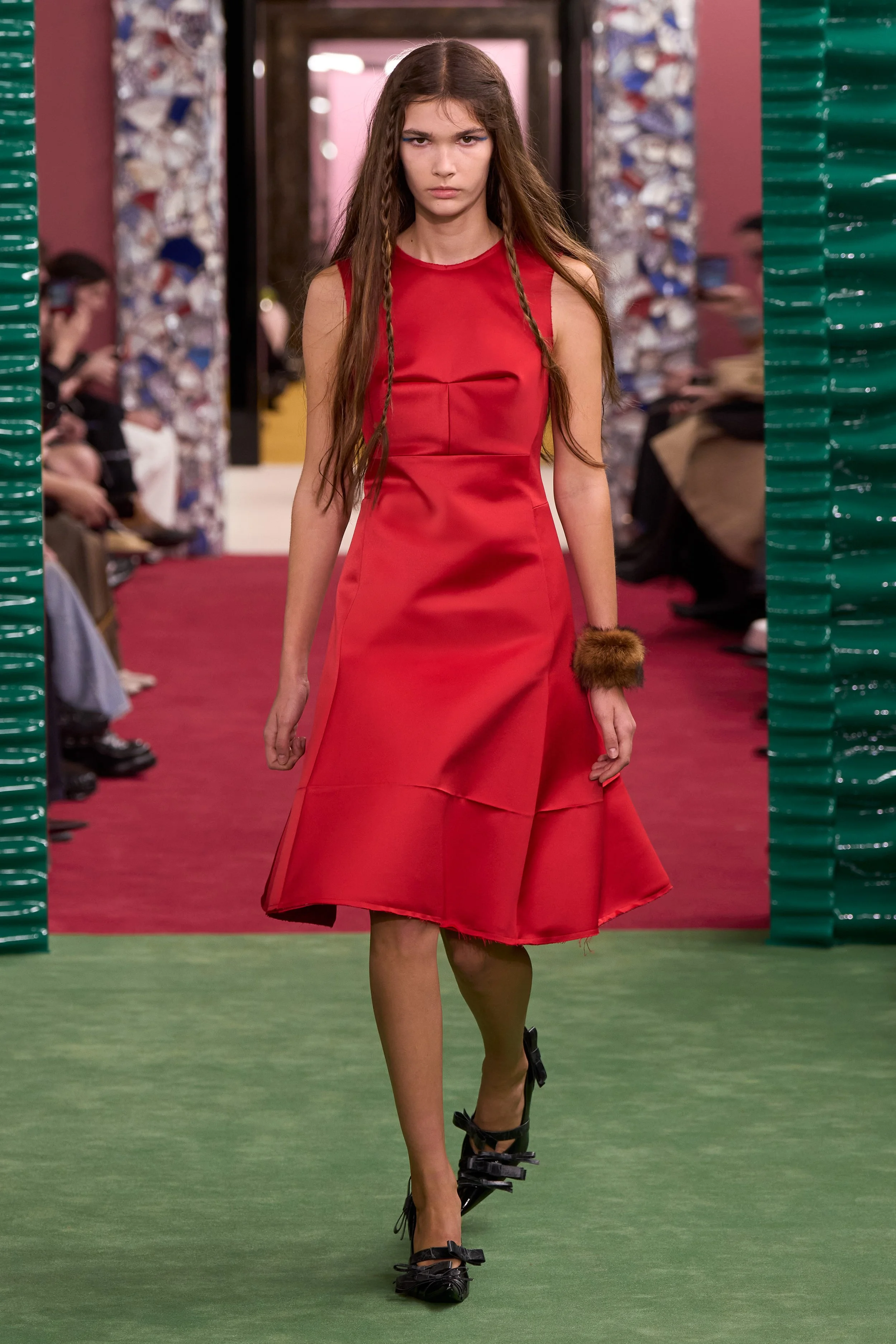
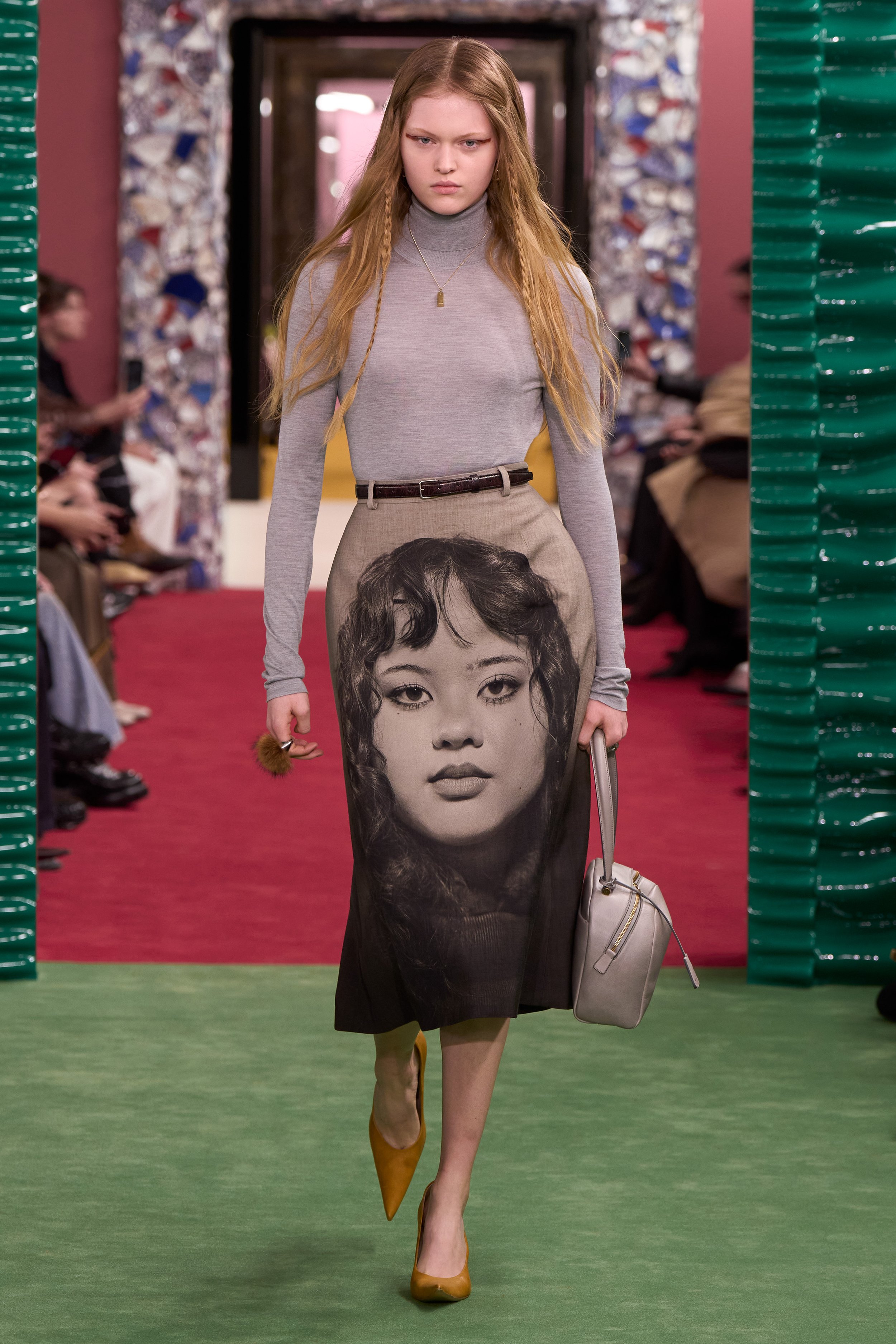
Acne Studios presented a Fall 26 collection that felt like a meditation on memory, though not in a nostalgic sense. Under the direction of Jonny Johansson, the brand marked its 30th year by revisiting familiar codes and twisting them just enough to keep things slightly off balance.
The setting unfolded as a sequence of salon-like rooms, echoing Johansson’s reflection on past shows, particularly the brand’s disruptive 2010 runway staged in Kensington Palace. That tension between institution and counterculture ran throughout the collection. Preppy elements, tailoring, silk scarves, and classic skirts were filtered through Acne’s typically contemporary minimalism.
The silhouettes felt very flexible. Cropped biker and aviator jackets arrived in punchy colours, paired with slim, tapered jeans; including a revival of the brand’s original 1996 cut. Prints — featuring works of Paul Kooiker — and patterns were subtly destabilised while accessories leaned eccentric with vintage-inspired eyewear tinted in vivid colors, and structured bags with single handles.
It wasn’t revolutionary, and honestly, it didn’t try to be. Instead, Acne Studios delivered a thoughtful and skilfully crafted re-imagining of its own history, proof that legacy can be something you question, not just celebrate.
TOM FORD
review by FRANCESCO PIZZUTI
all images courtesy of TOM FORD
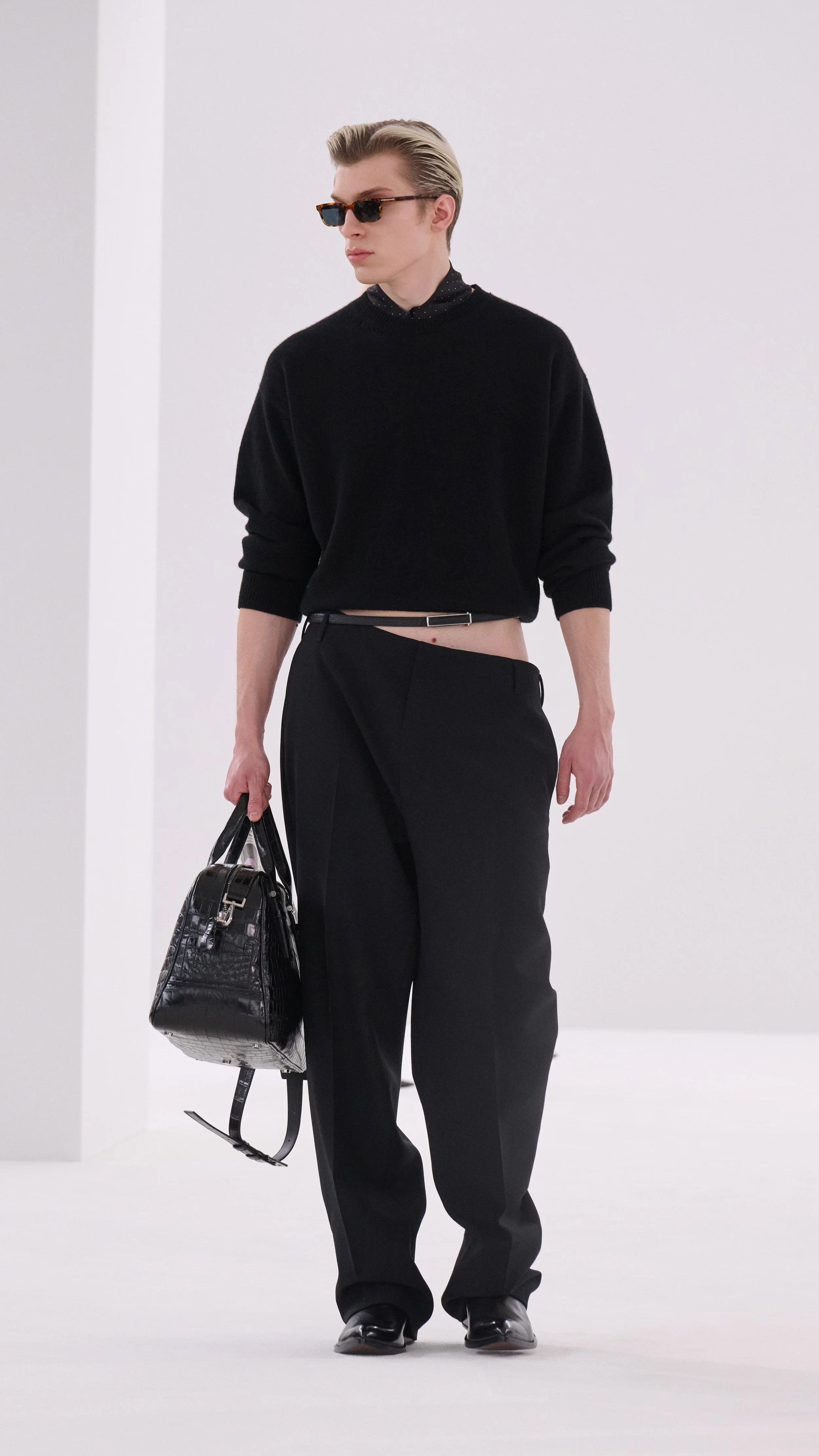
A juvenile seduction played out against the stark white backdrop of Tom Ford Fall 26 show, luring us in the aftermath of a flirtation that lingered just a little too long. Everything was precise, yet slightly disobedient: purity teased, stretched, and ever so slightly undone. As Haider Ackermann wrote about the collection, “they flirted with debauchery, now they stand up straight”.
And flirt they did. Pants slanted subtly at the hip, showing some of what they should cover. Tiny belts — barely belts — were protagonists in their own way; half-inserted into the loops, half clung to the naked skin between sweater and trousers.
Silky scarves positioned around necks with careless elegance, at times thin as ribbon and tied — or untied — as though by a passing breeze, or perhaps by the trace of a kiss that went slightly too far. One white vest appeared almost obsessively adorned, fastened by nearly thirty buttons, cinched in the neck area with a white band like a ceremonious offering to rigor.
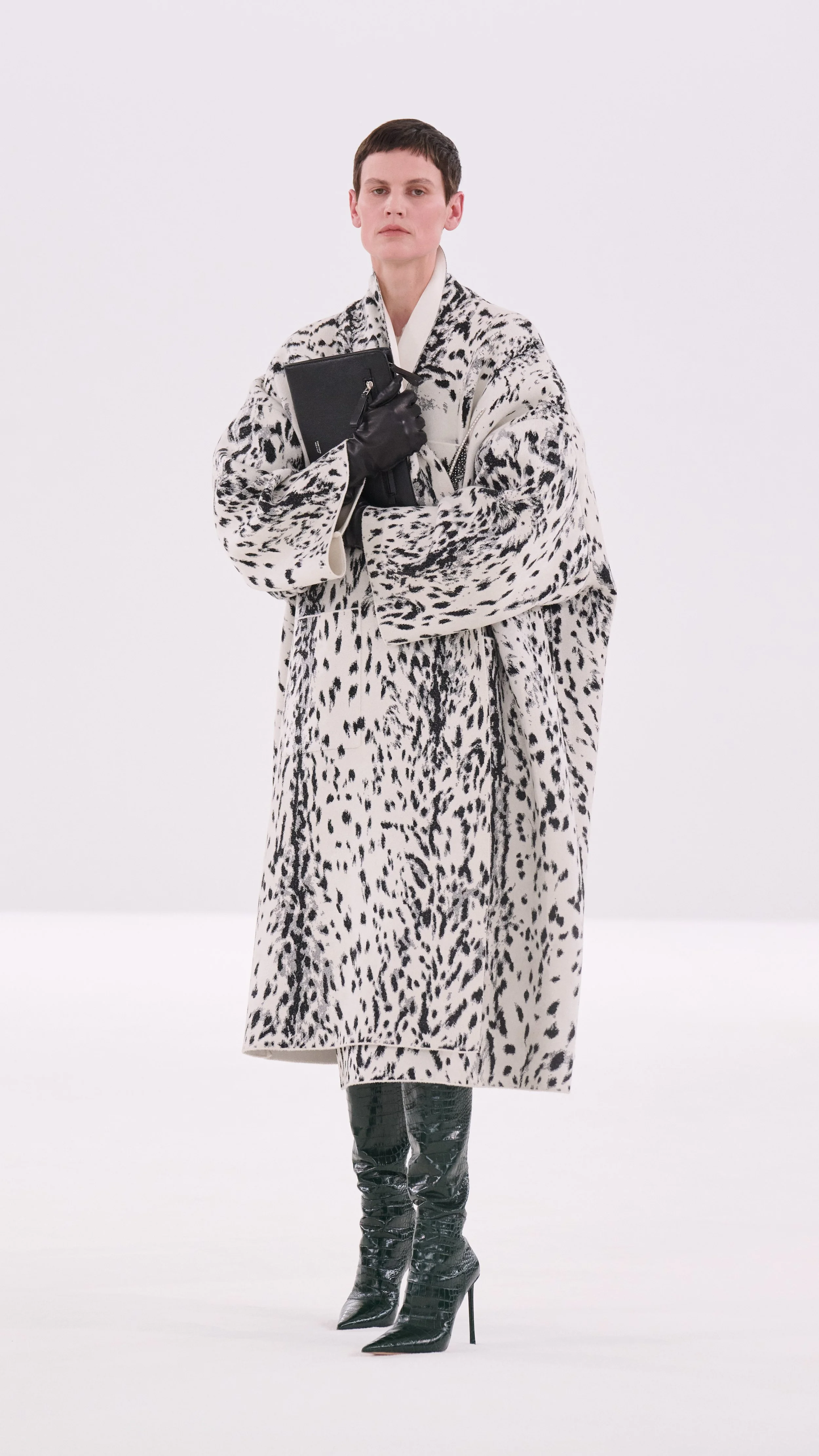
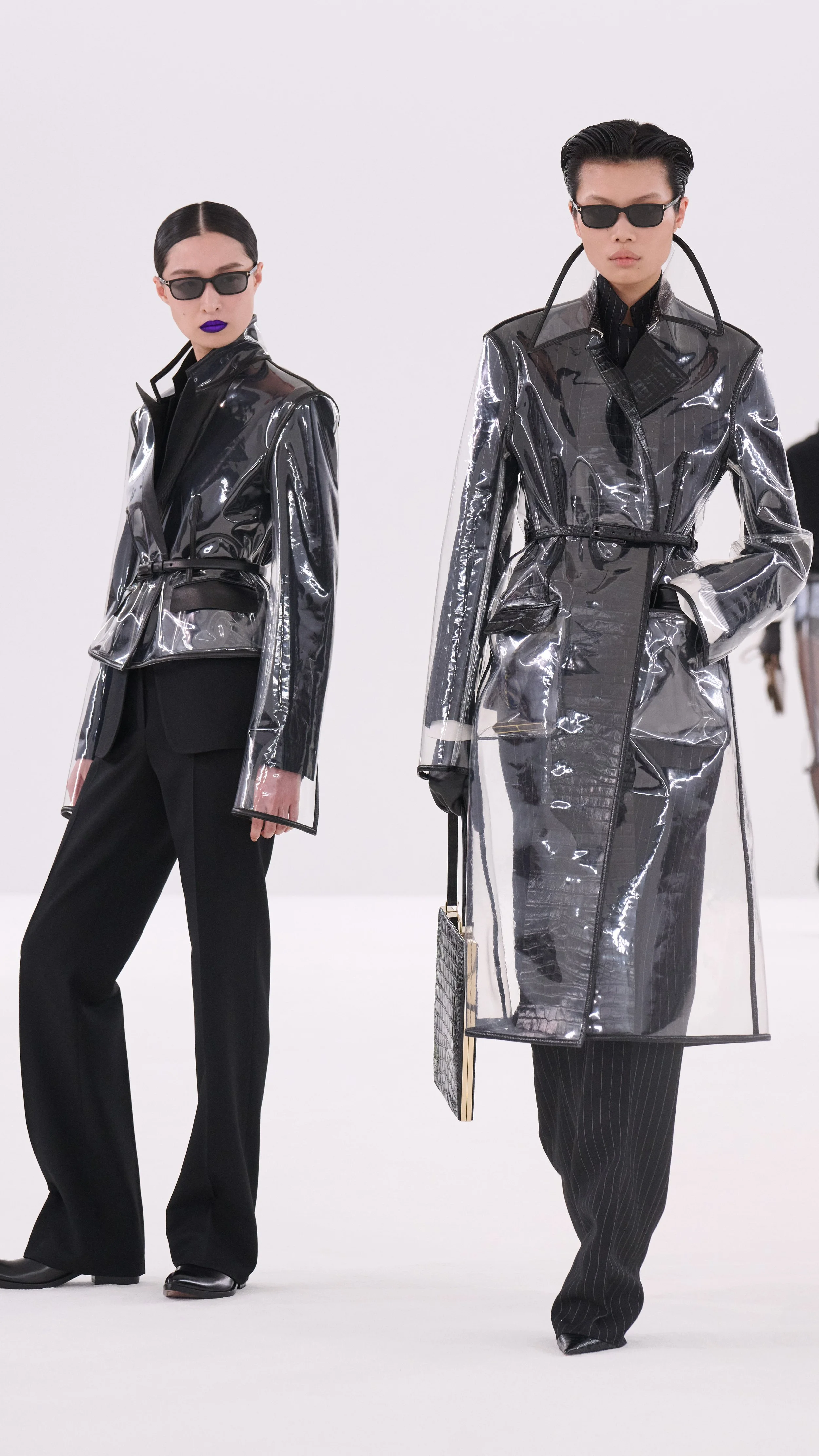
The collection was insanely elegant yet never authoritarian. Wall Street’s power suits loosened by fun, sexy ties, on top of dress shirts with leather or cheetah-print collars, at times punctuated by tiny studs. This rebellious spirit materialized most vividly in the clear plastic garments, often edged with black leather. Transparent blazers, skirts, jackets, and even elongated coats revealed their structure like X-rays. On the men, the clear coats, worn with shirt and tie — à la American Psycho — flirted with that plastic-wrapped corporate perfection.
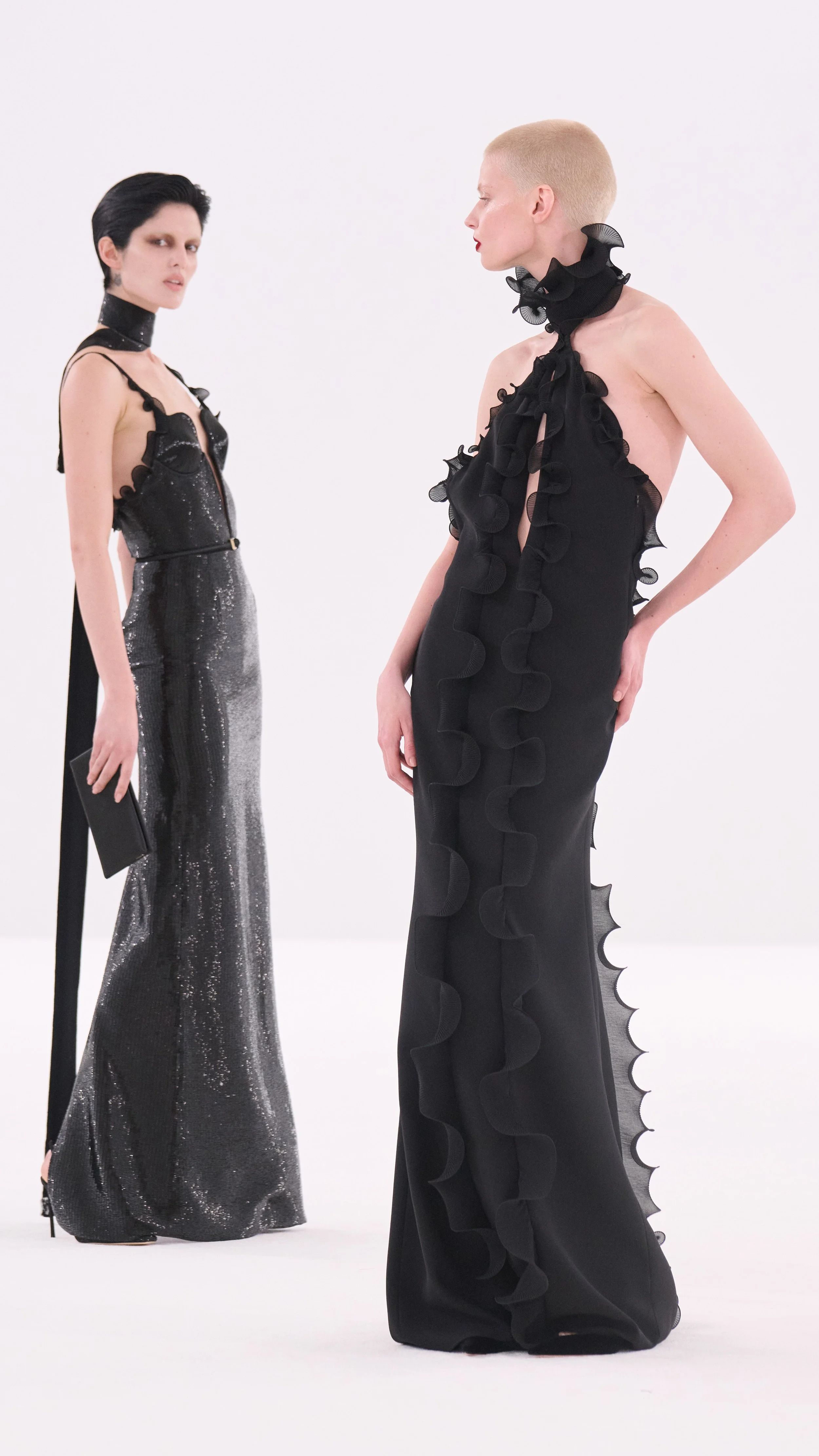
Evening arrived in a series of black halter gowns, their silhouettes elongated and sensual, rimmed with chiffon scalloped ruffles. Elegance, but always with lore. Elsewhere, wing-tip collar shirts met shorter patterned jackets and playful micro-scarves, while leather made its way through the whole collection, colliding with cashmere and plastic in a tactile perversion. Colour appeared sparingly but effectively: a flash of green bomber jackets, a wool long-sleeve dress in a similar shade, and the occasional red takeover.
To keep up the accessory saga, black leather gloves were omnipresent, most times worn only on one hand, or styled with nothing more than a black T-shirt and jeans; they radiated a kind of effortless sexiness.
Ackermann delivered a collection devoted to seduction; a seduction that’s in the fleeting details, that requires getting close. Daily life was treated like a sacred text, and every look felt like the beginning of something slightly dangerous. And like any good flirtation, it left you wanting more.
ALAÏA
review by MAREK BARTEK
all images courtesy of ALAÏA
It’s the end of an era over at Alaïa. Pieter Mulier presented his last collection for the iconic French house before his departure to Milan to take over Versace on July 1.
The fact that the new creative director reportedly hasn’t been found yet only highlights the impact Mulier had on the brand. As Richemont’s fashion & accessories CEO, Philippe Fortunato stated: “You know, one needs to take the time to really find the right person — someone who is thinking in the same direction for the brand. There will be a sign, and we will know this is the right designer.” Over the five years Mulier spent at Alaïa as its creative director, we saw the business flourish, allowing the brand to grow not only commercially but also aesthetically, and ultimately establishing it as one of the most exciting brands to look out for.
And so it comes as no surprise that when the time came, all eyes turned to the former Cartier Foundation, where Mulier decided to host his last show. To say that the expectations were sky-high feels almost like an understatement. And to really hit the nail on the head when it comes to crazy expectations, guests received one of the most elaborate invitations — a build-it-yourself brown leather armour-like top, sent in a huge brown leather box and closed with the black belt wrapped around it.
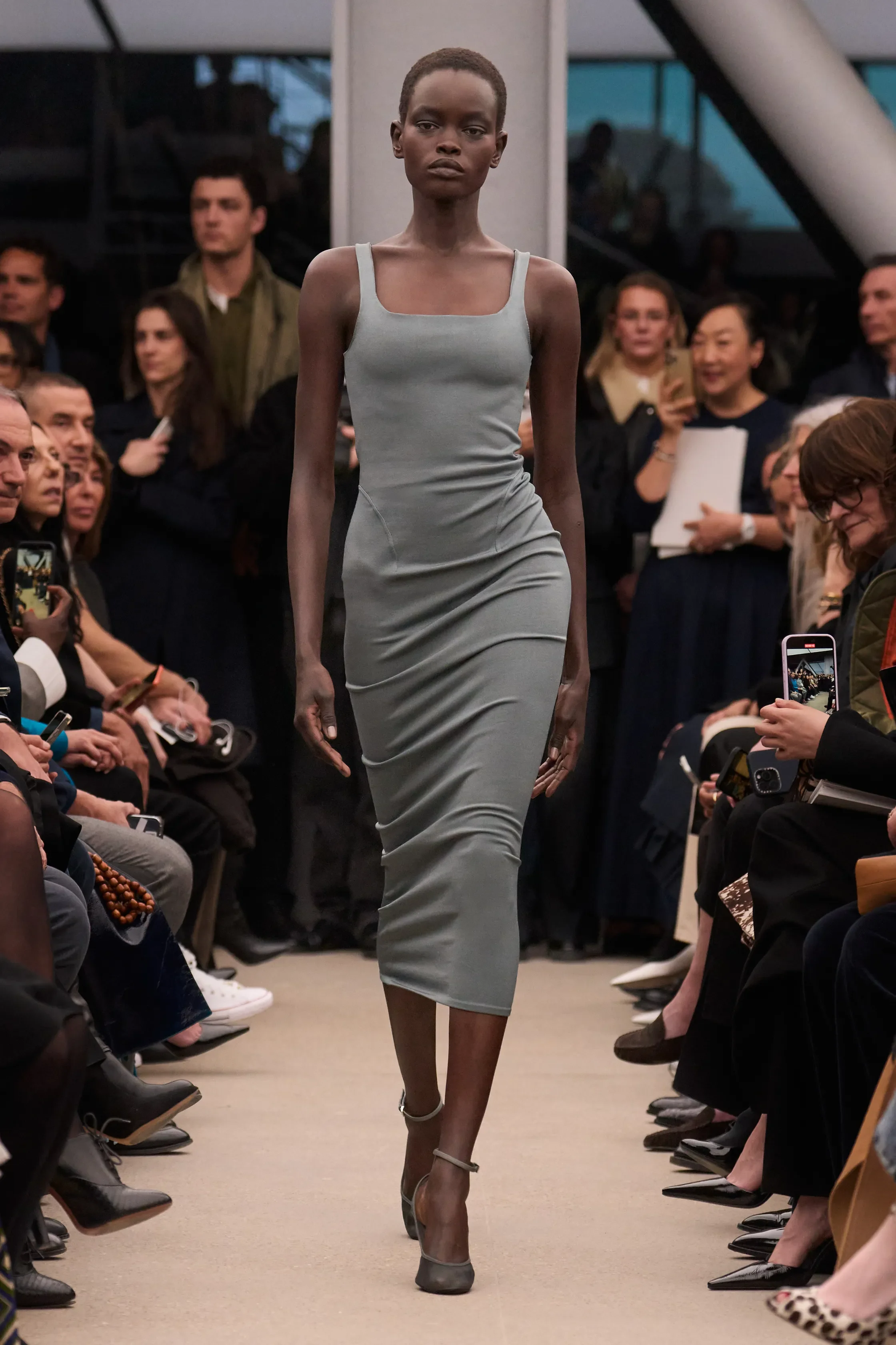
The collection opened with a trio of bodycon dresses, followed by a slim-fitting calf-grazing black coat, followed by another bodycon dress, followed by that same coat only this time in green velvet, and all that followed by ANOTHER bodycon dress. Body consciousness seemed to have been the unifying theme of the collection. From slight variations of dresses, delicately-knitted thin matching sets of long-sleeved tops and skirts or trousers, to gently snatched velvet suits, there were only a handful of looks whose main purpose wasn’t to highlight the lines of the body.
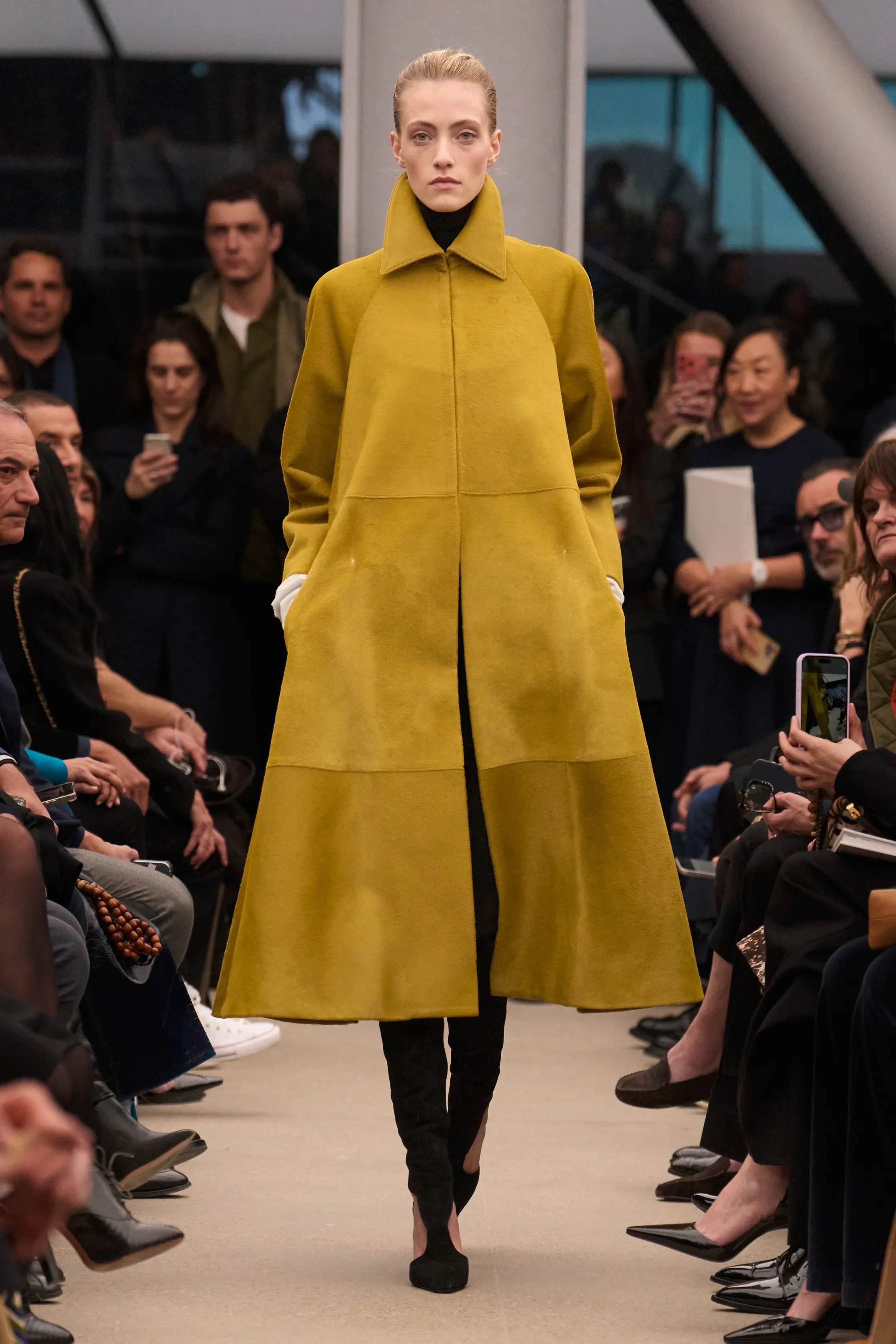
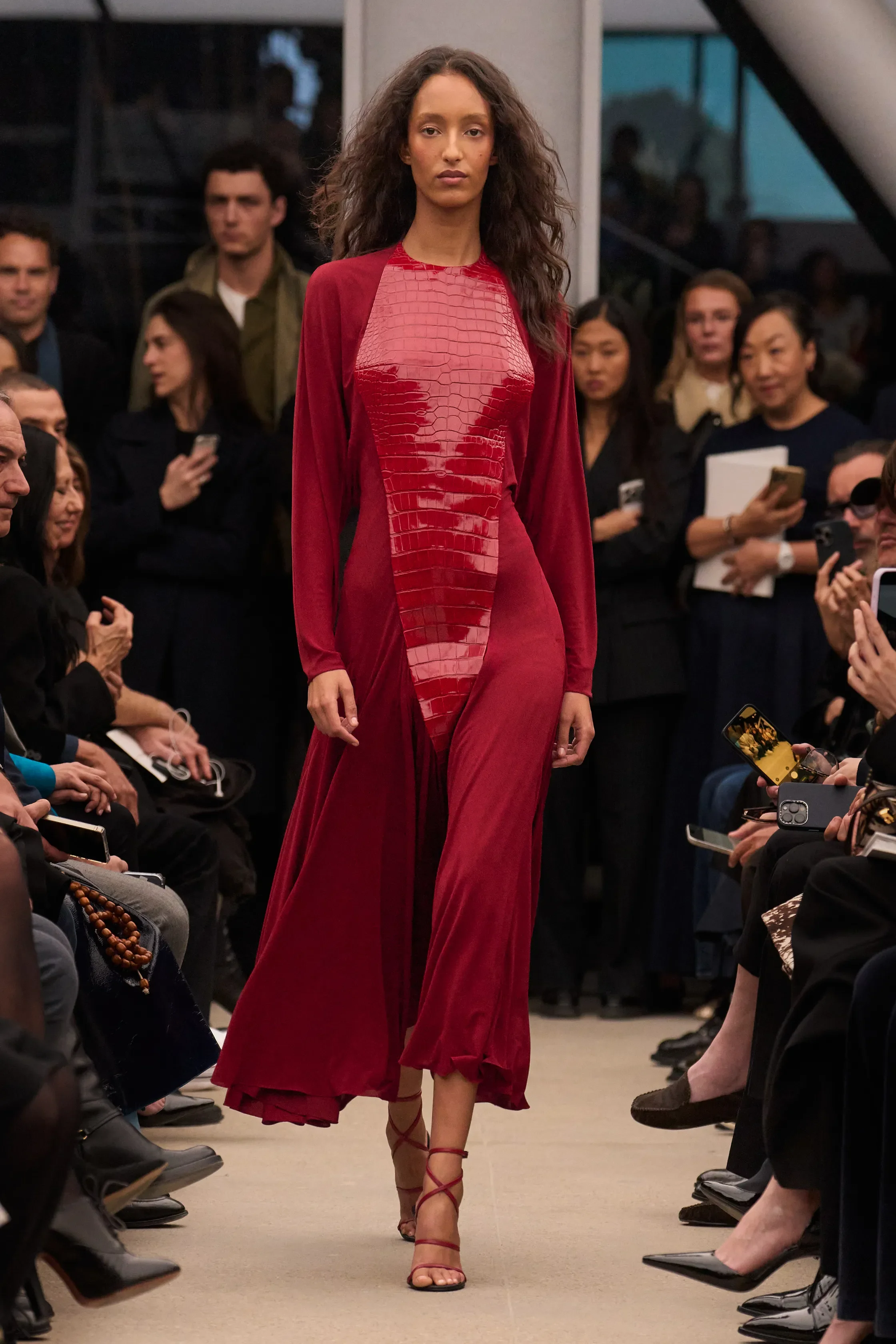
The triangular approach to design — at this point synonymous with Mulier’s work — was applied to the shapes of a red peacoat and slightly longer calf-length mustard yellow version. Inverted triangle appeared on the series of coats cinched at the waist, either just by buttons or by a matching belt, and on a few dresses with ruffles starting at hips and continuing down to the legs. As a design element, we also got three dresses with A-line skirts that featured a matching colour, croc-leather triangle motifs going from the neck down the dress, and ending in the middle of the skirt. Colour palette was muted and neutral, with a few punches of red, green and yellow.
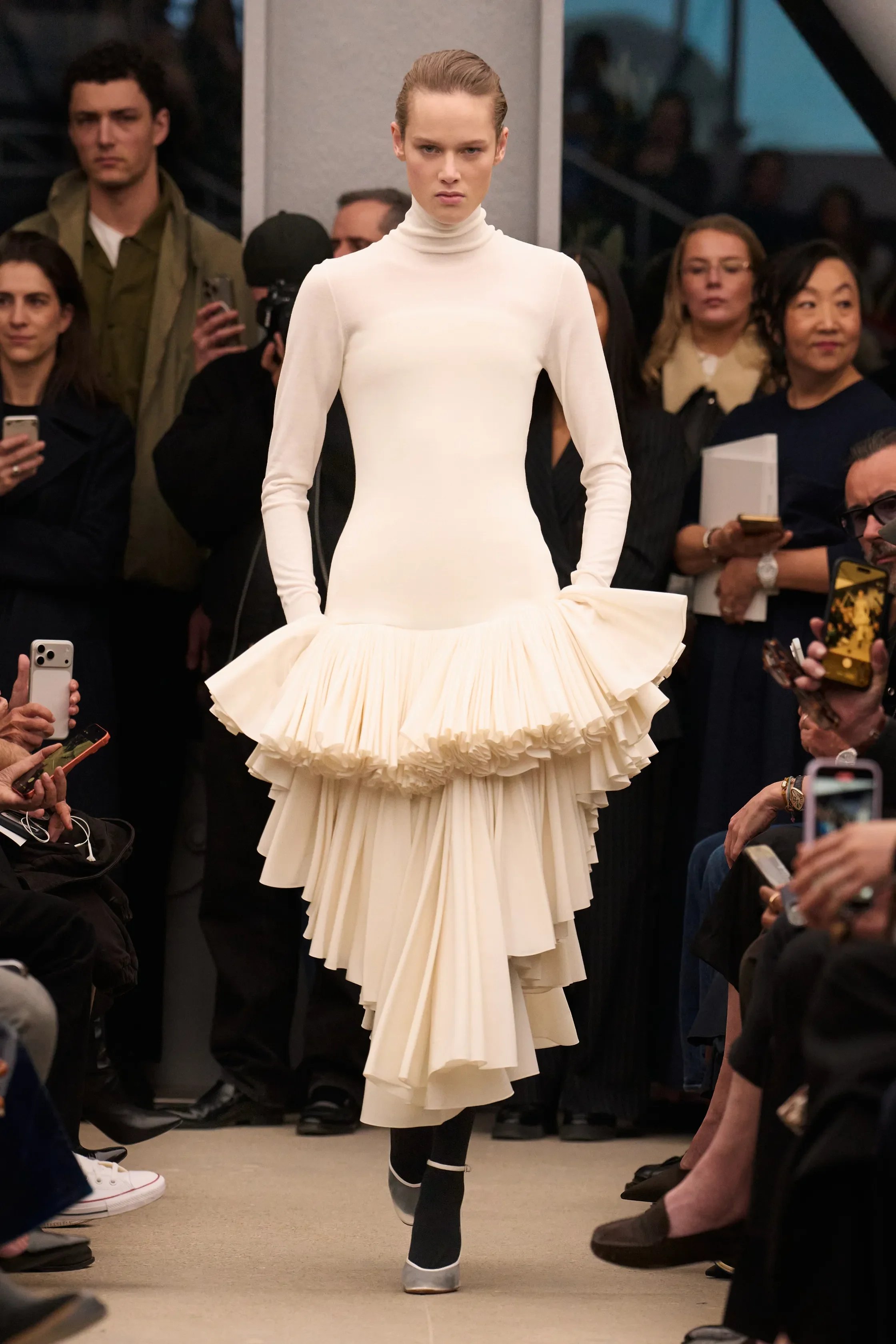
The last couple of looks felt slightly more elaborate with higher volume of ruffles, but not even they, or the attention to detail, or the simultaneous richness and delicacy of materials managed to overpower the fact that this collection felt too stripped back, too reduced to the very core and left too bare to fully appreciate. As one of the guests whispered while models were strutting down the runway: “Le minimum syndical,” — or union minimum. It’s almost unfair because you’d hardly find a person who didn’t love Mulier’s Alaïa, and now we were left yearning for that one last breath of fresh beauty we grew to love at Alaïa.