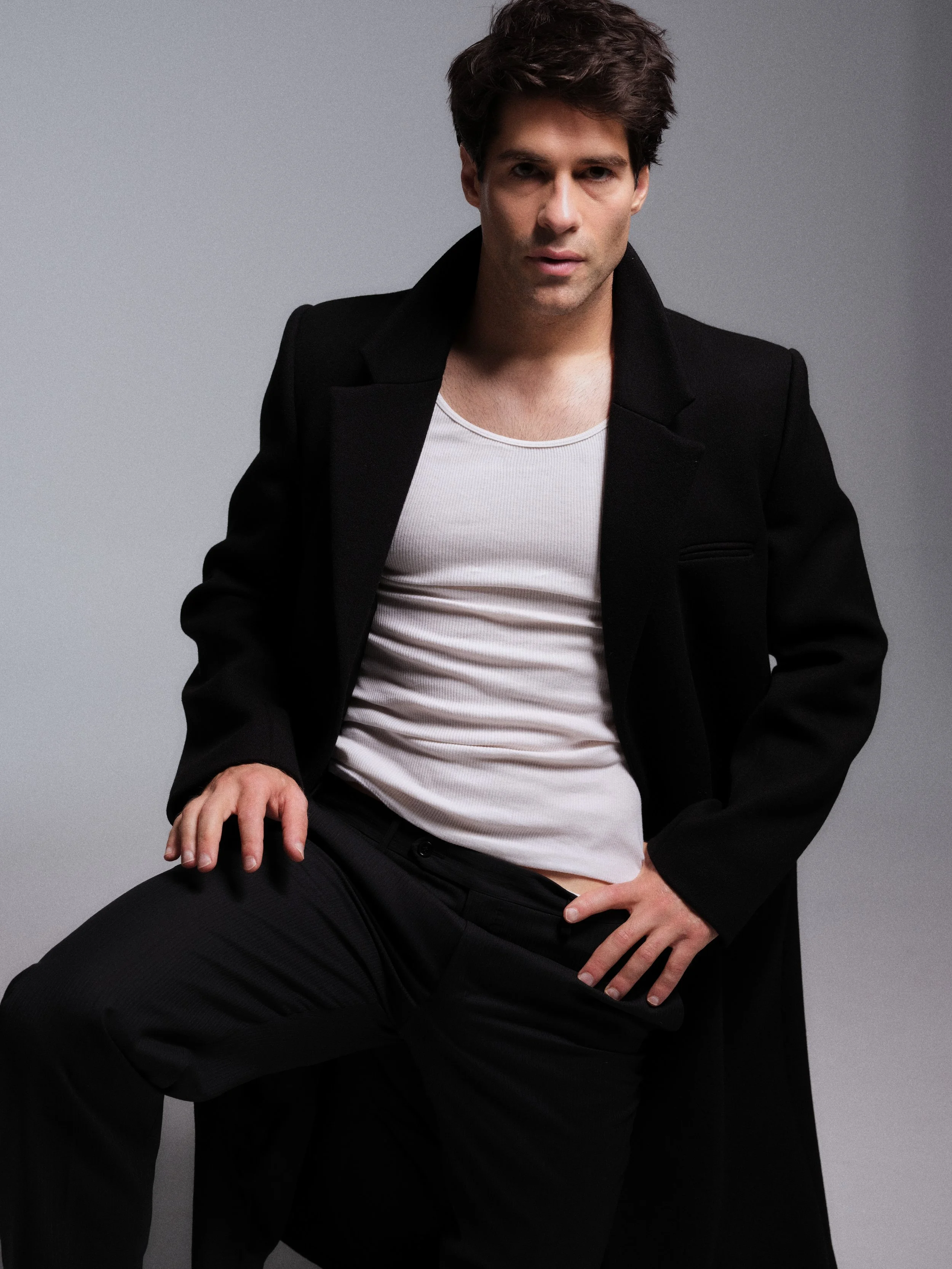
IN CONVERSATION WITH ASHER GRODMAN
interview by JANA LETONJA
Asher Grodman has spent five seasons turning Trevor Lefkowitz, the charming, finance-bro ghost condemned to eternity without pants, into one of the most memorable characters on CBS’s Ghosts. Now a two-time Critics Choice Award nominee, he brings an unexpected mix of swagger, vulnerability, and heart to a character who could easily have been played for the punchline alone. Offscreen, his résumé is just as layered. The native New Yorker is an actor, filmmaker, and acting professor whose teaching has extended from Hunter College to Rikers Island. As Ghosts returns with more supernatural chaos, we caught up with Asher to talk about Trevor’s evolution, finding humanity inside comedy, the strange intimacy of playing the same character for years, and, naturally, what happens when television’s most famously underdressed ghost finally gets dressed.
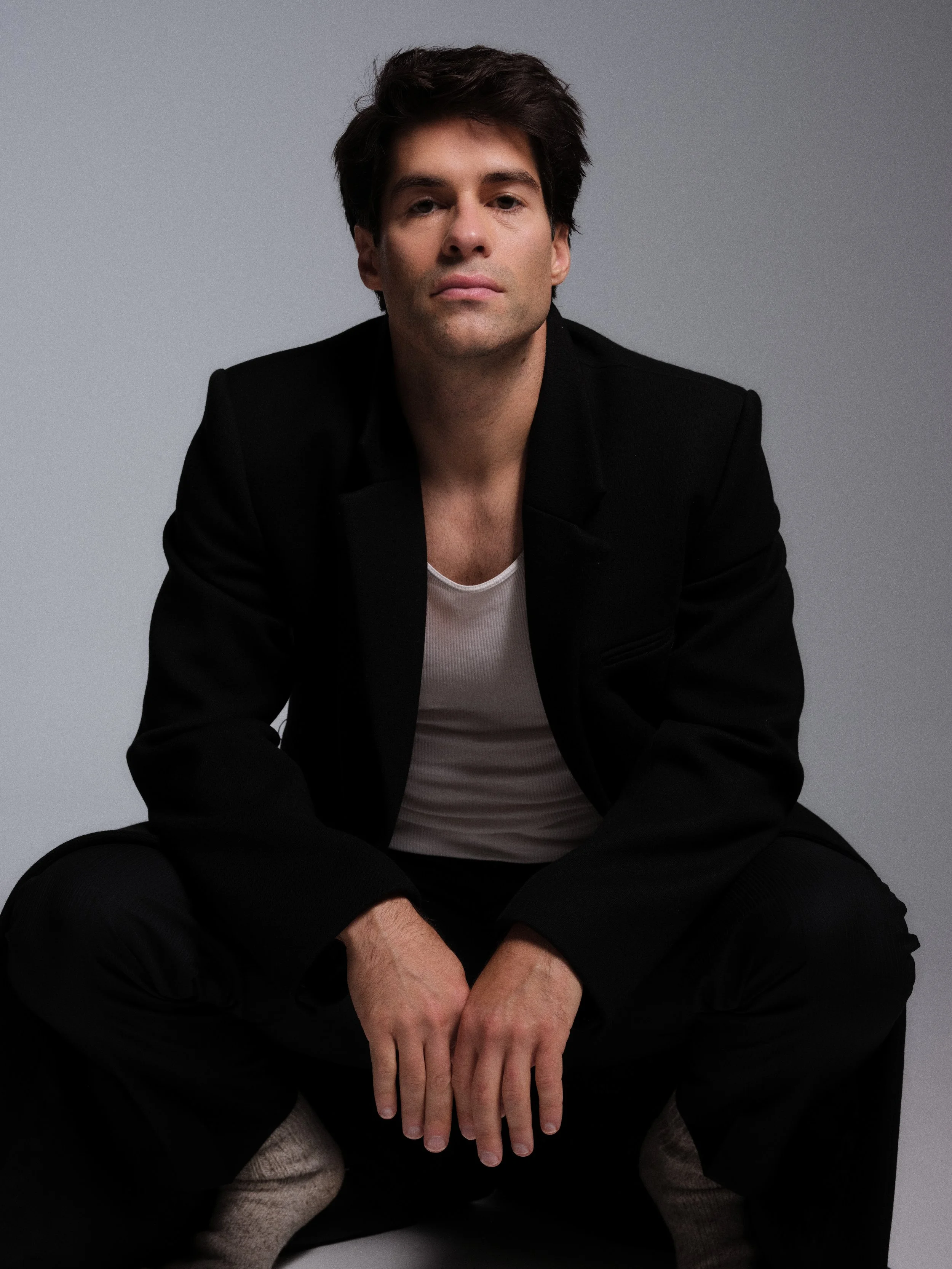
photography PIERRE CROSBY
You’ve lived with Trevor for five seasons now. What do you understand about him today that you didn’t understand when you first put on, or, technically, took off, the costume?
He's proven to be much more dynamic than I originally understood him to be. For a dead man, he lives a very complex and active existence. It's amazing to think of all the pots he's got a finger in. He catfishes women. He's become wealthy through a finance job that he lied his way into, only to then get in trouble with the IRS. He's got divorced parents and a wayward brother out there, plus a daughter who he's financially supporting, as well as a community of former colleagues, frat brothers, friends, enemies, and celebrities, including Jordan Belfort, in the world. All the while occupying a legendary status within the world of finance. Not to mention the deep relationships he has with the other ghosts in the mansion, to whom he's tethered for eternity. And who knows what's going to happen with all the combustible sexual entanglements he's mixed up in. Those are a lot of threads. I'm excited to see where they all lead.
Trevor initially presents as this unapologetic Wall Street finance bro, but over the years we’ve seen considerably more vulnerability underneath that bravado. Which side of him has surprised you most?
I'm continually surprised and impressed with his bravado. This dude is out here running around with no pants and no underwear and is completely unfazed by it. May we all be blessed with that level of confidence and self-assurance. That bravado is also a reflection of the time he comes from, that pre-9/11 world of the 1990s, when the economy was booming and technology seemed like a force of immense good, felt like a time of such confidence and optimism. Plus, in New York City, the party was raging. I don't think Trevor ever heard the word "no" in his life. He was an operator who found nothing but success and a flashy lifestyle. That's what makes his moments of vulnerability so much more impactful. You don't expect them coming from a guy like Trevor. Hetty is similar, which is why they're such fun foils. Both of them come from high-status, capitalistic, and competitive societies of immense abundance, despite living 100 years apart and by very different rules.
Trevor has become a genuine fan favorite. When did you first realize audiences were connecting with him on a level beyond the joke of “the ghost with no pants”?
That's very kind. I think all these ghosts resonate. They're each so specific. In terms of how the audience connects with Trevor, I did notice a difference when "Trevor's Pants" aired. It revealed such a different side of Trevor that surprised people. I have to shout out our writers' room, led by Joe Port and Joe Wiseman, for that. They penned one hell of a story. What starts as a murder mystery about a missing pair of pants ends as an exploration of hazing and bullying. It's a very well-crafted episode, directed by Trent O'Donnell.
Ghosts has such a large ensemble, yet every character has developed a very specific comic rhythm. After five seasons together, how much of the chemistry we see onscreen is now instinctive between the cast
The specificity of those comic rhythms is a testament to those incredible actors. I'm constantly surprised and inspired by everyone in the cast. And yes, the chemistry among that core group is off the charts. I believe the fun we're having together does show up on screen. At least that's something I hear from fans. Though, I weirdly feel like, even with all that joy coming through, it still scratches the surface of the bond that we've developed over the course of making the show. As the years have gone by, those relationships have become the things I treasure the most. We have a big Thanksgiving-style dinner table where we spend most of our time on set, and it's one of my happiest places on earth.
You’ve now received two Critics Choice nominations for playing Trevor. Has that recognition changed the way you think about the character or about the kind of work comedy requires?
It hasn't changed how I think about the character, and I certainly hope it hasn't changed my process. Don't get me wrong, the recognition is deeply validating, and I'm immensely grateful for it. I never saw either of those nominations coming. Once you spend 18 years toiling in unemployment, you develop an ever-present sense of imposter syndrome. But ideally, the recognition doesn't affect the work. As an artist, you have no control over the reception of your work. You can only control your process. So while the nominations certainly gave me some confidence, it's scary to rely on external factors. That said, I'm constantly blown away by this cast, and they've given me a lot of inspiration. They are so talented, and so funny.
Without giving too much away, what can you tease about Trevor’s journey this season? Is there a particular storyline that allowed you to see him differently?
Because Trevor enjoys a unique proximity to the living world, both because his family and friends are all still alive and because his power gives him unique access, he's constantly looking for ways to feel alive again, whether it's catfishing women online, interacting with his family, or getting a finance job just to be part of a company Slack. That quest continues this season, and he's pretty successful, perhaps more so than in the past.
If Trevor had survived into 2026 and had an unlimited fashion budget, what would he be wearing? Would he still be loyal to Wall Street uniform dressing, or would he have evolved?
I don't think Trevor was all that loyal to the Wall Street uniform at all. That's just what he died in because, after all, it was a workday. I imagine Trevor was pretty into fashion. I think he loved a statement piece, maybe some pastels. I can picture him in some powder blue boat shoes. Now, if Trevor were alive today, he'd be nearing 60 years old, but I do think he'd still be having fun with his fits.
You also teach acting at Hunter College and have taught acting to incarcerated students at Rikers Island. What has teaching taught you about acting that being on a professional set never could?
I'd argue that you learn much more being on a set than you ever could in a classroom. The classroom, whether you're a teacher or a student, is unique because it can help you crystallize what's important in the process and provides you an incubator to practice taking risks and failing. Failure is actually very important in acting because it sets you free to play. But at the end of the day, I think you learn the most by doing.
Is there a piece of advice you regularly give your students that you still have trouble following yourself as an actor?
Everything! I'm constantly surprised by the things I forget or need to remind myself. It's always a moving target because every script is different, especially on a show like Ghosts, where your responsibilities change episode to episode. Sometimes you're carrying the ball and driving the story, and sometimes you're just along for the ride, supporting the main action as part of a Greek chorus, or gaggle of ghosts, if you will. There are stories that are very heartfelt, dark, and deal with existential questions, and then there are others where we're insane muppets. So you're always calibrating which moments get which temperature and how much is too much.
You’ve spoken about the influence of Philip Seymour Hoffman and the idea of allowing chaos to exist within structure. Has your understanding of that philosophy changed as you’ve moved between drama and a highly calibrated ensemble comedy like Ghosts?
Not really. In a comedy like Ghosts, which is indeed "highly calibrated," the space for that chaos is much narrower. You still want to discover things in the moment and find that spontaneity, but you also have to be responsible to the timing and the structure of the scene, as well as to your castmates.
You’re also a writer, director, and producer. Does working behind the camera change the questions you ask, or the choices you make, when you return to a set purely as an actor?
I suppose so. You're certainly imagining how everything will cut together and asking how you can help that process. But you don't need to direct to figure that out. I personally love knowing what the camera is doing and being keyed into that dance. The trick is to make sure you still retain your sense of play and don't get stuck chasing a result.
It Was Written, your Jacksonville Jaguars schedule-release film became a major viral success and went on to receive recognition from the Webbys, Cannes Lions, and Tribeca X. What did that project allow you to do creatively that traditional television acting doesn’t?
I wrote, directed, and led the post-production process, so I was responsible for so much more of that project than I would have been if I were just an actor. As an actor, you're actually a very small part of the process. Your job is to give the creative team options — different takes, different tones — while as a director, writer, and producer, your job is to communicate, collaborate, and make decisions. It's a much broader task. I have so many fond memories of that process. It was such a joyful experience. We also knew we had something special. That project was so wildly unique. For an NFL team to break the mold of a schedule release video and provide that level of access was unprecedented. Plus, to trust an outsider to helm that endeavor was a huge honor and a vote of confidence. I think Patrick Kavanagh and Everett Sullivan of the Jaguars media department had more faith in my idea than I did. They were so selfless, creative, and collaborative. None of it would have been possible without them.
Football and acting can seem like completely different worlds, but you’ve spoken about both with a similar intensity. What does your relationship with football give you as an artist, and what does acting give you when you look at sports?
This will probably sound very cliché, but they're both high-pressure team sports where a variety of specialists, doing very different jobs, work together and coordinate to create a single vision. They're deeply collaborative endeavors where something always goes wrong, and you have to improvise and work together with limited time to make it work. Sounds fun, right?