
interview by TIMOTEJ LETONJA
What started as a chance encounter turned into a career spanning almost three decades. Benoît Gouez has spent twenty years as Chef de Cave at Moët & Chandon, helping shape one of the world’s most recognisable champagne houses. As the worlds of luxury, culture and sustainability continue to evolve, Gouez talks heritage, embracing innovation, and why the finest luxury is ultimately what we choose to preserve.
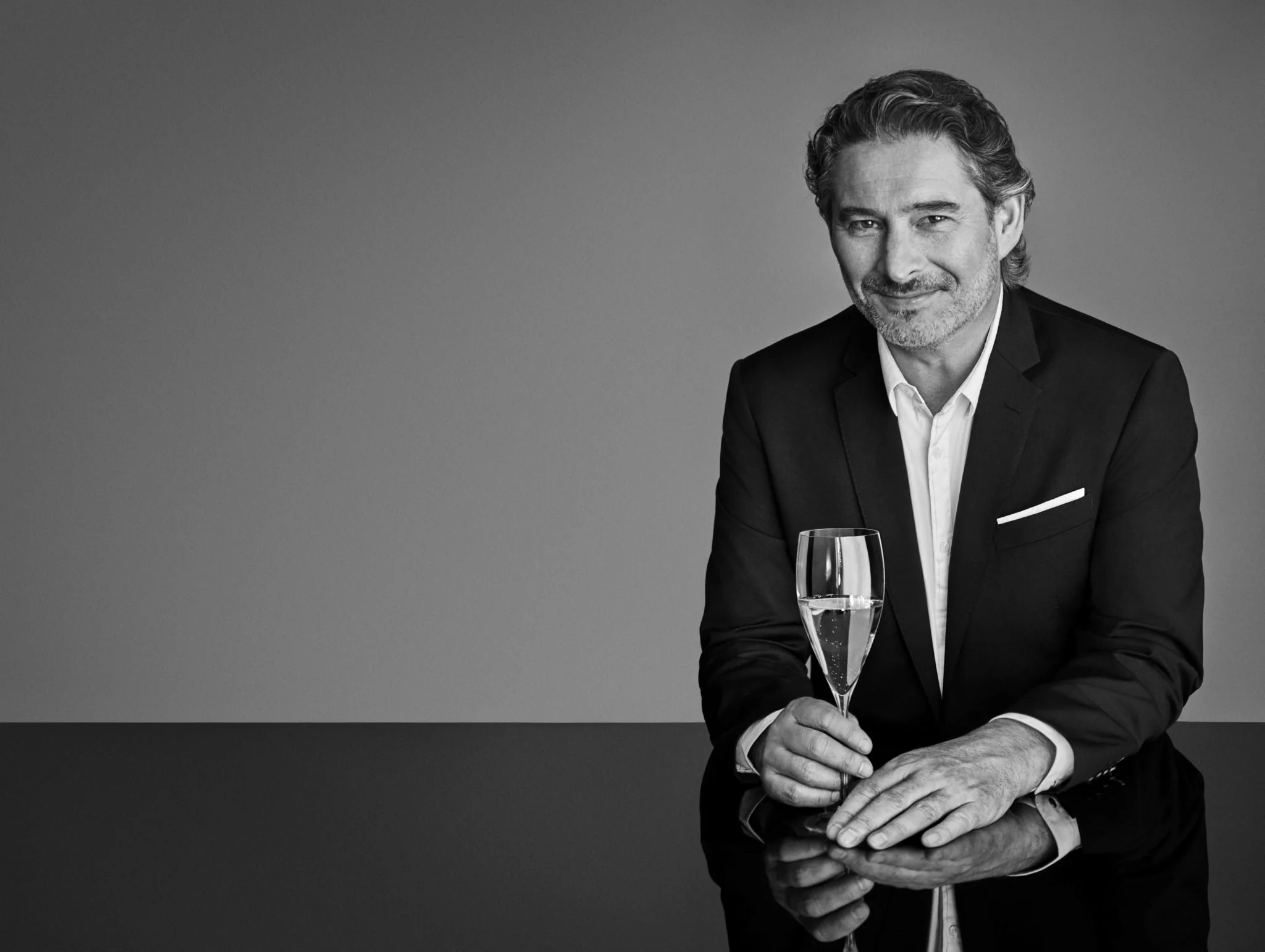
images courtesy of MOËT & CHANDON
How did entering Champagne as an outsider influence the way you approach tradition and innovation today?
I grew up in Brittany, and was raised in Normandy, far from any vineyard. It was a chance encounter in 1997 with the former Director of Oenology and Research at Moët & Chandon that changed my path. Before that, I had built my early career abroad and as a consulting oenologist in the south of France. Champagne had simply never crossed my mind. Yet here I am, 28 years at Moët & Chandon, twenty of them as Chef de Cave.
And that's exactly what arriving without a predetermined map does to you, it sharpens your senses. You observe differently. You listen more carefully. You question what others may take for granted. Coming to Champagne as an outsider meant I had to earn my understanding of this place, through curiosity, tasting, countless conversations with the people. Nothing was inherited. Everything had to be discovered.
And with time, discovery gave way to belonging. The role of Chef de Cave quietly transforms you, from someone who learns a heritage, into its most devoted guardian. Innovation has never been about breaking with the past. It's about keeping it alive, ensuring that what we have inherited today remains meaningful for the generations to come. Every blending decision, every research program, every new creation we craft at Moët & Chandon today is made in that spirit. Not for us, for what comes next.
You often speak about balancing science with sensitivity. In practical terms, how do you recognise the moment when a champagne moves from being technically excellent to emotionally compelling?
People often assume that science and sensitivity are opposites. They are not. They are conversation partners. Science gives you the tools, the analysis, the precision, the framework. Without technical mastery, you cannot make a great wine consistently. Technical excellence alone will never be enough. Without sensitivity, you may craft a very good wine. You will never craft a truly great one. The emotionally compelling champagne does something different, it surprises you. It says something you weren't expecting. A memory surfaces, an image, a sensation. Suddenly, you are no longer analysing. You are simply there, in the moment, entirely present. That shift, from technically excellent to emotionally compelling is impossible to manufacture. It can only be felt. In the end, the most honest indicator of a truly great champagne is the simplest one: the desire for another sip.
After decades devoted to champagne, what still fascinates or surprises you about the craft?
In nearly thirty years in Champagne, you might think you have seen it all but Champagne never stops surprising you. What continues to fascinate me, above everything else, is that Champagne breathes. It evolves. It speaks differently every single year. A living expression of a place, a climate, a moment in time that will never repeat itself exactly.
Every harvest arrives with its own personality, its own challenges, its own unexpected gifts. The same vineyards, the same grape varieties, the same hands and yet, something entirely new every single year. Nature simply refuses to be predictable. And I have learned, after all this time, not to fight that but to welcome it.
That is what still fascinates me. The humility that this craft demands. After twenty years as Chef de Cave, Champagne still teaches me something new every year. And I hope it never stops.
Your work is deeply connected to nature, yet Champagne is also one of the world’s most recognisable luxury symbols. How do you navigate the relationship between environmental responsibility and global luxury expectations?
At Moët & Chandon, nature is not the backdrop of our work. It is its very foundation. For three centuries, our destiny and the destiny of Champagne have been inseparably linked. Without healthy soils, without thriving vineyards, without a living terroir, there is no champagne.
This commitment is not new for us. Since 2001, we have been deeply engaged in sustainable viticulture, working with our vineyards, not against them. A commitment recognised through our double certification in Sustainable Viticulture and Haute Valeur Environnementale. Beyond our 1,300 hectares of vines, we have dedicated 380 hectares to biodiversity preservation.
And we wanted to go further. This is why we created Natura Nostra: a collective commitment to accelerate the ecological transition in Champagne, to protect its extraordinary natural heritage, and to ensure that future generations inherit a living, breathing landscape worthy of what we have received.
Because here is what I truly believe: the finest luxury is not what you consume. It is what you preserve. Environmental responsibility is not a constraint on luxury. It is its most sophisticated expression.
Having worked in California, Australia and New Zealand, what global perspective did those experiences bring to your understanding of Champagne?
In California, Australia and New Zealand, I encountered a completely different scale; vast, sweeping vineyards stretching as far as the eye can see, single varietals expressing themselves with boldness and immediacy. Wines that speak loudly, directly, with confidence. There is beauty in that straightforwardness that I deeply admire.
But when I arrived in Champagne, I understood immediately that I had entered a completely different world. Here, everything is about complexity and restraint. Our vineyards are small, fragmented and endlessly diverse. Three major grape varieties, hundreds of terroirs, dozens of villages, each with its own voice. From all of this, we create a single, harmonious expression.
Seeing winemaking at that scale, bold, direct, varietal, taught me to truly understand the genius of the assemblage. That nowhere else in the world is blending elevated to such an art form. It takes the diversity of an entire region and transforms it into something harmonious, elegant and unmistakably Champagne.
Those experiences abroad made me richer. They sharpened my instincts, broadened my palate, and gave a perspective that enriches our collective craft every single day. But they also gave me something unexpected: the ability to recognise, from the very first moment, just how extraordinary Champagne truly is.
Moët & Chandon constantly balances heritage with reinvention. How do you protect Maison’s identity while keeping it culturally relevant for new generations?
A signature, unlike a trend, never goes out of style and at Moët & Chandon, ours has been the same since 1743.
For nearly three centuries, our mission has never changed: to share the joy of champagne with the world. Every wine we craft, every experience we create, is an expression of that conviction.
But joy is not static, it evolves, it adapts, it finds new forms of expression and sometimes, staying true to that signature means having daring to challenge your conventions. That is precisely the spirit behind Ice Impérial. In 2011, we made a bold creative decision: to invent the first champagne specifically conceived to be enjoyed over ice. A champagne made for escape, free from convention, and designed to be lived as much as tasted. It is the most innovative and free-spirited expression of Moët & Chandon style. It defies the expected and sets its own rules.
Ice Impérial didn't break with our signature. It celebrated it, in its most playful way. That is how we stay relevant. Not by chasing trends, but by finding new, unexpected ways to share our joy with the world.
The recent Moët & Chandon x Pharrell Williams collaboration brought together champagne, music, fashion and contemporary culture. What makes a creative partnership feel authentic to the Maison rather than simply a marketing exercise?
With Pharrell Williams, the conversation started with shared values: Celebration and humanity. The belief that life is better when shared. These are not just words for us. They have been at the heart of Moët & Chandon since 1743.
Our collaboration with Pharrell didn't begin this summer. It started in 2025, when we first came together to reimagine birthday occasions, redressing our iconic cuvées in his own creative language. This creative dialogue continues today.
This summer, Pharrell turns his attention to Ice Impérial. His instinct was to strip everything back, to remove the iconic white sleeve and reveal the bottle in its most refined, essential form. Because for him, as for us, the experience must always come first. The champagne, the moment, the people around it. As he said himself: 'Strip it back to what matters. It's about summer, community, and enjoying champagne your way.'
That alignment between his creative instinct and our deepest values is what makes this collaboration meaningful.
Pharrell Williams has a very distinctive language around joy, creativity and community values that also resonate strongly with Moët & Chandon. How did his vision connect with your own philosophy of champagne as something fundamentally social and shared?
Pharrell has this great ability to make joy feel collective. He doesn't create for himself, he creates so that people feel something together.
Champagne, at its core, has never been a solitary experience. You don't open a bottle of Moët & Chandon alone. You open it for someone, with someone, because of someone. It is fundamentally an act of sharing: an invitation to pause, to look at each other, to be present together in a moment that matters.
What is remarkable about Pharrell's vision is that he understands this naturally. For him, the bottle is never the point. The people around it are. The laughter, the warmth, the spontaneous moments that become memories. That is exactly what we have always tried to capture at Moët & Chandon.
Ice Impérial, in many ways, is the best expression of that philosophy. A champagne that doesn't ask you to follow rules, it asks you to be present. To enjoy. To share. Over ice, under the sun, with the people you love.
We speak the same language, the one of human connection.
Champagne has long been tied to celebration and ritual. In today’s fast-moving, digital world, do you think people are redefining what celebration means?
For a long time, champagne was defined by its own mythology. Reserved for the grand occasion, the milestone, the formal toast. Something you waited for, something you earned.
Today, there is a generation that refuses that distance. They celebrate more spontaneously, more intimately, more authentically. A sunset with friends, an ordinary Tuesday that suddenly feels extraordinary. A shared moment that needs no justification beyond the simple fact that it is happening.
Celebration hasn't lost its meaning. It has found new ones and at Moët & Chandon, we welcome that with open arms and an open bottle.
If you had to describe the future of Moët & Chandon in three words not as a Cellar Master, but as a cultural observer, what would they be?
Joyful. Iconic. Elegant.
Joyful: because that is who we have always been. Since 1743, our mission has never wavered: to share the joy of champagne with the world. It is our reason for being.
Iconic: because Moët & Chandon is more than a Maison. It is a symbol present at the world’s most significant moment of joy, from grandest celebrations to the most intimate gatherings. A name that resonates across cultures, across generations, across continents.
Elegant: because elegance is not about formality. It is about intention. The intention to craft something beautiful, to share something meaningful, to elevate every moment whether on a sun-drenched terrace in Saint-Tropez or in the quiet intimacy of an evening with friends.
Three words but ultimately they all point to the same thing: a Maison that believes deeply that life is better when shared.