
IN CONVERSATION WITH CATE BLANCHETT
interview by TIMOTEJ LETONJA
Australian actor and producer Cate Blanchett is a force to be reckoned with. With her career spanning more than three decades, we have fallen in love with her in productions ranging from The Lord of the Rings to Tár, and most recently in Father Mother Sister Brother — a dramedy in which she portrays the character of a rather reserved Timothea.
You use your body language in such a subtle and beautiful way in this film. How do you think about physicality and movement when approaching a role like this?
Thank you. The spatial relationships were partly shaped by the costume; a lot of that starts to come alive during fittings. Once you know what you’re wearing, you understand how you’re going to move, and then space becomes another element to respond to.
Most families have a performative element to them. I don’t think it matters what kind of family you’re in or what period you’re living in — we’re often performing versions of ourselves. In this family, there’s a very formal performance at play, almost like a tea party staged as theatre. It’s awkward, a bit of a mishmash.
I thought a lot about the moments before and after the scene, as much as the time spent together. There’s an inherent awkwardness and a sense of performance, which I found interesting to explore in a subtle way.
Your look in the film — the glasses, hair, socks, teeth — is very striking. Did you build a full backstory for the character?
Jim and I talked a lot about who these people were outside of the family. Often, we evolve into very different versions of ourselves away from our families, and then when we’re back together, all of that gets suppressed and we revert to childhood roles.
At one point, Jim wanted the two sisters to hold hands like little girls again — something that would never happen in any other context of their adult lives. That regression was important.
Initially, Jim thought I’d play the character that Vicky played, perhaps because of echoes of the character I played in Coffee and Cigarettes. But I asked if I could play Timothea instead. She doesn’t speak much, she’s considered the dull one of the family. I was drawn to someone who doesn’t take up oxygen.
Quiet people are often overlooked or assumed to be unconfident or uninteresting, but containment can be powerful. I loved that she steps away, takes a quiet breath, then returns.
Costume was developed in dialogue with the others. Jim wanted red to appear across all characters, so it was important that we functioned as a trio, not in isolation.
The film focuses on family relationships. What do you think is needed for a happy, functional family?
Is there such a thing? I think that’s a kind of fiction. Families are a glorious, painful, often hilarious mess. They’re always in flux.
A friend once described happiness to me like monkey bars: you grab a moment and swing to the next. You only ever hold happiness briefly. That’s why shared laughter or connection in families feels like a life raft — it keeps you going.
In this film, I don’t think the sisters look forward to seeing one another, but they think about that engagement all year. Family shapes us, but we’re entirely different people out in the world.
Is it okay to turn away from relatives if you don’t get along with them?
I can’t help you with that. I’m not your therapist. (laughs)
Did this role prompt reflection on your own family?
I try to have no theories. Parenthood confronts you with your failures more than your successes, but it does help you understand your own parents better.
The performances feel incredibly restrained. Did you talk about what the characters weren’t saying?
Yes. I hadn’t worked with Charlotte before, and I admire how internal her performances are. I was surprised by how much she wanted to talk things through.
We talked constantly. We ate together, spent time in her room — it was like a two-week sleepover. That strange intimacy mirrored the story we were telling, so yes, we talked a lot about family, especially during shooting.
Did you ever fully “know” the character of Timothea?
It all comes into focus during fittings. Identity isn’t static — we understand ourselves through what we don’t say and how we don’t react. Sometimes watching the monitor helps you understand how something reads, even if you can never fully know.
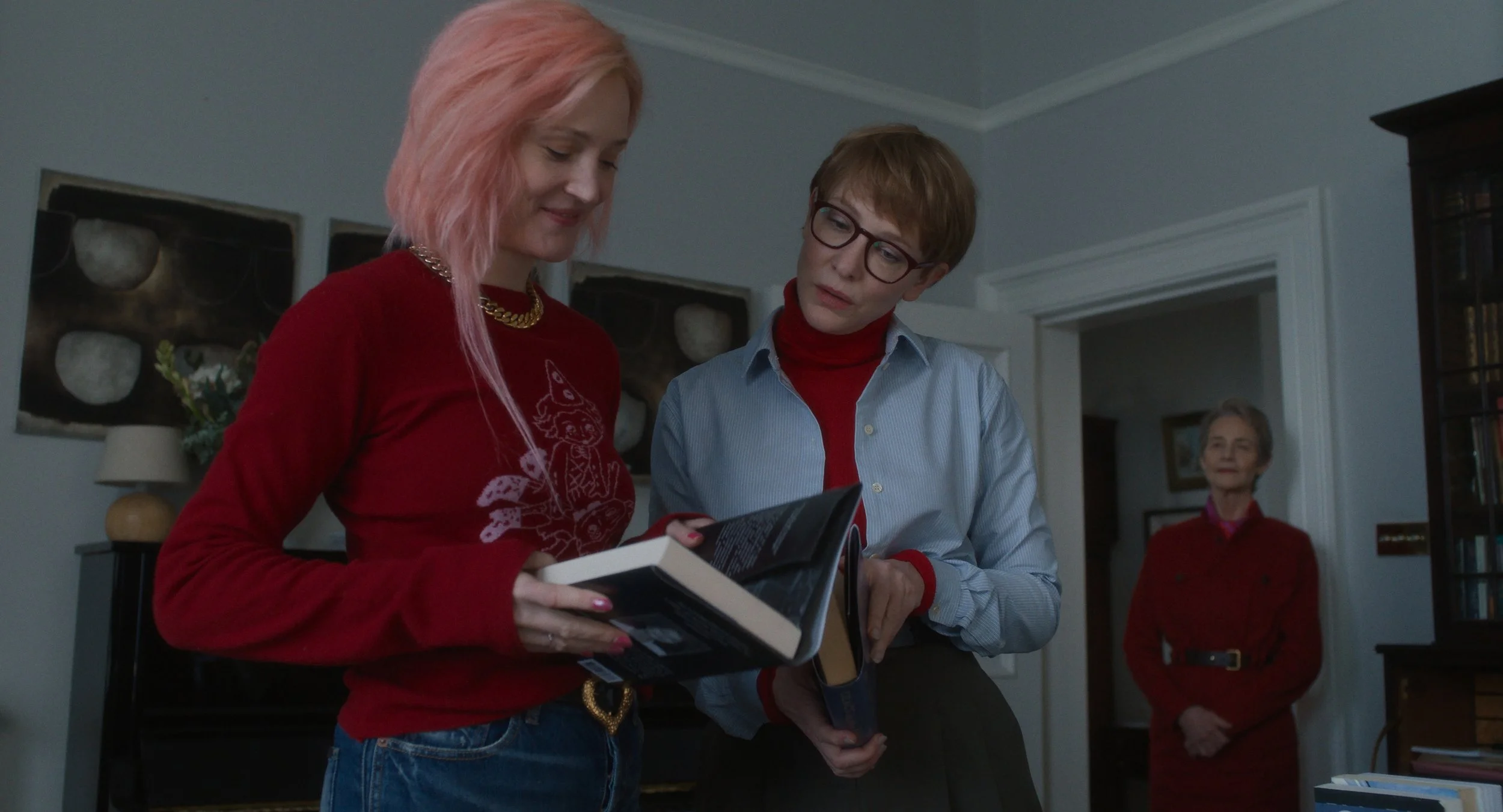
image courtesy of CINÉART
How does your part of the film connect to the other two sections?
There are subtle connections — linguistic ones, physical ones: cars, watches, houses, photographs, journeys. We think our families are unique units, but when you speak to others, you realise how universal these dynamics are.
When the film screened in Venice, I felt how Jim, through being very specific, taps into something universal. Strangely, the script felt more remote than the experience of making it. Casting breathes life into what Jim is trying to say — he really loves working with actors.
Did the full cast ever come together?
We didn’t share the set until Venice — and even then, not everyone was there. It was exciting to finally see the other sections. It completes the sentence of the film.
When you look back at your body of work, where does this film sit emotionally for you?
I rarely look back, if at all. Making a film is very different from watching it. But this was such a warm experience.
When I see Vicky and Charlotte now, it feels like a tiny family we made for that time. That kind of connection is rare and very touching. Reuniting with Jim reminded me of myself at an earlier point in my career.
How has working with Jim Jarmusch changed you over time?
Returning to a director builds trust. There’s a shorthand. It’s rare on film, and very special when it happens.
How much space was there for instinct and improvisation?
It’s all instinct. You have to respond. Jim’s films have a controlled chaos — meticulous but alive. You learn the structure, then make it feel improvised.