
IN CONVERSATION WITH HANNAH KHALIQUE-BROWN
interview by JANA LETONJA
Hannah Khalique-Brown is best known for her acclaimed lead performance as Saara Parvin in Channel 4 and Peacock’s cyber-thriller The Undeclared War, in which she returns this summer for the highly anticipated second season, reprising her role as the gifted GCHQ analyst whose unique way of thinking has become one of the show’s greatest strengths. Beyond The Undeclared War, she has built an impressively diverse body of work, from portraying Dorothea Wolsey in the BBC’s Wolf Hall and appearing in Greta Gerwig’s global phenomenon Barbie, to starring in Netflix’s Black Doves opposite Keira Knightley. Equally at home on stage, Hannah has earned acclaim for performances in productions including The Secret Garden and I Know, I Know, I Know. Off-screen, she is also a musician, performing in Jazz-Rock band Big Sky Orchestra alongside her husband. As her career continues to gather momentum, Hannah is emerging as one of the most compelling voices of a new generation of British performers.
The Undeclared War returns for a second season this summer. What excited you most about stepping back into Saara Parvin’s world?
I fell head over heels for Saara the first time I got to play her in season one, so I was so excited to step into her shoes again. The thing that excited me the most was probably getting to be in a brain that is so vastly different from my own. We have entirely different hardware, which makes playing her the most thrilling challenge.
Looking back, how has your understanding of Saara evolved since you first took on the role?
Season two picks up literally seconds after the cliffhanger ending of season one, so I had to go right back to how I understood her at that point in the story in order to craft the following beats. From there, my relationship with her has of course deepened, and the audience will definitely see some different aspects of her this season, especially some of the lighter sides of her personality and humour. But, I don’t think my understanding of her has necessarily changed.
One of the most refreshing aspects of the character is that her neurodiversity is portrayed as a strength rather than a limitation. Why do you think that representation is so important?
While not labelled at any point as specifically neurodivergent, Saara’s mind works very differently from almost everyone around her. Her incredible intelligence, her preternatural talent as a coder and problem-solver, and her unique way of seeing things in her mind’s eye set her apart from, and ahead of, almost everyone she comes across. She even knows this too, but she also feels deeply that she is different, that she doesn’t fit in with those around her. It’s this complexity that I think is most important for me.
How does Season 2 expand on the themes and tensions established in the first season?
A warning for spoilers for anyone yet to watch the first season. In this next instalment, Saara is spurred on by her promise to protect the life of her friend, Vadim, an undercover Russian agent to whom she feels a huge amount of loyalty, whilst also taking on an entirely new challenge with her boss Danny to secretly look within GCHQ itself to uncover the mole she and Gabriel begun to discover in season one. This underscores a wider arc of an even bigger conspiracy playing out globally than our characters realised in season one. The pressure builds from absolutely every angle. But as mentioned earlier, we get to see a slightly lighter side of Saara too, as she finds her place within a team, perhaps for the first time ever in her life.
The series explores technology, cyber warfare, and global politics. Has working on the show changed the way you think about the digital world?
Absolutely. From the very beginning, The Undeclared War opened my eyes to so many things I didn’t know about. I’m far more discerning than I ever used to be about the types of information and content I consume, highly aware that a huge amount of social media is made up of bots, ran by organisations or states with all sorts of nefarious agendas. I seriously question who stands to gain from any particular piece of information being spread. I think a great deal more about the importance of democracy too, and have found myself feeling incredibly protective over it in this mad, digital world.
Wolf Hall, Barbie, Black Doves, and The Undeclared War are all incredibly different projects. What connects the characters you choose to play?
I have to unconditionally love the characters I play. Even if it seems at first challenging to love them, for me, it is my duty to have a devotional loyalty to them. So a deep, strong tether of pure love connects each one to me, and to each other too. Aside from that, it’s variety and challenge that really attracts me to a role. On set, Mark Rylance and I were discussing our shared obsession with jumping from one thing to something almost polar opposite, if possible. Barbie was that jump for me after The Undeclared War. Then playing a sci-fi assassin nun in Dune: Prophecy to a Tudor nun in Wolf Hall.
Theatre remains a major part of your career. What does performing on stage give you that screen acting cannot?
There is a feeling, on stage, which you can’t get anywhere else. Call it an energy flow, a communion, however you describe it, the act of exchanging something with an audience, the give and take, live and different every night, is utterly thrilling. The presence that theatre demands of you is something we can work hard to recreate every take on set. And the cumulative effect of having played every scene in order on stage is powerful, this is something that takes great discipline on set to match, when you’re shooting everything out of order.
Is there a role or genre you haven’t tackled yet that you’re particularly eager to explore?
There is no limit to where I want to go with this craft. I’m an obsessive and an addict, and constantly in search of a challenge. That being said, I would love to do more comedy. I’ve mostly taken on drama in my screen career, but I started out doing a lot of comic roles in fringe theatre, and I love it. I’d also love to do some more strange or unconventionally written projects, and more horror would be good. I’m yet to play a fully fledged villain, someone truly evil. That is very much on my to-do list, it would be very satisfying to learn how to love them. I also love improvising, so I’d love to work with someone like Terrence Malick and stretch myself in long, improvisational takes.
You’re also a musician with Big Sky Orchestra. How does music influence your creative life and acting process?
Music and acting are both intertwined and separate entities in my life. I use music a lot in my acting process, it is an incredibly useful tool for the actor. I prepare for every role with various music choices, giving them their own desert island discs and a soundtrack to their life, and I use specific songs to prepare specific scenes. But aside from that, being a musician and playing in Big Sky Orchestra is a completely different part of my life. It is a separate, completely free and joyous creative expression for me, which also liberates me from those challenging times between roles where an actor can feel lost. Playing in Big Sky Orchestra has given me so much, a constant source of fun, an outlet for the wilder aspects of me, a creative force that has nothing to do with the acting industry, and a community built on love and freedom. These are things that keep my inner creative life singing.
Do acting and songwriting satisfy different creative needs, or do they inform one another?
Acting and songwriting feel very different to me inside, but in reality I suppose they do inform one another. Both require collaboration in a way that is quite similar. I’ll work privately on my characters in depth, but they don’t really exist until others’ collaborations lift them up, from a director, to scene partner, to all the work that’s done in costume, hair and makeup, set design, and sometimes most importantly, in editing.
In the same way that one of us will bring the beginnings of a tune forward in Big Sky Orchestra, but it grows into a living, breathing thing when each of us then builds on it together. It’s our collaboration that brings it into being, sometimes still growing weeks into playing a song live onstage and improvising with it, let alone when we get to recording and producing. Playing with the band on stage definitely carries some of the same thrill I get from being onstage in theatre, though it has a wildness that usually must be honed into something more precise in theatre. There’s no containing Big Sky.
How do you balance the increasingly public side of your career with maintaining a sense of personal identity?
I don’t think I’m all that aware of the “public” side of my life. Rather, I don’t really notice it. It helps not really spending time on social media. I use it for work, but I actively avoid it otherwise, deleting the IG app between posts. Without social media, the only time my life feels public is when people watch my work and let me know they liked it, which is just really lovely and always makes me super happy. So, it feels like a pretty healthy balance at the moment.
A sense of personal identity is maintained through having a life outside of your acting career, which I think is perhaps the most important thing. Being in Big Sky Orchestra with my husband Benedict is a huge help, as well as going to Japan as often as we can to visit family there, and keeping up my many hobbies such as learning Japanese and French, reading constantly, and watching Sumo wrestling. We just got back from watching the rikishi compete in Paris, our favourite thing in our favourite place.
With so many exciting projects on the horizon, what feels most important to you at this stage of your journey?
At the moment, I’m filming a movie, in between the release of our latest song Endless Light with Big Sky Orchestra and doing a few festival performances, so most important right now is getting enough sleep. Keeping healthy, open, hard-working, positive and always leading with love continues to be my guiding lights.
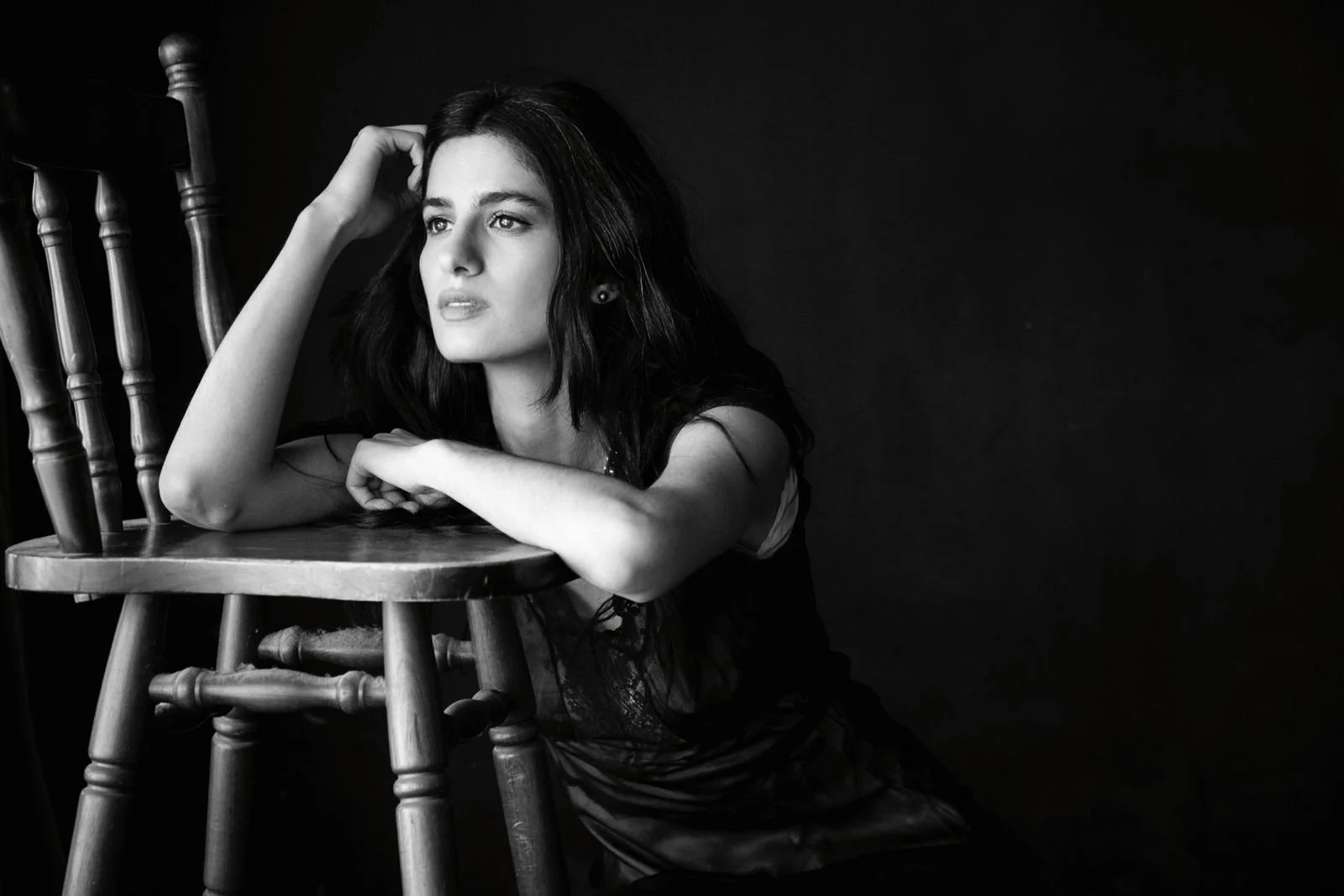
TEAM CREDITS:
photography LEE MALONE
styling LEILA AL ALI
hair LOUIS BYRNE
location PAPER DRESS VINTAGE
