
IN CONVERSATION WITH HOJO SHIN
interview by JANA LETONJA
South Korean actress Hojo Shin is quickly emerging as one of the most exciting new talents to watch. She stars in the hit Netflix series XO, Kitty, the beloved romantic comedy spinoff of the global To All the Boys franchise, which drew an impressive 57.7 million hours watched within its first four days of Season 2 release. Alongside her work on the series, Hojo will also showcase her dramatic range in the upcoming Korean short film thriller IDOLS, where she takes on the challenge of portraying dual roles — a world-famous K-drama actress and the aspiring hopeful doppelgänger desperate for a morsel of superstardom. With projects spanning international television and bold cinematic storytelling, Hojo is stepping confidently onto the global stage.
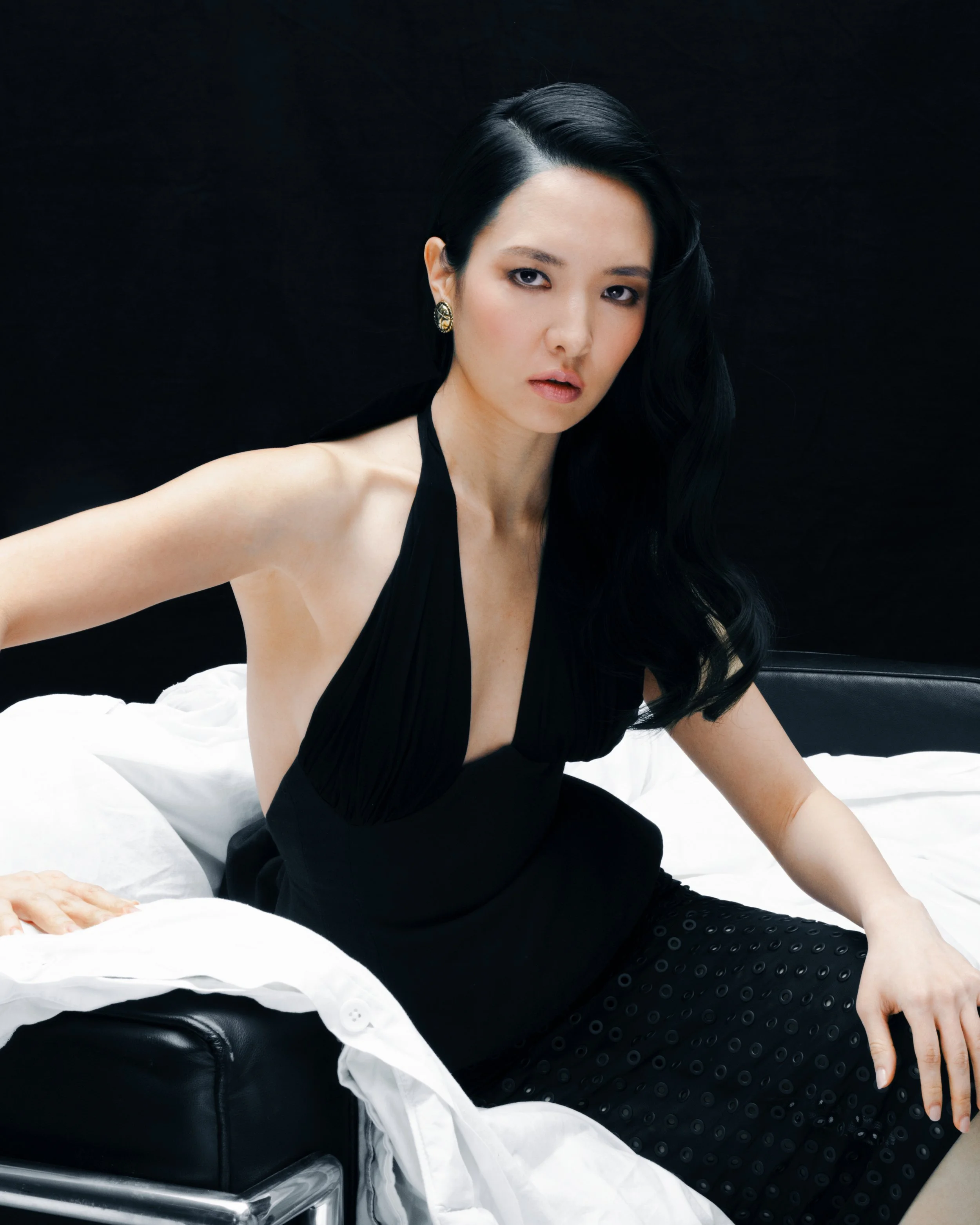
top TAE PARK
skirt ARCHIVE TOM FORD
shoes SAINT LAURENT
XO, Kitty has become a global favourite. What first excited you about joining the series?
I am a third culture kid. I grew up going to international schools in different parts of the world. So, it was surreal to see a show that took place at an international school in Seoul. Even the names were so similar. I went to YISS in Seoul, and our show’s school name is KISS. You can imagine how surreal it might have felt to join a show whose main character’s circumstances echoed my personal upbringing. Even with my rich imagination, I never thought a globally beloved show could have been centred around an international school in Seoul. It’s really heartwarming to think that while my generation grew up watching teens in the Upper East Side or Orange County, viewers now are growing up watching our world take place in Seoul.
Your character Jiwon is revealed as Kitty’s cousin in a memorable moment and becomes a grounding presence for Kitty in Seoul. How would you describe their dynamic?
She’s definitely more guarded and cautious than Kitty. I think through their little arc in season 2, we start to see a sisterly bond between them. In this new season, we’ll definitely see that dynamic evolve. I think Jiwon feels immense gratitude and fascination towards Kitty for bringing into her life the sort of reality that she only daydreamed of while studying English, or curiosity about the details behind her family dynamic. Though Kitty has two sisters, I think Jiwon definitely plays the big sister role for Kitty in Korea. I feel like they are your classic odd couple, opposites who complement one another.
What aspects of Jiwon’s personality did you most enjoy bringing to life?
Jiwon is quietly ambitious. It’s not the in-your-face type of ambition, but it’s visible. She’s never lived outside her small town in Bukjeon, yet she speaks fluent English. I think that quality about her ability to stay focused, driven and open speaks for itself. I love the realism she brings to the show regarding her sense of familial duty. It’s a very Korean experience for many of us, and Jiwon gets to introduce that world to Kitty and the audience. This season, though, Jiwon’s circumstances completely change, and we’ll see her journey of transformation. A big transformation. It was really fun and heartwarming to get to know her more in this new environment. We’ll see her shine as a woman, a friend, and a professional as she tries to claim her own form of autonomy. I got to love and care for her more, and hopefully, viewers do too! I also love that she is bilingual.
Season 3 promises new twists and deeper family relationships. What can you tease about Jiwon’s journey this season?
I can definitely say that she has a big fat journey. I can promise that she really transforms. In season 3, she navigates a whole new world outside of her small town, and as she does, I think we’ll see Jiwon become a little baddie. Through the twists and turns of life’s unpredictability, we’ll also see Jiwon and Kitty’s relationship profoundly deepen and seeing their family bond strengthen will be heartwarming. Without giving too much away, a few hints I can share about Jiwon’s journey would probably be perfectionism, vulnerability, womanhood, and bicultural identity confusion.
The show is set in Seoul but watched by audiences around the world. What does it mean to represent Korean culture on a global platform like Netflix?
There’s a highly revered Korean independent activist named Kim Gu. Similar to Martin Luther King Jr., he famously shared his dream and wanted Korea to one day become a nation whose power is rooted, not in force or brute strength, but in culture. When I was in year 3 of school, I remember distinctly that a classmate of mine didn’t know Korea and asked what it was. Cut to 2026, I would like to think that Korean kids these days have to explain or ask for permission less than our generation had to, and I haven’t even lived all that long. I think we’ve collectively transpired Kim Gu’s dream into reality. It’s really quite an ineffable feeling getting to witness the growth of Korean culture over the years, then to be a part of its representation on such a globally loved show like XO, Kitty. It’s cool that the world is not just merely watching but genuinely embracing Korean culture and storytelling.
In addition to the series, you’re starring in the short thriller IDOLS. What drew you to that project?
When I first read the script, I felt like I had just watched a whole movie. There were so many emotions bubbling inside of me, and not many scripts spark that vivid cinematic feeling, the kind that makes you want to gush about to everyone. For me, there are characters that speak to my logic and rare others that speak to my soul. Minha and Haemi were the latter. I was drawn in like a magnet. Ultimately, I think actors intuitively know when a special character comes along for them. Plus, I have a soft spot and deep love for independent cinema and films in general.
Playing dual roles — a world-famous K-drama actress and her aspiring doppelgänger — sounds incredibly challenging. How did you approach portraying two different characters in the same story?
For the first half of prep, I didn’t touch the characters. I read the script more than a hundred times. I do that in general for any work because I want to avoid being sucked into a vacuum of thinking about just my character or my lines. But that was the challenge for IDOLS. It’s mostly me against me, Minha against Haemi, with barely any other characters. So mid-prep, I had run into a mental block. In hindsight, I was also prepping for XO, Kitty, so the juggling could have contributed to it.
In any case, I was talking to my friend Jaewon Roh, a divinely talented Korean actor, about it, and he presented the idea of practising the two characters on separate days, never allowing them to meet on the same day. It’s no big revelation, but I think his advice turned on this sort of admin practicality switch that was crucial in building a system that separated the two. It’s an incredibly intense story with intense females, so it was important to build a system and set of rules for myself. It’s quite ironic, but I have found that in order to be free and open, painstaking logistical groundwork is essential. It was challenging, but because both characters are emotionally intense, I veered away from emotional prep and focused on things like structure, timeline and internal logic. I’m also an innately physical actor, so once I felt confident about the logistical groundwork, I made sure I knew their bodies and physicality. All that work thankfully allowed me to just freely play on set.
As your career grows globally, what kinds of roles are you most eager to explore next?
When it comes to roles, I think I’m pretty open. I would love to meet characters who push my spectrum and challenge my perception of the world. I’m into weird, quirky, rebellious characters. I also love the solemn, intense, or ambiguous ones. I’m eager to explore different genres, new professions that I can immerse myself in, historical figures who have been sidelined, stories that blend or bend worlds, and performing in different dialects or languages. I would love to do a role where French is required, that’d be fun. I’m also obsessed with Yorgos Lanthimos, so I would love to work with him one day. I also love Park Chan-wook, Guy Ritchie, Sofia Coppola, Lars von Trier, and anything Debora Cahn writes as well.
Outside of acting, what inspires you creatively or helps you stay grounded?
Living in a big city like Seoul, I like to find some respite in nature. When I’m not busy, I ride horses once a week. Spending time with horses definitely grounds and frees you. My family dog also grounds me. I was not a huge animal person, but he has changed our lives for the better. I also love to write. My brain is a constant feed of ideas, so I think writing allows me to just pour it all out. I’m actually working on releasing a Korean vocabulary book for English speakers imminently. I had put aside the draft for a couple of years, but playing Jiwon in XO, Kitty, who becomes a Korean Literature professor, allowed me to tap into the inner educator in me and work on finishing the book. The book is mnemonic-based, so it’s for all the visual learners out there who want to learn Korean. I think recently, aside from filming, all my creativity has been put towards making this book!
How do you hope your work contributes to the evolving global presence of Korean storytelling?
I hope we get to include more diverse stories. Historically, Korea has been a homogeneous society, but modern Korea is changing. As our global presence evolves, I hope I get to contribute to work that reflects the evolving dynamic of the Korean experience. As for me, I hope my work presents new perspectives and starts conversations that pivot perception. There are a few books I’ve read that I would love to see depicted on the screen and obviously, be a part of. I hope I get to tell meaningful and fun stories beyond Korea, as well. It’d be meaningful to work on projects that have lasting cultural impact, but mostly, I hope my work brings joy. At the end of the day, what matters is that people have a blast watching.
TEAM CREDITS
talent HOJO SHIN
photographer NICO DANIELS
stylist TAYLOR KIM
hair DAWSON HIEGERT
makeup YUMI MORI
editorial director and interview JANA LETONJA
