
IN CONVERSATION WITH HOWARD CHARLES
interview by JANA LETONJA
British actor Howard Charles is poised for a major breakthrough with the launch of Fightland, the new STARZ crime drama executive-produced by Curtis ‘50 Cent’ Jackson, that premierred on 31st July. Born and raised in London and trained at Drama Centre London, Howard has built an acclaimed career across stage and screen, working with the Royal Shakespeare Company, the Royal Court and the West End, while earning recognition for transformative performances in productions including Top Boy and Shadow and Bone. Now, with his biggest leading role to date, he’s bringing Duke Kilroy’s gripping story to audiences on both sides of the Atlantic.
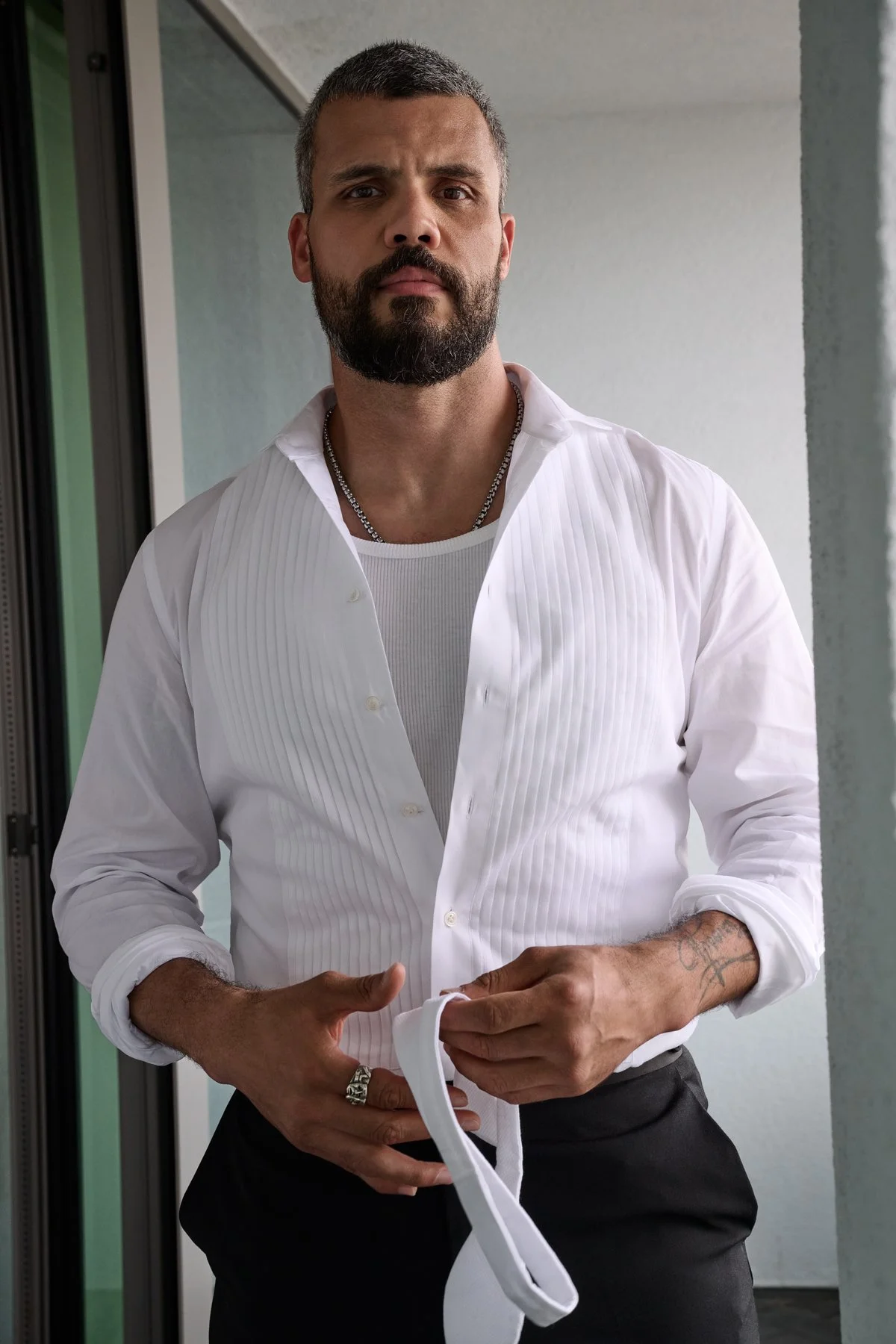
all photography by JEM MITCHELL
Fightland feels like a major moment in your career. What was your first reaction when you read the script and realised Duke Kilroy would be your next role?
I felt ready. Physically, emotionally, mentally, I felt ready for the challenge. The timing of it felt very meaningful to me. There are certain roles that arrive at a point in your life where you feel you have the tools, the appetite and the scars required to meet them properly, and Duke felt like one of those.
I knew immediately that he would ask a great deal of me. He would require discipline, stamina, emotional honesty and a willingness to go into some very difficult places. But that’s what excited me. I felt it was an opportunity to stretch myself in ways I hadn’t necessarily been afforded before.
Duke experiences immense loss, spends years in prison, and emerges driven by revenge. What drew you most to his journey?
His pain. That was the first thing I connected to. Duke is a world-class boxer whose life collapses on the very same night he becomes the heavyweight champion. He reaches the summit, then loses everything. His brother, his freedom, his future. What happens to a man when he loses everything he cares about? What does he become? And is there a way back? Those were the questions that drew me in. Revenge gives Duke purpose, but it also threatens to consume whatever is left of him. He returns from prison on the warpath, determined to avenge his brother’s death and destroy the empire of the man he believes destroyed his life. But Duke is not a monster. He’s wounded. Beneath the violence, there is grief. There is love. There is a man trying to survive the wreckage of his own life. That felt incredibly compelling to explore.
How did you prepare physically and emotionally to play a world heavyweight champion?
Fortunately, I already had a strong physical foundation. My physical life is one of the cornerstones of my work. But Duke required something more specific. When I first met the show runners, I was actually too lean for the role, so I had to put on some weight, around fifteen pounds. That meant making the necessary adjustments in the gym and in the kitchen. Lifting heavier, eating more, building a body that felt capable of carrying Duke’s history and physicality.
Of course, I started boxing. I had boxed a little when I was younger, so putting the gloves on again had a certain familiarity, but this was a new journey. Duke needed his own rhythm, his own style, and his own relationship to violence. We had a great stunt team on Fightland and we executed some wonderful fight sequences together.
Emotionally, I trust my instincts and I follow my curiosity. Every character asks something different of you, and I knew Duke would require me to go into some of the deepest and darkest spaces of the human heart. Grief, rage, love, vengeance, survival. I had to be willing to go there.
What were some of the biggest challenges of carrying a series as the lead for the first time?
I suppose the challenge is responsibility. Creatively, it felt like a natural progression for me, but carrying a series asks something very particular of you. You have to hold the centre, not in a self-important way, but in service of the work. I’ve had the pleasure of working with some wonderful lead actors and filmmakers, and the best of them all seem to understand the same thing, the story comes first. The work comes first.
As the lead, you help set the tone. You set a standard of focus, discipline and commitment. You have to be prepared every day, not only for your own work, but for the demands of the whole piece. That was the challenge, and also the privilege.
The show explores grief, trauma, loyalty and vengeance. What conversations do you hope it sparks among viewers?
I hope it sparks conversations about what we do with pain. Fightland is a world full of people trying to survive the wreckage of their own lives. It is absolutely a high-octane revenge saga, and I hope audiences are thrilled by it. But beneath that, it’s dealing with grief, loyalty, trauma, family, power and the cost of violence. What happens when people have no language for their pain? Where does it go? How does it come out? Through ambition, control, violence, revenge?
Duke is a man who has lost everything he cares about, and the question becomes: what does that loss turn him into? Can he come back from it? Can a life that has become darkness ever find the light again? So yes, I hope people are entertained. But I also hope they’re moved by it.
What was it like working on a project executive-produced by Curtis “50 Cent” Jackson?
It was exciting. You want to work with people who care about the quality of what they put into the world, and Curtis has an extraordinary track record. His success across music, television and business is undeniable, and there is something very impressive about that level of instinct, ambition and execution.
He understands audience. He understands world-building. He understands power, survival and reinvention, all of which feel very connected to the DNA of Fightland. So to have him involved in the project was exciting. He is a winner, and you want winners in your corner.
You’ve worked across stage and screen throughout your career. How has your classical training influenced your approach to a role like Duke?
My training is the foundation of everything I do. Working with the classics gives you a framework. It teaches you discipline, structure, language, rhythm, psychology and scale. You are exposed to some of the richest expressions of the human experience: love, betrayal, rage, grief, ambition, power, revenge.
In that sense, the classics are not separate from a modern role like Duke. They prepare you for him. They give you the tools to approach complex characters and emotionally demanding material with rigour and confidence.
It’s not unlike a fighter’s training. You do the work in the gym so that when fight night comes, you are ready. You may not be thinking consciously about every part of your training in the moment, but it’s in your body. It’s in your breath. It’s in the way you meet the work. It becomes instinctive.
You’ve developed a reputation for disappearing into roles. What is your process for finding a character’s voice and mindset?
It’s always difficult to articulate. Partly because I believe certain elements of the work should remain between the actor and the character, and partly because every character demands something different.
For me, I suppose it begins with curiosity. You set out on a journey of discovery, trying to understand who this person really is, what formed them, what they want. You listen for the essence of this other life, without judgement. And from there, slowly, you begin to find an understanding. Something begins to reveal itself. It requires patience. And a great deal of faith.
Looking back at your journey from Drama Centre London to leading a major US television drama, what lessons stand out most?
The work has to remain sacred. People come and go. Circumstances change. There are highs, lows, disappointments, rejection, moments of certainty and moments where you have to walk through the dark with only your instincts and determination to guide you. But the one constant is your relationship to the work. So one of the great lessons has been to protect that relationship. Protect your integrity. Stay true to the character. Serve the story. Don’t let noise, ego, fear or mediocrity pull you too far from the thing itself.
I’ve also learned that all conditions are temporary. Success is temporary. Failure is temporary. Praise is temporary. Rejection is temporary. What remains is the work, and the person you become in pursuit of it. At its best, acting is an act of service. You are trying to tell the truth, to stir something in an audience, to remind people of themselves. That is still what matters most to me.
With Fightland launching this summer, what excites you most about this next chapter of your career?
The possibility. Fightland feels like the beginning of a new chapter, and I’m excited by what that might open up for me as an actor, as a filmmaker, as a storyteller. My heart is very much in film. There are filmmakers I would love to collaborate with, like Paul Thomas Anderson, Christopher Nolan, Denis Villeneuve, David Fincher, Mia Hansen-Løve, Jacques Audiard, to name a few. I’m drawn to work that has scale, intelligence, danger, soul. Stories that ask something of the audience. As a writer and director, I’m also looking forward to finding like-minded collaborators who can help bring my own stories to life. So what excites me most is the chance to keep stretching. To work with serious people. To make work that travels. Work that moves audiences. To build something lasting.