
IN CONVERSATION WITH JESS JACOBS
interview by JANA LETONJA
photography by MONIKA OTTEHENNING
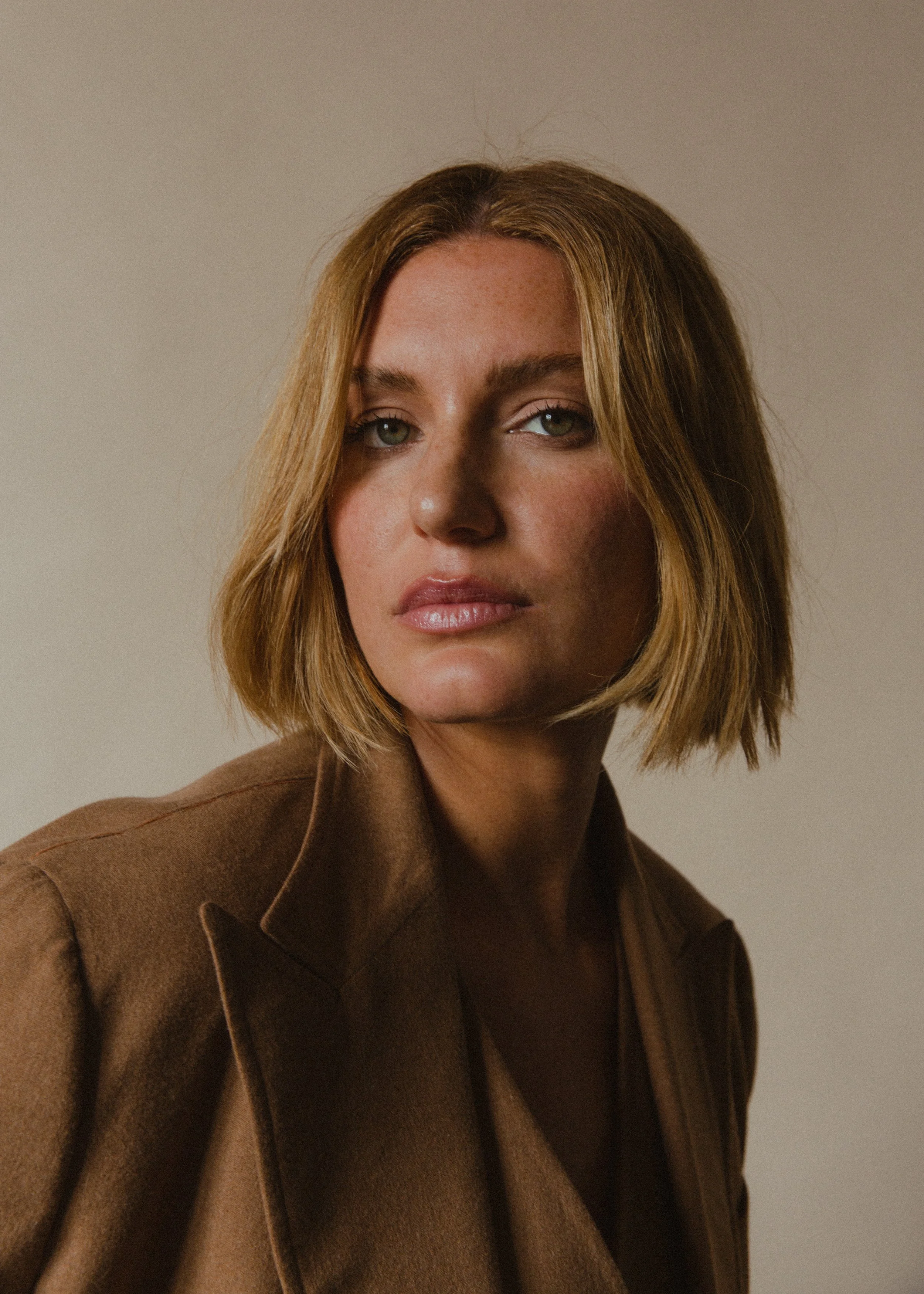
Jess Jacobs is an actor, writer, and filmmaker whose work is rooted in intimacy, urgency, and social consciousness. In the new independent film ‘If You See Something’, which she co-wrote and stars in, she explores love, displacement, and moral responsibility through a contemporary romance set against the realities of asylum and global conflict. Executive produced by Doug Liman, the film premiered at the Woodstock Film Festival and arrives on streaming platforms on 6th January. Beyond narrative film, Jess continues to use storytelling as a tool for impact, recently executive producing the acclaimed documentary ‘Plan C’, which screened at Sundance and SXSW and is now streaming on Apple+ and Amazon Prime.
What sparked the idea for ‘If You See Something’, and why did this story feel urgent to tell now?
‘If You See Something’ originated with director Oday Rasheed seeking political asylum, living in New York, in love with an American woman, and deeply happy. He began to ask himself what could come from his past to disturb the precious experience he was having, and not only how that would affect him, but how it would also affect the woman that he loves. Maybe that’s a universal question. Sometimes when I’m happy, I find the masochistic side of myself wondering when the other shoe is going to drop. For Oday, that question was existential and he began to put the story down on paper with Avram Noble Ludwig, the film’s original writer who was taken from us by cancer in 2019. I had attached to the film as an actress in 2016 and was involved in development of the script and story, so I picked up the pen to continue the work after losing Av.
For me, it felt like an urgent story to tell when I met Oday and Avram for the first time because it was one of the few scripts I had read which was the product of a truly unique collaboration between an artist with lived experience and an artist with deep American industry connections, and it had a distinctly dynamic female protagonist. It felt urgent in 2022 when we shot the film, because we had just emerged, or so we thought, from the Trump years, which had a devastating toll on the lives and rights of immigrants, Arab-Americans and women. It seemed that perhaps we were on a path to being able to explore the thematic questions of the film with greater shared understanding of the stakes. Today, as the film releases into the world, it feels urgent because I believe in the essential duty of artists to use the powerful tools we have to resist fascism in the United States being built on the backs of immigrants by a systematic process of dehumanization. In film, and in this film specifically, this resistance comes in the form of imagination and representation.
How did co-writing the film shape the way you approached Katie as a character?
It allowed me to inhabit her over years, which is often much longer than the time you get with a character when you’re cast and on-set in weeks or months. As an actor, I often call upon my own experiences to map onto a character I’m playing, sometimes consciously and sometimes subconsciously, but in this case, I spent five years investigating Katie’s crevices, her nooks and crannies, her relationships, so there were times on set where I recalled memories which did not belong to me, instead belonging to a past draft, to a previous version of Katie, to a self I had lived only in my mind. I hope that doesn’t make it sound like I should be institutionalized. There is a delicate dance both as a writer and as an actor between crafting a character and letting her emerge. I loved authoring Katie, and I loved getting to meet her over and over again as she revealed herself to me during the process.
Additionally, because I spent those years also in the heads of the other characters, I was so enmeshed. I couldn’t fully compartmentalize, so I think co-writing the film also fashioned a character who was understanding, very patient, who kept her emotional range just below the surface, and who fought for the possibility and the goodness of each of the film’s characters, even during tribulation.
The film balances romance with political and emotional tension. How did you maintain that intimacy without softening the stakes?
I personally believe the intimacy of the film is where the stakes lie. The closer to truth I could be in the moments of romance, the more human and resonant the political commentary and emotional experiences were, at least in this particular film. We’re used to seeing romance as this whirlwind experience on screen, replete with swelling orchestrals and gauzy images. I love a good romance, don’t get me wrong, but I wanted this love to feel lived-in. I wanted the relationships to feel earnest and quotidian. For many, including some characters in the film, the fact of this romantic relationship is exceptional and unusual. For Oday and I, we wanted to express the relationship as commonplace. That constructed a filmic reality where the urgency is proximate, rather than theoretical, for our audiences who surely see their own relationships as normal by virtue of living them. The political statement lies in the ordinariness of the relationship and the intimacy, and how the complications which arise are unjust dominantly because these two people are simply trying to live a life together, as any of us are when we love.
What challenges come with performing in a role you helped create?
There is a challenge in letting go of the scene I had in my head while writing, in order to perform with the flesh-and-blood actor in front of me. But Katie didn’t write the script, Jess did. So knowing this character as well as I did, it was a process of shedding my skin and donning hers. Plus, I was surrounded by exceptional, sensitive actors and had the support of Oday, whose direction I trusted implicitly.
I, as Jess, knew the psychology of characters and the inner workings of scenes where Katie was not present, and therefore had so much information Katie would not have. It demanded radical presence. It demanded an expansion beyond my own thoughts, feelings and self-awareness into a dimension where the scene was reality. Hard, and rewarding, and, God, so fun.
The film asks what it means to love someone whose past is still unfolding. What questions were you hoping audiences would sit with?
Over a decade of working on this project, you’re the first person to phrase the question of the film that way. It’s brilliant. Ali’s past is tapping on his shoulder explicitly in the film, though each character is grappling with an implicit version of that experience in their own way. I mean, all of our pasts are still unfolding and all of us seek to love and be loved. Personally, my closeness with my husband is crucially dependent on both of us unpacking our past lives in order to be in the present with one another, and thereby to lay claim to our future. That’s a huge element of Ali and Katie’s journey, individually and jointly.
I thought I would be on the press tour for ‘If You See Something’ talking about the basic human need to overcome shame and develop trust across difference, whether cultural, national, racial, gender-based, or simply the fact of being distinct individuals trying to connect across meat suits. I stand by that thematic foundation, especially as a way of articulating that this is a film for anyone who has ever loved. I’m also profoundly aware that the authenticity with which we told this story carries particular weight today. The ICE jackets in the film land differently as their real-life counterparts perform barbarous acts of injustice, the threats various characters feel are understood in the bones of many Americans, the question “Do you like it here?” sparks new reflection as emigration from the US for safety becomes more common. I hope audiences sit with both the cathartic pain and the immense possibility the film offers, in equal measure.
How does ‘If You See Something’ challenge the idea of neutrality or emotional distance in times of crisis?
I think this response could only be unpacked appropriately in like a PHD thesis meeting psychology, sociology, philosophy, pop-culture and political science. But I’ll give it a stab. I fundamentally believe neutrality does not exist, especially during times of injustice or crisis. There is complicity, there is dissent, and there is ignorance. Non-action is active and avoidant, not to be confused with rest, which is active and essential. I intended for this set of beliefs to find their way into the film, dominantly but not exclusively through the female characters. There is a persistent desire to isolate, to disengage from pain and awfulness, which is so understandable, and which is overcome only by the belief that our actions can make a difference. Our film insists that action is possible, and it matters, big and small. Kindness is action. Commitment is action. Presence is action. Risk is action. ‘If You See Something’ isn’t about world leaders making change, it’s about an intimate constellation of everyday people, with diverse points of view, discovering how emotionally rich it is to be interconnected.
Your work often intersects with social and political realities. Do you see storytelling as a form of activism?
Maybe you asking this question means the answer to it is self-evident. Yes, I really, really do. Storytelling is an ancient tool for communication and communication is the heart of mutual human understanding. I like to situate my work in the realm of character-driven storytelling, which allows any political value and implication to occur to an audience, instead of spoon feeding some kind of agenda. The core value I hold around autonomy includes the audience. Audiences are so smart, and deserve to experience creative work which honors their intelligence and savvy.
The realities of migration are core to human existence over millenia, only becoming more relevant in contemporary times. The product of war, the climate crisis, genocides, the rise of authoritarianism, economic opportunity, as well as the pure and natural human instinct to explore other places to call home. We had better figure out a way to sustain our emotional engagement and our actions toward an expanded vision of humanity, rather than as a zero-sum, us-versus-them game.
And for the record, I expect I’m not going to get it “right” sometimes despite the rigor. I certainly have limitations. Actually, I hope I don’t get it “right” all the time, even though it’s a little scary in the current climate, or else I’m not stretching enough. I look forward to the discourse in those moments. That’s what art is for.
How do you decide which stories you want to invest in creatively and emotionally?
I tend to have my creative and emotional interest piqued by stories, themes or questions which don’t have an obvious, binaristic right and wrong. I grew up on Disney fairytales and superhero movies like the rest of us, but as a grown woman in a complicated, nuanced, demanding world, it feels so much more stimulating and gratifying to shed that either/or in favor of with/and. But beyond that, I decide because I decide, I guess. Something interests me so I invest. At the end of the day, I would direct readers to David Lynch’s philosophy that intuition has no explanation. Why does a painter flick their brush this way or that way? You can’t answer the question. It’s intuition, it’s instinct.
What drew you to ‘Plan C’, and why was it important for you to support that project as an executive producer?
I had been in relationship with the film’s eponymous organization ‘Plan C’ for years, after having my first abortion with pills when I was a teenager, so the film came onto my radar that way. I loved working with Tracy Droz Tragos, who is a genius and wonderful, alongside the rest of the creative team. It’s a documentary celebrating real world heroes. In the way Katie and Ali’s ordinary love creates a setting for extraordinary realization, so too did the ordinary heroes of the self-managed abortion movement in ‘Plan C’ intend to spur an understanding of the power of individuals in times of systemic oppression, and offer a blueprint for abortion access during a time of dismantlement of basic human rights and criminalization of freedom and autonomy. I was inspired by that, massively, and wanted to be a part of telling a story that was actionable. ‘Plan C’ was actionable. It was not intended to change hearts and minds, to be honest. It was intended to preach to the choir, and to get the choir to sing louder and in clearer unison.
You move fluidly between acting, writing, and producing. How do these roles feed one another?
That’s a compliment. Thank you. I’ve been performing professionally since my teenage years so that’s kind of in my blood. When I started to write, I felt that my craft as an actor served character development most deeply. Building plot and story from a deep understanding of character has driven my creative process since. To be honest, I rarely start with plot. I always start with character, fleshing out the inner worlds and psyches of each character, just as I would develop a role to perform it, to determine where the story goes. I started to produce because I was tired of waiting for someone to hand my life to me. It gave me agency as a creative person. Understanding how the sausage gets made allowed me to hone my business acumen and to develop a skillset to have some say over my creative destiny. When I’m working on a project in any capacity, my experiences give me profound respect for the work of collaborators performing those roles, and also allows me to trust myself when I feel that something is not right. Having the knowledge and the skillset to articulate that feeling when it arrives has been helpful, especially as a woman in a male-dominated industry.
What have you learned about yourself as an artist through this multi-hyphenate path?
About myself as an artist, I’ve learned that every form of self-expression drives the next. Making art with integrity and curiosity, rather than because I think it’s what executives and financiers are looking for, keeps me grounded. It’s so easy to be results-oriented, and I spent a lot of time in my early career thinking that if I could just get x, y or z film made, then it would be easier. Then I could start to make the work I really cared about. I was auditioning, writing, producing for someone else, and not even a real someone else, just the idea of someone else. Finally, I said fuck it and put my attention on my process and on working with people that I like and respect on topics and stories and characters which make me glad to be alive. My creativity is so much more dynamic as a result, and paradoxically I feel both more ownership over it and less precious about it. Plus I’m enjoying my career so much more. The struggling artist trope is a romantic and non-practical identity. My conspiracy theory is that it was devised to keep artists paralyzed and disempowered. We deserve better, we deserve to tend to our seeds in rich soil, dutifully watering them until they grow. Then, revel in each beautiful flower.
What kinds of stories or themes are you most interested in exploring next?
I’m currently working on a couple films exploring desire and pleasure, and how that relates to power. Yes, sex, and also desire, pleasure and power in a global sense. I’m curious about hunger. As part of that, I’m dismantling my own relationship to control, so that’s starting to show up in my work. I’m also developing a project around journalism, and who gets to tell whose stories. A little meta, I guess. I think the overall unifying factor is an interest in agentic women, in life and in art, because they are stepping off the altar of self-sacrifice, deprioritizing being ‘likeable’, and centering themselves, their vision, their stories. I want to know where that courage comes from. I want to be courageous.
