
Interview by Samo Šajn
Japanese composer Keiichiro Shibuya brings together piano, electronics and live strings on his new album, “Threshold,” exploring a world approaching its breaking points. We caught up with him to discuss the record, his work with AI and non-human performers, and the possibilities that keep him curious about music.
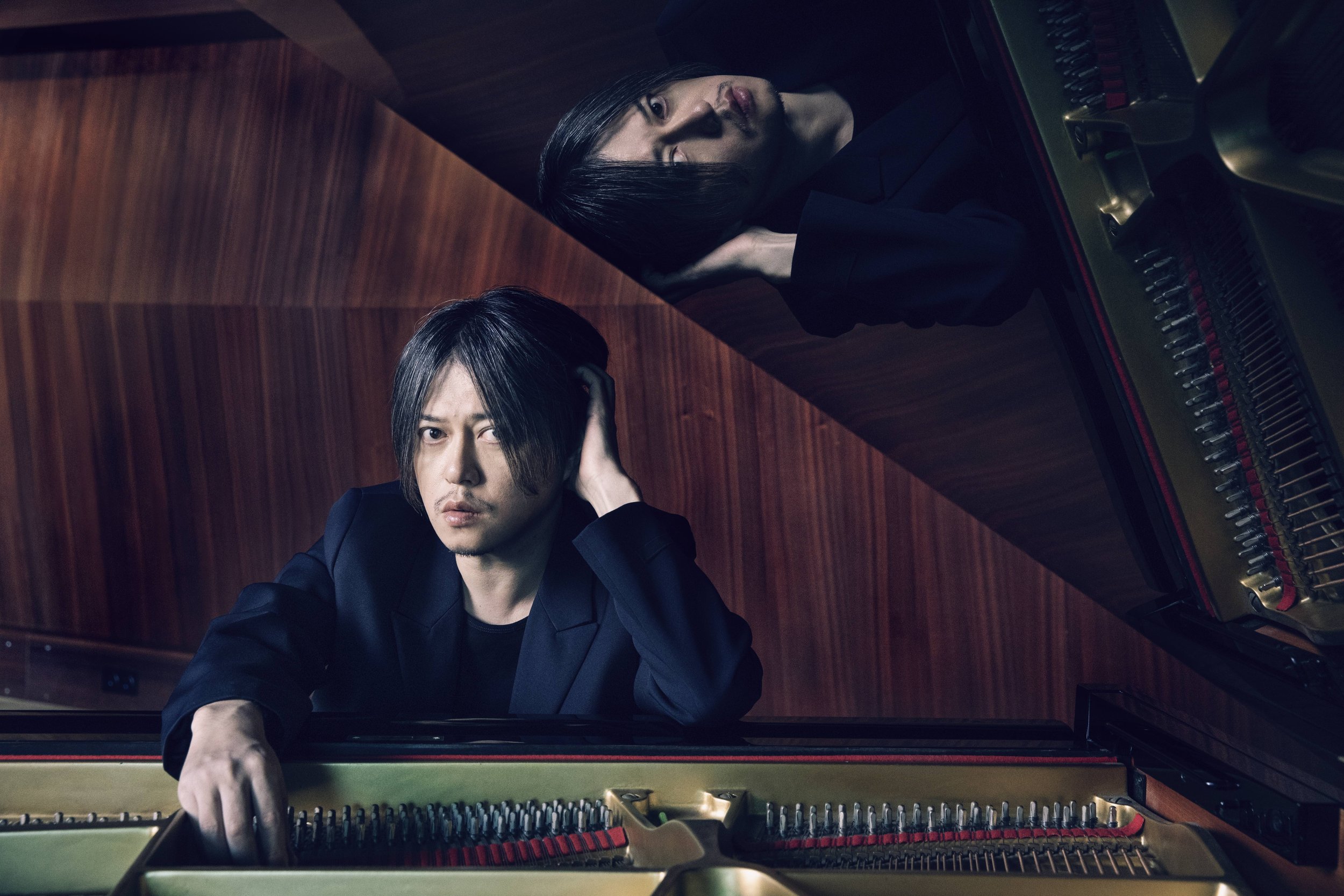
Your new album is called “Threshold,” a title that connects sound processing with the world reaching its breaking points. What first drew you to that idea?
It began with a commission from NHK, Japan’s public broadcaster, to write music for a documentary about a female soldier in Ukraine. The series also explored the refugee crisis and other stories of a world reaching its breaking points. Around the same time, I received an invitation to bring my Android Opera to Ukraine, which I’m working towards making happen next May. More recently, invitations to perform in the Gulf were put on hold as conflict loomed. Even on a personal level, I felt that the world, through war and in so many other ways, was approaching a very difficult point. Meanwhile, in the studio, I was making tiny adjustments to control whether sound crossed a threshold. Suddenly, those movements at my fingertips connected with the urgency of what was happening in the world. That intuition became the title.
The album grew out of your score for “On the Edge.” How did you turn music written for a screen into a record with its own story?
From the beginning, I wrote with a solo album in mind. I had been so busy that I needed a break, and I was planning to turn down the commission. But the journalists and directors behind the documentaries were fascinating, passionate people I wanted to work with. I’ve always been drawn to the idea of a world pushed to its limits, so their subjects felt close to my own concerns. Although I was writing for the screen, I felt I could make the music my own. I wanted it to offer a kind of hope, something strong enough to stand against the brutality of what we were seeing.
You have spent years exploring AI through your work. What made you want to put it aside for this album, and did that change the way you composed?
When I wrote this music in early 2025, it was actually much faster to make what I wanted myself than to work with AI. The music came straight out of intuition. Looking back, perhaps that was one of the last moments when we humans could say, “It’s faster to make it ourselves.” Avoiding AI wasn’t a matter of principle; it was simply the most direct way to work at that time. Working with AI can stimulate your imagination and expand what you can create, but you’re no longer creating entirely on your own. It changes the process. So this might be my “last personal music,” or perhaps what will change is the meaning of “personal” itself.
“Threshold” brings together piano, electronics and live strings. How did you want these different elements to interact?
I wanted the sounds to permeate one another until it became difficult to tell where one ended and another began. Digital and acoustic, software and analogue: those distinctions exist when you’re making the music, but they can dissolve in the experience of listening. That was what interested me.
You describe the album as something close to swimming through an unconscious sea. How do you translate that feeling into music?
That describes how I felt while composing. I wasn’t deciding every destination in advance. I was following the sound from one place to the next. You can also hear it in the structures. Music often moves from A to B and then returns to A. Apart from the main theme, “Threshold,” many of these pieces move from A to B to C and simply keep going. That sense of moving forward without knowing where you will arrive is what I mean by “swimming in a sea of the unconscious.”
You remain enthusiastic about AI at a time when many artists are worried about its impact. What possibilities excite you most, and where do you have doubts?
I don’t find it interesting to generate music with AI and use it as a finished track without changing it. If the aim is simply to reproduce conventional music, I don’t see a reason to get involved. What interests me is using it selectively to discover things I wouldn’t have thought of myself. That expands my own possibilities. I see what AI produces as a preliminary sketch rather than something finished. For example, I might take parts from an AI-generated MIDI file, pull them apart or develop the sounds and restructure them, then create what comes next myself. That can take me beyond the limits of my own habits and open up somewhere new to go.
From Hatsune Miku in “THE END” to the humanoid singer in your Android Opera, you have created performances without a human lead. What have these experiences taught you about how audiences connect with a performer?
People have been moved by human performances for thousands of years, and I don’t think there is any limit to what they can offer. But I wanted to explore other ways of moving an audience. Through working with Hatsune Miku and androids, I’ve found that non-human performers can evoke feelings we’ve never experienced before. I’m interested in what we feel in their presence precisely because they are different from us. There is something meaningful about discovering an unfamiliar emotion. For me, these works are a way to expand the range of what we can feel. That’s what makes them worth creating as an artist.
When you compose for film or television, how do you decide what the music should express and what should be left to the images or silence?
If the images or the story are strong enough, it can be better to leave them in silence. Looking at the work objectively, sometimes adding music can actually weaken its impact. But in practice, that isn’t always the case. Music often needs to pick up what the images alone cannot convey and give them a hand. Directors and producers often point to a specific moment and say, “We need the music to help us here.” That’s quite a common request.
Your work moves between intimate piano pieces and large theatrical productions. What does the piano allow you to express that you cannot find elsewhere?
At the piano, the movement of my hands and the sound coming back to me are directly connected. I hear something and immediately adjust my touch. Both composing and performing happen through that exchange. I can make a change by feel before I’ve worked out a logical reason for it. That immediacy matters to me. While making “for maria,” the album dedicated to my wife, who passed away in 2008, I found myself touching the piano almost as if I were massaging it, taking hold of it rather than simply playing the keys. I felt the sound change. A different physical relationship with the same instrument could change both its tone and the music itself. The piano became a way to reflect through touch.
After making “Threshold,” what are you most curious to explore next, and has the album changed how you imagine working with technology?
I’m working on a new stage production for 2027 with the British choreographer Wayne McGregor and the Japanese architect Kazuyo Sejima. At the moment, I’m composing entirely with electronics, focusing on the physicality of timbre, how sound acts on the body. My approach has tended to focus on structure, and I’m trying to move away from that a little. I’m experimenting with digital and analogue instruments, old and new. I think a different style will emerge.
I’m curious about the latest AI and software, so of course I try them. At the same time, when it’s so difficult to feel hopeful about the future, I find myself looking back at music from the past with affection. I see older instruments as things to play today rather than collectors’ items. There are so many wonderful analogue instruments. I want to bring those sounds together with new technologies, making music in which different eras can coexist. Electronic music offers a way to work across time and space.
