
IN CONVERSATION WITH LAURA DONNELLY
interview by JANA LETONJA
At a moment where stage mastery meets global screen momentum, Laura Donnelly enters a defining new chapter. An Olivier Award winner and two-time Tony nominee for her work in The Ferryman and The Hills of California, she has long been recognised for her emotional precision and commanding presence. Now, with a series of major projects set to unfold, from the neo-noir sci-fi Sugar alongside Colin Farrell, to the psychological drama The Dark, and her portrayal of Rose Kennedy opposite Michael Fassbender in the upcoming Netflix series Kennedy, she steps into a space of global visibility. It’s a moment that feels less like a breakthrough and more like a natural expansion of a career built on depth, restraint, and quiet intensity.
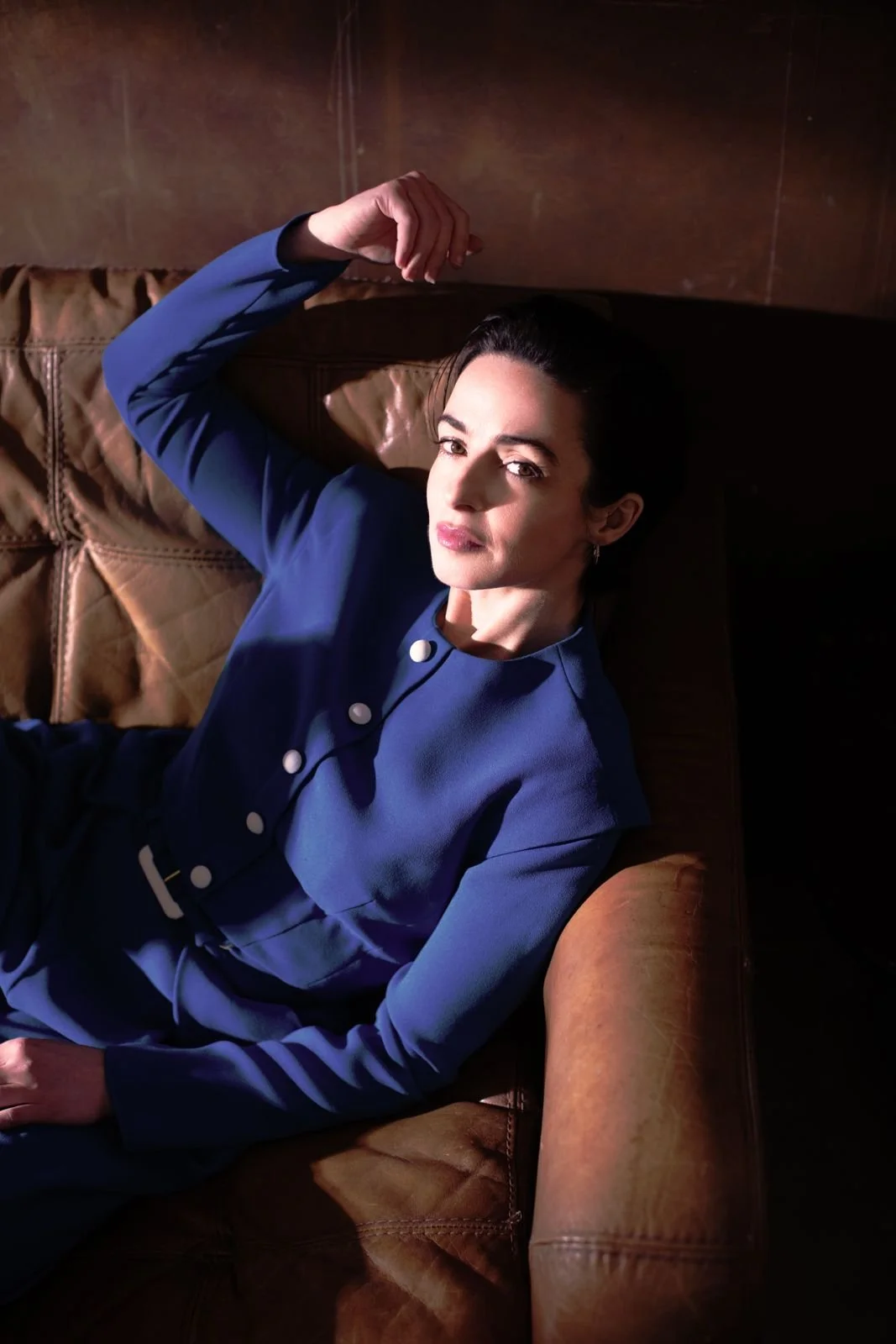
top and trousers EDELINE LEE
shoes CHRISTIAN LOUBOUTIN
jewellery ASTRID & MIYU
This feels like a pivotal moment in your career. Does it feel that way to you as well?
I tend not to think of my career as a whole like that anymore. I have found in the past that there have been moments where I thought that something was going to be quite pivotal, that things would really be different after, and for one reason or another it hasn't worked out that way. And you don't know what's ever coming around the corner, whether it's Covid or anything else.
You never know how something's going to be received. So, I don't concentrate on the outcomes of the projects that I do anymore, and I'm really much more focused just on the today, because it is, quite literally, the only thing that we have for sure. And so I'm always just questioning whether I’m happy and fulfilled in the thing that I'm doing right now. And if that is the case, then that's enough for me right now.
You know, I feel really content at the moment with where I've got to in terms of the freedom and the choices that I feel I have. And I can only hope that that will continue. I'd love to be able to stay in that kind of area. But in terms of counting on big turning points or what comes next, I don't really do that. And in fact, when I look back at my career, it's often been the things that I didn't expect to make a difference that really do. I can chart a real turning point in the past around a small play that I did in the Almeida in 2011. And because Ian Rixon, the director, came to see me in that, unbeknownst to me, a year later he was calling me in for a job at the Royal Court that really changed the direction of everything for me.
So yeah, I don't count on anything other than what that I'm doing right now. And right now, I'm really happy with where I'm at.
How do you navigate stepping into projects that carry such scale and visibility?
I don't treat any job any differently from the one before it, which is to say that I do my best to prepare and give it everything I've got, to make myself proud in the work that I'm doing and hope that people enjoy it. But I don't believe that thinking in terms of scale and visibility can contribute anything artistic. That would only pull you off course as an actor.
If I were to step into something thinking, "Oh, this is going to be really big, it's going to be watched by lots of people," I can only imagine that that adds pressure and nothing else that's helpful. So, I pretty much approach every single job exactly the same way, which is to do my best in the ways that I know how, and not worry about the bigger context of it.
What drew you to Sugar and its neo-noir, sci-fi world?
The thing that first drew me to it was the idea of getting to work with Colin Farrell, because I've been such a big admirer of his work over the years, and I'd heard how wonderful he is to work with. And that's a huge factor for me in wanting to do any job, knowing who I will be spending my days with. That was definitely the first thing that drew my attention to it, because I think he's just so fantastic.
And the next thing was when I had chatted to our showrunner, Sam. It sounded like nothing I had done before in terms of getting to play around in this neo-noir, old Hollywood kind of atmosphere, and that just sounded like a really fun thing to do. That and shooting in Los Angeles, which is somewhere I've always wanted to work and a place I've spent a lot of time in, but never actually got to film there because so little is actually filmed in LA anymore. So it seemed like a real opportunity to do the kind of thing that I had wanted to do from when I was a kid, when I imagined what being an actress would involve.
But as usual, it was kind of all those elements coming together. It just sounded like it was going to be a lot of fun, and it really was.
What challenges come with balancing stylisation and emotional truth in a project like this?
I guess that was there in the back of my mind while I was preparing, but it wasn't something that I was kind of worried about in any way. I know the feeling in my body when something feels emotionally truthful, and if I don't feel that while I'm preparing or on set, then I'm not going to stop there. I did give some thought to how I would be able to lean into this character and the style of this world. That's really helped by watching the first series and seeing how Colin does it, and how it's shot and edited. That's always a huge bonus to be able to do that, rather than trying to create something that is essentially all in your head, or all in other people's heads, as that’s essentially invisible to you.
I did give some thought to those old Hollywood film noir actresses. The performances by the likes of Lauren Bacall and Gloria Swanson, and thought about the way they move, or how they might use their voice, and kind of allowed that to seep in anywhere that I could. But once you've done all that, it's really just a case of getting on set and only playing the truth, and trying to really forget about the rest.
And then things like styling, costume, hair, and makeup make a huge difference as well, and they do a lot of the work too. So, it's a collaborative thing to create a character, all the more whenever the piece is as stylised as this is. My job is to just take all that and create something real from it, which is the basic instinct for any actor on a set.
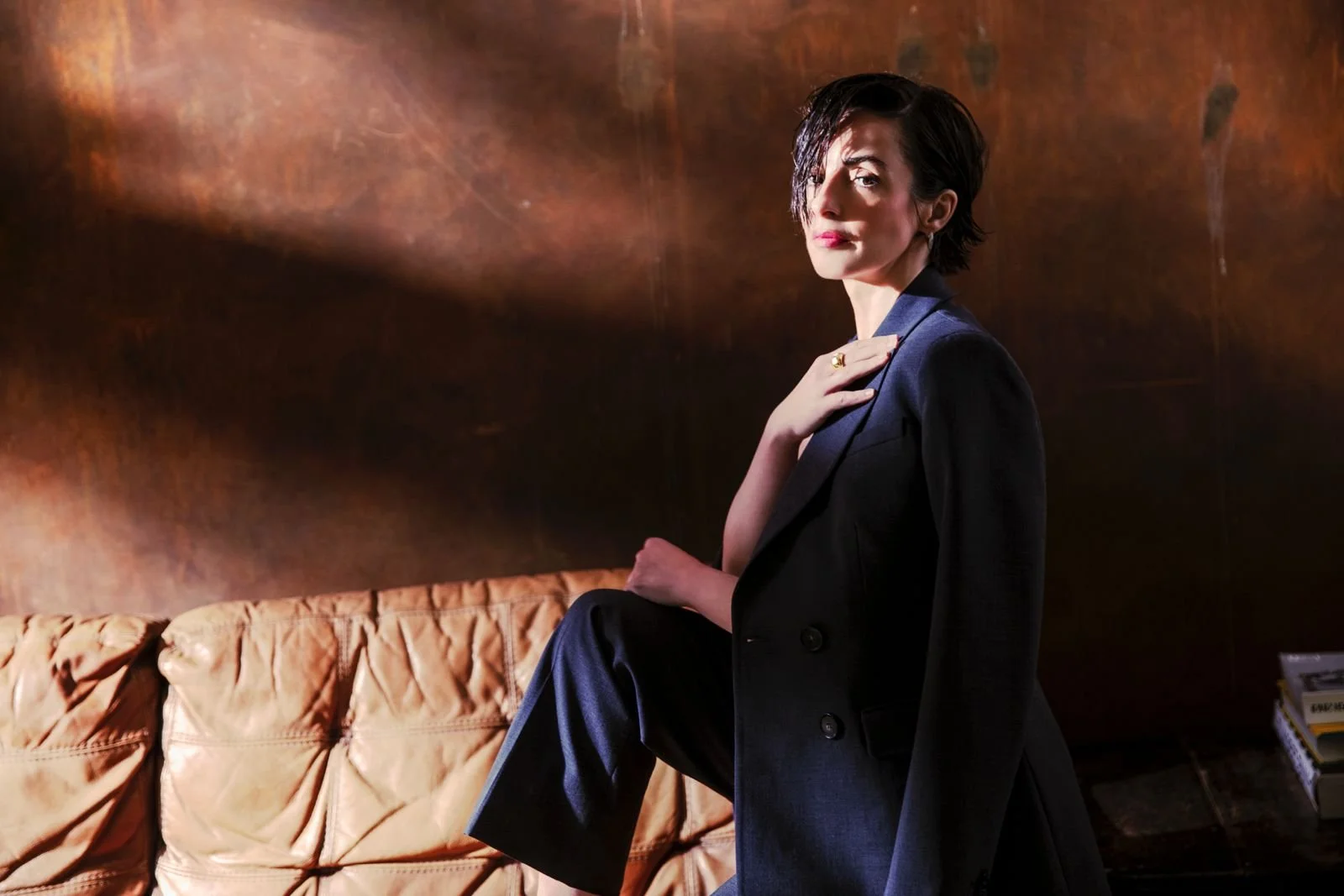
suit EMILIA WICKSTEAD
bodysuit ZIMMERMANN
earrings LUCY DELIUS
ring BEAR BROOKSBANK
The Dark explores a very unsettling narrative. What attracted you to this story?
I read the first script and didn't have a really clear idea about who Monica was, but I knew that I wanted to find out. And really, that was the whole draw. I couldn't pinpoint her in just that one script, and I have often found, watching detective shows or reading scripts for them in the past, that there are some very broad strokes being put down in terms of signalling who the character or lead detective is straight away. What are their flaws? What are their worries? What motivates them? And there seemed, in the first script, to be hints toward those things, but I didn't have a full picture of her in my mind. It felt like I was being given little breadcrumbs that I wanted to follow. I wanted to follow them, so that was really what drew me in there.
How do you prepare for roles that sit within such intense psychological territory?
I don't find that the subject matter being this dark takes me to a darker place. I think it might be a bit different if you're playing the killer, but as the detective in a story like this, I find I just have to be very clear on the simplicity of what she's trying to achieve, and that is to figure something out before time runs out.
We all know what desperation feels like, what worry and concern and responsibility all feel like. So, it's tapping into the things that drive her rather than focusing on the subject matter itself. I think that as an actor, you're always playing an intention. You're not playing an emotional state. I don't know how I would act in a way that focused on the crimes in this drama for example. It's just that she has a job to do, and she has challenges that are set against that, obstacles that she has to overcome, and her intensity comes from her desperation to get that done. But it doesn't necessarily feel to me any different to playing a character who is really desperate to achieve something for their own sake, or to parent their child really well.
And then you’ll also be portraying Rose Kennedy in Netflix’s Kennedy. How do you approach embodying a real figure who carries such cultural weight?
It helps that it's a real-life person. In the case of Rose, there are interviews that I can watch, and many documentaries and books that I can read to try and get an inkling of who she was as a spirit, what drove her, and what she was up against. Those are often the things that you need to find as an actor with a lot less information.
If you’re portraying a fictional character, you've got your script and that's maybe it, so you have to find all of those things for yourself. But instead, when it's a real-life character, you get lots of clues and far more nuance is available to you if you’re able to do proper research on that person. And I loved doing that.
I’ve played one or two real-life characters before, but never anybody that there’s so much information out there about them. And for me, it wasn't about doing the perfect imitation of her or trying to recreate exactly who she was in every single detail. It was about figuring out her essence, or her essence as I saw it to be, and working with that within the context of the story that we tell in this particular series.
In terms of the cultural weight, I mean, yes, there's a slight sense of responsibility there. I'm always aware that whenever you're playing somebody real, there will be people who remember them. There’s living relatives for example, and they will have their own views and feelings about that. But it's not something that I can bring into my performance or my preparation of the character. That's only something that sits in the background or on the side while I do my job, and there's not really anything that I can do in a practical way about that.
With comparisons already being made to The Crown, how do you position your performance within that expectation?
I don't.I just did the best I could at the job, and I don't think of myself within the position of anything other than the broader story that we're trying to tell, how I interact with my fellow actors and their characters, and what kind of story we can all tell together. My responsibility there is owed to them on set, to do my best and meet them with everything I've got. In terms of the broader context of the project, and especially the expectation around it, I consider that to be none of my business.
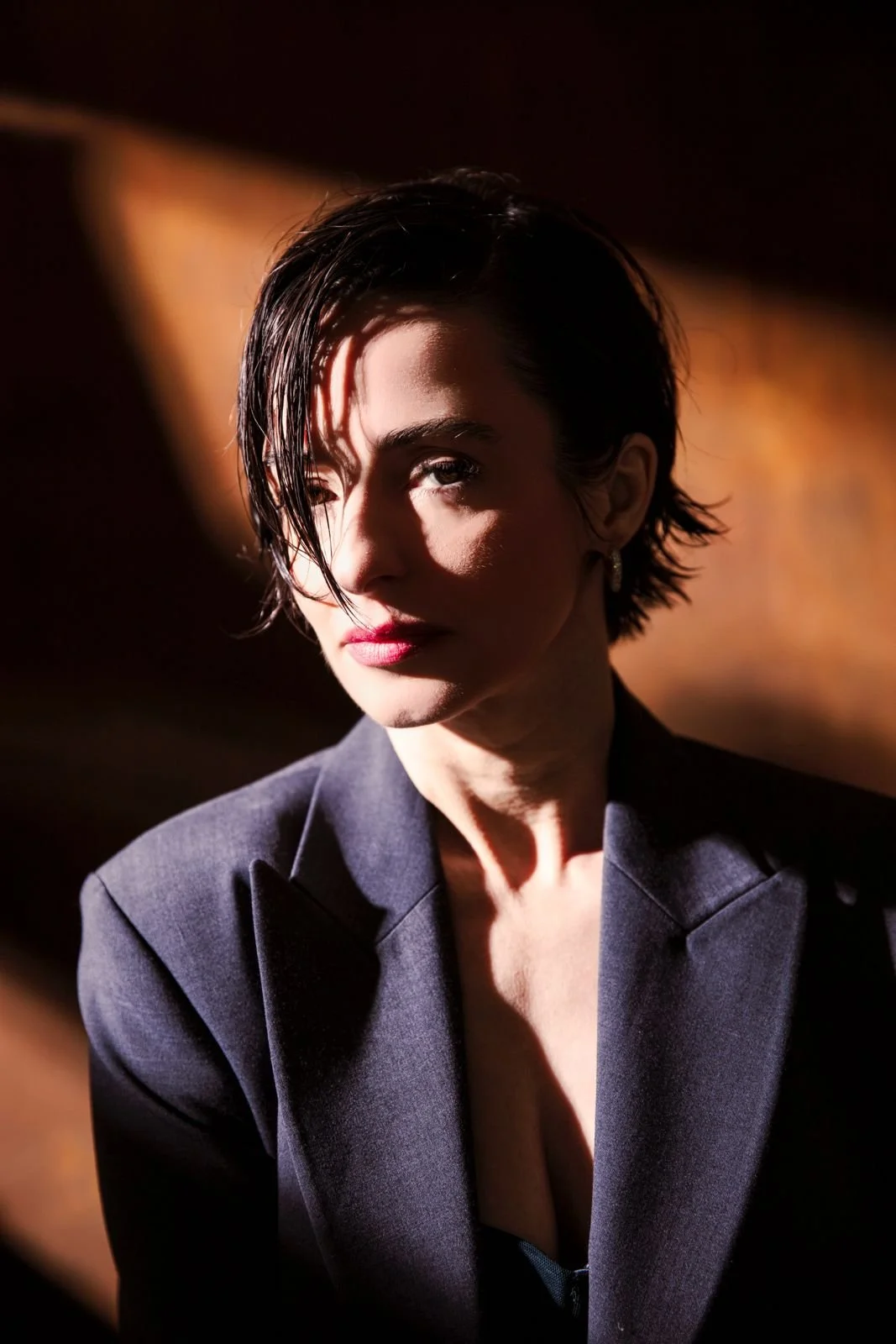
suit EMILIA WICKSTEAD
bodysuit ZIMMERMANN
earrings LUCY DELIUS
You’ve had extraordinary success on stage. What continues to draw you back to theatre?
The thing that I always get most excited about whenever I think of doing a play is the thought of rehearsal room with a whole, preferably big, cast of other actors and a fantastic director at the helm. That, to me, is the most exciting part of any job that I have ever experienced and can imagine.
I so look forward to being in a rehearsal room, being able to delve into the text, to pull out the subtext and the details and nuances of the characters and the storyline. Explore the many ways available to us of how to tell that story, and the way that we bounce off each other. And I know that that’s going to continue then on for many nights on a stage, where we get to continue to experiment. The freedom to play and not think that it has to be gotten right, ever, but that it just has to be an expression of something, that’s what really excites me.
The whole reason I fell in love with the theatre and wanted to become an actress was that feeling of being backstage, especially during a tech where the performances are still ahead of you, but you've got the production together and you're all there in a shared endeavour. It's a true collaboration, and you're around wonderful people who you respect, and it just feels so intensely exciting. It's like that little moment of what feels like total freedom and possibility before everything tips over into the next bit and it's out there in the public. That's the feeling that I hold onto all the time. When that feeling starts to rise again, that's when I know I'm starting to want to go back to the theatre again.
With so many major projects coming out, how do you think this period will shape your career moving forward?
Similar to what I said earlier. I just don't really think of my career as something big and whole. I try to stay in the present, and I'm really enjoying it, and I hope that the sense of creativity and freedom that I have at the moment continues. I find it really exciting, the idea of not knowing what on earth comes next. But I certainly have absolutely no expectations from it.
What kinds of roles or stories are you interested in exploring next?
It’s not that I have any particular ambitions to play a certain type of role, or have an idea of a play that I really want to explore. Instead, I feel most excited whenever I actually don't know what's coming up. So, I guess I’m most interested in anything that feels expansive, that's going to give me a new experience, either of myself or the work, that might take me to somewhere I've never been before and would love to go. Or that I might get to work with people who I've always admired and haven't had a chance to work with yet, or go deeper into something that I feel like I've only touched on a little bit previously.
I mean, one aspect that I've really enjoyed from Kennedy is playing a real-life character. The possibilities there are extensive, and I'd love a chance to do that again. Anything that feels like it's going to really challenge me on an artistic level. Where I look at it and think, "I don't know how I'm going to do that, and I'm a bit scared to do that," that's when I know that I'm on the right track. But equally, some roles are there just to be savoured and enjoyed, and that can be for all sorts of reasons, such as location, the people involved, and so on.
I don't have any strong ideas about what's next. I will follow my nose, but like I say, it’s about expansion. Anything that makes me feel expansive, that I know I'm alive and changing, and therefore I'm happy.
TEAM CREDITS:
photography ALEX BEER
hair SVEN BAYERBACH
makeup JUSTINE JENKINS
styling FREDERICA LOVELL-PANK
