
IN CONVERSATION WITH OURI
interview by FRANCESCO PIZZUTI
Canadian multi-instrumentalist, singer, and producer Ouri makes music that resists genre, pulled between orchestral sounds, real-life textures, electronic music, and digital processing. Her latest album, Daisy Cutter, is at once physical and transcendental, real and imagined, in a constant tension between control and letting go. Her music seems to be driven by a desire, an almost visceral longing for feeling, highly exacerbated by the graininess of the sounds that are at once clear and distorted, embodied and virtual. Through Daisy Cutter, Ouri plays with horizontality and collapses hierarchy, creating a fluid community of collaborators, shaping the album in fragments recorded across informal, lived-in spaces, resulting in a body of work that resists set definitions.
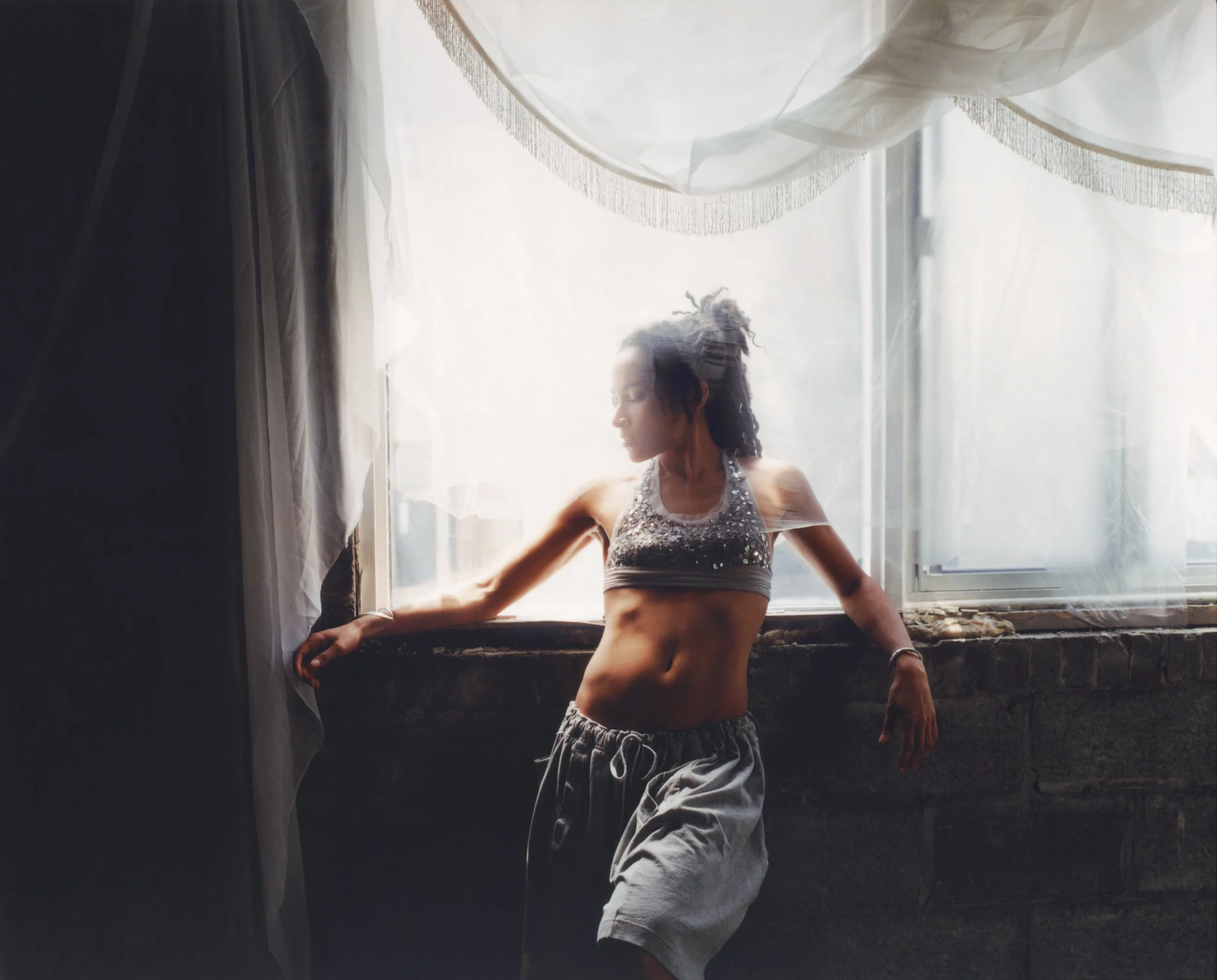
Starting off strong, your work constantly moves between control and surrender. Where in your life or music do you find it hardest to let go of control?
I think music is definitely one. But I’m learning to let go. I just want to offer space for other people to complete my world, because I believe most beauty is found in those spaces where you meet, where there’s an organic connection. Because you can’t control or force a connection. And witnessing that in music is like a miracle, so I love collaborating, and I’m trying to have less control over it. Let people come together and just see what works, what doesn’t. But it’s not easy.
But where I truly find it the hardest to let go of control is with visuals. That’s the hardest. Because I often forget that I’m a physical being — I lose myself in music. So needing help to create visuals with people who don’t think in those terms, while still knowing how I want to be represented… that’s a really difficult balance. Especially as a mixed person. It gets into very complicated territory.
Your work feels very tactile — like it can be felt as much as heard. That also comes through the Death Row music video, where skin, texture, and the body feel really central. Do you think about your music and visuals as something that physically touches or reshapes how we experience our bodies? And were there any films that influenced that visual language?
For sure. With this album, I’ve been trying to create a sort of in-between world between fantasy and reality. Music is in the air; you can’t really touch it, but for some reason, there are sounds that evoke something very physical and tactile. And I feel like that anchors it in reality even more, and makes the experience of listening to music even weirder.
I’m really obsessed with that. I feel like some people make music that’s so clean, you can play it anywhere, and it almost feels like it’s coming from another world. But I want to create a bridge between the real— the physical experience — and the imagined — emotion.
For the Death Row video, I don’t know if I had specific references. Everything I’ve seen probably led me there. But it was a very chaotic process — writing a story, trying to make it softer to watch, and then deciding, actually, I want to go harder.
I had never kissed someone on camera, and I felt like the escape moment couldn’t be a fight. It needed to be a kiss. And I didn’t want it to be a dry kiss — that’s too easy. I wanted little pearls of saliva.
Your sound feels both very embodied and very digital, like the body dissolving into something virtual. Do you experience technology as extending your body, or as distancing you from it?
It’s both. I think there’s a risk of getting lost in your own head when you’re only existing digitally. But at the same time, it can extend your expressivity, and remind you — and remind other people — of physical limits through that virtual existence.
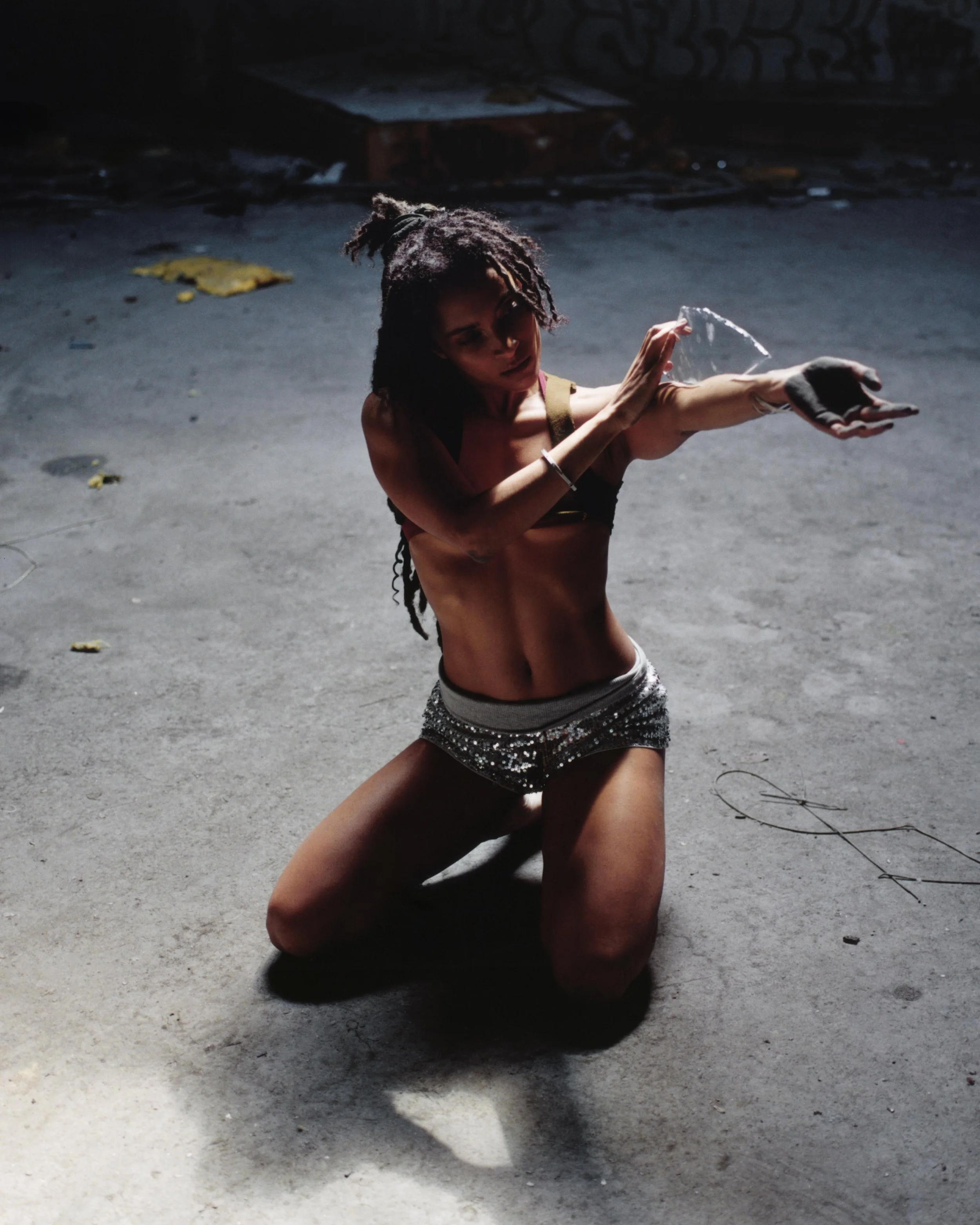
There’s a feeling in your work that identity isn’t fixed — it shifts, glitches, reforms. Do you experience making music as stabilizing yourself, or staying inside that instability?
I make music to calm myself and to ground myself. And even though people say it’s very shapeshifting, I sometimes experience it as almost too linear. I’m really trying to anchor myself in the present moment while making music. And then I think, ‘maybe there should be a crazy shift’ — but I never want to force that. Instead, there are all these subtle shifts of emotion, and I feel like that’s just a property of music that’s non-negotiable; there’s always evolution, reformation, and duality.
Your collaborations feel less like features and more like shared interior worlds. What has to exist between you and someone for that kind of closeness to happen?
It’s funny because whenever you collaborate with someone, the other person might experience it completely differently from you. For me, there needs to be a feeling of understanding and trust. You can know someone for years and have no trust, or not know someone very well and still have a lot of trust and respect.
It’s also about playing with closeness and distance, making sure everything feels fluid and respectful and exciting for both people. You can make mistakes, of course, there are actually many breakups between collaborators. It’s the most selfless experience… until it becomes full of ego, and then there’s no way back.
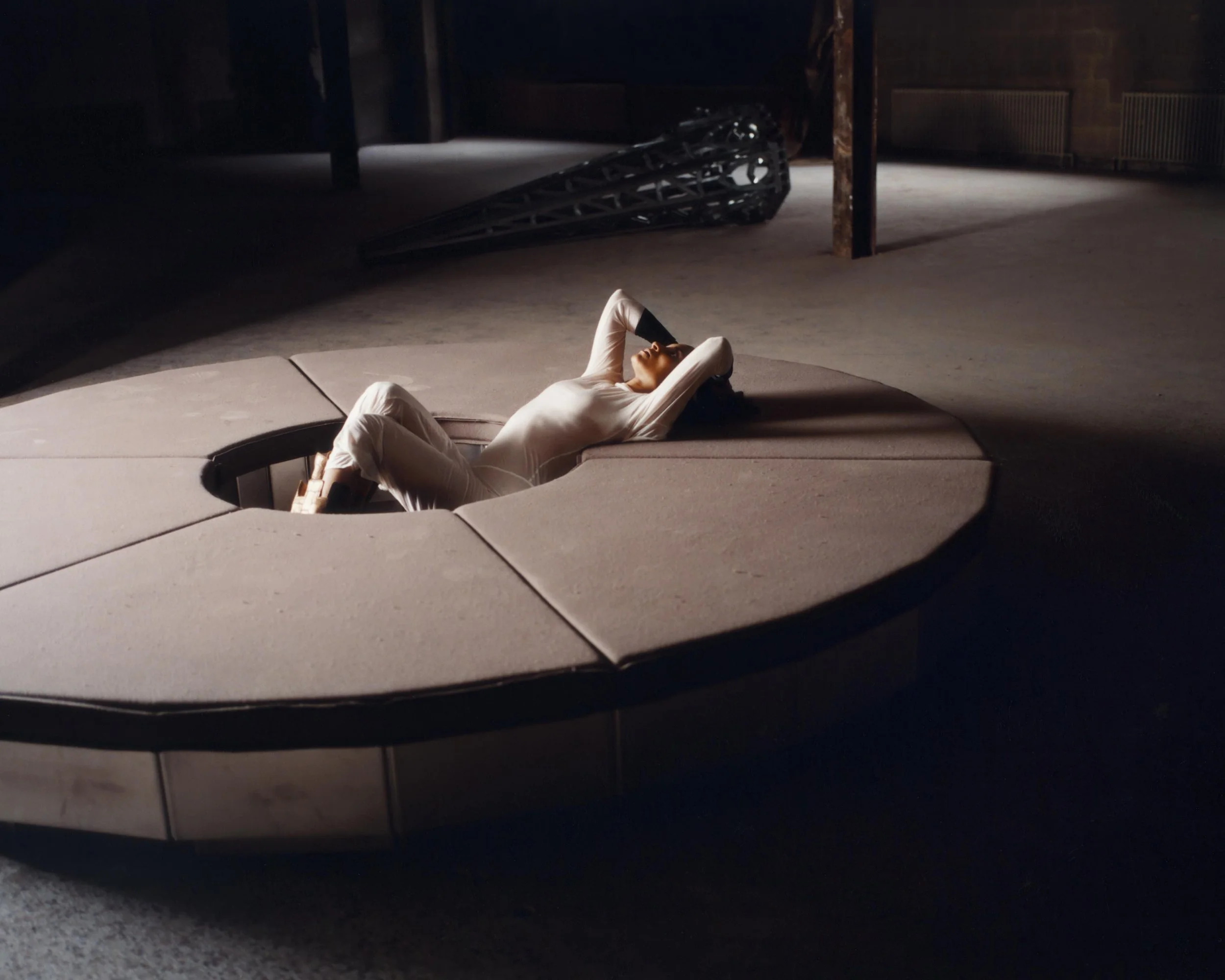
Within the universe of your latest album Daisy Cutter, you built a couch — a shared, horizontal space where everyone is at the same level. Do you see that as a political gesture, or more as a way of staging intimacy differently?
I think it’s both. The couch definitely references hierarchy as a mental construct. We’re all on this planet; we all deserve space as humans, yet we try to negotiate our importance because we carry these traumas of not being seen or valued. So we create tensions, shortcuts, ways to access some kind of emotional security.
And in horizontal collaboration — not just in music — someone might bring 90%, someone else just 1%. But that 1% can complete the whole thing. And still, we tend to value the 90% more. We all need each other in different ways.
I feel very frustrated in group settings because there’s always some kind of power dynamic, and it makes me uncomfortable. We forget that every person present changes the space in their own way, and we make people invisible. Horizontality is important — on an intimate level, but also politically.
multiLove embraces the intensity of desiring many at once. Do you see your music as creating space for forms of love that don’t need to resolve into something stable?
I don’t think love has to resolve into something. I like seeking experiences to understand attraction, to understand what I’m made of; how I react, and what comes out of me in certain situations. It’s a form of self-discovery and self-knowledge.
The title Daisy Cutter holds both destruction and care. Do you think desire is inherently a little violent, even when it feels soft?
I don’t think so. I don’t want to think that. But when we start to desire something, it can become more about us than the person in front of us. And that can uncover self-hate, or self-destructive patterns; that’s where the violence comes in.
But desire itself, I don’t think it’s inherently violent.
You just played at Rewire Festival this weekend, which focuses on experimental and immersive sound. How do you approach a live performance, and what excited you about performing there?
I saw so many names on the lineup — I was like, ‘I’m so fucking proud to be part of this’.
Of course, I prepared a lot, but I wasn’t trying to impress. I just wanted people to feel deeply, to bring them together in understanding something collectively.
But on stage, I want to connect deeply to my feelings and transmit something raw. I just want to feel — maybe cry. We’re in an era where we’re a bit desensitised because there are so many horrible things happening. I want to offer a space where people can feel again.
Do you think performing in such contexts shapes your experience of your own music?
For me, it’s the ultimate challenge. I used to find comfort in being in my studio, creating everything I wanted. But transmitting that physically to an audience — that’s the pinnacle of musical expression, I think.
I want to find those moments where I’m most vulnerable, where something could shift, where I could fail. And when I don’t, it creates this raw, human feeling; like, ‘this is real’.
Not in a masochistic way — just in a real way.
With your latest single, Lose Control you return again to this tension between control and letting go. Do you feel your future work is still negotiating that balance, or are you moving somewhere else?
I definitely feel like there’s a shift happening. I don’t know exactly in which direction, but I want to have less control. I want to be bolder in the spaces I allow myself to enter creatively. I think we benefit from hearing art that comes from that mindset — unmediated expression.
The more I grow, the more I see where I restrain myself. And I’m trying to get rid of that.
