
IN CONVERSATION WITH PEDRO PABLO HOZ
interview by TIMOTEJ LETONJA
Pedro Pablo Hoz Domínguez is a self-taught Spanish visual artist from Málaga whose surrealist practice explores perception, consciousness, and the ways images shape our understanding of reality. Drawing from European art history, Mediterranean culture, and personal experience, Hoz creates enigmatic worlds populated by anthropomorphic and organic forms, religious symbols, everyday objects, and impossible architectures. His paintings invite viewers into spaces of uncertainty, where memory, myth, intuition, and reality intersect.
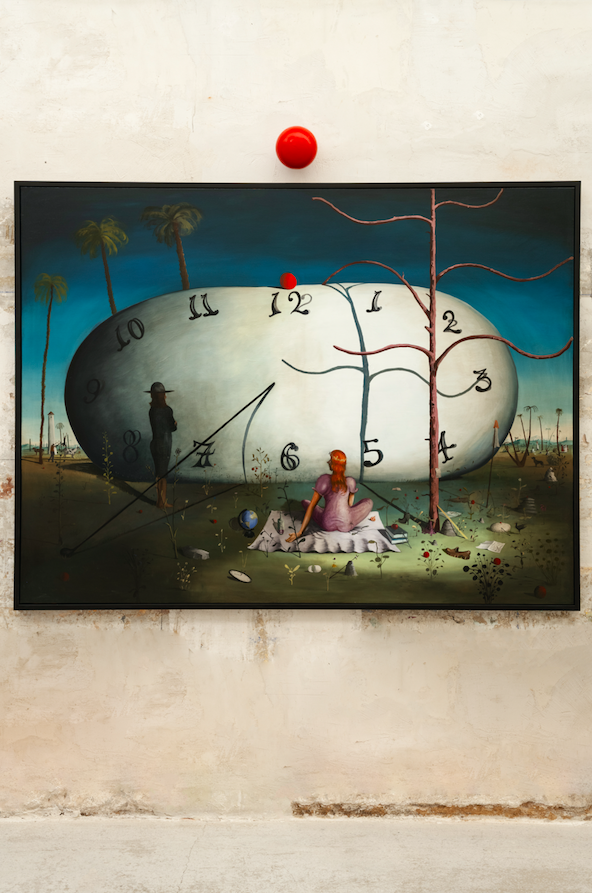
Being self-taught and coming from a family without an artistic background, how has the distance from formal artistic training formed the way you approach painting and the artistic world?
I will always be grateful that I never received a formal artistic education. A large part of my work comes precisely from questioning the systems and paradigms in which we are immersed, and an academy is, inevitably, also a system: it has its own rules, methods, and a particular way of understanding what art is and what it should be.
I am certain that my work would not have developed in the same way had I studied Fine Arts. When you enter an educational structure, there are people who inevitably influence the way you look, think, and build a practice. For many artists that can be tremendously useful; in my case, I have always needed to discover things for myself and, above all, to listen to my intuition.
I also see in some friends who went through art school a tendency to inherit a certain seriousness or institutionalization of artistic practice. Sometimes I feel that, in that process, art can stop being a game. For me, it is essential that it remains one. My creative search is a game, but at the same time it is a necessary practice for the development of my soul on Earth, and probably the most important thing in my life. That contradiction between playing and taking it absolutely seriously is essential to me.
I believe everyone has to be faithful to their own nature. Some people benefit from having external agents structure their learning and development. I have always preferred to listen to my intuition. If I had enrolled in an art academy, they probably would have thrown me out by the second term.
What does “reality” mean within your practice when you describe painting as a tool for questioning reality?
For me, reality is everything we perceive through consciousness. The problem is that, as we grow older, that perception becomes increasingly blurred. It fills up with social constructs, parameters, rules, paradigms, traumas, experiences, and expectations that end up conditioning the way we see the world and the way we see ourselves. Sometimes I think we spend a large part of our lives confusing all those layers with reality itself.
When I feel lost, I try to do the opposite: to look deeply inward. I try to forget what other people think of me, what I was taught I should be from childhood, and, as far as possible, all those accumulated experiences that have gradually constructed my identity. That is why I am so interested in children and animals. There is something in them that has not yet been completely contaminated by all those structures. Curiously, I find something similar in very old people. Not from innocence, but from the opposite extreme: after an entire lifetime, they often seem to have learned how to let go of the superficial and keep only what truly matters.
My painting is the place where I try to construct a universe without the limitations of human logic. But I do not want to escape this world completely: I am interested in starting from its archetypes, from nature, the body, and certain universal laws, and then distorting them to construct another reality. Human figures - and especially the female body - appear as inhabitants of that universe. Through them I can travel through the human psyche and explore its different states, from fear to love, entering those recesses of the mind that we often cannot explain rationally. In that sense, painting does not serve me as a way of representing reality, but as a way of constantly asking which part of it is actually real.
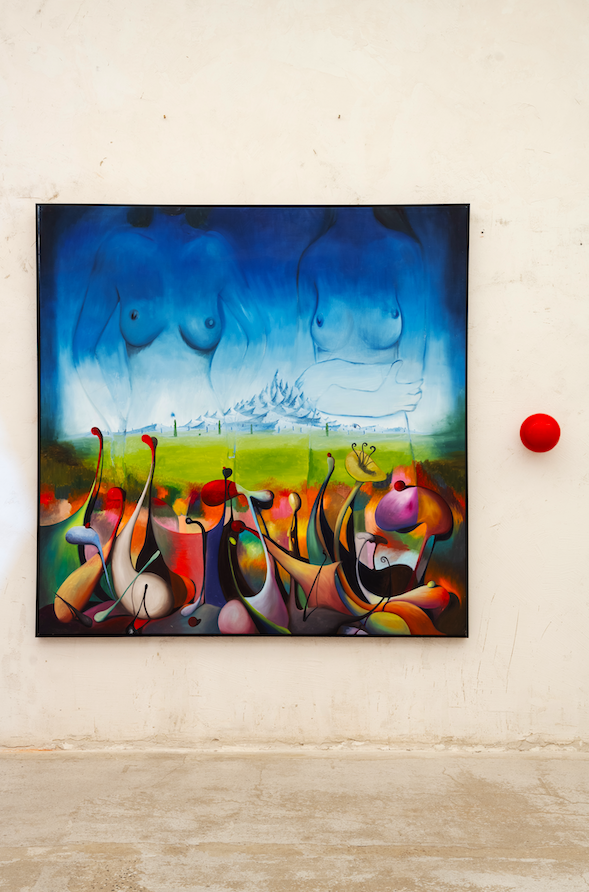
You have said that you try to flee from concept and explanation, yet your work engages with questions about perception, consciousness, symbolism and reality. How do you balance intuitive painting with the intellectual questions that surround it?
In reality, I do not flee from concept or explanation; what I try to avoid is imposing them on my works beforehand. Of course I am the creator, but I rarely begin painting with the intention of saying something specific. First the work appears, and once it exists, meanings begin to emerge. That is when I start to understand what my inner self was trying to say. For me, painting therefore has much more to do with listening than explaining. I try to reduce rational control as much as possible so that images, symbols, and relationships can appear that my conscious mind might never have been able to construct.
I have a fairly spiritual view of all this. I am almost certain that I am simply a transmitter of a cosmic energy that, for some reason, has chosen me as a vehicle so that certain images and ideas can pass into the plane of existence. I do not need to understand them completely in order to allow them to exist. I have a theory that we are the universe experiencing itself in every possible variation, and I am simply one of those variations. From that perspective, creating is almost a natural consequence of being alive. Human beings have an enormous capacity both to create and to destroy. I choose to create.
There is a strong influence in your work from European art history, from Flemish painting and Hieronymus Bosch to Dadaism, Dalí and Picasso. What do you find in these traditions that remains useful for an artist working today?
I think painting, and especially the methods we have repeated for hundreds of years to construct an image, are some of the most punk and anarchic tools we have today. We live in a world obsessed with immediacy, practicality, and efficiency. Against that, spending hours, days, or months constructing an image with tools practically identical to those used by painters centuries ago feels almost like an act of resistance.
But what interests me about art history is not only its methods. Human history is full of people who were capable of constructing their own language and, through it, their own reality. Bosch, the Flemish painters, Dalí, Picasso, or the Dadaists belong to completely different moments and contexts, but I find in all of them a willingness to question what was in front of them and to propose another way of looking at the world. I see myself simply as one more person within that chain. I draw from them when I need to, but above all I admire the sacrifice involved in dedicating an entire life to creation.
I do not like to victimize myself in any way, but I believe that a life devoted to art involves a constant struggle with oneself and with one's own inner world. In a sense, there is never complete rest: even when you are not painting, you are still looking, thinking, absorbing, and constructing. That is why I feel I owe so much to all those masters - not only for the images they left behind, but for having devoted their existence to trying to create something that did not exist before.
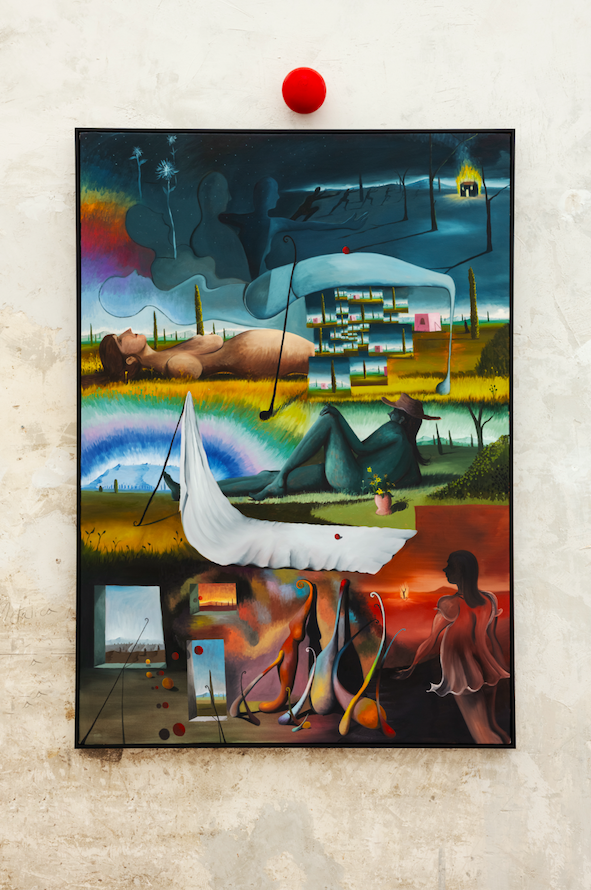
Málaga and the Mediterranean appear as important influences on your visual and cultural imagination. What aspects of your hometown continue to inspire your work?
I think my relationship with Málaga and the Mediterranean has less to do with the landscape itself and more to do with the idea of roots. We are the result of thousands of people who lived before us, each of them going through completely different lives and adapting their nature to the needs of their time and environment. All of that gradually built a kind of language that was mixed generation after generation until it reached us.
For that reason, it has been very important for me to try to understand where I come from: who my grandparents were, who their parents and grandparents were, what they did, what place they occupied within their communities, what their character was like, and what relationship they had with the land. The more I have understood my ancestors, the more I have been able to understand myself. Above all, it has helped me accept my own nature as a starting point rather than trying to become someone else.
I am also very interested in the contradiction within my own roots. On my father's side I have Basque and Cantabrian ancestry, connected to a historically harsher, colder, Atlantic north, with an entire imaginary of the sea, whalers, mythology, and witchcraft. On my mother's side there is Málaga: the countryside, the mountains, the Mediterranean, the heat, and a completely different temperament. I feel that I am a mixture of those two worlds.
Perhaps that is why my roots appear in my work not so much as a direct representation of Málaga, but as something much harder to identify: a memory whose exact origin I do not know. I like to think that some of the images that appear when I paint do not belong only to my individual experience, but may be part of something much older than me.
Do you prefer viewers to construct their own meanings about your paintings, or are there particular symbolic relationships that you hope they will notice?
To be honest, I prefer not to expect anything from anyone. I do not want to decide what a person should understand when they encounter one of my works, nor do I want to check whether they have arrived at the meaning I may have found in it. Once the work exists, it no longer belongs entirely to me. What has become increasingly clear to me, however, is that I care deeply about how that encounter takes place. I do not want following my path and my development as a painter to consist simply of scrolling through a screen and consuming my works among the thousands of images we see every day.
In fact, I am interested in making things difficult digitally. I like the idea that if someone truly wants to follow my work, at some point they will have to move, travel, and stand physically in front of it. There are things that can only happen when you share a space with a painting: understanding its scale, its materiality, its imperfections, even the silence it generates around itself. As I mentioned before, I think that in many respects we need to move backwards. We have repeatedly confused evolution with speed, convenience, and immediate access. Perhaps recovering certain difficulties, certain periods of waiting, and certain physical experiences could make us a little happier. So I do not expect the viewer to find any particular meaning. If I expect anything, perhaps it is simply that they are truly present in front of the work.
What interests you about placing images from different cultural, religious and historical contexts next to one another without necessarily resolving their contradictions?
I think those symbols are, above all, the result of how I am constructed internally. I do not consciously distinguish between the religious, the historical, the everyday, the mythological, or even the absurd. Everything forms part of the same archive of images that I have accumulated throughout my life.
When they appear together, it may seem as though there is no direct logic connecting them, but I think that contradiction exists mainly on the surface. If you go deeper into the subjects they represent, points of connection begin to emerge. A cross, an animal, a female body, an impossible architecture, or an everyday object may come from completely different contexts and yet end up speaking about very similar things: fear, death, desire, spirituality, transformation, power, or our need to find meaning in existence.
In the end, cultural and historical categories are tools we have created to organize the world. I do not think the mind - and especially the subconscious - necessarily works that way. Within us, personal memories, religious images, experiences, myths, fears, inherited symbols, and seemingly insignificant things coexist without respecting any hierarchy. I think my painting functions in a similar way. I do not try to resolve those contradictions because I am precisely interested in keeping them open. Very often, two images that rationally should not belong together generate, when they meet, a third meaning that neither possessed on its own. It is almost as if each symbol modifies the other simply by sharing the same space.
And I think that is where part of what I am searching for in painting lies: not in constructing closed meanings, but in generating relationships. I want to create a universe in which images can encounter one another freely, and where the viewer, through their own memory, culture, and experience, can discover connections that perhaps even I had not perceived.
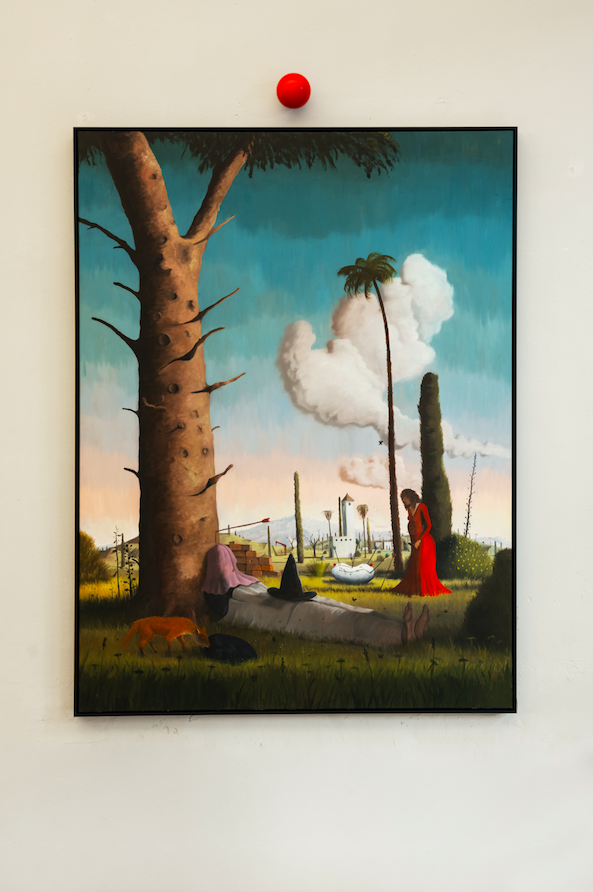
Has encountering audiences from different cultural contexts changed your understanding of your own imagery or revealed interpretations you had never considered?
Yes, and in fact I love listening to what other people manage to extract from my works. Very often I discover things in them through other people that I had not seen myself. Curiously, some of the interpretations that interest me most are those of my mother or my grandmother. Their way of looking is not conditioned by art history or by the need to immediately contextualize an image within an artistic tradition. In that sense, their way of seeing is almost the opposite of mine, and that is precisely why I find it so valuable. They do not try to identify my references or work out where each element might come from; they simply react to what is in front of them.
Sometimes I find the opposite in people who are deeply connected to the art world. There are collectors or viewers who seem to approach a work almost as if they were trying to catch the artist out: quickly finding the reference, identifying where an image comes from, or demonstrating that they already know what you are doing. It is a completely legitimate way of looking, but I am much more interested when someone allows themselves to experience an image before trying to explain it.
As for cultural differences, I think that is precisely where one of the great powers of art lies. Images existed as a form of communication long before we shared a common language, and they still have that ability to cross cultural and linguistic borders. An image can produce fear, desire, strangeness, tenderness, or fascination in people who may have almost nothing else in common. Of course, each culture will project different meanings onto it, and that is exactly what interests me. I do not need a person in Málaga, Seoul, or Mexico City to see the same thing in a painting. I am interested in the possibility that the same image can travel between completely different contexts and continue to provoke something. For me, that capacity to communicate without translation is one of the most powerful things about art.
What would you ultimately like someone to experience when they stand in front of one of your works?
Each work can awaken a different emotion: fear, love, discomfort, desire, sadness, or even rejection. I am not interested in deciding what the viewer should feel. But if I had to choose one thing I would like to provoke, it would be something much simpler: that, for a moment, the person standing in front of the work feels profoundly human. That they remember they are alive, that they feel, that they are afraid, that they love, that they are going to die, and that they are part of something we will probably never fully understand. In the end, I think that is what I try to remind myself of every time I paint: that I am a human being.
