
IN CONVERSATION WITH CARLOS GONZÁLEZ
interview by JANA LETONJA
Carlos González is a Spanish actor from Navarra who moved to Madrid at the age of 18 to train at Estudio Corazza. Since then, he has built a versatile career across film, television and theatre, appearing in acclaimed series such as Veneno, Maricón perdido, Cardo and Mariliendre. His portrayal of Bob Pop in Maricón perdido earned him several nominations and awards. In film, he stars in Javier Ambrossi and Javier Calvo’s La Bola Negra, selected for the Official Selection at the 2026 Cannes Film Festival, and has recently worked on Como volé, directed by Salvador Calvo, and A una isla de ti, directed by Alexis Morante. In 2022, he also stepped behind the camera to write and direct his first short film, Muñeca.
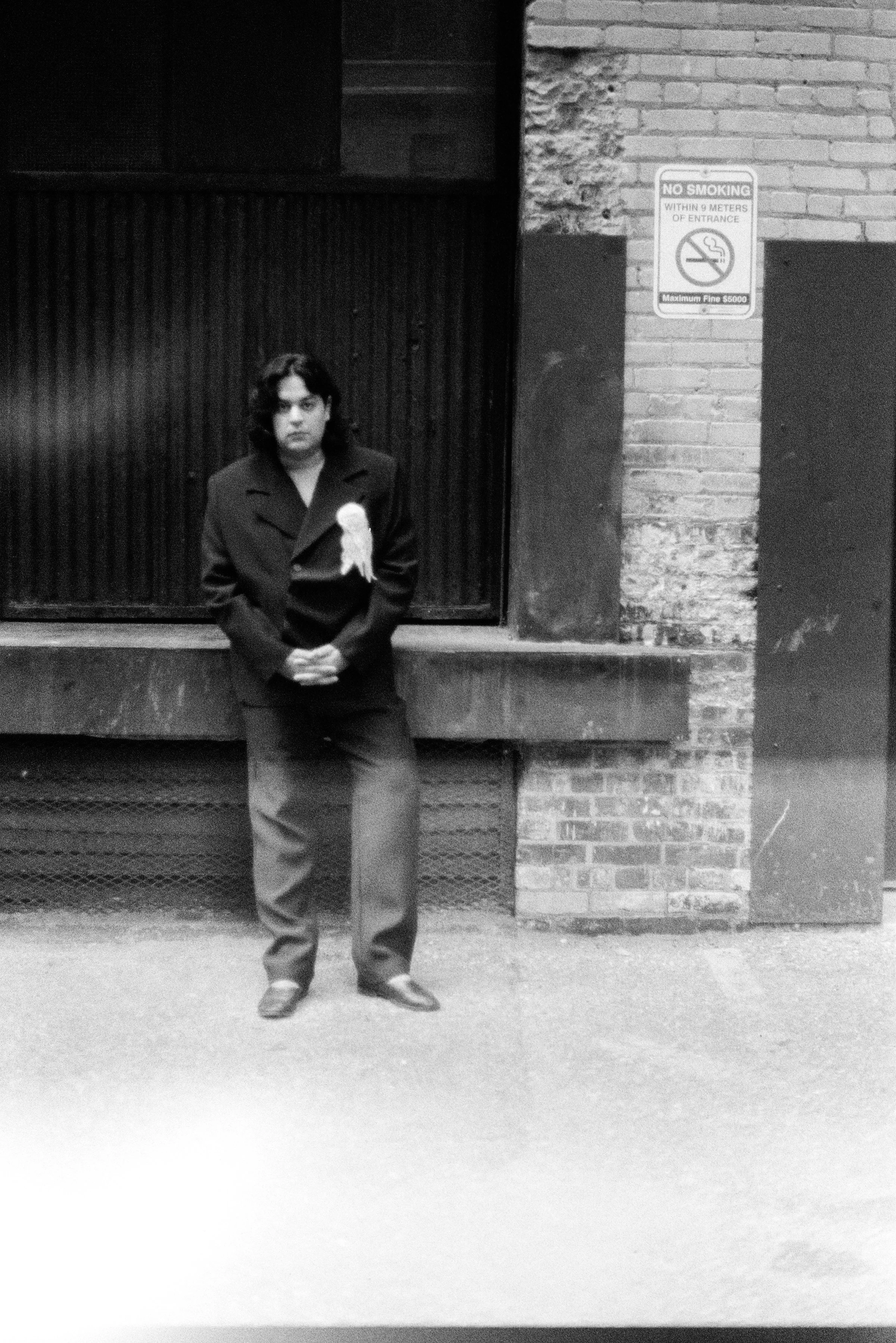
full look REPARTO
You left Navarra for Madrid at just 18 to study acting. What do you remember about that decision and about the person you were at the time?
I remember feeling that there was no other option for my future, that there was only one decision to make and that I had to be the best, because if this didn’t work out, I was going to be very unhappy. I couldn’t have any other profession, it was my destiny. Even though at first I was very insecure and wasn’t completely sure I was actually good at it, I found it difficult to connect with the characters because there was a disconnection within myself. I remember that doing personal work and becoming more honest with myself allowed me to learn how to act. You can’t run away from your demons if you want to work as an actor. That was the first great lesson I learned.
How has working with Juan Carlos Corazza influenced the way you understand acting today?
Whenever I’m asked for advice, I always say the same thing, train in whatever it is you want to do. Being surrounded by actors and actresses from the age of 18 at the school, rehearsing every day, going to the theater and the cinema, talking about it and wanting it so badly, that’s what has brought me here today.
You create a community with your classmates and discover texts by Shakespeare, Chekhov, Lorca, etc. for the first time. You delve into them and grow as a person and as an artist. You learn to respect the profession and understand it in a way that isn’t superficial.
And technique is important for an actor, because untamed talent is wasted talent. You have to know your instrument and protect yourself. It’s a very strange and complex profession.
Juan Carlos, to me, is the best teacher there is, and everything he does for the profession is such a profound act of love that I will never find a way to thank him or make him understand that, thanks to him, my life has meaning.
Theater was an important part of your early training. What did you learn from working with writers such as Shakespeare, Lorca, Chekhov and Brecht that you still apply to film and television?
I was actually talking about this in the previous question. I could talk about it for hours and days because these are authors with such a profound understanding of life, and whose circumstances were so complex because of their historical contexts, that their texts reflect all of that.
I think what I learned most from working with writers like Shakespeare, Lorca and Chekhov was not to be afraid of what isn’t said. They are writers where, very often, what truly matters lies beneath the text, in what the character wants, what they are trying to hide, or what they are unable to name.
That’s something I still apply a lot in film and television. The camera sees so much that you don’t need to explain everything or constantly demonstrate what the character is feeling. Sometimes it’s enough to genuinely think something, listen to the other person and let things happen.
They also taught me to trust the text. When something is well written, you don’t need to decorate it, you need to discover why those words are there and what need the character has to say them at that particular moment.
And perhaps, above all, they taught me that characters are never just one thing. They can love and hate at the same time, be cruel and vulnerable, be afraid and still move forward. That contradiction is probably what I look for most when I’m also working in front of a camera.
La Bola Negra was selected for the Official Selection at Cannes. What did it personally mean to you to have worked on a project that reached that stage?
I remember that we experienced that day with a great deal of presence, and I don’t know how or in what way we managed not to dissociate. I often think that this film is much bigger than all of us and that it speaks for itself. So the only thing left for us to do is enjoy everything that is happening to us and keep living.
What attracted you to your character in La Bola Negra, and what did the role demand from you that you had never explored before?
Working with Los Javis was one of my most ambitious dreams. They gave my actor a gift and believed in me. They gave me the opportunity to play this character, who is completely different from everything I had done before.
It wasn’t easy at first because the pressure and the desire to shine are always in your head, until you realize that the story we’re telling is much bigger than your own ego.
Breathing has been the most important thing for me throughout this process. Alberto breathed differently from all the other characters I had worked with before. It was a challenge to take off my own backpack so I could put on someone else’s. I had no place in this story, I had to use my imagination 100 percent, and that was a lot of fun. It’s a side of myself that I’d like to keep exploring.
In 2022, you wrote and directed your first short film, Muñeca. What made you feel that it was the right time to tell a story of your own?
Well, unemployment, basically. I can’t sit around doing nothing, and I wanted to very humbly try out what it was like to write and direct. It was really beautiful to experience, but for now I still have many things to explore as an actor.
Maybe in the future. I don’t know, honestly. Perhaps I enjoy working one-on-one with actors more than writing. Writing seems to me like the most demanding and complicated act there is, and a very lonely one.
Did directing other actors change the way you relate to directors when you’re the one in front of the camera?
I really enjoy helping my fellow actors with their characters during auditions. I have a great time, and my imagination works much faster than when I’m working on myself.
It’s very difficult to be a good actors’ director. Every person has different needs depending on the character they’re working with at that particular moment, and knowing how to work with all your actors and understand what each one needs from you as a director is extremely complex.
Sometimes, for me, it’s also a question of ego. You have to know when you need to direct and what you need to direct, because sometimes it’s much more important to create the right atmosphere for a scene than to impose an idea of what the scene should be like. Otherwise, you miss all the magic that can happen.
Do you see writing and directing as another facet of your career that you’d like to develop further?
Not at the moment. I really, really feel like acting.
Looking at your work in Veneno, Maricón perdido, Cardo and Mariliendre, how do you think your way of telling LGBTQ+ stories in Spanish film and television has changed throughout your career?
I think that at first I approached LGBTQ+ stories with a much clearer awareness of what it meant to represent them. I felt a certain responsibility to give a name to things that, for a long time, hadn’t had a space or had been told from an outside perspective.
Over the years, the way I look at them has become freer. I no longer think so much about “playing an LGBTQ+ character,” but rather about playing a specific person, with their contradictions, their desire, their family, their fears, their sense of humor and their way of being in the world.
And I think fiction has changed too. More and more, we can allow our characters not to constantly have to explain who they are or represent an entire community. They can make mistakes, be uncomfortable, selfish, radiant or contradictory. For me, that’s where the real progress lies, moving from representation to complexity.
But I still think there is a huge amount of work to be done. And it’s not a responsibility that falls solely on actors. It has to run through every department that makes a film or series possible - who writes these stories, who produces them, who directs them, who makes the decisions, who is behind the camera, and whose perspectives are given space to tell them.
I think true representation isn’t just about seeing diversity on screen, but about that diversity also existing in the places where fiction is conceived, written and created. In my career, I’ve been lucky enough to take part in very different projects, and I feel that each one has taught me that telling LGBTQ+ stories also means no longer treating them as a separate category, and allowing them to occupy every possible place within fiction.
At this point in your career, what scares you more creatively: taking on a role you don’t know how to play, or accepting one that feels too familiar?
That doesn’t scare me. Of course, I’d rather challenge myself and travel to more unfamiliar places than do something I already know. Even so, if you bring creativity to something, you don’t necessarily have to fall into familiar territory.
What scares me is losing faith in what I’m telling. That’s why I need to choose something that I feel motivated to tell at that particular moment, because if I believe in it, everything else tends to fall into place.
If you could show the 18-year-old Carlos who arrives in Madrid to become an actor where you are today, what do you think would surprise him the most?
That you can be very happy with very little. That you don’t need noise to be okay. That all you really need is a rehearsal room, a space where you can express yourself, whether that’s film or theatre, and with that, a nice walk with your grandmother, a good Wednesday at Embajadores cinema, and that’s it.
TEAM CREDITS:
talent CARLOS GONZÁLEZ
stylist MARTXELL MONTERO
groomer LIZ OLIVER
editor TIMI LETONJA
editorial director and interview JANA LETONJA
