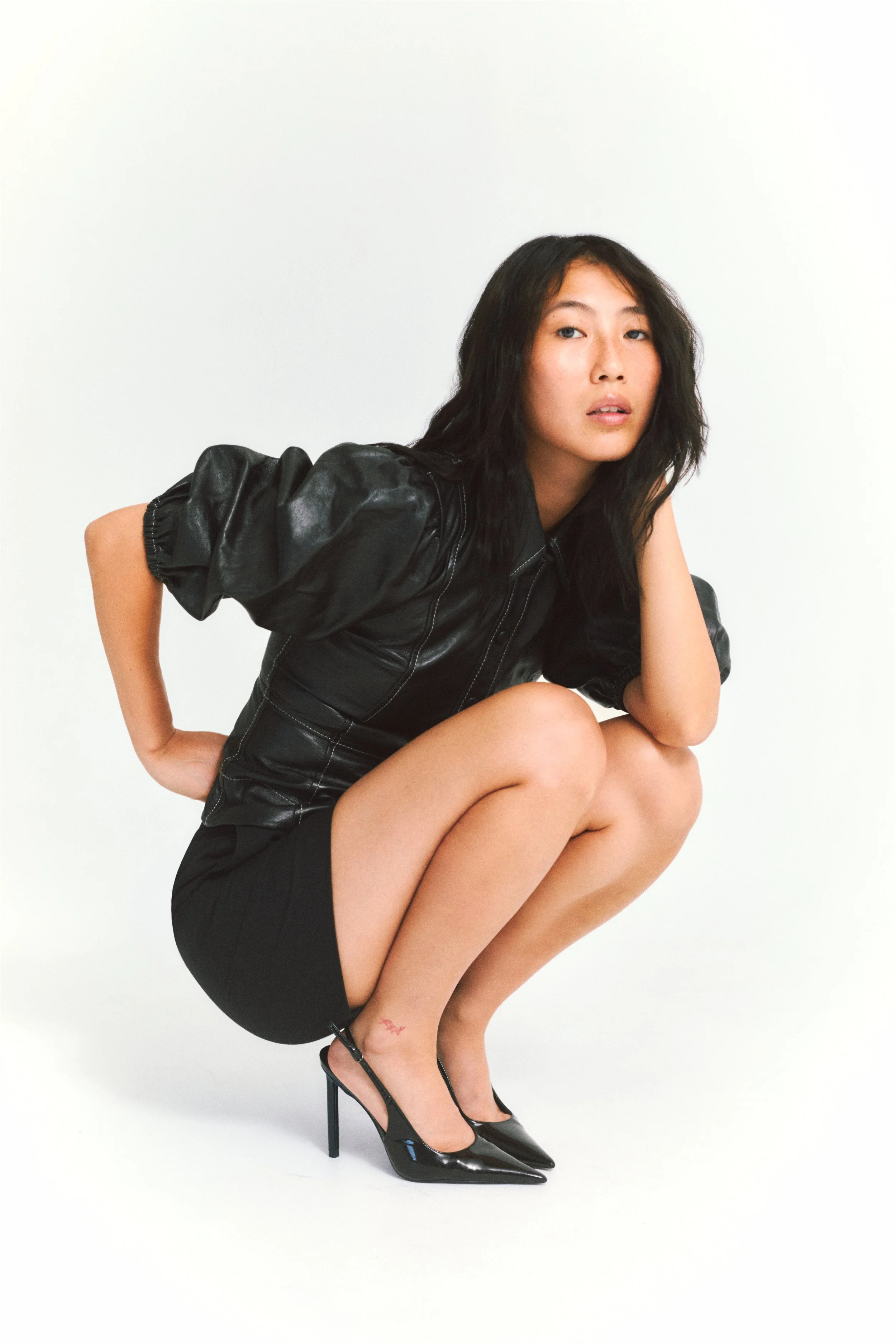
interview by JANA LETONJA
Shirley Chen is having a breakout moment, building on acclaimed performances in Dìdi and the SXSW Grand Jury Prize-winning Slanted, with a leading role in Netflix’s highly anticipated psychological thriller The Body, premiering November 11. Created by Quinn Shephard, the gritty coming-of-age series centers on a Catholic school dance troupe whose initiation ritual spirals into a frenzy that consumes an entire community, channeling the provocative energy of Y2K teen thrillers through a distinctly contemporary lens. With a growing body of work that explores identity, adolescence, belonging and the pressures of becoming yourself, Shirley is quickly emerging as an exciting young actor to watch.
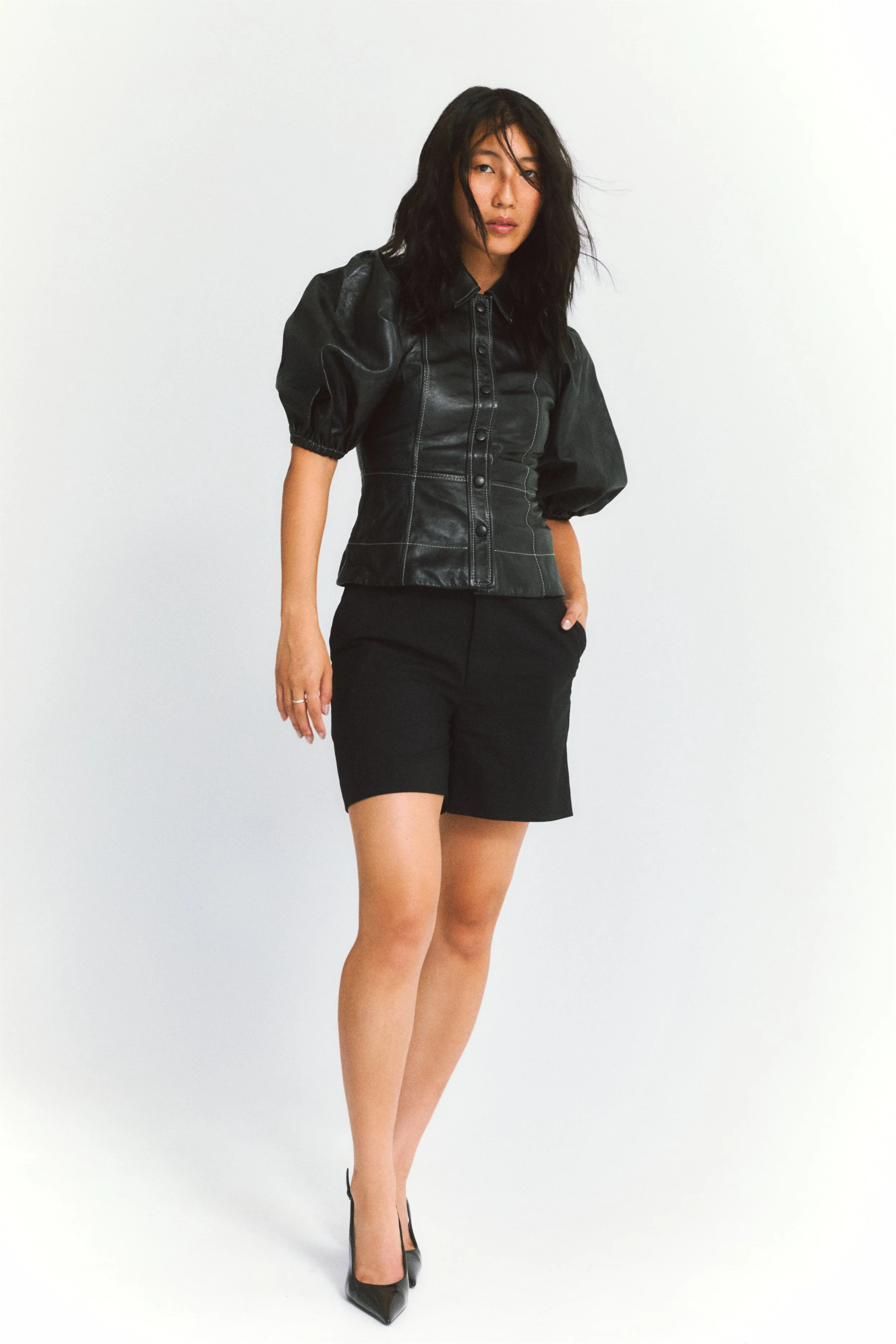
photography by TY CHEN
The Body has such a striking premise—a Catholic school dance troupe, an initiation ritual, and then this escalating collective frenzy. What was it about your character that made you feel you had to play her?
Absolutely everything. Maddie’s so joyful, but has a really complicated underbelly. She stands up for what she thinks is right, even if she’s under-estimated or seems to, on the surface, be “the nice one.” Above all else, she’s a loyal friend. Everything she does is rooted in true love for a friend. That’s always my way into her because, to my bones, that feels just as colossally important to me as it does to Maddie. But still, who she sees when she looks at herself in the mirror is starkly different from how the world perceives her, how her friends receive her. So she immediately jumped out at me, and the more that our creative team and I built out her life and family background, Maddie continued to become someone who feels very complex, and someone I haven’t gotten to be before.
Without giving too much away, how would you describe who Maddie is when we first meet her, and how does the experience of the series change her?
At the start of the series, Maddie’s definitely the most optimistic of the group, very happy-go-lucky, very sweet. She’d let everyone on the dance team if she could and is just a glass half-full kind of girl. But privately, she harbors deep-seated shame. She’s immensely guilt-ridden and is desperate to get rid of that feeling. So, over the season, Maddie shows real range and undergoes a total transformation. By the end, she grows into her own. She does something very brave and finds herself with a new sense of belonging and hope.
The series deals with the desire to belong and the sometimes frightening things people will do to feel accepted. Was that something you connected with personally from your own teenage years?
We’re always re-negotiating what it means to, in different environments, simultaneously feel free to be yourself, but also to be special and to belong. What that looks like, the type of acceptance we’re seeking and from whom, and what’s at stake if we don’t “fit,” that just evolves as we get older. So personally I actually wouldn’t say it’s a teenage thing, but a human thing.
I relate to Maddie’s version of this desire a lot. I have strong convictions in what feels right and wrong, but I might not be the voice that people are drawn to following. I’m the one that’s questioning, “Why are we all going along with something we know is wrong?” That discomfort, of not feeling heard or seen, can be disorienting.
The show has been described as a love letter to Y2K teen thrillers. Did you revisit any films or performances from that era while preparing for the role?
Maddie is canonically a Mischa Barton fan, and idolizing how Mischa looks is quietly baked into her even if we never explicitly see it. Our showrunner Quinn Shephard, writer Lily Houghton, and I would talk a lot about that, especially in relation to one of the episodes. So while filming, I’d watch a bunch of The OC and alternate that with Skins, stuff she would’ve been really susceptible to at that time. One of the greatest gifts of Maddie was the opportunity to embody a challenge that, in the early aughts, wasn’t really portrayed on a body that looks like mine or Maddie’s, so it was helpful to watch characters and images from the time that informed how Maddie felt about herself. And I also loved bringing people I care about into Maddie so that I, as Maddie, was never really alone. I’d actually bring in photos of Brenda Song in Get a Clue and ask my hair artist Shannel if she could do my hair up just like her. If Brenda read this, she’d probably be like “biotch please!”
When a story involves a group descending into something increasingly irrational, the performances have to make that escalation feel believable. How did the cast build that sense of collective intensity?
We all booked the show at such a new and important time of our lives, so it meant something special to all of us. We really wanted each other to feel proud of what we did, and to push all of our performances to feel as real as possible. There were so many times when my castmates would come in and be with me when they didn’t have to, like during intense Maddie scenes, when the other girls would stand in for me when no one would have actually been there, or offer me a hug in between takes. I am so grateful to them for that. We always looked out for each other on set and I think that care really translates to how our characters interact with each other. We’re playing a team, so we really felt like a team.
Between Dìdi, Slanted and now The Body, you’ve played young women navigating identity, belonging and other people’s expectations in very different ways. Do you see a thematic connection between those characters?
They’re definitely different, their personalities, looks, but they’re all fighters. They’re fighting to be heard, understood. Honestly, that’s a thread starting with the first feature I’d done where I felt like I’d shared something real, Beast Beast, and it’s how I still view my characters after The Body, too.
In middle school, someone once told me I had grit, and that’s something I take pride in being able to translate to the roles I play. I find myself getting plucked up by passionate artists with whom I feel really aligned, like we value depth, spontaneity, and brute vulnerability rather than shininess. So these projects are all helmed by artists who took a chance on what they saw in me. The honest, to-my-core me. Even if the dressing looks different.
Slanted takes on beauty standards and racial identity through a provocative premise. What did leading that film teach you about carrying a story, and about the kinds of stories you want to tell?
Our director on Slanted, Amy Wang, she is such a beast. Being part of that project, surrounded by all sorts of women, taught me that literally all standards, regardless of the body you’re in, are constantly moving and impossible. It taught me that there’s real power in looking at the things you don’t like in yourself and saying, it’s okay that you’re part of me, too. Doing the things that seem most terrifying, accepting them as fact, surprisingly makes living easier. It’s a risky story, it’s strange, but it’s grounded in something vulnerable and shameful and I love that.
Dìdi became such a beloved coming-of-age film and earned major recognition at Sundance and the Independent Spirit Awards. Did the response to that film change anything for you professionally or personally?
Shortly after Dìdi played in theaters, I got far into a couple of processes by absolute dream filmmakers whose worlds I’d never imagined I could fathom being in. Funnily enough, it taught me about my own slim-sighted pessimism. It gave me hope that a lot of people who don’t look like me could see stories like mine and want more, all because Dìdi could share something truthful. Sean Wang, for years, named inspirations like Hiro Murai and Spike Jonze, who then moderated talkbacks for Dìdi. And man, that blew my mind. That “I see you back”. Like, your work inspired me and here’s something I made because of it and wait, no way, what I made inspired you back? Are you kidding? It’s surreal. Sean must have played it more cool than me, I don’t know, I’m geeking over that to this day. And then to get a response from audience members who just felt awkward growing up and making mistakes, it’s a dream. Sean has a beautiful way of bringing people together, so I learned so many lessons every step of the way.
As your profile grows, what are you looking for when you read a script now? Is there something you haven’t had the chance to do yet that you’re eager to explore?
Something far-off, dystopian, or otherworldly, unreal with very real emotion. I’d also love to sink into a physical regime. Imagine I just get insanely shredded and do some crazy kicks. I’d also love a story about falling in love. Sue me.
This has been an extraordinary stretch of projects for you. Does it feel like a breakthrough moment from the inside, or are you too close to it, and too busy, to think about it that way?
I believe the healthiest way is to just see everything as beautiful stepping stones to a new gift I have yet to discover, no matter how long that takes. I’m grateful for sure, I’m hopeful for more, and I never expect anything to be the thing. I’m also hungry and I doubt I’ll ever lose that quality, but I look back on myself a year or two ago, and I’m proud. I’m proud of my foundation. And my parents are really proud of me. That feels nice.
Outside of acting, what are the things that keep you inspired and busy?
I stay physical with some martial arts and dance classes. Mostly, I write. A huge milestone would be to make something I've written. I write to work with friends, always about odd worlds I’d love to put them in. So definitely, my friends inspire me. We play lots of games and I love getting them gifts like Gary the Snail hats or adventuring together to Missouri or Minnesota or the Wisconsin Dells. When I’m away working, I miss them a lot, so I cherish any time we get to laugh together when I’m home.