
interview by TIMOTEJ LETONJA
At The White Room, Chef de Cuisine Tristan de Boer delivers world-class gastronomy by combining native Dutch produce, like Kamperlam and lemon geranium, with the rich flavors of Indonesian, Thai, and Surinamese traditions. Raised in Amsterdam and cooking since age 13, De Boer channels the city's history to transform authentic regional cuisines into modern fine-dining creations.

Your cuisine is deeply rooted in Dutch ingredients while drawing inspiration from Indonesian, Thai, and Surinamese traditions. How do you strike a balance between honouring those cultures and creating something entirely your own?
For me those influences come from memories of my childhood and living in Amsterdam surrounded by different cultures. Whenever I start working on a new dish I start with the basics. The original. How I remember it tasted when the grandma of a childhood friend made food for us. Then I try to stay as close as possible to that authentic flavour while making it lighter so it works in a multi course menu.
You often describe Amsterdam's history as a global trading city as a major influence on your cooking. If Amsterdam had a flavour today, what would it taste like and why?
Honestly i dont think 1 flavour could describe a city with such a big and deeply rooted history with so many different cultures. I believe that if you want to “taste Amsterdam” you should get out of the touristic area’s and dive into the local communties that we have.
Many chefs speak about terroir in geographical terms. Your menus feel almost cultural in their terroir. What stories are you hoping guests leave with after experiencing your cuisine?
That the guests really experienced seeing Amsterdam through my point of view. That they have become more curious about what Amsterdam has to offer with all of its history.

You started cooking at just thirteen, inspired by a connection to your late father. Looking back, what is one lesson from those early years that still guides every service today?
The biggest thing that I got from making that decision is to always stay curious and try things out of your comfort zone. I never wanted to work in a kitchen or become a chef. I wanted to work with computers. But because I tried something so far out of my comfort zone I discovered a true passion.
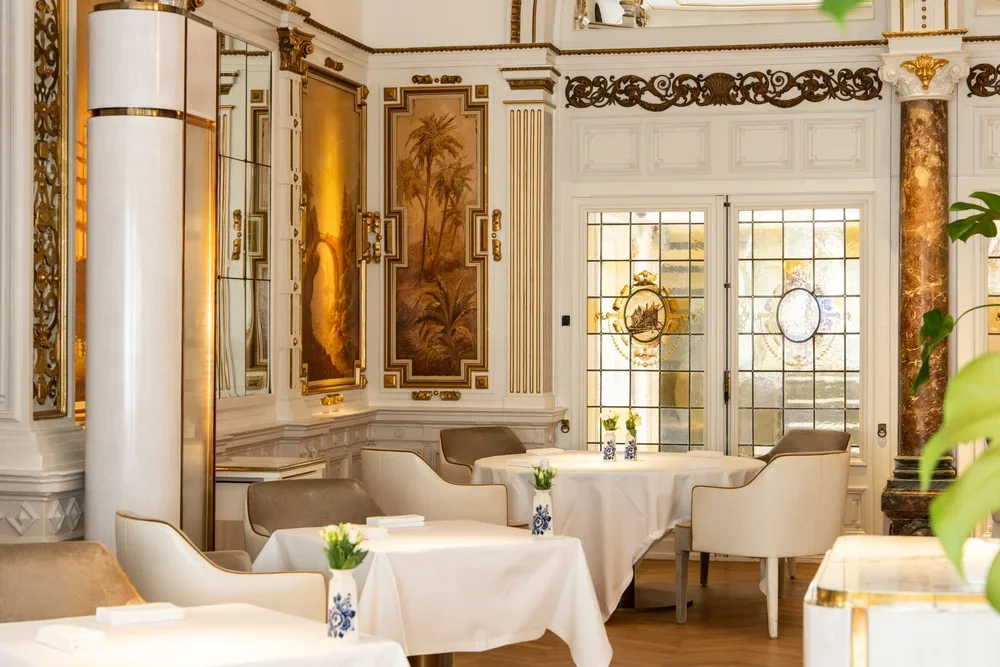
The White Room is housed in one of Amsterdam's most historic dining rooms. Does cooking in such a space make you feel like a guardian of its legacy, or does it challenge you to constantly reinvent it?
I kind of try to go against it if that makes sense. It is such a majestic room, big tall white pillars, chandeliers, golden accents. And then you have this young guy covered in tattoo’s, cooking dishes that are meant to get you out of your comfort zone and get your hands dirty. I believe that that contrast really creates a beautiful and unique experience!
Your dishes often combine unexpected ingredients such as cacao with Dutch cèpes or Surinamese flavours with langoustine. What makes you realise that two seemingly unrelated ingredients belong together?
For some reason my brain doesn’t think in; Sweet/Sour/Bitter, but more in specific ingredients. So when I am in the process of creating a new dish I often taste something and think; “This needs banana”. While for most people those things on paper don’t work, for me that makes total sense.
Fine dining has become increasingly focused on storytelling. Do you begin with a narrative and build the dish around it, or does the story emerge naturally through the ingredients?
Flavour should always stay the main focus in a dish I believe. Story telling can really help to elevate those flavours and make the whole experience better, but if a dish lacks flavour it will never work.
You work closely with Head Sommelier Frederico Figueiredo, who has described your partnership as resembling a long marriage. What have you learned from collaborating so closely with someone whose perspective begins in the glass rather than on the plate?
We have the same goal and that is to create an amazing experience. So we let each other do their thing, and trust each other. However during the tasting I don’t want to know anything about the wine, I will just taste blind and pick what I like. And 99% of the time we agree.
Dutch gastronomy has earned enormous international respect over the last decade. Where do you think the next evolution of the Netherlands' culinary identity lies, and what role do you hope to play in shaping it?
I hope that the new generation of dutch chefs start to value what we have over here and start to learn more about our own history instead of looking up to the hypes that are going on. A bit like what Rene Redzepi has done with Noma. Learn from everywhere, but make it your own.
If you could design a single dish that tells your personal story from your beginnings in Amsterdam to earning a Michelin star what would be on the plate, and what would each element represent?
I would point towards the Langoustine dish we still have on the menu. Based on the Suriname crab soup, but then made with Langoustine. Blended with a lovage oil, also known as “Maggi”. Next to it a dressing of Markoesa, the Surinamese passionfruit which you drink next to your meal, and then the roasted langoustine topped with a crème of Masala. It really tastes like eating a Surinamese crabsoup with a Markoesa juice next to it but then trough a fine dining lens. A dish that I could enjoy everyday of the week!
