
FASHION’S MUSICAL CHAIRS ARE SPINNING AGAIN
words by DEBORAH DRENOFCI
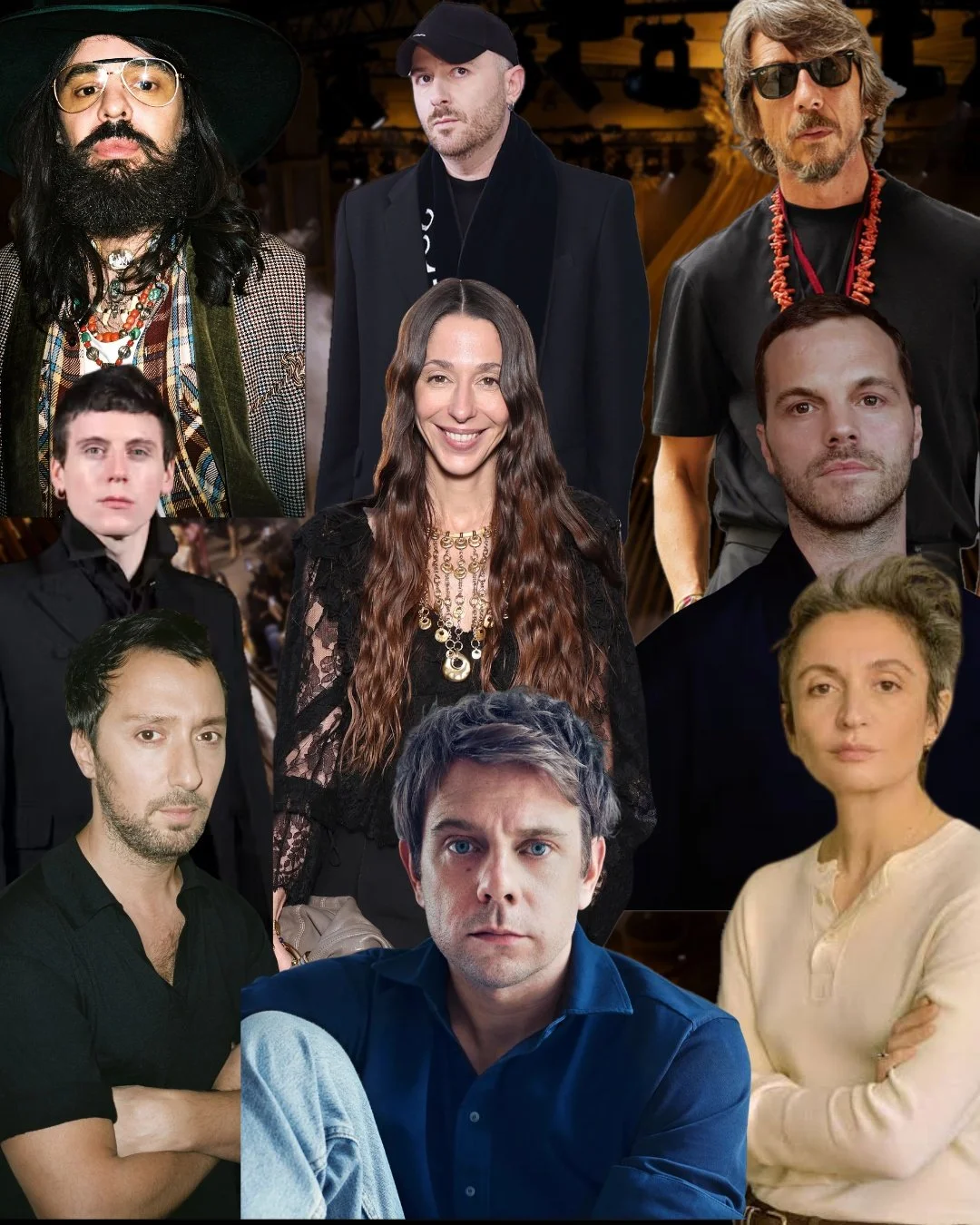
After Anthony Vaccarello made his departure from Saint Laurent official, we were expecting the domino effect to take place and the musical chairs to undergo yet another round of changes. And so the music has started again, and the game continues, with two creative directors announcing their departures on the same day. Beyond the curiosity of keeping up with who sits where, there are other questions that have been poking around for a while, and they deserve to be discussed. At this point, isn’t it logical to ask whether these constant movements are sustainable? A lot has been said about how the rapid consumption of literally everything in today’s era has shortened our attention span. Well, it seems to have affected our patience as well. Or perhaps this is not a matter of patience. Could it be a lack of trust? Or the creation of an invisible dynamic that is further thinning the line of connection and loyalty between the public and a fashion house and its creative director?
Veronica Leoni has announced that she is leaving Calvin Klein Collection. It is a journey that ended rather fast, after only four runway collections. Leoni will be remembered for bringing the brand back to the runway in February 2025, but most importantly for being the first woman creative director of Calvin Klein Collection. Although her previous collections received mixed criticism, her recent SS27 collection during New York Fashion Week seemed to attract some positive social engagement. Despite all this, Leoni’s chair now awaits a yet-unknown successor.
The second announcement came on the same day from the conglomerate Kering, which confirmed that Seán McGirr is leaving McQueen after three years. Luca de Meo, Kering’s CEO, stated that the parent company is restructuring the brand, from its retail network to its business model. McGirr joined the house in 2023 as the successor of Sarah Burton, who had led McQueen for more than a decade after Lee Alexander McQueen’s death. During his time at McQueen, McGirr tried to rekindle the connection between the house and London’s creative culture and youth. There was definitely a story to tell, yet it takes time to build a narrative. McQueen is a brand rooted in strong, passionate storytelling, and beyond the house’s codes, storytelling itself does not come with a fixed manual. It’s an exploration. The numbers, however, tell a less poetic story. The brand has been loss-making, and for years it has leaned heavily on its sneakers to stay afloat. A good narrative is hard to sell when the business underneath it is struggling.
In times of uncertainty, rumours bloom like flowers in spring. There is speculation that Dilara Findikoglu, or Hannah Rose Dalton and Steven Raj Bhaskaran, may take the chair at McQueen. The public, however, is strongly opinionated and believes that both Findikoglu and the Matières Fécales pair should stay where they are and further develop their own brands. Others go further, arguing that the house should be allowed to rest, in line with what many believe Lee Alexander McQueen himself would have wanted, rather than being rearranged again and again in search of something that may no longer need fixing.
Now that the creative director chair at Saint Laurent is free, it is said that Chemena Kamali, current creative director of Chloé, will take the lead. If this is true, Kamali will be the first woman creative director of the house, which is not only exciting but also much needed in the industry. Meanwhile, Pierpaolo Piccioli is rumoured to be leaving Balenciaga after just one year.
There is something very important when it comes to real craftsmanship, or any creative matter really. Something the world as a whole seems to have forgotten: the process. The slow process of discovering and, ultimately, becoming. Karl Lagerfeld was at Chanel for over three decades, Phoebe Philo turned Celine into what it is today during her decade-long tenure, and Jonathan Anderson did the same for Loewe across 11 years. Yet in the past three years alone, we’ve seen more movement than ever, at a pace that allows neither the public nor the house to fully digest it. Matthieu Blazy took Virginie Viard’s place at Chanel. Demna said goodbye to Balenciaga and embarked on his Gucci exploration. Dario Vitale’s Versace was cut short, Alessandro Michele succeeded Piccioli at Valentino, and now Piccioli might leave Balenciaga.
There might be many other factors behind the curtain driving these decisions. But could our disconnection from slowing down be part of the problem? News arrives in a flash. Opinions are shared across multiple platforms at once. We can watch collections from home. Within minutes, we can find something, whether a new pair of heels or a random vintage CD player, that once required an actual treasure hunt. Everything around us is in time-lapse mode. And we adapt. In this case, adaptation, which is inevitable, manifests as impatience. The public seems impatient with a new creative director who is still figuring out his own language at a house with years of baggage to unload. Impatience, in itself, is irritation with the process. So instead of giving creative directors time, impatience kicks in and creates a big bubble of criticism. With digitalisation and the democratisation of fashion, this bubble expands beyond professional, industry-insider opinions to those of the fashion lover or the anthropologist. This is a good thing. Every point of view matters.
But there is another side to the coin: the impatience that lives inside the business itself. The dream factor matters, but a fashion house is still a company, and it needs money to keep going. It needs sales. It needs to make ends meet. So behind the curtain, strategic decisions have to be made, sometimes simply for a brand to survive, whether that means appointing a new creative director to drive sales or reallocating resources elsewhere. Today, that pressure is sharper than ever. Brands are dealing with a smaller pool of customers, and those with less spending power tend to buy into the house through accessories, which no brand can rely on alone. Here, impatience stops being an emotion and becomes a strategy. Of course, there are cases like Blazy and Anderson who stepped in and delivered almost immediately. Vaccarello was not only a great creative fit for Saint Laurent, he also made the house a lot of money. But that is not the case for everyone, and apparently when the numbers don’t follow, the chair rarely waits.
Fashion has never existed in isolation from the rest of the world, be it film, music, politics or social movements. Everything is connected. In fact, fashion is a great mirror of both history and the present. So is the world’s current turbulence being reflected in the fashion industry? It is a possible hypothesis. Maybe the zeitgeist of the moment is instability. The Business of Fashion reported a decline in Gen Z luxury consumption, affecting both sales and engagement. Lower purchasing power meets a fast-moving world, which meets uncertainty. Even beyond fashion, this combination breeds not only impatience but also a lack of trust. And the latter matters, because trust is what fundamentally connects us to one another.
These rapid rounds of musical chairs might be exciting, refreshing, or even fair. But even so, they leave little space to cultivate trust between the customer and a new creative director’s vision, and, in turn, the brand itself. There are, and always will be, loyal customers, or customers attached to a particular creative director’s work. But then there are those, arguably the majority, who accept change but perhaps need more time to become friends with it. Change is good, even when it’s disruptive. And sometimes disruption is necessary. Cost-cutting, restructuring and new leadership can be what keeps a house alive. But slowing down matters. It is through the slow process that trust is built, garments are woven, and great stories are told.
