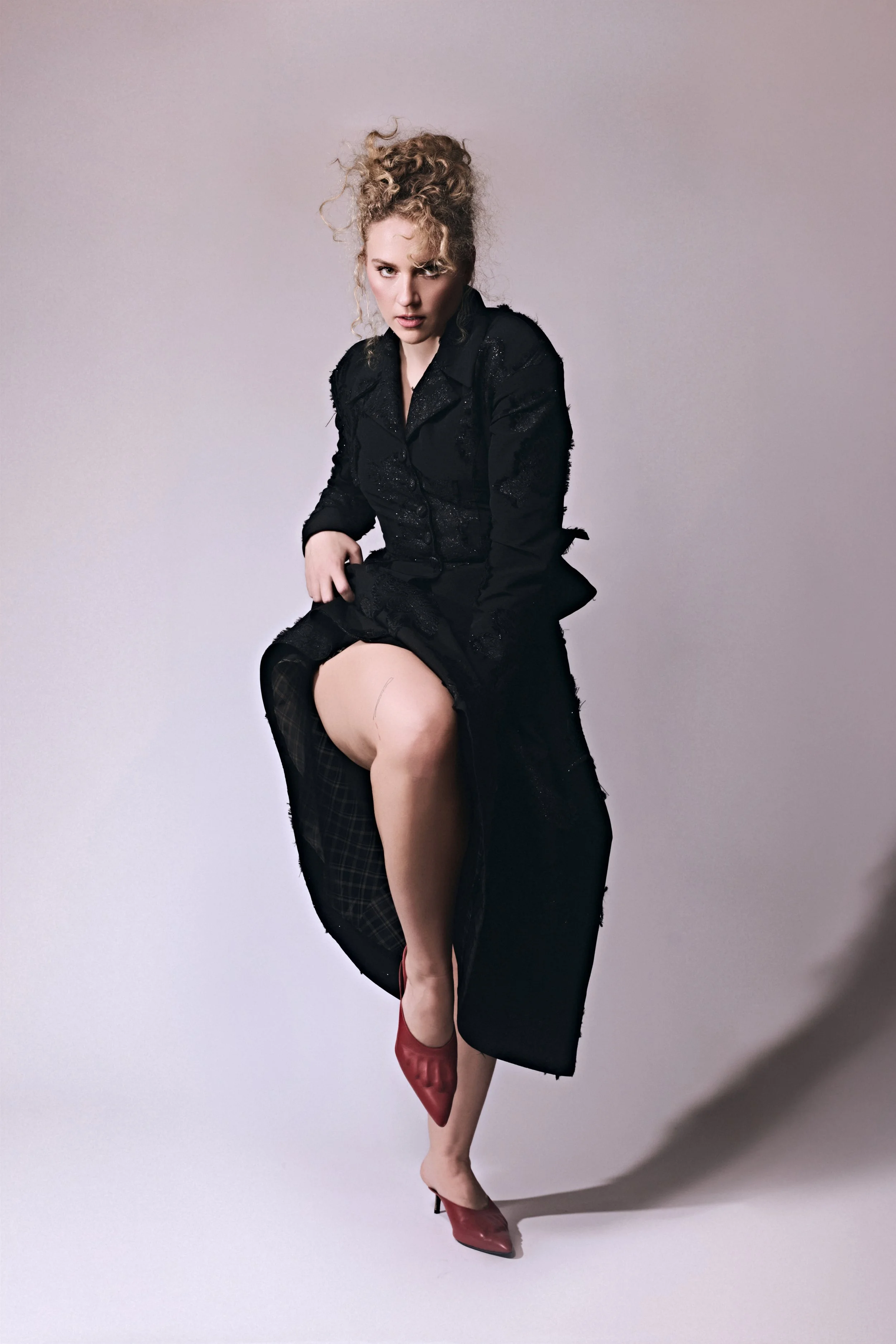
IN CONVERSATION WITH KAT CUNNING
interview by JANA LETONJA
Kat Cunning has built a career around transformation. An actor, musician and multidisciplinary performer, they first developed their craft through worlds as varied as Cirque du Soleil, New York’s immersive Sleep No More, concert dance and queer cabaret before moving increasingly into film and television. This September marks a major new chapter, with Kat appearing opposite Jon Hamm in MGM+’s psychological thriller American Hostage, followed immediately by a series-regular role in NBC’s Line of Fire. At the same time, Kat continues to develop their identity as a recording artist following their 2023 debut EP, Glass Jaw. Moving between acting, music, movement and live performance, Kat is less interested in choosing a single creative identity than discovering what becomes possible when all of them collide.
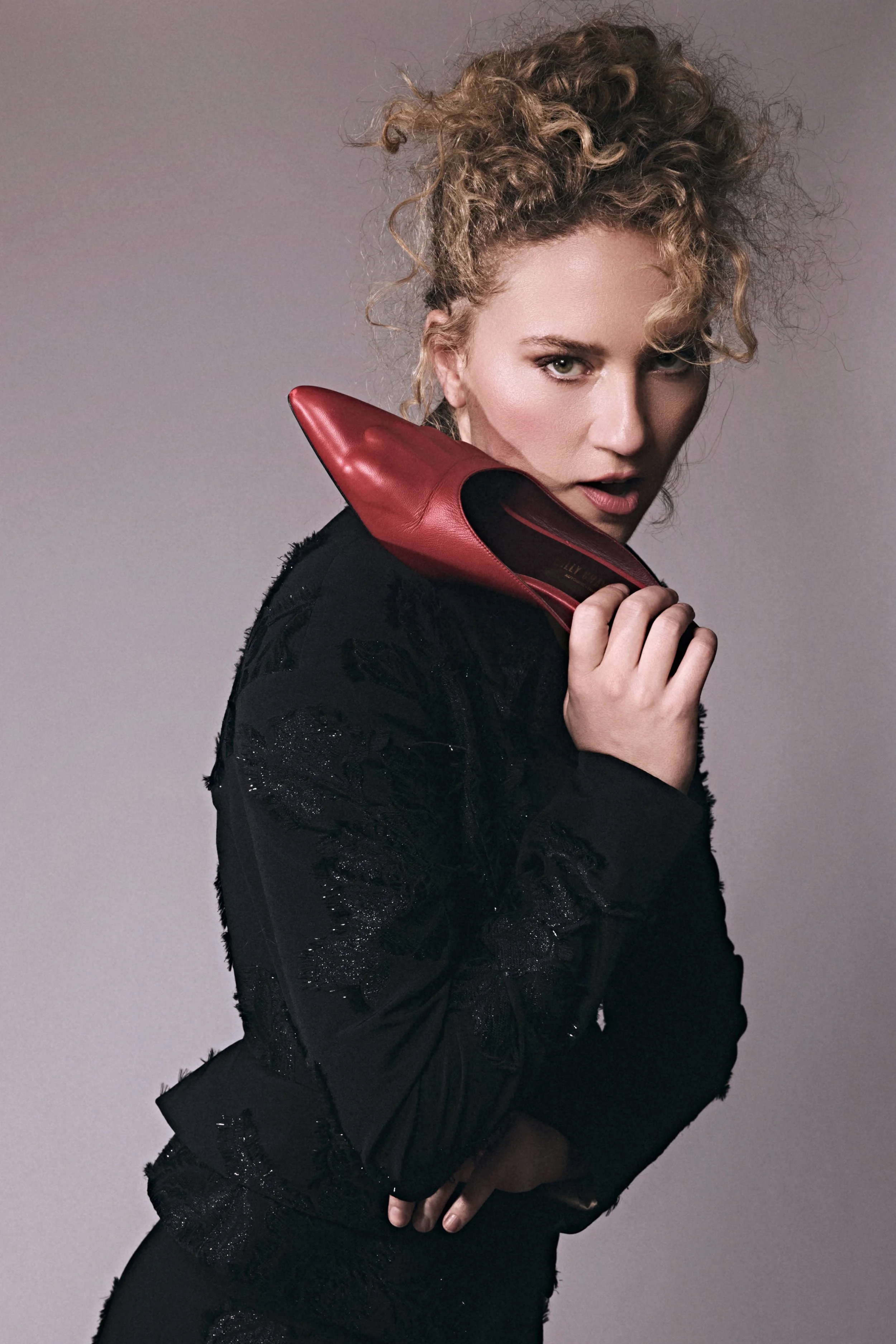
photography by GABRIELE DI MARTINO
September feels like a significant moment for you, with American Hostage and Line of Fire arriving almost back-to-back. Does it feel like you’re entering a new chapter in your career?
Having my face on billboards and busses is definitely a first and I am constantly tempted to recreate the Sex and the City opener where Carrie Bradshaw steps in a puddle while the bus with her face drives by, but so far I’m too busy on set to go bus-hunting, and that’s how I like it. I’ve been a freelancing polymath for the last decade, and while I’ve accomplished so much I’m proud of in my music and acting careers, the ability to spend every day on set in the full machinery of a network television show is the rigorous schedule I was built for in my ballet training. Like my character Clare in Line of Fire, I relish the opportunity to obsess over what I love.
Your path to acting is anything but conventional. You’ve worked in circus, dance, immersive theatre, cabaret and music. How have those different disciplines shaped the performer you are on screen?
The diversity of my experience is incredibly valuable to me and my work. My a-linear road to acting is a patchwork of writing, spoken word poetry, concert dance, a short stint in a strip club, many underground performance art venues in NYC, sideshow, circus and eventually directing my own music videos, choreographing them and writing more formally. This twisty journey to acting has made for sort of an accidental method approach where the real life immersion into different cultures became absorption.
Dance is at the core of all my formal education and that’s why I like to learn the character I’m playing kinesthetically, in the world, instead of analytically on a page. Though it’s not for lack of interest in acting training, I tried to transition from the Dance Conservatory to the Acting Conservatory at SUNY Purchase but I didn’t make the cut, and after school I couldn’t afford an acting coach until I got my first acting gig. I was broke and I wasn’t going to go further into debt waiting for the permission to do what I loved. I was going to fake it till I made it and learn these skills on the job. That audacity paid off.
You performed with Cirque du Soleil early in your career. What did that world teach you about physicality, discipline and taking risks?
Circus people are rockstars and entrepreneurs. They don’t audition for the group dance, they bring their act, which they created, to the circus and barter on their singularity. That taught me I wanted to do the same thing with my one shot at life.
I thought I would love a long Broadway musical run as a singer and actor, and although I did end up writing my own song in the show, I quickly realized I wanted to be a rockstar. I craved the impulsivity and intimacy of tour and I find that in film and TV too. You only get a couple chances to breathe the words and notes, and then that moment has passed and you’re experiencing something new. I like being kept on my toes and my years in the circus and on Broadway really inspired me to harness my own act and keep chasing my own taste.
Sleep No More requires a very different relationship between performer and audience than traditional theatre. Did immersive performance change your understanding of intimacy and presence?
Immersive performance raised the bar for intimacy in art. I think of the principles of “contact improv,” which is a dance term basically used for fight choreography or any improvised weight bearing movement, every time I do my own stunts on camera, including sex scenes. I’m really passionate about putting tactile touch on screen. I relish in a well choreographed physical scene of any kind, it’s an art form.
I was a part of the Deuce where we set the precedent for intimacy coordinators and I am so happy they exist now, for so many reasons, least of all to have a partner in the room to make the best, most honest things happen between 2 people, with respect for our bodies and how magical they can be in contact with one another.
I also had my first huge concert in the ballroom and SNM, and I will never forget singing when doves cry at the Romeo + Juliet, Baz Luhrman inspired, super cinema party. It raised the bar for my dreams as a pop star to experience that level of production, having been carried out singing in a human sized balloon that I popped from within. It’s truly amazing what dreams we made come true “for one night only”.
American Hostage takes you into a psychological thriller based on an extraordinary true story from the 1970s. What immediately drew you to the project?
I thought my chances of booking Ibby were slim to none, so I hardly prioritized my audition. I’ve been begging to do a period piece of any kind again because time travel is my favorite thing about this craft. Being that my process is so physical, there is nothing like touching the artifacts of another time and letting them inform how you behave. How you move in a corset makes you a different kind of woman. How you ash in a tray or flip through a phone book with nails etc., it’s a delicious part of the process and in American Hostage our set design was particularly detailed. We got to be on real phones having real time conversations with both actors shot in that moment. So much of it felt like a live play.
The story revolves around an incredibly high-pressure hostage situation. How did you approach finding the humanity within such an intense narrative?
I think I sort of thrive in chaos. I like the way a hurricane shuffles us around like seeds that grow trees on new terrain. I think Ibby was due for a storm.
I read Ibby at a time I desperately wanted a chance to play a character who was dynamic, let alone get a job at all. I kept saying “There must be more for me out there” on loop and I played her with that desire at the core. Yes, she loves her husband and doesn’t want him to die, yes, she wants her kids to have a father, but she is also given the precious opportunity of time to think, outside of her regular loop of duties, about where she is in life. While the world holds its breath, she takes a drag of her cigarette and mourns some of the dreams she had for herself. The death of her husband takes center stage, but the death of her own desires, and the life of a new kind of intimacy with Barb are what ground her.
Period projects ask actors to enter not only another story but another social and visual language. What interested you most about inhabiting the 1970s?
The aesthetic relief of not looking at ugly technology all day, the magic of spinning a rotary phone and hearing another voice on the line, shag carpets and sunken living rooms and men in high waisted pleats. The cusp of feminism not fully embraced by every housewife that bubbles like a seltzer in women at that time.
Playing in a world of analogue treasures really informs the character, and playing a woman from an era is an honor. It makes me really proud to be free to express my gender however I want, but it’s sort of a study of gratitude for what they went through.
I’m grateful for the opportunity to embody the little traps of their clothing and hair and responsibilities.
You move almost immediately from American Hostage into Line of Fire, a contemporary law-enforcement drama centered on a family hunting an assassin. What attracted you to your character in that series?
I played her the way I wanted to see her. Smart, grounded, uncompromising. Sardonic, boyish, dry but fiery. I used her as a chance to be myself for the first time. The only way I was going to pull off playing FBI was if I truly imagined myself somehow becoming FBI, and FBI is kind of the most creative and rock and roll arm of enforcement. I’ve spent most of my career as a character actor, but as Clare I’m pretty much myself, just straight and packing heat.
You’ve spent much of your career performing live, where the audience gives you an immediate response. What do you find liberating, and perhaps frustrating, about surrendering that control when acting for the camera?
You said it all. You have to relinquish so much control and be in the moment, and the final product of the character is a major collaboration with so many people. I like the act of letting go and trusting myself to become something bigger and more real than I can choreograph or curate. When you have very little time to prepare, which is the case in a network TV show and a lot of streamers these days, because they’re writing the episodes as they’re coming out, you have to release the grip of what you think and allow for what you are in that moment to sing. You’re the sum of so many parts and I love being that channel for the work of so many brilliant people.
I’ve never really liked the way I’ve looked on camera in character because Kat Cunning the artist would have done it differently. But that’s the magical part. I’m not alone in my ideas and I don’t carry the burden of being the entire brand. I’m just one part of a big picture and my job is to live inside the frame as honestly and presently as possible. It’s freeing and especially liberating when you hit the stride with a team who aligns with your taste and you don’t have to fight for a certain outcome. You just trust their eyes and live in the role. I found that with Adam Arkin and Nina Lopez Corrado on American Hostage and I found that with Josh Safran and Becca Thomas on the Line of Fire Pilot.
You also created and hosted your own queer cabaret during the pandemic. What did creating a space of your own teach you about the kind of artist and storyteller you wanted to become?
I basically became a standup comedian in that cabaret. It really satisfied my desire to “do it all” in one room over the course of an hour. I’d go from Super Bowl half time level production for one of my songs and then sing directly to one person in the audience. When the Housewives of Miami came to the show, they loved the moment where I interview one audience member about the definition of fetish and what their kink is. The show was a hit and I just felt like I was playing in my living room. It was an amazing breeding ground for my ability to host, so having my own version of Traitors or a Cher-esque talk show is likely in the cards for my next trick.
You’re currently working on new music. Has everything you’ve experienced as an actor over the past few years changed what you’re writing about or how you want the music to sound?
The gigantic platform of 2 hit TV shows has really just made me more intentional and indulgent about what it is I want to share. The goal is no longer to trick people into listening, it’s more like, “Now that I have your attention, here are some of my favorite toys.” My debut album Notes From the Brink will have songs from the past 10 years. It will be a more organic reveal of real notes on the things I’ve gone through in that time. It’s been an incredible journey and these are some of my most treasured artifacts from the last decade, proof of life I’m proud to call a legacy.
You’ve resisted being defined by a single discipline. Has that always felt empowering, or have there been moments when the industry wanted you to choose one identity?
People always tell me to pick a lane and they’ve always been wrong. It’s never lost on me each time that I’m lucky enough to be paid for what I love to do, and when I’m not so lucky, I’ve been bouied by my curiosity and will to find pleasure in unlikely corners. You have to follow your pleasure to teach your body that you are here in this industry on your own terms. I’m never engaged in some invisible competition with someone else’s blessing because there is plenty of beauty to indulge everywhere we look and the ways to transmute that beauty are endless if you allow yourself to journey toward them.
With two major television projects and new music on the horizon, what part of Kat Cunning’s creative world do you feel audiences still haven’t seen?
I have yet to win my Oscar for playing a heartthrob gay vampire in a period piece. More darkness, more grit, more macabre opera period pieces, more transformation, perhaps an EGOT, Madison Sq Garden, I don’t know, but there will be corsets and cumberbuns in my future, and my scorpio sun will rise and set on it all.