
IN CONVERSATION WITH TIAGO PEÑAO
interview by TIMOTEJ LETONJA
Tiago Penão has been establishing himself as one of the most compelling names among Portugal’s new generation of chefs, leading a contemporary approach to Japanese cuisine with precision, sensitivity, and a distinct personal identity. His journey, marked by curiosity and a deep dedication to detail, has resulted in a cuisine where technique and emotion coexist in pursuit of excellence.
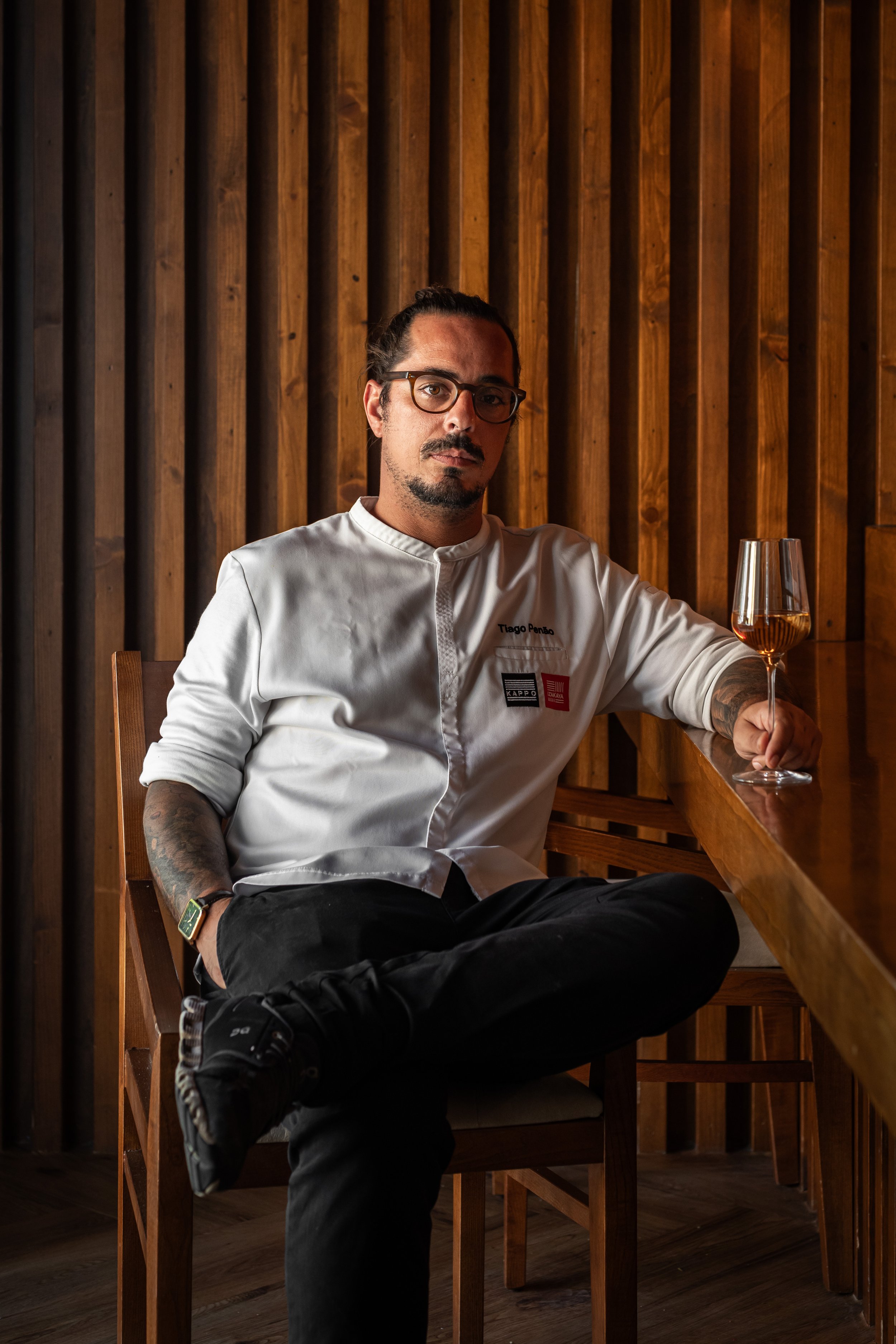
Having developed a very distinctive voice within Japanese cuisine in Portugal, what made you feel that this cuisine could become your very own?
I never felt that Japanese cuisine had to become “mine.” I think it was almost the opposite: I was the one who wanted to understand this cuisine better and better. What I fell in love with was precisely the depth behind things that appear deceptively simple. A broth, rice, a cut of fish, a fermentation. The more I study, the more I realise how much I still have to learn. Over the years, I naturally began to find my own way of cooking within that language. Not by trying to reinvent it or make it Portuguese, but by respecting it while, at the same time, allowing my personality and the place where I cook to come through. Perhaps today there is a voice of my own, but it was born much more out of this obsession with learning and improving than from a conscious attempt to create a style.
How do Portuguese ingredients influence the way you cook Japanese food, and are there ingredients from Portugal that you particularly enjoy working with?
Portugal has a huge influence on my cooking because I am fortunate enough to cook in a country with extraordinary produce, especially from the sea. I don't feel the need to import a fish from Japan simply so I can say that I am cooking Japanese cuisine. I am much more interested in applying Japanese knowledge and techniques to the best produce I have here. I particularly enjoy working with our fish, seafood and shellfish. Red mullet, sardines, scarlet prawns, goose barnacles, clams, Atlantic prawns... we have an incredible diversity of produce. For me, it is very interesting to think about how a Japanese chef would look at these ingredients. That question is constantly present in my kitchen.
Do you approach the food differently when you are cooking for Kappo compared with the Izakayas?
Completely. They are almost two different sides of my personality. At Kappo, I look for precision, silence and restraint. I think a lot about the season, the sequence of the menu, temperature, tableware, and the exact moment when something should be served. Very often, the work is about taking things away rather than adding them. The Izakayas are the other side. They are noise, fire, fat, charcoal, dishes to share, beer, sake. I want them to be fun and incredibly satisfying. But the foundation is exactly the same: respect for the ingredients and for Japanese cuisine. What changes is the way I want people to feel.
What does Kappo mean to you beyond being a restaurant, and what do you hope guests feel when they sit at your counter?
Kappo is probably the most personal project I have. It is the place where I can express, in the most complete way, what I think about cooking. And the counter is fundamental because it removes almost all the barriers between the person cooking and the person eating. I want someone who sits there for two hours to forget, at least for a little while, where they are. I don't necessarily want to constantly impress them. I want to create a sequence of small moments. If, in the end, someone leaves with the feeling that they experienced something rather than simply ate a menu, then, for me, Kappo has fulfilled its purpose.
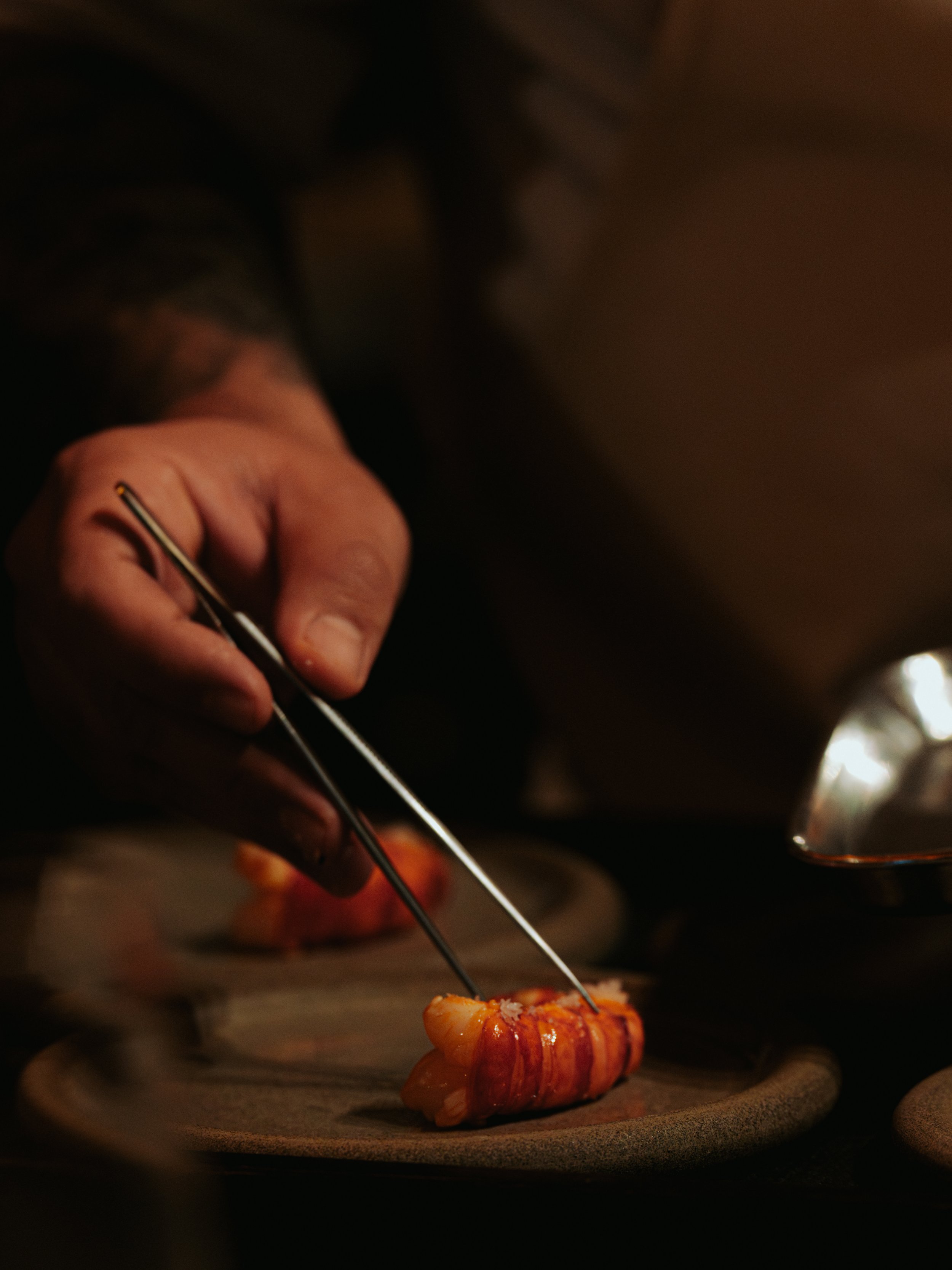
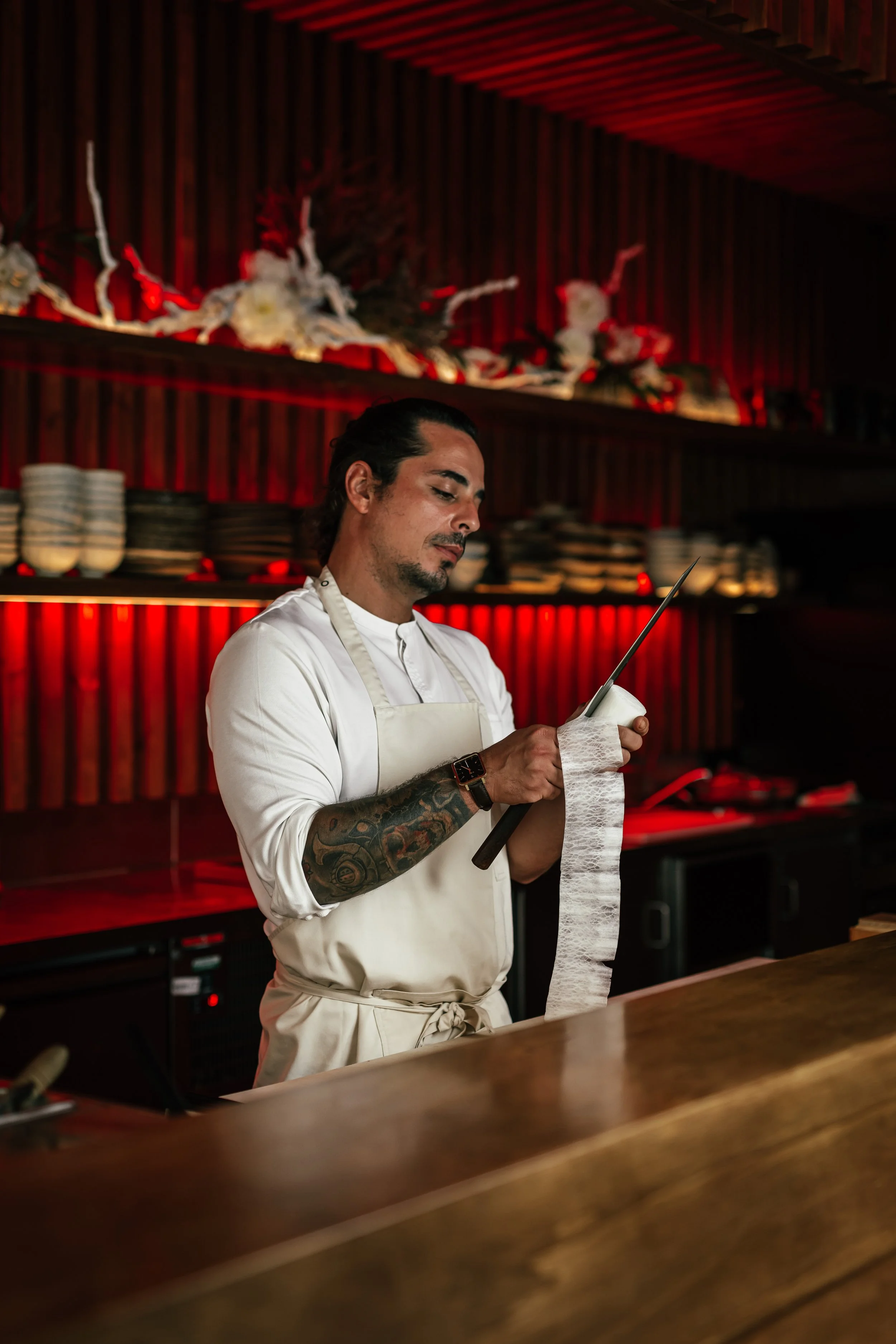
What do you enjoy most about cooking directly in front of guests at Kappo?
The proximity. In a normal restaurant, the cook often never sees the person they are cooking for. At the counter, that disappears. I can immediately pick up on a reaction, even without anyone saying anything. There is also a huge sense of responsibility in that, because there is nowhere to hide. The guest is just a few centimetres away and sees everything: the cut, the fire, the hands, the silence, the mistakes. But that is precisely what I love about it. The cooking happens in that moment, and for those people.
How do you interpret seasonality through Portuguese ingredients and the reality of cooking in Portugal?
Seasonality is one of the things that interests me most about Japanese cuisine, but I think it is important not to literally copy the seasons of Japan. I am cooking in Portugal. So I try to understand the Japanese philosophy of seasonality and then look at what is actually happening around me: which fish is at its best, what seafood has arrived, which vegetables are in season. For me, respecting Japanese cuisine does not mean pretending I am in Tokyo or Kyoto. It means understanding its principles well enough to apply them honestly to the place where I am.
Is the strong sense of freedom, noise, fire, and spontaneity in your Izakayas a reflection of your personality as a chef?
Very much so. Kappo probably shows my more obsessive and disciplined side. The Izakayas show a much more relaxed side. I love the energy of a true izakaya: people talking loudly, dishes in the middle of the table, things coming straight off the charcoal, someone ordering another beer or another dish because they are not ready to leave yet. I didn't want to create Japanese restaurants that were overly perfect or solemn. I wanted them to feel alive. And I probably need both worlds. If I only had Kappo, I would miss the chaos of the Izakayas; if I only had the Izakayas, I would miss the concentration of Kappo.
How important is Portugal to the food you create? Do you see your cuisine more as Japanese, or Portuguese?
My cooking is Japanese. I have no problem saying that because it is the cuisine I chose to study and to which I have dedicated a large part of my professional life. But it is Japanese cuisine made in Portugal, by a Portuguese cook, and that inevitably leaves a mark. Portuguese produce is hugely important, but I am not trying to create a fusion between Portugal and Japan. I am more interested in using a Japanese language and Japanese techniques to reveal what a great Portuguese ingredient already has. I don't want a scarlet prawn to stop tasting like a scarlet prawn. I want to find the most beautiful and precise way to serve it.
Did the Michelin star you received in 2026 change the way you see Kappo or your own work? Do you feel more pressure now, or does the recognition give you more freedom?
The star was very important. Being recognised by Michelin for such a personal project is obviously special, and it gave us the feeling that we were on the right path. But it did not change what I want to do. If anything, it increased the sense of responsibility. Because after receiving a star, it would be very easy to start cooking simply to keep the star. And I don't want to fall into that. I want to continue cooking in order to make the restaurant better. I continue to study, test, change recipes, and question things I have been doing for years. There are dishes we change because of details that probably almost nobody notices. But I notice them. The star cannot be the destination. It has to be a consequence of the work.
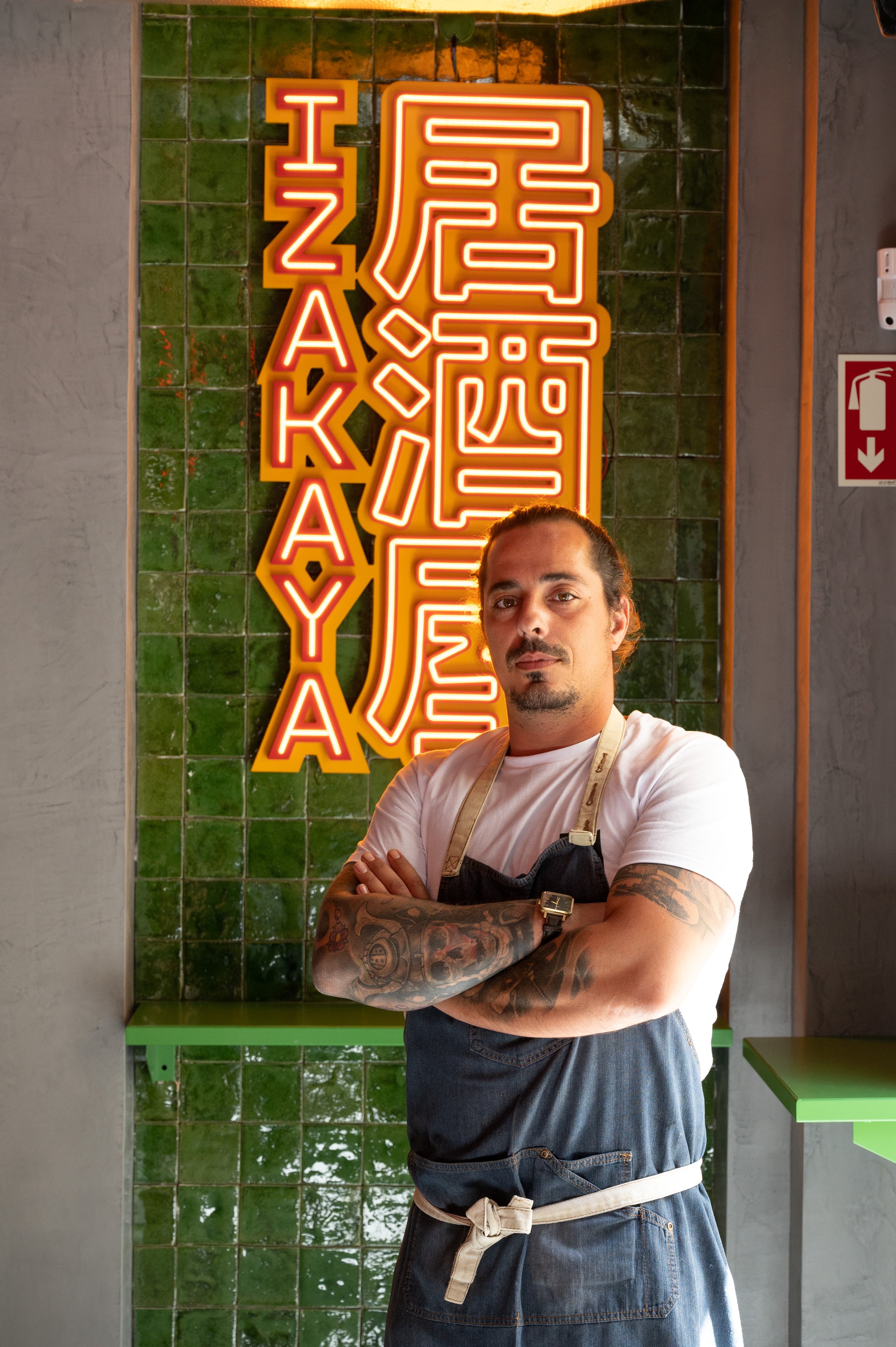
Where do you want to take your cuisine and your restaurants next?
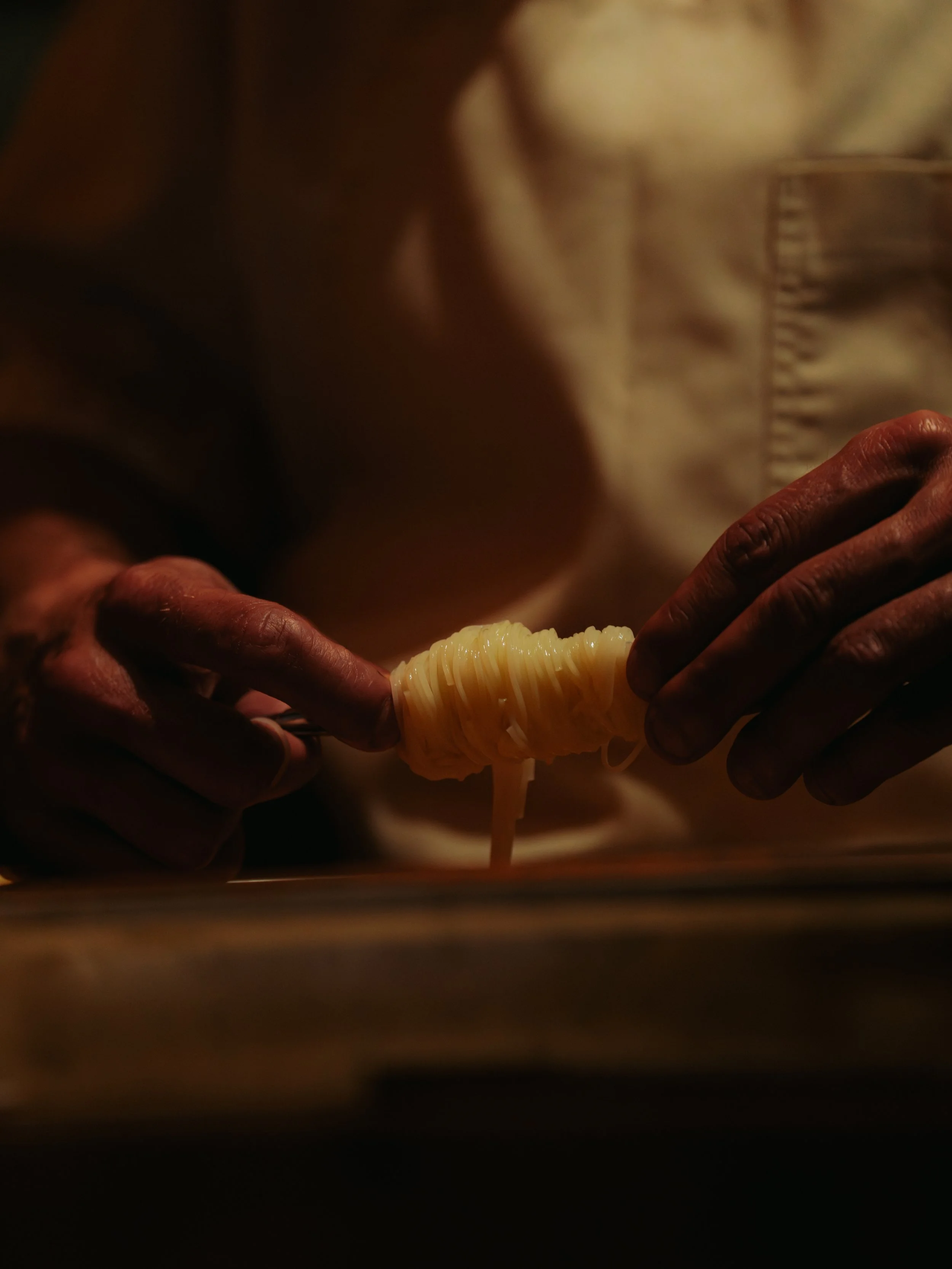
I want to go deeper, rather than simply grow. At Kappo, I want to keep moving closer and closer to the cuisine I have in my head. There is a level of precision and maturity that I still want to reach, and I know that takes years. At the Izakayas, I want to continue pursuing an experience that is increasingly authentic, fun and spontaneous. And now there is a project that particularly excites me: Yokosho Ramen Lisboa. We entered this project with a very clear ambition: we want to make the best ramen in the country. It may sound like an ambitious statement, but that is precisely what pushes us to work every day and question every detail.
We are completely obsessed with showing people what ramen can really be and bringing them closer to the experience of eating a great bowl of ramen in Japan. For a long time, ramen was rather misunderstood here. A great bowl of ramen is an extremely complex construction, even though it may look simple when it reaches the table. We are developing our own noodles and working individually on every element - the broths, the tare, the aromatic oils, the chashu, the menma, the egg, the wontons. I want someone who has never been to Japan to be able to sit down at Yokosho, eat a bowl of ramen and realise: “So this is what ramen can be.”
Ultimately, that is what I want to continue doing in all my restaurants. I have no interest in opening places simply to have more restaurants. I want to create places with a very strong identity, where there is a genuine obsession with what we do. And I want to keep studying. The deeper I go into Japanese cuisine, the more I realise how much I still have to learn.
